
Our 2025 started off with the Institute of Mass Information’s (IMI) network of regional Mediabaza hubs losing its funding due to the cancellation of US support programs. The events planned for early February still took place, but without an understanding of whether we would be able to host more in March or to pay the rent for our locations, and purchasing new equipment was off the table entirely. The key achievement of 2025 is that not a single IMI Mediabaza closed down. Despite a period of having no donor funding, the teams rallied and kept working at full pace: giving out equipment, hosting networking meetings, and receiving journalists in a safe space.
The year ended with Mediabaza Dnipro being destroyed in a Russian air strike. However, we are not listing these examples to fish for pity, but to show that the Mediabazas project has shown incredible resilience over the year. It was not funding or the locations that kept it together — although these components are also crucial — but regional communities, which have grown capable of mutual support and aid over the 3+ years that the project has been active. This year also featured classes for Odesa oblsat students by MOST chief editor Serhiy Nikitenko, stand-up paddle trips, discussions on self-regulation in the media, round table panels with city authorities, and much more. It is these small bricks that shaped the community throughout this year, and it is them that we will be talking about here.
The Mediabazas hosted 183 events in 2025, which were attended by 3383 participants. Media professionals used the hubs as co-working spaces 1605 times besides the classes. Journalists leased safety gear and equipment free of charge 196 times.
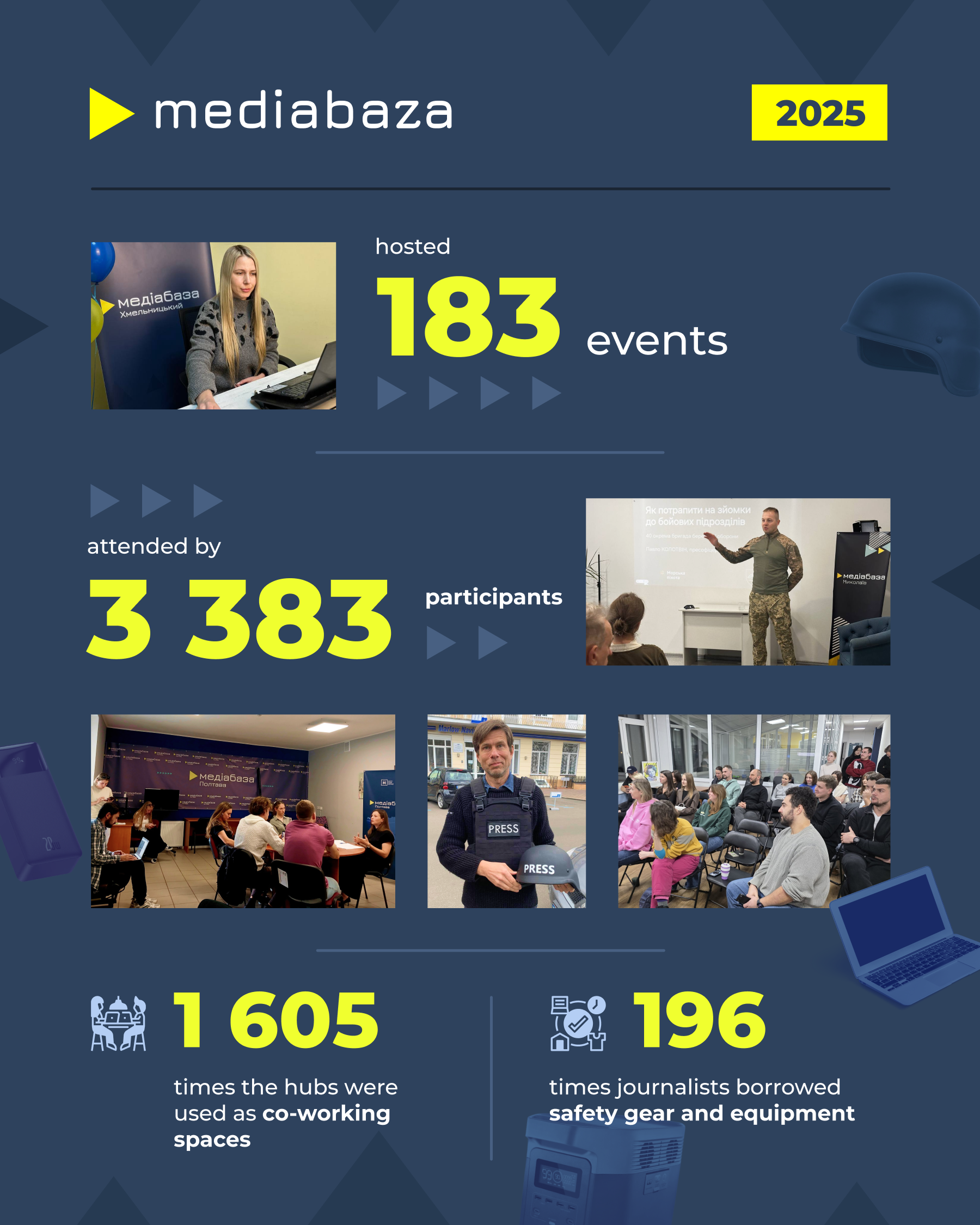
The Mediabazas in 2025
Focusing on Support
IMI’s annual survey showed that the biggest challenge for journalists in 2024 was mental exhaustion, lack of rest, and constant stress: this was reported by 79.2% of respondents. Going off on this data, in 2025 we focused on helping media workers unwind and replenish their internal resources.
For instance, Mediabaza Chernihiv hosted the class “Resilience without armor: how not to lose oneself in the news”.
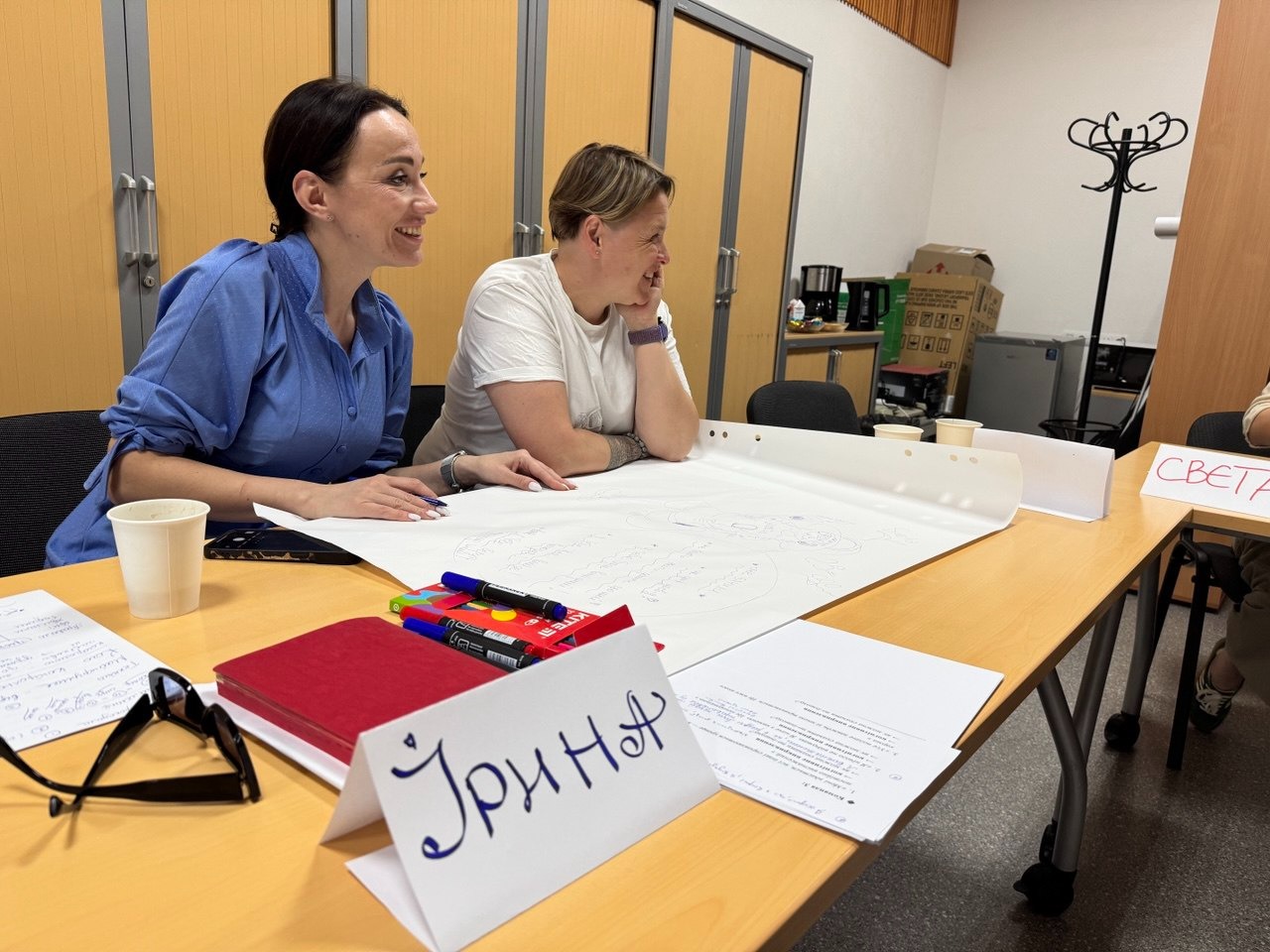
Attendees of the class “Resilience without armor: how not to lose oneself in the news”. Photo by Pavlo Pushchenko
The participants discussed self-grounding techniques for acutely stressful moments. Here are some of them:
“Crocodile”. take a deep breath through your nose and hold your breath for six seconds, like an “ancient crocodile,” then exhale through your mouth. Then hold your breath for eight seconds, like a “mature crocodile,” and finally for sixteen seconds. This exercise will save you in stressful moments and help you calm down and clear your thoughts.
“5–4–3–2–1 Grounding”. You need to focus and name five objects that you see, then four sounds that you hear around you, then three different textures that you can touch. After that, you need to name two smells that you feel, and finally one thing that you can taste right now. This exercise helps you ground yourself in moments of acute emotion.
“Circle of Control”. This exercise helps you figure out whether you can influence a particular situation. To do this, you need to divide a sheet of paper into three parts and write down the specific things you control in this situation, what you can influence, and what is completely out of your control.
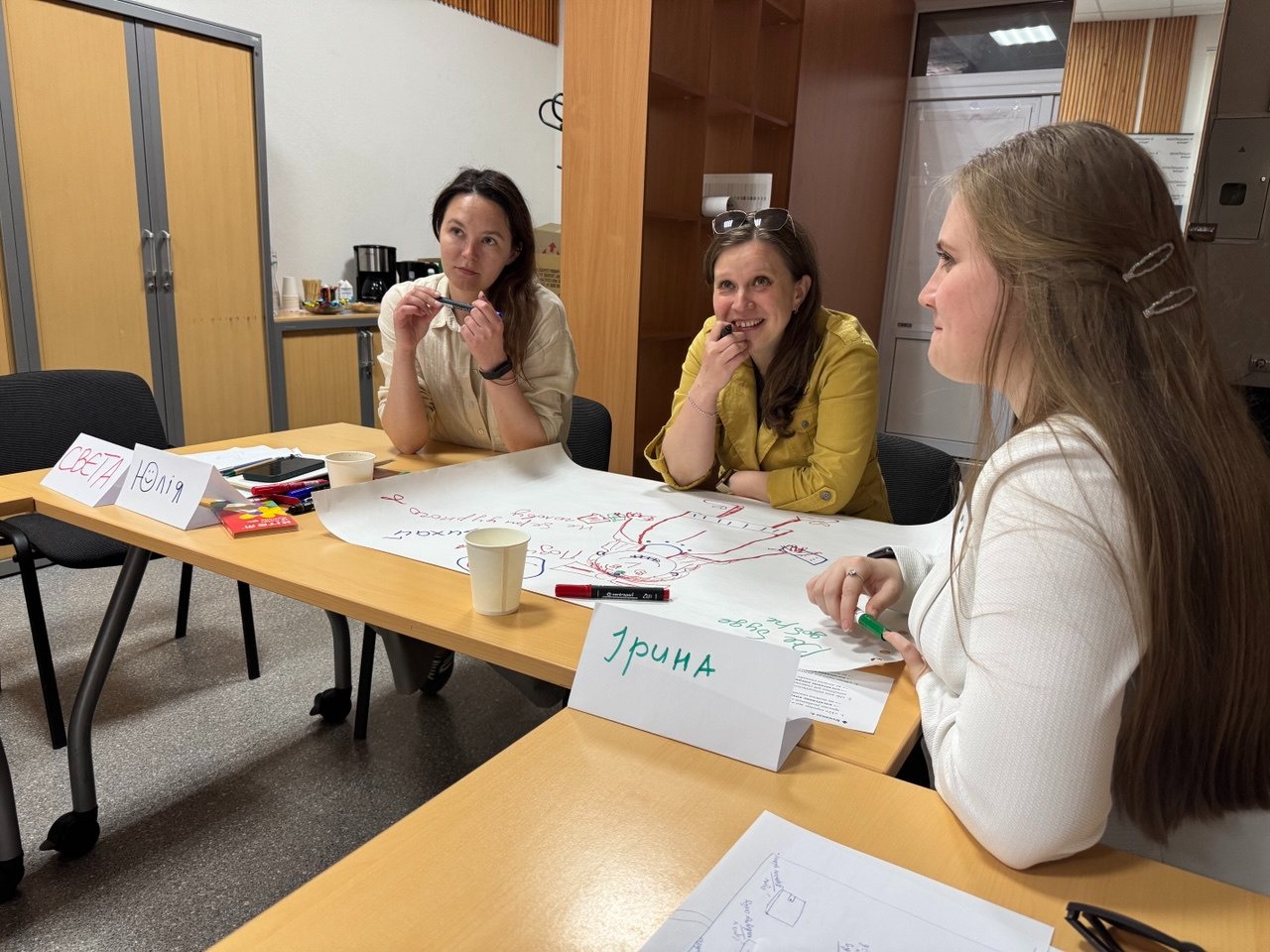
Discussion during the class “Resilience without armor: how not to lose oneself in the news”. Photo by Pavlo Pushchenko
Meanwhile a mental health discussion at Mediabaza Cherkasy focused on preventing burnout. Some tips from the coach, Inna Lukyanets:
- get enough rest, plan out your leisure as you do your work;
- learn to say “no” without feeling guilty;
- look for something that gives you fulfillment and not just drains your internal resource;
- find a physical activity to your taste;
- do not be afraid to show yourself and do what you want, not what others expect of you.
In an “emergency” scenario, when the first signs of burnout are already noticeable, the psychologist advised taking a break to recover and take care of your basic needs: fix your sleep schedule, take walks to get some fresh air, take a contrast shower, eat your meals on time and balance your diet, and get rid of everything that drains you.
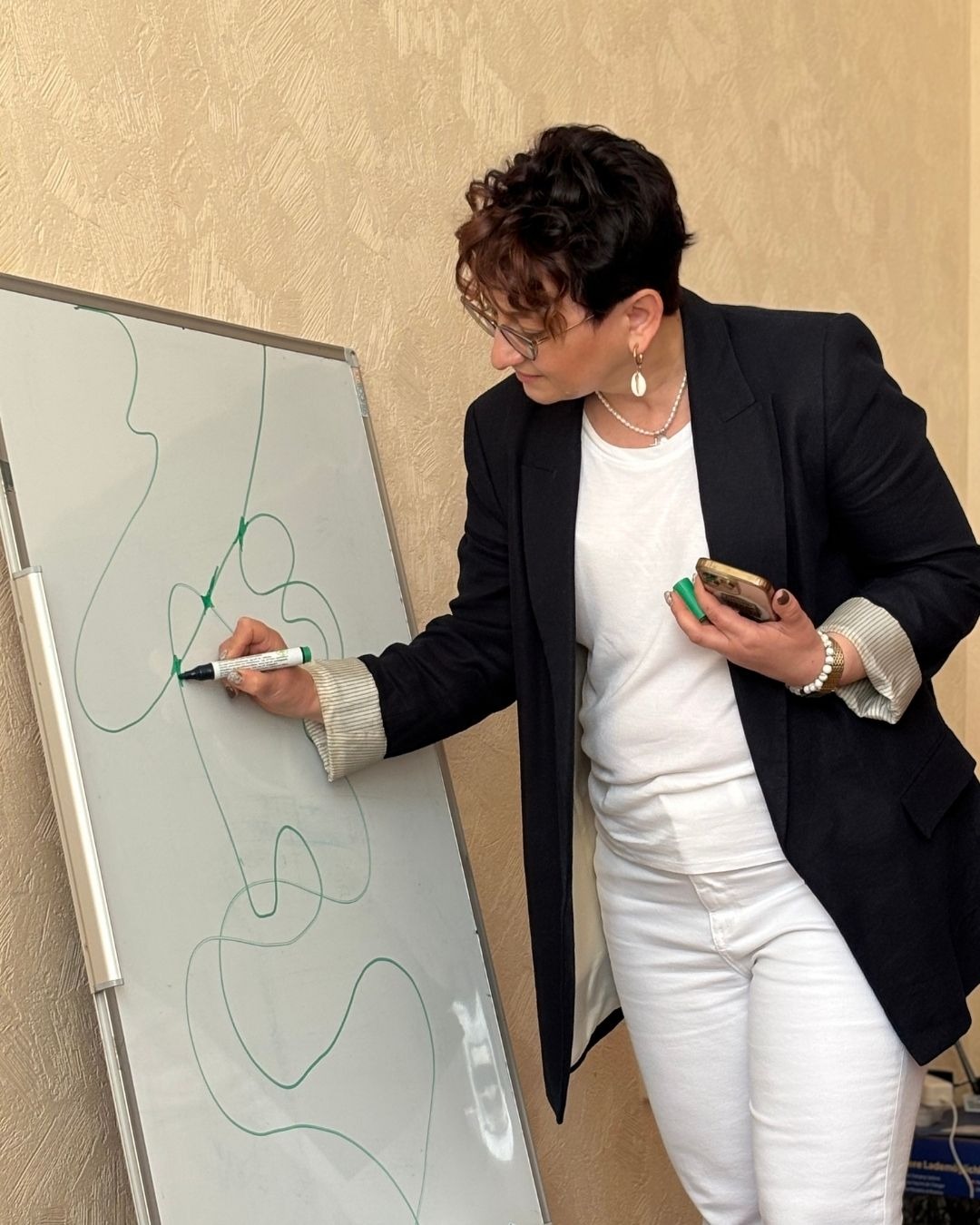
Self-regulation practices for media professionals. Mental health discussion at Mediabaza Cherkasy. Photo by Anastasia Neboha
In the summer, when the weather and the safety situation allowed, media profesionals went stand-up paddling and kayaking: such events took place in Cherkasy, Dnipro, Mykolaiv, Khmelnytskyi, Chernihiv, and Zhytomyr. Journalists said that such outings helped distract them from depressing news and focus on something positive.
“This was both a new experience and an opportunity to switch focus, get distracted, and relax together with your colleagues. It’s nice that we are united by something more than the job,” said Fakty ICTV journalist Iryna Tsymbal.
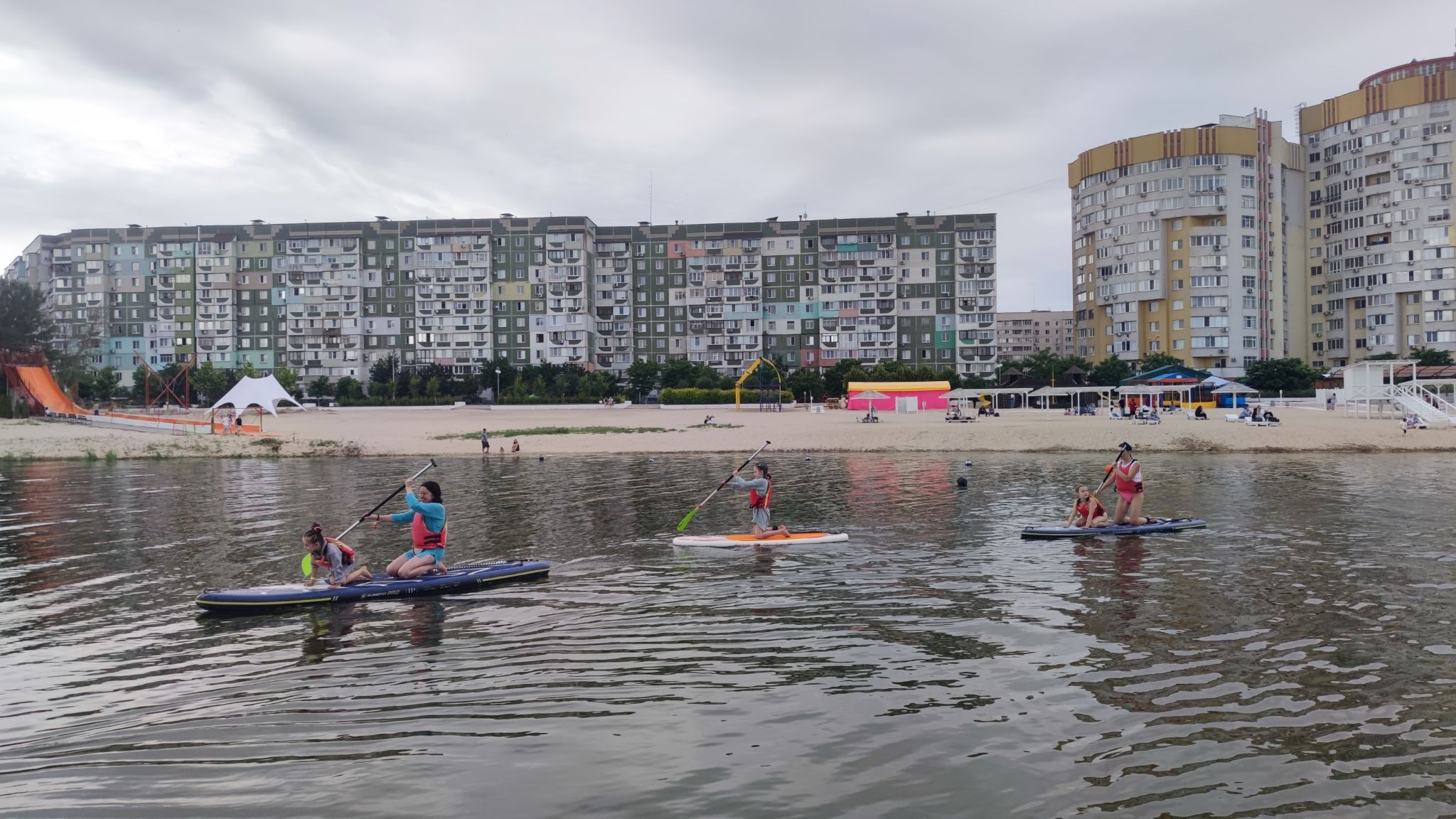
Stand-up paddling organised by Mediabaza Cherkasy. Photo by Serhiy Dnistrian
“After busy workdays and constant news feeds, I finally was able to truly relax for the first time in a long time. It was incredible!” said MykVisti reporter Daryna Melnychuk.
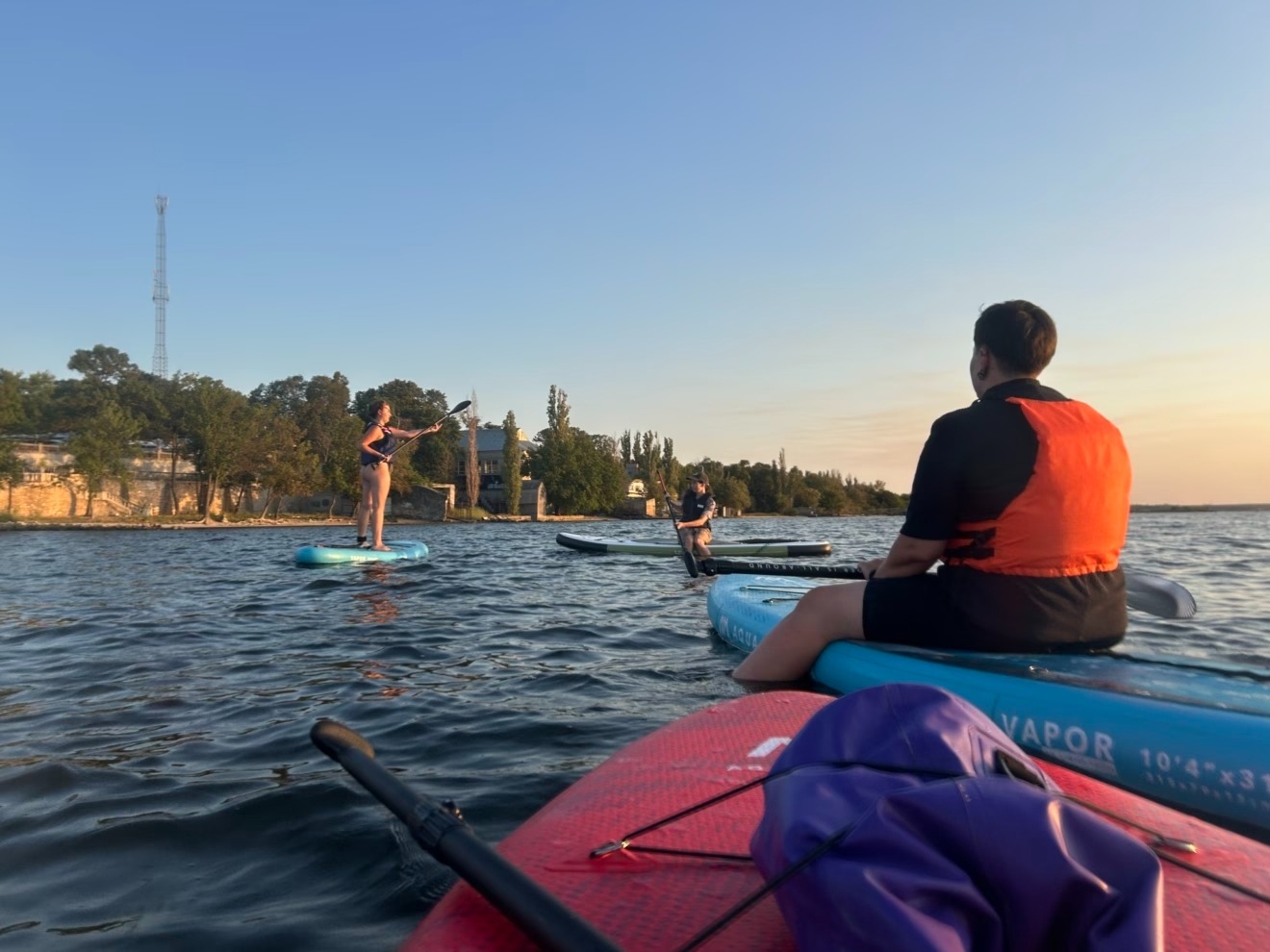
Mykolaiv journalists on an evening stand-up paddle ride. Photo by Yelyzaveta Moskvina
“This ride was a real reboot for me. In such a difficult time, every opportunity to get distracted, spent some time outside, and rewind is priceless. This is what we lack so much right now,” said Cheline journalist Iryna Ponomarenko.

Chernihiv media professionals kayaking. Photo by Vladyslav Savenko
Towards the end of the year, the Mediabazas hosted a series of art therapy meetings where media professionals could discuss the challenges and achievements of 2025 and make plans for 2026 while doing various calming activities together. For instance, Mediabaza Mykolaiv and Mediabaza Chernihiv hosted sculpting workshops, while journalists in Khmelnytskyi mastered Petrykivka-style painting and those in Cherkasy made their own candles.
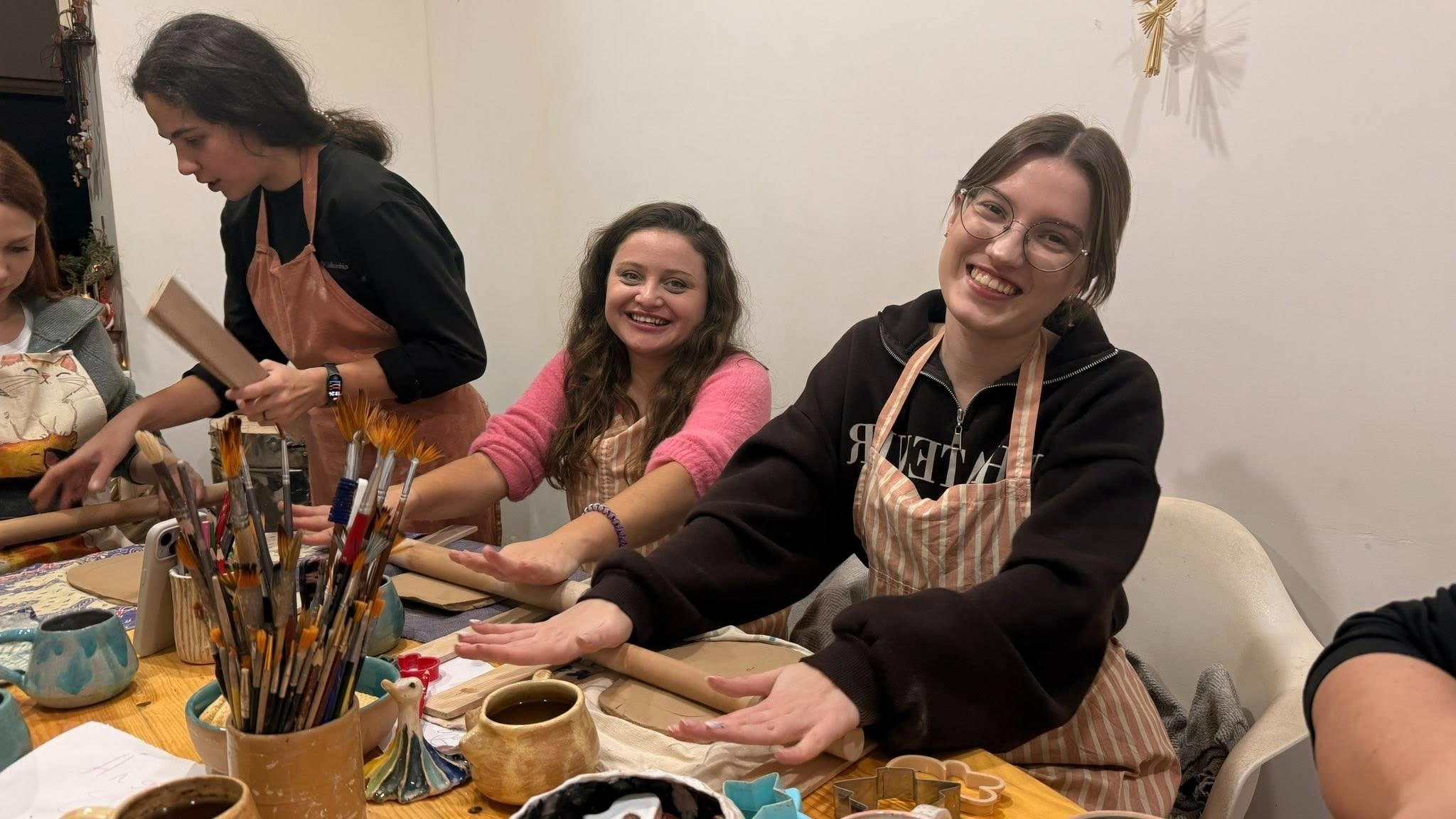
Journalists spent two hours sculpting Christmas ornaments, mugs, and plates. Photo by Mediabaza Mykolaiv

Candlemaking workshop for Cherkasy media professionals. Photos by Mediabaza Cherkasy
Responding to the Staffing Crisis: Working with Students
In the 2024 survey, 43.3% of journalists complained about the staffing crisis. Editors of major news outlets reported the same. Many have enlisted, moved abroad or switched professions, and there is a large gap between what journalism programs teach and what the labor market is like in reality. The Mediabazas worked to bridge that gap throughout the year.
Mediabaza Chernivtsi hosted a discussion on how to start working in a media outlet. “Newbie journalists are afraid of asking questions and clarifying things. They are afraid of feedback and criticism is painful to them. Making mistakes and learning from them is normal, what’s bad is not drawing conclusions from situations. You should also show initiative. A journalist is a generator of ideas and topics for reporting, so you should not wait the editor to give you tasks, but look for them yourself,” said the coach, Oleksandra Pylypenko, media director at the NGO Maye Sens, which includes the Slovyansk website 6262 and Chernivtsi’s 0372.
MykVisti journalist Darya Melnychuk shared a similar message when giving a class at Mediabaza Mykolaiv: “What matters is that you are not afraid to start. Write short reports, post them on social media and take criticism as a learning opportunity.” Here are a few more insights from the event:
- start with something small, e.g. short news items;
- keep an eye out for local events and issues in your community;
- try working in a student-run news team or as an intern in a regional media outlet;
- look for opportunities to advance, from grants and journalism schools to classes and online courses.
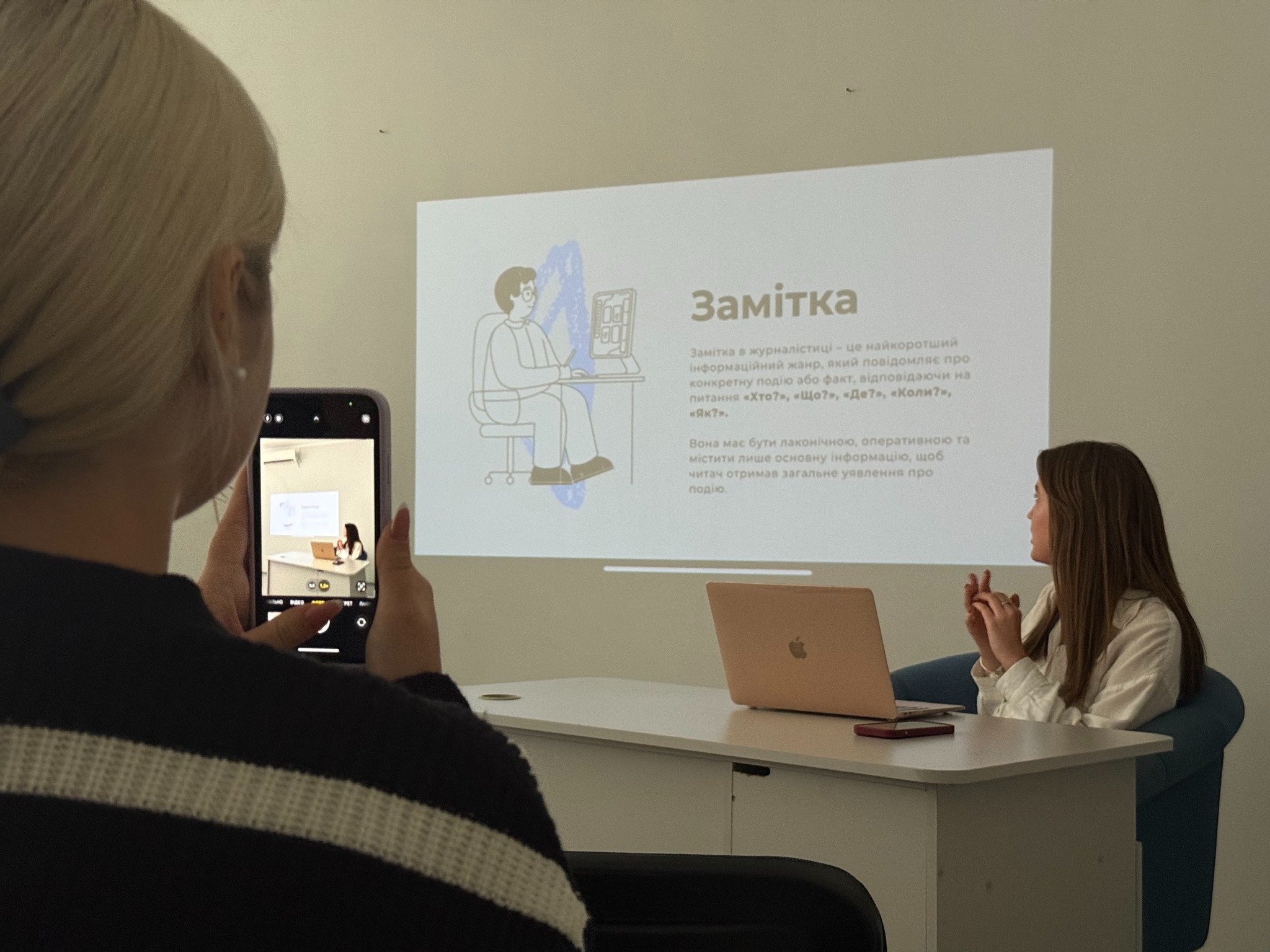
MykVisti’s Darya Melnychuk. Photo by Yelyzaveta Moskvina
Serhiy Nikitenko, chief editor with the Kherson-based news website MOST and Mediabaza Odesa / Kherson coordinator, organised a series of meetings with students from Odesa universities. For example, journalism majors from the Odesa Law Academy learned some secrets to high-quality reportage:
- Work on your personal growth. Develop a sense of observation, learn the theory, watch good movies, read high-quality texts.
- Always follow the approved routes and press officers’ guidelines when reporting in the yellow and red zone. “The more precisely you follow the rules, the more you will be trusted, and trust is key to quality reporting,” Serhiy said.
- High-quality reportage must center the person, their experience, their pain or triumph. “You can come across a subject for your story by chance, but it all depends on whether you can build trust. The ability to communicate and negotiate with people is your main tool.”
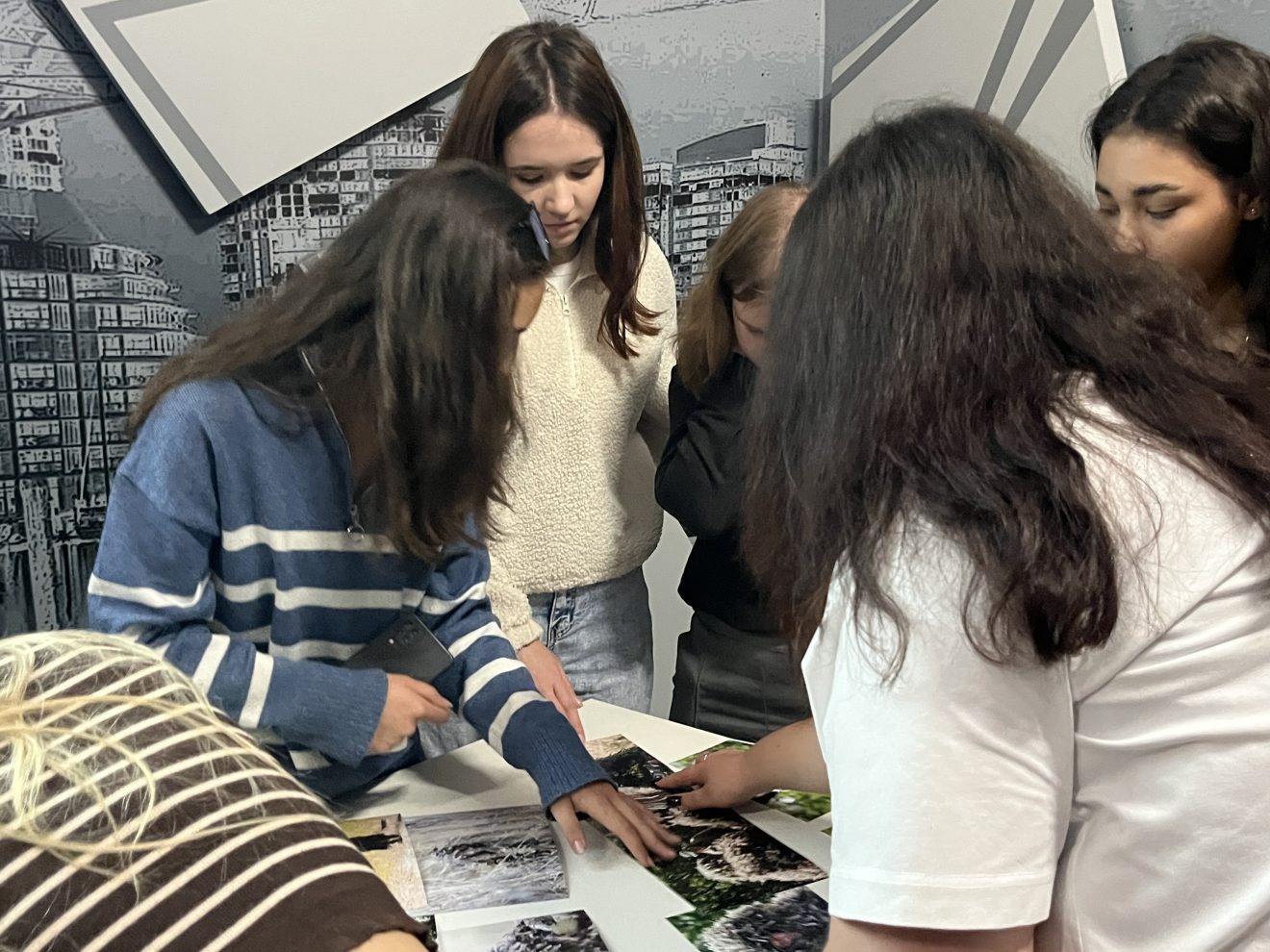
Event participants working on a practical assignment where they had to create their own reportages. Photo by Dana Hrynko
On a separate occasion, journalism students from the Mechnykov University of Odesa met to discuss the nuances of working in areas adjacent to the frontline.
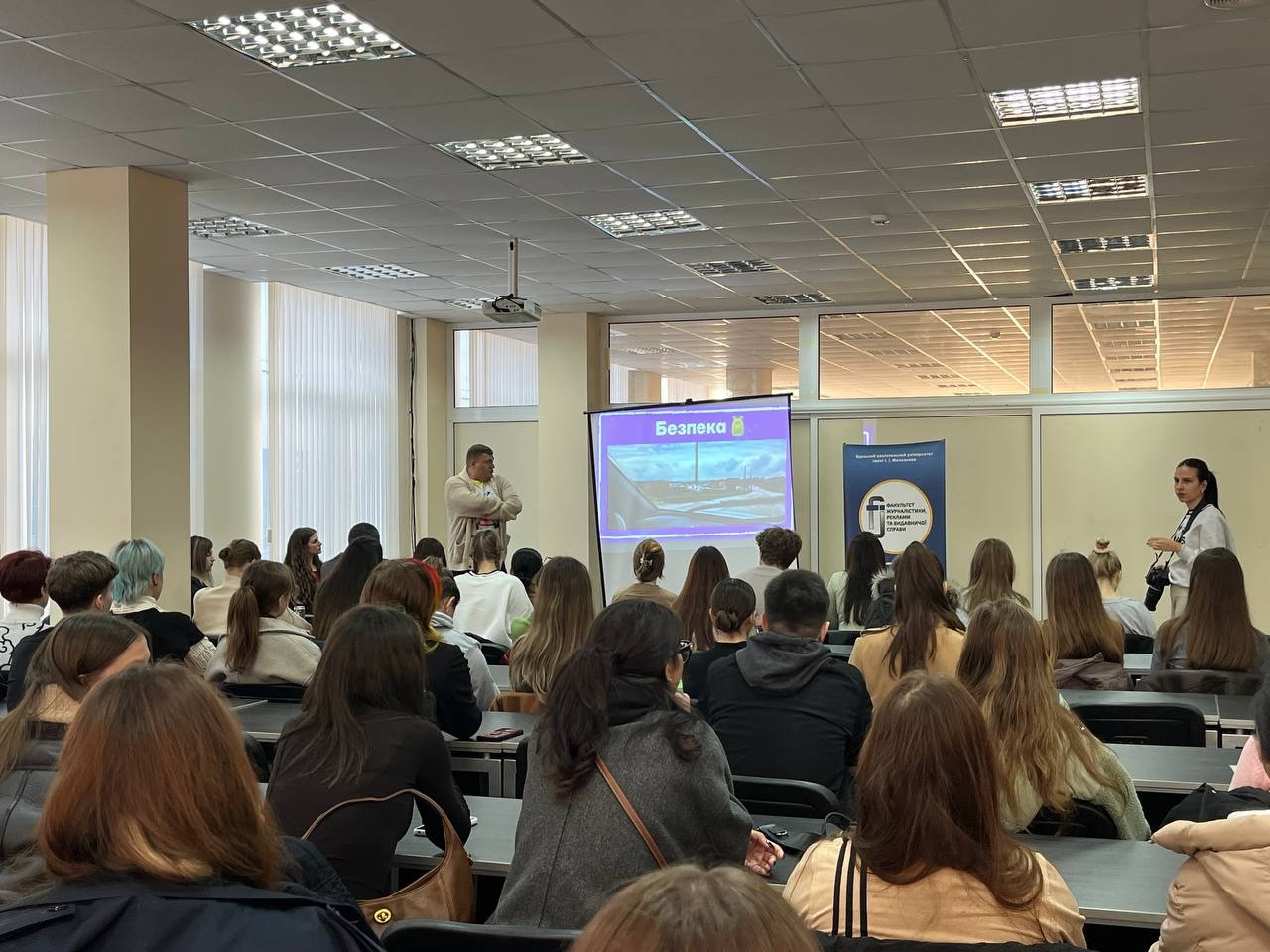
Students attending a lecture on reporting in deoccupied territories. Photo by Diana Hrynko
Serhiy said that in frontline areas, access often determines whether a journalist is able to produce a truly powerful story. “It’s all random. If we’re talking about Kherson oblast specifically, everything here depends on access. The ones who get the most interesting stories are those who have already firgured out where to go and how to get there,” he said.
Serhiy Nikitenko advises journalists to be flexible: even if the plan doesn’t work out, there are stories to be found around you: you just have to observe and be attentive to details.
“When we head out on a filming trip, we usually have a plan. But sometimes we arrive in a village and just start talking to people. They share their stories themselves. Sometimes they even text us on social media after a story gets released,” said Serhiy.
For example, one MOST reader messaged the news outlet on Facebook following a news story about a Kherson oblast village: “He gathered the people himself, and that’s how our report from Andriivka was born.” Nikitenko said that it is such spontaneous stories that often end up having the most value, because they contain the live emotion, pain, and truth of the occupation survivors.
“What matters is that you do not lose your humanity. We are not just collecting information – we are recording the history that our country is living through,” Serhiy Nikitenko concluded.
Course for Automation: Journalists and AI
80% of respondents in the annual IMI survey reported the use of artificial intelligence by news outlets as another trend in journalism. The Mediabazas in Khmelnytskyi, Chernivtsi, Chernihiv, Cherkasy, and Slovyansk hosted lectures on how to use AI ethically, avoid sharing hallucinations, and preserve a news outlet’s uniqueness.
Cukr co-founder and director Dmytro Tishchenko advised checking out the following tools:
Claude Pro (20 USD/month)
- works well in Ukrainian;
- low likeliness of making up facts;
- follows a news outlet’s tone and style;
- the context window is large in capacity.
“For our team, Claude is the best option for editing, for management, and for adapting content for social media platforms. We also use it to work with research,” Dmytro Tishchenko shared his team’s experience. Other tools have their advantages as well:
ChatGPT Plus (20 USD/month):
- has many plugins and integrations;
- good code and data analysis;
- image generation feature included;
- access to GPT-4o.
Gemini Advanced (20 USD/month):
- Google Workspace integration;
- data analysis and visualisation;
- search in real time.
Perplexity Plus (20 USD/month):
- web search with links;
- perfect for briefings;
- monitors trends;
- has good citations.
“This is an AI tool trained to work with primary sources. Perplexity will be for you if you want to be sure that the system is not hallucinating and shows you the sources of the data,” said Dmytro Tishchenko. “I use it mostly for search and research. For example, if you need to make a top list of mentions of something. These could be mentions of your news outlet on other resources.”
Grok (X Premium, tariffs vary):
- works well with social media posts;
- unconventional approach;
- mixed support of the Ukrainian language.
Meanwhile at Mediabaza Slovyansk, over 100 media professionals attended an online class to learn how to use two AI tools (Pinpoint and NotebookLM) to process documents.
Pinpoint’s key features include:
- Optical Character Recognition (OCR): the service processes scanned documents, images, and photos of pages, making their contents searchable.
- Automatic transcription: audio and video files are automatically transcribed with timecodes, allowing you to find the quotes you need in hour-long interviews quickly.
- Document comparison: this tool is ideal for analysing tender paperwork, draft bills, or court rulings, automatically highlighting the differences between files.
- Structured data extraction: the AI allows you to automatically create spreadsheets, extracting the necessary information (names, positions, dates, sums) from an array of documents.
- Team collaboration: journalists can work on a file collection at the same time, allowing them to create news stories more quickly.
NotebookLM is helpful for:
- Quotes with citations: each generated responde contains clickable citations which link directly to the corresponding fragment in an uploaded document for instant verification.
- Audio Overview: a unique feature that converts uploaded documents into audio with two AI-generated presenters discussing and summarising the contents, allowing the journalist to quickly familiarise themselves with 100+ page reports.
- Studio panel: contains tools for transforming content, e.g. creating mind maps, reports, and questionnaries based on uploaded material.
Not Just Grants: Monetisation Opportunities for the Media
The US funding crisis showed that diversifying funding is a critically important skill. The Mediabazas worked to help news outlets develop it.
Valeriy Harmash, head of the NGO Maye Sens, shared some tips on competing with Telegram channels in ad sales at Mediabaza Chernivtsi. When developing your advertising services, you should keep your own brand in mind, as well as trust, which should be your strong point. Any Telegram channel will be less trusted than a news outlet with integrity and many years of experience. Valeriy Harmash said that a media outlet should talk about themselves and show off their strengths. It is also important that advertising be handled by a specific person on the team who is responsible only for advertising.
Valeriy Harmash said that local media should prioritise package offers that allow advertisers to do what most Telegram channels cannot. Specifically, multi-platform advertising. For example, a Telegram channel can not offer a package that would include different advertising formats on the website and various social media pages. Overall, the media should offer at least three ready-made packages, outline clearly and concisely what the business will be getting. Highlighting past successful cases is also important.
Maye Sens’s chief accountant Maryna Kurakova gave a lecture on financial planning for local news outlets at Mediabaza Slovyansk. Here are the key tips:
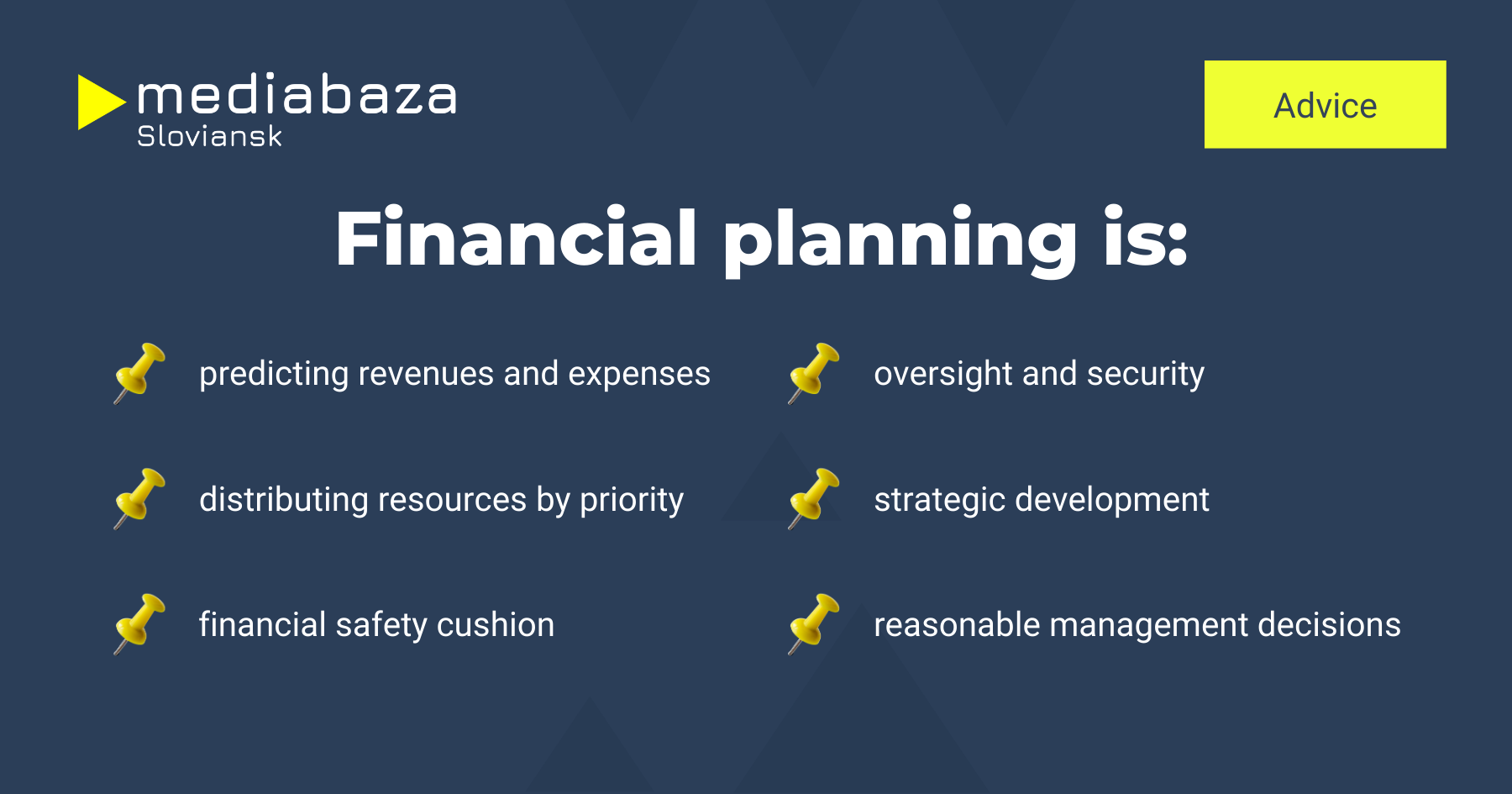
Illustration by Mediabaza Slovyansk
1. Consistent accounting is the basis of stability.
Many news teams operate in a state of financial chaos because they do not track income and expenses consistently. Maryna Kurakova advised small teams to use Google Sheets and larger teams to use special software to record every income and expense.
2. Calculate the break-even point.
The break-even point is the minimum sum that a news outlet must earn in order not to be in the red. “When you know what this sum is, the constant stress about whether you are going to have enough money by the end of the month is lifted,” the expert explained. The training participants learned to calculate this point in order to plan their budget with a clear understanding of their needs.
3. Analyse discrepancies.
If actual income or expenses are different from what was planned, this is a signal that something has to be done. Maryna advised running a discrepancy analysis every month to quickly adjust your plans and avoid financial pitfalls. “A financial report is your GPS in the world of money,” she added.
4. Create a financial cushion.
A media outlet’s stability depends on it having a reserve. Maryna recommends having a three- to six-month financial cushion to help you survive periods when grants or other income are delayed. Participants confessed that having no such cushion often pushes them to take on projects that do not align with their mission.
5. Diversify income.
Permanent sources of income (advertising, subscriptions, donations) should form the basis, while one-time sources (grants, rent) should only be a supplement. “If your news outlet is reliant on one source, you are at risk,” Maryna emphasised. She advised attendees to look for new monetisation options such as paywalled content or partnerships.
How to contact IMI Mediabazas
To join a Mediabaza event or lease equipment (safety gear or technology) free of charge, message the coordinator of your nearest Mediabaza on Facebook:
- Mediabaza Khmelnytskyi — Olha Zahoruyko;
- Mediabaza Cherkasy — Yelena Shchepak;
- Mediabaza Zhytomyr — Oksana Trokoz;
- Mediabaza Chernihiv — Pavlo Pushchenko;
- Mediabaza Kharkiv — Olha Kaplun;
- Mediabaza Poltava — Nadia Kucher;
- Mediabaza Zaporizhzhia — Natalia Vyhovska;
- Mediabaza Kropyvnytskyi — Pavlo Lisnychenko;
- Mediabaza Mykolaiv — Kateryna Sereda;
- Mediabaza Sumy — Alyona Yatsyna;
- Mediabaza Odesa / Kherson — Serhiy Nikitenko;
- Mediabaza Slovyansk — Maria Kucherenko;
- Mediabaza Chernivtsi — Tayisia Harmash.
Please note:
- Mediabaza Kherson only issues equipment;
- Mediabaza Slovyansk offers equipment for filming, video and audiostreaming;
- Mediabaza Slovyansk has a studio to record podcasts.
If necessary, contact the national Mediabaza coordinator Pavlo Lisnychenko via: 050 594 20 58 / [email protected]. If you need safety gear (a bulletproof vest, a helmet, a first aid kit) or some other equipment, contact the Mediabaza coordinator in your region or fill in this Google form: https://bit.ly/48pX9GZ.