
Over the four years of full-scale war, Russia has repeatedly revamped their set of explanations as to why attack Ukraine and what for. The vocabulary has changed several times, but the propagandists are yet to come up with a new toolkit. As a result, the justifications for Russia’s aggression have lost the last shred of plausibility by now.
The justifications stem from the claim that “they made us do it.” Russia says it did not start the war, but was simply responding to the threat of NATO expansion to the east and rushed to “defend the Donbas.” The Kremlin was peddling such narratives long before the start of the full-scale invasion, along with stories about “biolabs” and claims that “Ukraine was created by Lenin” and has been “taken over” by Nazis. By 2022, propagandists had laid the ground for Russians to accept that “there was no other way” and not question the reasons for the attack on Ukraine.
The mechanics of Russian propaganda are quite simple as well. Any fact that contradicts the basic picture (such as the air strikes at cities, destruction of infrastructure, civilian casualties) is either hushed up, declared a “set-up,” or blamed on Ukraine.
When the facts are so self-evident that they can not easily be turned on their head, the Russians fall back on the ubiquitous formula: “things are not as clear-cut as they seem.”
Language stunts: “SMO” & “denazification”
The term “SMO”, invented by the Kremlin, is another hoax. The war was declared an “operation” so that Russians would stay unaware of the scale of action or their own responsibility for it. This helped construct a quasi-reality where Russia’s aggression is not an attack on Ukraine but a “necessary” response that aims to “protect the people”. Moreover, the term “operation” left room for endless explanations as to why it dragged on year after year.
At the same time, the Kremlin’s linguistic balancing act was rooted in the list of the invasion’s objectives as defined by Vladimir Putin in his 24 February 2022 address. He denied that occupying land was the goal and instead declared his intention to “demilitarise” and “denazify” Ukraine. That is to say, he used the vaguest definitions possible. Goals phrased in this way cannot be achieved within specific deadlines and clear parameters, which makes them convenient for covering up any new excuse: the land grab, the draft, the escalation, the strikes on infrastructure. Ambiguous terms that allow for relentless manipulation have been a feature of Russia’s propaganda from the very beginning of the full-scale invasion.
Propaganda “switching gears”
Russia’s war propaganda is a set of building blocks that can be rearranged time and again to suit the recent developments, nevermind the initial plans. When a quick victory for the Russians did not come to pass, the focus shifted:
- from “liberation” towards “defending Russia”;
- from “defending the Donbas” to fighting NATO;
- from “brothers” to “a dangerous enemy”.
This is not ideas evolving, but rhetoric being adjusted to the situation. Propaganda serves the Kremlin regime and works to keep it alive. It tries to keep Russians in good spirits, snuff out inconvenient questions about the price of war, lift the moral barriers, and normalise violence.
Thus in 2024, as the big war entered its third year with no definitive results to show for it, Russian propagandists had to add in a narrative about the need to create a “buffer zone”. And when 2025 brought no military successes of note, they had to significantly ramp up the “explanation” component and start repeating the “hostile West” narrative more often.
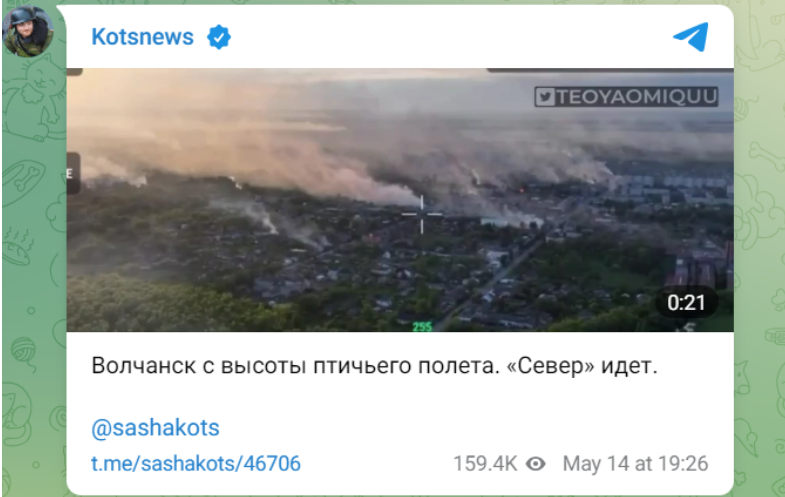
“Bird’s eye view of Vovchansk. ‘North’ is coming.”
Screenshot from Kotsnews on Telegram by IMI
Both major news outlets closely linked to the Russian government and smaller propagandists running Telegram channels were on the task. The “explanations” on Telegram had a harsher tone, seeped with hatred, and sometimes spilled over into hysteria. Still, they promoted the same agenda as the official propaganda, talking about the “split” in Ukraine, Zelenskyi’s “illegitimacy”, the “tensions between the army and the government”, and complaining about Ukraine being “managed from outside” and NATO. The regurgitation of identical narratives was clearly intended to create a mass confirmation effect for the audience.
2022: Betting on a “quick operation”
In 2022, “objectives” such as “demilitarisation” and “denazification” ensured there was room for manipulation. When the pre-made stubs assuming a quick victory were exhausted, any step could be declared part of the plan, as could any failure. This fueled the Russians’ confidence and their expectations that Ukraine would soon buckle.
That was the time when Russian propaganda started showing features reminiscent of a severe mental disorder. It began to contradict itself. Domestic audience was being sold the ideas of “historical justice” and “inevitability” of Russia’s victory while the outside world was being fed claims denying the occupation and presenting the operation as “limited in scale” and “only targeting specific spots”. Meaning, the war was to be presented as “messianic” and a “temporary measure” at once. However, in today’s digital world, this split personality of the Russian propagandist could not have gone unnoticed.
Ukraine remained standing, and Russian state media were quick to write the collapse of the initial plans off as a “gesture of goodwill” and to start building a framework for explaining why the war was dragging on. Propaganda started leaning towards acknowledging the aggression while trying to frame it as “justified” and flip the cause-and-effect relationship by shifting the blame to Ukraine. Moreover, manuals advising propagandists to blame “the collective West” for everything emerged.
2023: “War with NATO” and “peace talks”
In 2023, Russian propagandists began the coordinated effort of explaining to their audience where the power of the “second army of the world” had gone. They started describing the war as a confrontation with the West or NATO, and Ukraine as “dependent” and “managed from outside.” Framed like this, any failure was no longer losing to Ukraine but an episode in a “great historic battle.” The deadlines for the war Russia started were now irrelevant.
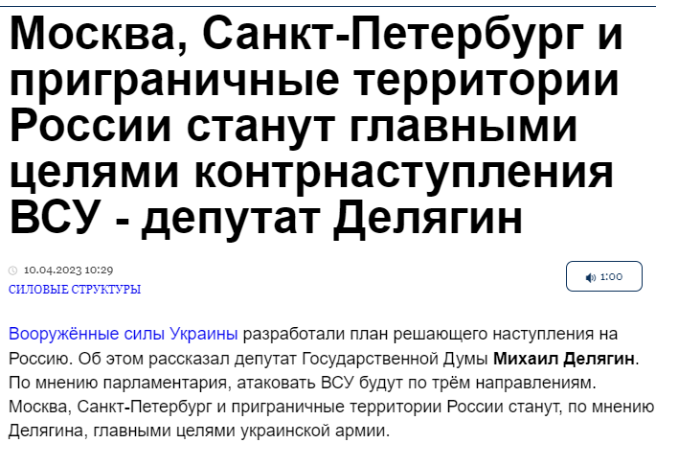
“Moscow, St. Petersburg, and the territories near Russia’s border to become primary targets for the UAF counteroffensive, says MP Deliagin”.
Screenshot from the news website Silovyie Struktury by IMI
However, Russian propagandists appeared to not have been accustomed to the new reality yet, so they entered a period of the deepest instability. They oscillated between assuring their audience that victory was coming soon, then falling into despair and panic, then going back to triumphant rhetoric. This moment of despair and putting the entire world in opposition to Russia is when nuclear strike threats began.
In the meantime, propaganda outlets were quoting Putin as telling military commanders during a meeting in the Kremlin that “the situation is evolving” and so “the goals and objectives” may evolve with it.
Towards the end of the year, propagandists began to cover up the lack of real achievements on the Russian army’s part with swarming claims that “Ukraine’s defeat” was inevitable, essentially targeing the domestic audience in a psy-op. The narrative reached the point of ubiquity in December 2023.
To add to the confusion, Russian propaganda started suggesting that peace talks might be in order, but denied that any concessions on the aggressor’s part were possible. That is, they were presenting negotiations as not as a way to achieve compromise but as a means of putting Russia’s demands on record.
All this gymnastics had an impact: the Russians internalised that “objectives may be redefined,” narratives may shift to promote opposite messages almost daily, but the war will drag on longer than they thought.
2024: Making it up as they go, “buffer zone”
In 2024, Russia’s propaganda machine tried to legitimise another round of escalation by convincing the Russians that the Kremlin’s aggressive appetites had subsided. Not straightforwardly, of course, but by pretending that nothing had changed and that that was the plan all along. Russian state media started insistently suggesting that a “buffer zone” needs to be established on the border with Ukraine, allegedly in response to strikes on Russian territory and the Ukrainian Defense Forces’ incursion in Kursk region.
At the same time, propagandists focused on smaller objectives, making them up as they went. In general, they continued to operate as they had the previous year, regularly swapping the “highs” and the “lows”.
During the Kharkiv oblast offensive in May 2024, the euphoria from the Russian toops’ minimal advances and “decisive battles” made way for attempts to justify the Russian army’s failures and nuclear strike threats. Still, the Kremlin’s mouthpieces tried to sound plausible even when reality offered no “triumphant pictures.” That is, if the result did not look like victory, they would redefine the objectives and parameters for what counts as one. During this period, claims about the Russian army’s “successes” in “decisive battles” accounted for about a third of all content featuring hostile narratives about Ukraine.
The propagandists served the regime in one more aspect: as it tried legitimise itself yet again. The media made efforts to tie the “objectives” of the aggression against Ukraine to Russia’s sham democracy. Playing along with Putin’s “election”, pro-Kremlin resources used the image of an enemy eager to disrupt it to scare the Russians and claimed that the war necessitated “unity”. In the end, the propagandists conjured up a somewhat odd vicious circle where war was necessary for there to be an “election” and the election is necessary because there is a war.
2025–2026: The “objectives” are different now
In 2025, Russian state media tried to keep pushing their loud triumphant rhetoric and insisted that the “objectives” remained unchanged. However, now they measured “success” in “zones”, villages, sometimes simply meters of land and “wearing the UAF out.”
The emergence of the negotiation track initiated by the new US administration gave Russia and its propagandists more platforms and pretexts for aggressively promoting their made-up ultimatums: demanding Ukraine reverse its course towards NATO, withdraw its army from the four oblasts that Russia had declared it owned, and expand the “buffer zone” in the border regions. That is, Russia’s “objectives” lost the vague ideological component such as “denazification” and acquired a territorial outline.
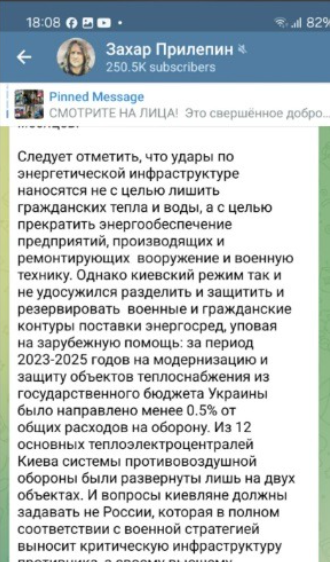
“It should be remarked that the energy grid strikes aim not to leave the civilians with no heat or water but to disable the power supply to the enterprises producing and repairing weapons and military vehicles. However, the Kyiv regime still has done nothing to draw the lines between military and civilian supply chains or to defend and reserve them, relying on international aid: less than 0.5% of Ukraine’s defense spending in 2023–2025 was allocated for upgrading and fortifying heating facilities. Air defense systems were only installed in two out of 12 major combined heat and power plants in Kyiv. And it’s not Russia, who is disabling the enemy’s critical infrastructure in full accordance with warfare strategy, that the Kyivans should take their questions to, but their own top officials, who have left everything to chance and devote all their time to angling for funding from abroad, which gets embezzled immediately.”
Screenshot from Zakhar Prilepin on Telegram
Still, this did nothing to change Russian propaganda’s primary method: flipping reality upside down. As mass air strikes on Ukraine resumed, becoming especially cynical in early 2026, the Russian media and influencers claimed they wanted the war to end. They acknowledged the strikes on the energy grid, but denied the destroyed facilities were civilian infrastructure, claiming those were all “military objects”, and failing to mention the way the strikes affected people’s lives. In such cases, Russian propagandists usually resort to drier, technical language. Not out of respect for the facts, but because such tone makes it easier to conceal the real goal of the strikes: terror.
The image of Ukrainians: from “brothers” to fear and loathing
At the beginning of the full-scale invasion of Ukraine, a considerable portion of the Russian state media product was built on the assumption that the “brotherly people” were tired of being Ukrainians and would offer no consistent resistance. Over time, as the assumption proved wrong, the tone shifted. The Kremlin media switched to dehumanising Ukrainians through depersonalization, portraying them as cruel, and making violence against them sound justified so that the audience would more easily accept the idea of purges and mass murder.
As early as 2023, pro-Kremlin Telegram channels and media outlets tried to aim the hatred at the Ukrainian authorities. It was them who was labelled “neo-Nazis”. Russian state media distinguished between the officials and the rest of Ukraine’s citizens.
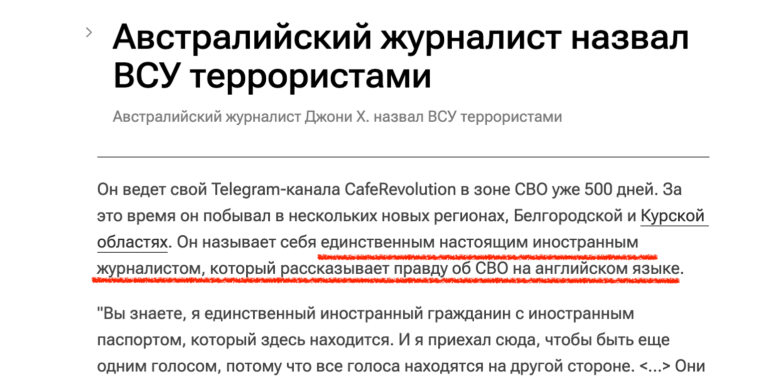
Headline: “Australian journalist calls UAF terrorists”. Highlighted: “[He calls himself] the only real foreign journalist telling the truth about the SMO in the English language.”
Screenshot from the Russian state-affiliated news website RIA by IMI
Yet as soon as 2024, Russian state media began consistently constructing an image of Ukrainians that was rooted in demonisation and genocidal rhetoric, replacing people with types easy to blame for the war. It is noteworthy that even the phrase “brotherly people” eventually lost its literal meaning among the pro-Russian crowd and acquired a connotation verging on irony and hostility.
The staples of Russian propaganda
Despite the turmoil that Russian propaganda have gone through over the years of the big war against Ukraine, the structure of the aggressor’s self-justification machine remains unchanged. It relies on several staple techniques:
- First, moral inversion: Russia is portrayed as the side who was “forced to do it” while Ukraine is the one to blame of the consequences.
- Second, redefinition: civilian objects are declared military ones and unfounded claims replace evidence.
- Then, the fog of uncertainty: evident crimes are washed down to a matter of interpretation.
- Finally, dehumanisation, which ensures the Russians feel no empathy and feeds their thirst for violence.
These techniques work as a complex. First, the victim is stripped of entitlement to empathy, then the demand for proof is erased, and then the discourse is stirred towards the realm of doubt. In the years of Russia’s war on Ukraine, the propaganda machine’s vocabulary has evolved, but not the set of techniques. It is has worked equally well for “denazification,” “buffer zones,” and for justifying terror against civilians.
But the fact that Russian state-affiliated media have been following an unchanging script suggests a passive approach to their own work. In the long run, their techniques grow outdated, their manipulativeness becomes obvious, and their propaganda becomes unconvincing.