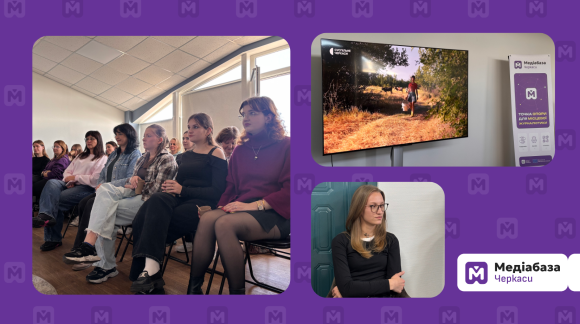

Over 100 media professionals across Ukarine attended the class “Processing Documents and Audio with AI: Free Tools for Media Teams,” organised by the Institute of Mass Information’s (IMI) regional hub Mediabaza Slovyansk, to learn how to use advanced AI tools to efficiently process large bodies of data.
The coach, Yulia Mashuta, digital director at NGO Maye Sens, presented two free to use Google tools that can speed up the work of investigators and content writers.
Pinpoint: Systematic archive processing
Pinpoint is a Google tool designed for journalists who have to process hundreds of unstructured files. The system accepts PDF, audio, video, and text files, creating a single searchable database.
Yulia Mashuta presented the following Pinpoint features:
- Optical Character Recognition (OCR): the service processes scanned documents, images, and photos of pages, making their contents searchable.
- Automatic transcription: audio and video files are automatically transcribed with timecodes, allowing you to find the quotes you need in hour-long interviews quickly.
- Document comparison: this tool is ideal for analysing tender paperwork, draft bills, or court rulings, automatically highlighting the differences between files.
- Structured data extraction: the AI allows you to automatically create spreadsheets, extracting the necessary information (names, positions, dates, sums) from an array of documents.
- Team collaboration: journalists can work on a file collection at the same time, allowing them to create news stories more quickly.
NotebookLM: Source-guaranteed accuracy
The other tool, NotebookLM, runs on Gemini and generates responses solely based on uploaded sources (up to 50 files in the free version). This minimizes the risk of hallucinated information, which is critical for analysing court cases and official reports.
NotebookLM’s key features include:
- Citations with references: each generated responde contains clickable citations which link directly to the corresponding fragment in an uploaded document for instant verification.
- Audio Overview: a unique feature that converts uploaded documents into audio with two AI-generated presenters discussing and summarising the contents, allowing the journalist to quickly familiarise themselves with 100+ page reports.
- Studio panel: contains tools for transforming content, e.g. creating mind maps, reports, and questionnaries based on uploaded material.
AI tools: From routine to analytics
The class showed the tools to be indispensable for regional newsrooms. Pinpoint and NotebookLM allow you to save the time you would otherwise spend manually transcribing audio and searching through files, and instead spend it on in-depth analysis of facts and creating high-quality investigations. This lifts the financial barrier and empowers journalists to work with big data even with limited resources.
by Varvara Verbytska, Maye Sens communications manager