

Report and diagram corrected: one legal pressure case removed as it did not occur in February. This did not affect the total sum of violations for the month.
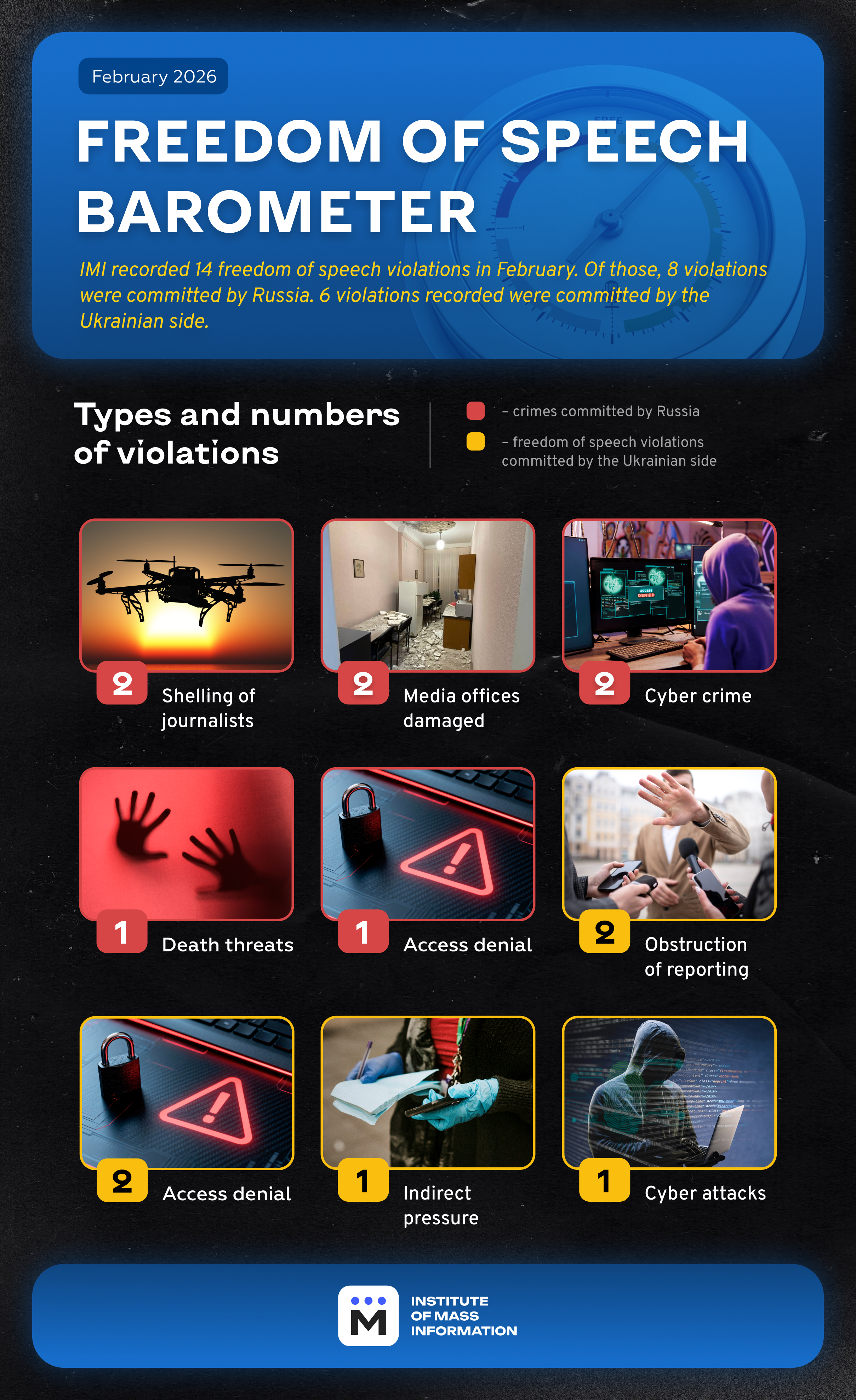
The Institute of Mass Information experts recorded 14 freedom of speech violations in Ukraine in February 2026. Eight were committed by Russia, as evidenced by IMI’s monthly monitoring study Freedom of Speech Barometer.
Russia’s crimes against media and journalists in Ukraine included armed strikes at journalists and death threats to them, destruction and damage of media offices, and cyber crimes.
The death of one media worker turned UAF servicemember was reported in February:
- Serhiy Fisun, UAF Airborne Assault Forces officer and journalist born in Kharkiv. He was killed in a Russian Lancet drone strike on 5 February 2026.
Filming crews coming under Russian drone fire
- Suspilne Dnipro came under attack in Ternivka (Dnipropetrovsk oblast) while filming the aftermath of an earlier Russian strike at a bus carrying miners. The drone fell down about 700 meters away from the journalists. They were wearing bulletproof vests and helmets with PRESS markings and were unharmed.
- Journalists with the Latvian Public Media (LSM) were attacked while working near the front line in Ukraine. The drone exploded near their car, damaging it, but the journalists were not injured. The crew was working on a news storya bout a Latvian national fighting in the ranks of the UAF in Donetsk oblast.
Destroying or damaging media offices
- The office of the Snovsk-based newspaper Promin (Chernihiv oblast) was severely damaged in a Russian drone strike. The team was unharmed and the equipment was intact, the team is looking for benefactors to help shoulder the repairs.
- Nashe Zhyittia office in Novomykolaivka (Zaporizhzhia oblast) has been effectively destroyed and is now unusable as a result of the guided bomb strike by Russian forces. The windows and doors are broken, the walls and furniture battered. The team is unharmed and is considering relocating.
Death threats to journalists
- The news website Kremenchutskyi Telegraf (Poltava oblast) received an email claiming that bombs had been planted in two dozen facilities in the oblast. The email listed the supposedly sabotaged buildings, which included malls, railway stations, and local government bodies.
Cyber-crimes
- A cyber-attack on an Internet provider’s servers resulted in two Chernivtsi-based TV channels, Chernivetskyi Promin and C4, briefly broadcasting content promoting Russian propaganda narraitves.
- The Astra 4A satellite, which retransmits TV channels of Ukraine’s public broadcaster Suspilne, experienced brief signal interference. The incident occurred on 26 February at 11:00. The disturbance was eliminated by 13:55.
Blocking access to media
- Roskomnadzor included the website of the Syla Pravdy Center for Investigative Journalism in the list of resources banned in Russia. The team learned of the ban from an email they received in their inbox. The register lists no reasons for the ban.
IMI also recorded press freedom violations unrelated to Russia’s war on Ukraine. These included obstruction of reporting, denial of access to information, indirect pressure, and cyber attacks.
Obstruction of legal reporting
- Odesa-based journalist Ksenya Sitinska faced obstruction of reporting while carrying out an editorial assignment for Freedom TV: the security guards at an apartment complex barred her from filming the aftermath of a recent Russian air strike. Despite the journalist being accredited by the Ministry of Defense, the guards demanded a permit from the complex administration and tried to cover her camera lens with their hands.
- Chetverta Vlada reported pressure on their journalist Myroslava Prymak by Rivne-based lawyer Oleksandr Lutsiuk, who was featured in her investigation. He asked her personal questions during a phone call and made unfounded allegations about her family. The team views this as an attempt to discredit the journalist and interfere with the upcoming article.
Access to information for journalists
- The Odesa Oblast Military Administration refused to disclose the sums spent on the top officials’ and staff’s business trips abroad taken during the martial law period to Nikcenter journalists, saying that preparing a response to their query would “require significant intellectual effort” and claiming that the requested data was not public information.
- The news website Poltavshchyna reported that the Poltava City Council had left three of their information queries regarding permits for the ongoing repair work in the local Corps Park without response. One of the queries had to be submitted twice because the City Council missed the response deadline the first time.
Indirect pressure
- Ukrainska Pravda chief editor Sevgil Musaieva reported a campaign aiming to discredit the agreement between the news outlet and the Netherlands-based fund Pluralis B.V. She said Telegram channels had made manipulative claims about the investor’s alleged ties to Russian oligarchs. Musaieva stressed that their ownership structure was transparent and that no Russian or Belarusian money was involved.
Cyber attacks
- Syla Pravdy received a series of dubious copyright infringement notices from Google. The team considers the notices to be frivolous and views them as an attempt to damage their search engine indexation and their visibility. The contested articles have not been taken down, but the team is wary of possible future consequences.
See the full list of press freedom violations in Ukraine in February 2026 below.
Russia’s crimes
Armed strikes at journalists — 2
1. Suspilne Dnipro crew comes under Russian drone fire in Dnipropetrovsk oblast
02.02.2026 A Suspilne Dnipro filming crew came under Russian Shahed fire while working in Ternivka (Dnipropetrovsk oblast) on 2 February. The journalists were filming the aftermath of the Russian strike at a bus carrying miners that occurred the day before, on 1 February, the broadcaster’s correspondent Anton Sirenko reported to Kateryna Lysiuk, the Institute of Mass Information representative in Dnipropetrovsk oblast.
The filming crew arrived in Ternivka, where a Russian drone had hit a bus carrying civilians (DTEK miners) the day before. Another drone had arrived shortly after, hitting the wounded people as they were trying to help one another get out of the bus.
The reporter said that the crew had been preparing for the live Suspilne slot in the telethon, having recorded the aftermath of the attack. At that moment, they heard gunfire, and then spotted a suicide drone flying towards them.
“I was just finishing the script for my report, my colleague, the cameraman, was setting up the camera, when we heard a crackling sound (automatic rifle rounds. – Ed.), we froze up and listened, and only then did we hear and see the Shahed. It was flying straight at us,” said Anton Sirenko.
He added that the filming crew was wearing safety gear: bulletproof vests and helmets with PRESS labels. There was nowhere to take cover nearby, so the journalists tried at least to hide behind a fence.
“We were wearing bulletproof vests, helmets, we always work in gear labelled PRESS, we tried get at least some cover behind the fence, a kind of imitation wall, since there was no shelter nearby… At the last second, the Shahed took a sharp turn around and hit the mine again, as it did yesterday,” said Anton Sirenko.
The Suspilne Dnipro team (the correspondent, the cameraman, and the driver) were unharmed.
Anton Sirenko said that the Shahed had hit a coal mining facility 700 meters away, which had already been damaged by two drones the day before.
After the explosion, the team quickly left the danger zone. Later, having reached the central city, the reporters heard another explosion and saw smoke rising about a kilometer away.
2. Latvian journalists come under Russian fire in Ukraine
10.02.2026 A camera crew with the Latvian Public Media (LSM), including reporter Odita Krenberga and cameraman Aigars Kovaļevskis, were attacked by a Russian drone near the front line in Ukraine, the broadcaster reported on 10 February.
The incident occurred as the journalists were working on a news story: they were travelling along with Ukrainian soldiers, heading to a UAF unit’s positions. The drone exploded next to their car, the fragments damaging the rear and breaking the windows. The driver managed to react quickly, so none of the journalists or soldiers were injured.
The journalists were working on a report about Aleksandrs, a Latvian national from Alūksne who is fighting in Donetsk as part of a UAF airborne brigade. The journalists visited the unit’s combat positions to tell his story.
The broadcaster writes that despite the weather being unfavourable for drones during the LSM crew’s visit (the wind was strong in some areas, there were blizzards and the visibility was poor), the cameraman, reporters, as well as Aleksandrs and other Ukrainian soldiers were still spotted and targeted by a drone.
The path then ran under the cover of a forest, along the edge of a field. The group soon reached the unit’s positions, where the journalists managed to film the story.
LSM stressed in a statement that the work of journalists in the combat area is extremely important: it helps show the reality of war as well as document war crimes and human rights violations.
LSM chief editor Anita Brauna said that independent battlefield journalism is an important counterweight to propaganda and enables society to get verified facts.
“The LSM crew is aware of the risks it faces when visiting Ukraine’s defenders and recording the reality of the war, because it is this kind of presence that enables us to document the true face of war no matter how dangerous or cruel it may be. We highly appreciate the work and courage of our reporters, because independent journalism in this situation serves as an important counterweight to false and manipulative news, allowing society to rely on facts, not manipulation,” Anita Brauna said.
LSM has been covering Ukraine new since 2014 and has continued to work actively following Russia’s full-scale invasion in February 2022.
Destroying or damaging media offices — 2
1. Newspaper office damaged in Russian strike in Chernihiv oblast
08.02.2026 Russian troops targeted Snovsk (Chernihiv oblast) in a drone strike on 8 February, damaging the office of the newspaper Promin, chief editor Olena Kompanets reported to the Institute of Mass Information representative in Chernihiv oblast.
Kompanets said that the blast wave from the strike ripped out the door in the office and shattered the glass in six windows.
“It was a terrible, destructive strike in Snovsk. It started late on 8 February 8 and lasted through the morning. Many civilian infrastructure facilities were damaged, especially the railway. The shelling was extremely intense: it destroyed a diesel locomotive located 100 meters away from our office. And the blast wave blew out our door and shattered the glass in six windows,” Olena Kompanets recalled.
The newspaper’s office is located in central Snovsk, in the building that once hosted the railway freight office.
“Our city in special in that the railway is actually located in the center. We can see the railway depot in our window, and if we go out the other door, we end up is the central square,” the editor explains.
City Council staff have since reinstalled the damaged door, but it is beyond repair. The windows have been covered up with plastic film.
“What matters is that no one was hurt. This is the second blow to our team. The emotional toll is especially difficult, I have two colleagues working with me, their hands were shaking. They had to take an extra day off,” said Olena Kompanets.
The equipment in the office is intact. The team is now looking for benefactors to help shoulder the repairs.
2. Office of Zaporizhzhia newspaper destroyed in Russian air strike
22.02.2026 The office of the newspaper Nashe Zhyttia, based in Novomykolayivka village (Zaporizhzhia oblast), was effectively destroyed and is now unusable as a result of the guided bomb strike by Russian forces on Sunday, 22 February, chief editor Kateryna Zavarzina reported to Natalia Vyhovska, the regional Institute of Mass Information representative.
Zavarzina said that the office, which was located in the village council building, had effectively been destroyed and the team was now looking for a temporary space to work and store equipment and the archive.
“This [air strike] happened yesterday, on Sunday, at 10:15. So, thank God, the team was unharmed. The office itself was badly damaged: the windows, the doors are gone. The walls and furniture are also damaged, everything is battered by glass shards. There was no fire, the editorial equipment survived,” said Kateryna Zavarzina.
She added that she was considering relocating the newspaper to Zaporizhzhia city, but the decision was difficult.
The Zaporizhzhia Oblast Military Administration reported on Telegram that Russian occupiers had carried out 754 strikes on 44 municipalities in Zaporizhzhia oblast over the past 24 hours; in particular, Novomykolayivka was targeted with aerial bombs and UAVs. Two people were killed and four more were injured.
Death threats — 1
1. Kremenchutskyi Telegraf receives bomb threats via email
02.02.2026 The news website Kremenchutskyi Telegraf (Poltava oblast) received an email on 2 February claiming that bombs had been planted in two dozen facilities in the oblast, chief editor Lesya Lazorenko reports to Nadia Kucher, the Institute of Mass Information representative in Poltava oblast.
Lazorenko said that, the letter referred to upcoming terrorist attacks at several facilities.
“We received a letter by unknown persons who said they could not give their names but possessed information that could prevent a catastrophe. The email continued, ‘Our ‘curators’ made us participate in the preparation of terrorist attacks. They promised us big money, but we cannot live with this. We made several explosive devices based on the plastic explosive PVV-4,’” said Lesya Lazorenko.
She added that the senders listed several locations where bombs had supposedly been planted: the Halaktyka shopping mall (Kremenchuk), the Kremenchuk City Council, the Kremenchuk railway and bus stations, the Mykhailo Ostrohradskyi National University of Kremenchuk, the shopping mall Yevropa (Horishni Plavni), the Horishni Plavni Town Council, the Zolotnyshyne railway station (Horishni Plavni), the Horishni Plavni bus station, the Horishni Plavni Vocational College, the shopping mall Myrhorod (Myrhorod), the Myrhorod City Council, the Myrhorod railway and bus stations, the M. Gogol College of Arts and Industry in Myrhorod, the shopping mall Lubny (Lubny), the Lubny City Council, the Lubny railway and bus stations.
Cyber-crimes — 2
1. Two Chernivtsi-based channels briefly stream Russian propaganda after cyber-attck
23.02.2026 A cyber-attack on an Internet provider’s servers resulted in two Chernivtsi-based TV channels briefly broadcasting content promoting Russian propaganda narraitves, reports Alyona Chorna, the Institute of Mass Information’s regional representative, citing reliable sources.
The attack led to:
- a temporary failure of the cable channel Chernivetskyi Promin on 23 February;
- a failure of the TV channel S4 on 25 February.
Alyona Chorna’s sources say that the hackers targeted the servers of the Internet provider that ensures the functioning of cable television. According to preliminary reports, one of the servers was not properly protected, which allowed the hackers to interfere with the broadcast.
The failure lasted several minutes. Specialists quickly eliminated the problem and added extra safeguards.
2. Suspilne reports disruption of their satellite broadcasting
26.02.2026 The Astra 4A satellite, which retransmits TV channels of Ukraine’s public broadcaster Suspilne, experienced signal interference on 26 February at 11:00. The disturbance was eliminated by 13:55, Suspilne reports.
The broadcaster said that the incident had affected viewers who receive the signal from the satellite directly and a limited number of cable network subscribers.
Suspilne was in contact with the telecom service provider to restore the signal.
Suspilne Broadcasting is an independent media company that offers robust coverage on all platforms through Pershyi TV, Suspilne Culture, Suspilne Sport, and the national network of local channels.
Suspilne’s satellite broadcasting has been repeatedly attacked. On 9 November 2023, the Russian forces tried to disrupt five of their channels through satellite by jamming them and replacing their content.
On 13 March 2024 Suspilne’s signal was being jammed from Russia.
Likewise in May 2024, Russian hackers tried to jam Suspilne’s satellite signal and replace its content with a broadcast of the Victory Parade in Moscow.
Blocking access to media outlets — 1
1. Russia blocks access to Syla Pravdy website
16.02.2026 Access to the website of the Ukrainian Syla Pravdy Centre for Investigative Journalism has been blocked in Russia, the news outlet reports.
The team learned about the ban incidentally: a Russian citizen wrote them an email offering help in protecting or hiding the Syla Pravdy domain.
In a comment to Maya Holub, the Institute of Mass Information representative in Volyn oblast, the news outlet’s journalist Oleh Kryshtof said that the email had arrived in the editorial inbox and they saw it by chance.
The journalists learned that Russia’s Federal Service for Communications (Roskomnadzor) included the website in the ban list on 12 August 2025 and the decision took effect on 14 August.
The Syla Pravdy team says that the Russian register lists no reasons for the ban. The journalists suggest that Roskomnadzor’s attention may have been attracted by their reporting about the trial against musician and treason convict Illya Smetanin, who helped the Russian army aim the missile strike on the Lutsk military airfield at the beginning of the full-scale invasion. The news outlet also reported on the aftermath of the Russian air strikes on 6 June and 9 July. In November 2025, the team investigated the Russian forces’ efforts to recruit Ukrainian children and coerce them into committing crimes.
The news outlet points out that the website’s traffic from Russian users has somewhat increased since it was blocked.
Crimea — 1
1. Iryna Danylovych faces torture in Russian prison
05.02.2026 Iryna Danylovych, a Crimean citizen journalist imprisoned by Russia, has lost hearing in one ear due to untreated otitis media and is suffering from constant severe headaches. The prison administration withholds medical care, instead subjecting her to psychological pressure, Iryna’s relatives tell the Crimean Tatar Resource Centre (CTRC).
Danylovych’s family say that Iryna has completely lost her hearing in her left ear, suffers from hearing constant noise and whistling in her head, as well as severe headaches. Despite repeated requests, she was not provided with qualified medical assistance for a long time and the medication she needs is not available in the prison.
In addition to the health issues, Iryna Danylovych has faced continuous psychological pressure. Russian music is consistently and deliberately played in her unit’s barracks loudly, with prison staff ignoring Danylovych’s repeated requests to turn down the volume.
The journalist’s relatives say that no mental health support is available in the prison and Danylovych’s morale remains extremely low due to the combination of severe health problems and the conditions she has been living in.
According to Danylovych’s family, the food in the prison remains subpar, but Iryna tries not to complain about it during their short conversations by phone. She is exempt from forced labor due to her health.
Danylovych spends most of her free time reading books, or at least she has this opportunity on paper.
She can only stay in touch with her family through 2-3 minute phone calls. Parcels are delivered through volunteers and acquaintances. Letters of support, especially those sent from abroad, do not reach her: the prison administration does not pass them on to her.
The CTRC stressed that Danylovych had repeatedly expressed support for other Crimean political prisoners and pleaded for them not to be forgotten.
The press freedom situation in Ukraine unrelated to Russia’s war
Physical aggression
Obstruction of legal reporting — 2
1. Odesa journalist faces obstruction by apartment complex security
17.02.2026 Odesa-based journalist Ksenya Sitinska faced obstruction of reporting while carrying out an editorial assignment for Freedom TV: filming the aftermath of a Russian air strike at an apartment complex on 17 February.
She wrote about the incident on Facebook and elaborated in a comment to the Institute of Mass Information representative in Odesa oblast.
Sitinska sid that the apartment complex’s security guards barred the crew from filming the aftermath of the strike, saying they needed permission from the complex administration.
“When we said that we were accredited by the Ministry of Defense and legally allowed to work and film the consequences of Russian strikes at civilian facilities, the security said that it didn’t matter if we had permission from ‘God himself,’” wrote Ksenya Sitinska.
The journalist suggested calling the police if the filming crew was in violation of the law. However, the security did not do this, and the media workers continued to work.
She said that later, unknown men ran up to the filming location and tried to interfere with the journalists’ work as well. They did not show any ID documents confirming their authority.
The filming crew contacted the administration of the apartment complex and called the chief engineer, who was supposed to give them permission to film, but received no response.
In a comment to the IMI representative, the journalist specified that they had been approached at least three times. At first, the security guards demanded they stop filming and get permission. After that, one of them tried to cover the camera with his hand, but later walked away.
“We were able to collect the material for the news story, so we did not call the police or record the fact of obstruction separately,” she said.
The journalists were also barred from entering the building by two other persons who did not show their IDs, either.
2. Chetverta Vlada reports pressure on journalist by investigation subject
18.02.2026 The investigative journalism agency Chetverta Vlada reported pressure on their journalist Myroslava Prymak by Rivne-based lawyer Oleksandr Lutsiuk, who was featured in her investigation. The news outlet reported on the incident on 16 February. He asked her personal questions during a phone call and made unfounded allegations about her family. The team views this as an attempt to discredit the journalist and interfere with the upcoming article.
The incident occurred as Prymak was working on a news story about a fish farming company that had recently been granted critical enterprise status. It had exempted ten of their employees and two co-owners, including the athletes, businessmen, and lawyers Stanislav Kostiuchenko and Oleksandr Lutsiuk, from the draft.
The journalist asked the company’s co-owner Oleksandr Lutsiuk for a comment. At first, he refused to answer her questions, but later he called Myroslava Prymak back.
During the conversation, which lasted more than 10 minutes, Lutsiuk started asking the journalist personal questions. In particular, he claimed that he had read online that the journalist’s husband was a “drug addict with a criminal record,” and added that “the public would be interested” to know about it.
“I wanted to ask you a follow-up question. Well, to better understand who you are, who I am talking to. Tell me, please, is it true that your husband and the father of your child, ‘Andriy’, used to be a drug addict and was convicted of drug trafficking?” were the words Oleksandr Lutsiuk opened the conversation with, Chetverta Vlada reports.
Journalist Myroslava Prymak responded that she had heard nothing of it and entered into a debate, later calling Litsuk’s allegations a lie and gossip.
The team views the phone call as pressure on the journalist by the lawyer in order to interfere with the release of the investigation about the company’s dubious draft exemption practices.
Chetverta Vlada assumes that the lawyer’s false claims may later be featured in new smear content targeting the news outlet.
Censorship, access to information
Access to information for journalists — 2
1. Odesa OMA withholds data on staff’s business trips from Nikcenter
06.02.2026 The Odesa Oblast Military Administration refused to disclose the sums spent on the top officials’ and staff’s business trips abroad taken during the martial law period to Nikcenter journalists, saying that preparing a response to their query would “require significant intellectual effort” and claiming that the requested data was not public information, Nikcenter reports.
The team was asking about officials’ trips abroad and the budget money spent for them in December 2025 for their upcoming news story.
On 12 January 2026, the Odesa OMA responded by refusing to provide any information, claiming that only “represented and documented” information that does not require “additional analytical work” could be provided upon request.
The administration added that fulfilling the request under martial law could have harmful consequences, because some of the Odesa Oblast Administration’s top officials are “servicepeople in the Security Service of Ukraine, and one of them was a serviceman in the Ukrainian Armed Forces in 2022–2023.”
The response did not explain what harm disclosing the data on officials’ business trips abroad could cause.
Volodymyr Zelenchuk, a lawyer at the Institute of Mass Information who reviewed the query and the response, believes that the Odesa Oblast Administration withheld public information from the journalists unlawfully.
“The information requested by journalists does not necessitate production of any new content, as it is reflected in the documents ordering the business trips, which are mandatory staffing paperwork. Even if journalists did not request the documents themselves (ideally), copying the requested information from the documents into the query response does not require “analysis, additional analytical work, additional justification” or even “significant intellectual effort.” The OMA’s arguments in denying that data on business trips is public information directly contradict established judicial practice,” the lawyer believes.
2. Poltavshchyna says City Council left 3 of their queries without response
27.02.2026 The news website Poltavshchyna reports that the Poltava City Council left three of their information queries without response. The team elaborated on the situation to Nadia Kucher, the Institute of Mass Information representative in Poltava oblast.
Poltavshchyna journalists submitted two queries to Poltava City Council, asking about permits for the ongoing repair work in the local Corps Park. However, the team received no response.
In a comment to the IMI representative, journalist Anastasia Nedohorska clarified that the city authorities ignored three of their queries.
“The city authorities ignored three of our queries. We had to submit one of the queries twice, because they missed the response deadlines,” she said.
The IMI representative has contacted the City Council’s press service and the acting mayor of Poltava, Kateryna Yamshchykova, three times over the past two weeks via a group chat for city officials and journalists, but is yet to receive a comment on the situation.
Institute of Mass Information lawyer Volodymyr Zelenchuk said in a comment to IMI’s regional representative Nadia Kucher that the state body’s failure to answer a query constitutes a violation of the right to information as per Article 23 of the Law “On Access to Public Information”.
Indirect pressure
Other instances of indirect pressure — 1
1. Chief editor says Ukrainska Pravda has no Russian investors or owners
13.02.2026 Ukrainska Pravda chief editor Sevgil Musaieva wrote in a Facebook post that there had been attempts to discredit the agreement to attract a minority investor from the Netherlands-based fund Pluralis and refuted allegations by Telegram channels and dubious news websites that the investor had ties to Russian oligarchs.
“They do this by purposefully mashing up the names of companies, jurisdictions, and persons that have nothing to do with one another,” Musaieva stressed.
She said that news resources with a dubious reputation and Telegram channels have been promoting claims that one of the fund’s investors was connected to Russian oligarchs.
“Certain [media] cesspools and Telegram channels have spread claims about the alleged ties between one of the fund’s investors and Russian oligarchs, basing this ‘breaking news’ on a manipulative combination of various legal entities with similar names. This is an attempt to create a toxic association where there is no direct involvement or influence,” Musaieva wrote.
Musaieva explained that Pluralis investors include VP Capital, a Dutch-Belgian investment fund created by the van Puijenbroek family in 1863 that specializes in long-term impact investments and support for independent media.
“This fund has no relation to the structures that are trying to give traction to this story by altering names and jurisdictions,” Sevgil Musaieva stressed.
She added that Pluralis works with the Media Development Investment Fund, an international organisation that has been investing in independent media in various countries around the world for decades.
“The structure of the agreement is transparent, legally phrased, and has undergone due diligence. There are no Russian or Belarusian owners in the structure of Ukrainska Pravda. There is no Russian or Belarusian money involved in this deal,” Musaieva wrote.
It was reported on 26 January 2026that the Netherlands-based fund Pluralis B.V., managed by the Media development investment fund (MDIF), became a minority shareholder of Ukrainska Pravda (LLC UP Media Plus and LLC UP Media). The agreement was signed by Tomasz Fiala and Pluralis B.V. representatives.
Pluralis B.V. invested a total of about UAH 20 million in Ukrainska Pravda (LLC UP Media Plus and LLC UP Media).
On 26 May 2021, Ukrainska Pravda reported that the Dragon Capital group had acquired 100% of the corporate rights to the news outlet and all its assets.
Online pressure
Other instances of online pressure — 1
1. Syla Pravdy receives series of frivolous copyright complaints
24.02.2026 The Syla Pravdy Centre for Investigative Journalism has received eight dubious copyright infringement notices from Google in 2026. The team has received 26 such complaints via email since 2024.
Syla Pravdy considers such notices to be frivolous and views them as an attempt to disrupt their work, because the content their journalists create is original and exclusive, Syla Pravdy director Yuriy Horbach reports to Maya Holub, the Institute of Mass Information representative in Volyn oblast.
“I believe that this is an attempt to harm the media outlet by someone who is very bothered by our work,” he said.
Horbach explained that his team received four to five copyright complaints monthly. They have already received 8 such notices from Google since the New Year. For instance, for their January 2026 reporting on a then-upcoming corruption trial against a judge and for a 2020 article about another judge’s performance review.
“We received five [notices] in November, five in December, four in January and four in February. The mechanic is the same: disjointed words or phrases from articles the copyright for which is beyond complaint, one would think… Such as, ‘Abuse in Volyn families: numbers, stories, lawyer’s comments’, ‘BMW X5 and a 385 square meter house’, ‘Laska’, ‘A priest that gave into temptation’, and so forth,” he said.
He added that the team had received no takedown notices about any of the articles on their website.
According to Horbach, the 26 notices concerned articles seemingly picked at random and no connection between them could immediately be found. Some complaints listed entire tags or sections of the website as allegeldy infringing.
In February 2026, the team received a series of notices regarding articles released in 2018–2021.
Yuriy Horbach said that the notices seemed to have no negative impact on their website. Still, the team worries that the increasing number of such complaints may in time damage their search engine indexation.
Horbach said they had tried to appeal one of the notices, but the reply they received was nonsensical. The team is working to figure out what to do next.
Defending freedom of speech
The authorities’ response to press freedom violations — 2
1. Police opens probe into illegal surveillance of journalists by Midas suspects — Yurchyshyn
11.02.2026 The National Police has initiated a probe into illegal surveillance of journalists by suspects in the Midas case, MP Yaroslav Yurchyshyn, Chairman of the Verkhovna Rada Committee on Freedom of Speech, reported in a Facebook post after receiving the police’s reply to his parliamentary appeal.
According to Yurchyshyn, the police have entered the data into the Unified Register of Pre-Trial Investigations under number 12026105090000009. The case was preliminarily qualified under Part 1 of Article 182 of the Criminal Code of Ukraine (violation of privacy).
“The suspects could have been illegally watching the media professionals, collect intelligence about their location, movements, personal contacts, etc.,” Yurchyshyn said.
The pre-trial investigation is being carried out by Maksym Konopatskyi, an investigator from the Solomyanskyi Police Department in Kyiv.
Yurchyshyn said that the Midas suspects were gathering intelligence on the following journalists: Maryna Ansiforova, Yuriy Butusov, Volodymyr Fedorin, Yuriy Nikolov, Stanislav Rechynskyi, Olha Chaika, Andriy Kulykov, as well as the late Volodymyr Mostovyi and Oleksa Shalaiskyi.
Yurchyshyn added that he intended to contact NABU to learn whether the two agencies have been in contact and whether the police requested access to documents containing the journalists’ data. Moreover, he plans to find out whether the media professionals have been interviewed as possible victims.
As IMI reported, the suspects in the Midas graft case had compiled hundreds of “dossiers” on journalists, officialsm and NABU detectives; these included 10 journalists investigating corruption such as Yuriy Nikolov and Oleksa Shalayskyi.
NABU announced a special operation to expose corruption in the energy sector on 10 November 2025. The investigation revealed that the persons involved in a criminal organisation had built a large-scale scheme to influence strategic state-sector enterprises such as Energoatom.
On 15 December 2025, MP Yaroslav Yurchyshyn, Chairman of the Verkhovna Rada Committee on Freedom of Speech, published a list of journalists whose dossiers had been compiled by the suspects in the Midas case. He received the list from the National Anti-Corruption Bureau of Ukraine (NABU) and shared it with the Bureau’s permission.
The list included: Maryna Ansiforova (COSA Intelligence Solutions, LIGA.net), Yuriy Butusov (serviceman, Censor.net chief editor), Stanislav Rechynskyi (ORD chief editor), Volodymyr Fedoryn (Forbes Ukraine chief editor), Olha Chaika (Forbes Ukraine editor), Yuriy Nikolov (NashGroshi co-founder), Andriy Kulykov (Commission for Journalist Ethics chair). It also featured two late media workers: Dzerkalo Tyzhnia founder Volodymyr Mostovyi and investigator Oleksa Shalayskyi.
It was reported in January 2026 that the police had opened proceedings over illegal stalking of journalist Yuriy Butusov.
2. Odesa court convicts fisherman of violent threats to journalist
20.02.2026 The Chornomorsk City Court (Odesa oblast) sentenced a local fisherman to two years of probation, finding him guilty of threatening to physically assault a journalist with the news website Alternatyva.org.
The ruling was passed on 20 February 2026, reports Sudovyi Reporter.
According to court documents, the journalist arrived in Mykolaivka village in October 2024, having heard of potential illegal fishing on the territory rented by the fishers’ cooperative Zorya 2. He entered a makeshift fishing hut on the shore of the estuary, introduced himself, showed his journalist badge and started filming. This sparked a conflict, with one of the fishermen saying telling the journalist, “What? Heras says hi… The boys will come and rip your ass.”
In court, the journalist said that the defendant swore obscenely at him and shouted that one Harazd, a man of local authority, would come and deal with him in way he would not enjoy. He viewed the threat as real, because people had reported being beaten by Harazd to the police in the past.
The defendant pleaded not guilty. He claimed that the fishermen were working legally and the journalist had baselessly accused them of being poachers. He did not see his words as threats.
The court found that the journalist had been easily identifiable as a reporter: he wore a “PRESS” vest and a badge around his neck, and introduced himself accordingly. Eyewitnesses confirmed they had seen the inscruption on the vest and the camera. The defendant also admitted he knew who the plaintiff was, as he had seen the journalist’s videos on YouTube before.
However, the court also ruled that the reporter’s actions, namely alleging that someone was committing a crime while still collecting information, was potentially in violation of journalism ethics. The court also ruled that the fishermen’s makeshift building was private property and thus legally protected from trespassing despite having no fence around it.
Still, the court’s opinion was that violations on the journalist’s part did not cancel out the fact that he was engaged in legal reporting and did not justify the crime committed against him. The court saw no grounds for self-defense on the part of the defendant.
The latter was sentenced to two years on probation and has to pay the plaintiff 10,000 hryvnias in moral damages and 50,000 hryvnias in compensation of the attorney’s fee, and to pay 30,000 hryvnias to the state for an expert’s services. The ruling can be appealed.
Alternatyva.org reports that the journalist in question was the news website’s chief editor Roman Varshanidze. He said that his lawyer was drafting an appeal and that since the defendant had pleaded not guilty, the penalty should be real and not mere probation.