
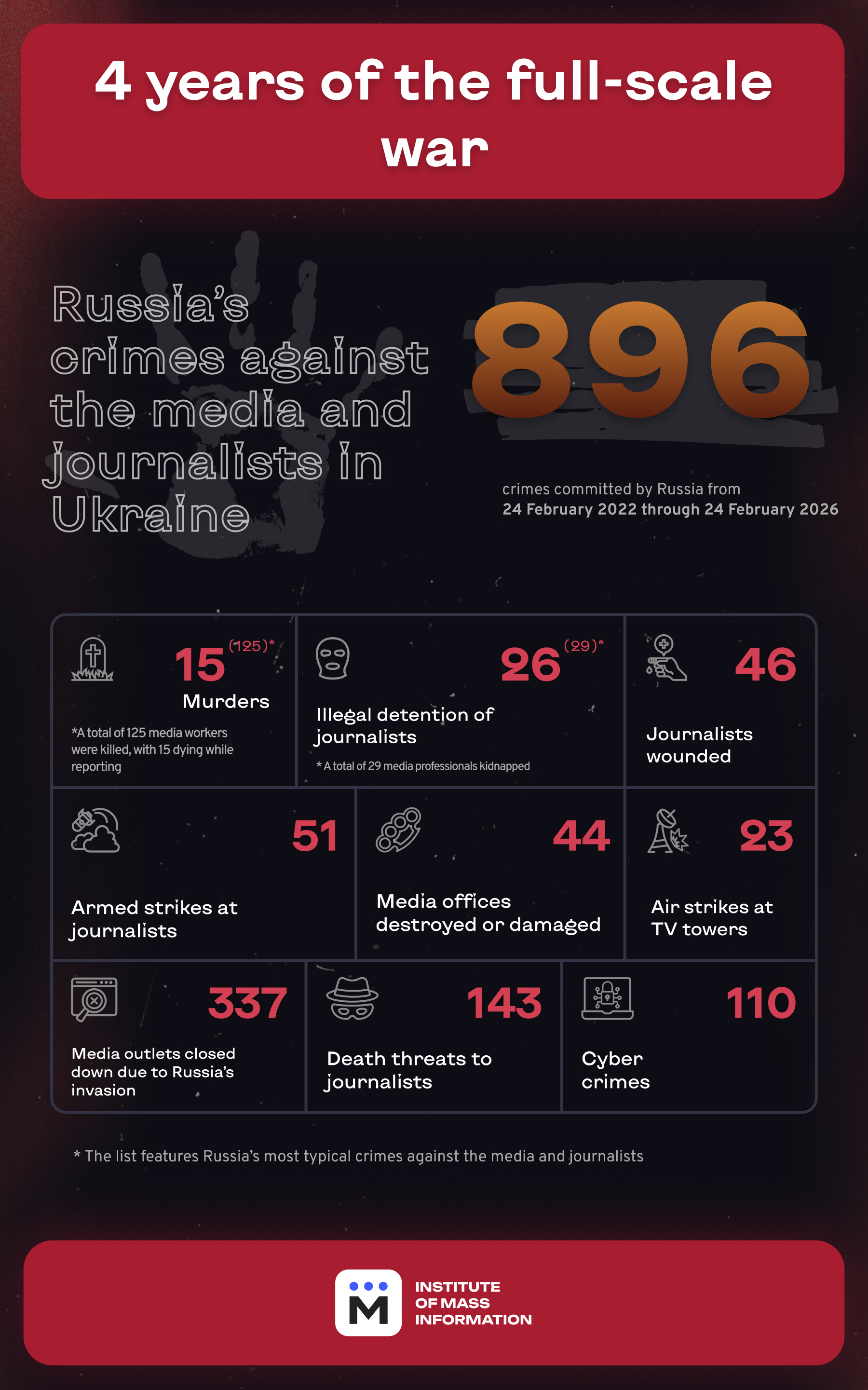
Russia committed 896 crimes against journalists and the media in Ukraine in the four years since the start of the full-scale war. The full-scale war continues to present the biggest challenge for the survival of Ukrainian media and the safety of journalists, as evidenced by the Monitoring Study of Russia’s Crimes Against Journalists and the Media, which the Institute of Mass Information has been carrying out since the first day of Russia’s invasion of Ukraine.
Here are the most serious crimes against journalists and the media committed on Ukraine’s territory:
- journalists murdered — 15 (125)*;
- journalists kidnapped — 26 (29)*;
- armed strikes at (51) and wounding journalists (46);
- persecution, death threats, intimidation of journalists — 143;
- media offices damaged in Russian air strikes — 44;
- strikes at TV towers — 23;
- disabling Ukrainian broadcasting and using Ukrainian media outlets’ capacities to broadcast Russian propaganda — 35;
- cyber-crimes — 110;
- media outlets closing down due to the financial and staffing crisis triggered by the full-scale Russian aggression — 337;
- legal pressure — 34.
Physical aggression
Russia killed 125 media professionals in Ukraine in the four years since the start of the full-scale invasion. Of those, 15 died while reporting, 96 were killed in action, and 14 died as Russian air strike casualties or were tortured to death by Russian forces.
IMI recorded the deaths of three media workers while reporting in the fourth year of the full-scale invasion. All three died in Russian drone strikes, which have become the dominant danger factor in 2025–2026:
- Antoni Lallican, French photojournalist, died in a Russian drone strike near Druzhkivka, Donetsk oblast, on 3 October 2025. He has been documenting Russia’s invasion of Ukraine since 2022.
- Alyona Hramova (Hubanova), war reporter with the Ukrainian international channel Freedom TV. Died in a Russian Lancet drone strike in Kramatorsk (Donetsk oblast) on October 23, 2025.
- Yevhen Karmazin, cameraman with the Ukrainian international channel Freedom TV. Died in a Russian Lancet drone strike in Kramatorsk (Donetsk oblast) on October 23, 2025.
The risk has spread beyond the battlefield and to the cities in the frontline-adjacent regions that are relatively far away from the combat zone. In 2024–2025, Russian troops adopted a tactic of relentless drone terror, which has significantly limited journalists’ reporting capabilities and created a demand for extra safety equipment. A total of 132 Ukrainian and international media workers have been killed since the beginning of the Russo–Ukrainian war in 2014, with 18 dying while reporting.
At least 46 cases of journalists being wounded and at least 51 cases of armed strikes at journalists were recorded in the four years of the full-scale invasion. Reporters with Ukrainian and international media outlets alike have come under Russian fire. IMI’s monitoring study suggests that Russian troops have been deliberately targeting journalists in drone strikes (e.g. with Lancet, FPV, or fiber optic drones). In some cases, journalists were clearly identifiable as mass media representatives, wearing bulletproof vests with “PRESS” badges and working in the open, their filming equipment visible. Journalists have been severely wounded in Russian strikes: the leg of Ukrainian journalist and photographer Heorhiy Ivanchenko had to be amputated and the left eye of Freedom TV journalist Oleksandr Kolychev had to be enucleated as a result of their injuries.
Illegal detention of journalists
While no new arrests of journalists in Ukraine’s temporarily occupied territories were recorded, nearly all journalists detained by Russian for political reasons remain behind bars to this day. At least 26 Ukrainian civilians working in the media are illegally imprisoned by Russia. Only three journalists came back to Ukraine in 2025: Dmytro Khyliuk, Mark Kaliush (both released as part of a prisoner swap), and Vladyslav Yesypenko (completed his illegal prison term). All three shared stories of torture and human rights violations they had faced while in Russian prison.
Damage to media offices
The spike in the number of media offices damaged in Russian air strikes was the most noticeable during the fourth year of the full-scale war: no fewer than 16 offices located in cities close to the frontline as well as far away from it were affected. For instance, the Russian army destroyed the Suspilne branch in Dnipro: during the 17 November 2025 strike the Suspilne Dnipro premises were targeted by 21 Shahed-type drones, with 13 hitting the office building itself.
The offices of three more news outlets were affected by the Russian air strikes on Ukraine’s energy infrastructure: pipes in many buildings burst due to the sudden change in temperature when heating was switched on after being disabled for a long period. This led to flooding. Technology and working equipment was damaged; the offices have temporarily become unusable.
Media outlets closing down
At least 337 media outlets closed down or suspended operations over the four years of the full-scale invasion. Temporary occupation and financial struggle caused by the war are cited as reasons most often. Russia’s war has led to media outlets shutting down in nearly all regions across Ukraine.
Intimidation, bomb threats, cyber-crimes
IMI recorded several waves of false bomb threats mailed to Ukrainian media outlets and journalists. The latest wave was recorded in late January 2026; most messages contained claims of bombs planted in buildings or threats to detonate the media outlets’ offices. These cases suggest a mass intimidation campaign aiming to disrupt the work of the media.
Furthermore, in the four years of the full-scale war, IMI experts recorded 110 cyber-attacks on Ukrainian media outlets by Russian actors. Namely, Russian forces targeted national and regional news websites and hijacked Ukrainian TV broadcasts to display propaganda.
As a reminder, Russia committed 823 crimes against journalists and the media in Ukraine in three years since the start of the full-scale invasion, 567 in two years, and 497 in the first year.
The Institute of Mass Information (IMI) is a civil society organization specializing in the media, operating since 1996. IMI defends the rights of journalists, studies the media landscape and reports on media-related events, fights propaganda and disinformation, and provides media workers with safety equipment for trips to combat areas (since the start of the Russo–Ukrainian war in 2014).
IMI carries out the only monitoring study of freedom of speech in Ukraine, keeps a list of transparent and responsible online media outlets, and tracks Russia’s media crimes in the war on Ukraine. IMI has representatives in 20 oblasts of Ukraine and runs a network of Media Hubs that provide journalists with unfailing support. IMI’s partners include Reporters Without Borders (RSF); the organization is also a member of the International Freedom of Expression Exchange (IFEX).