

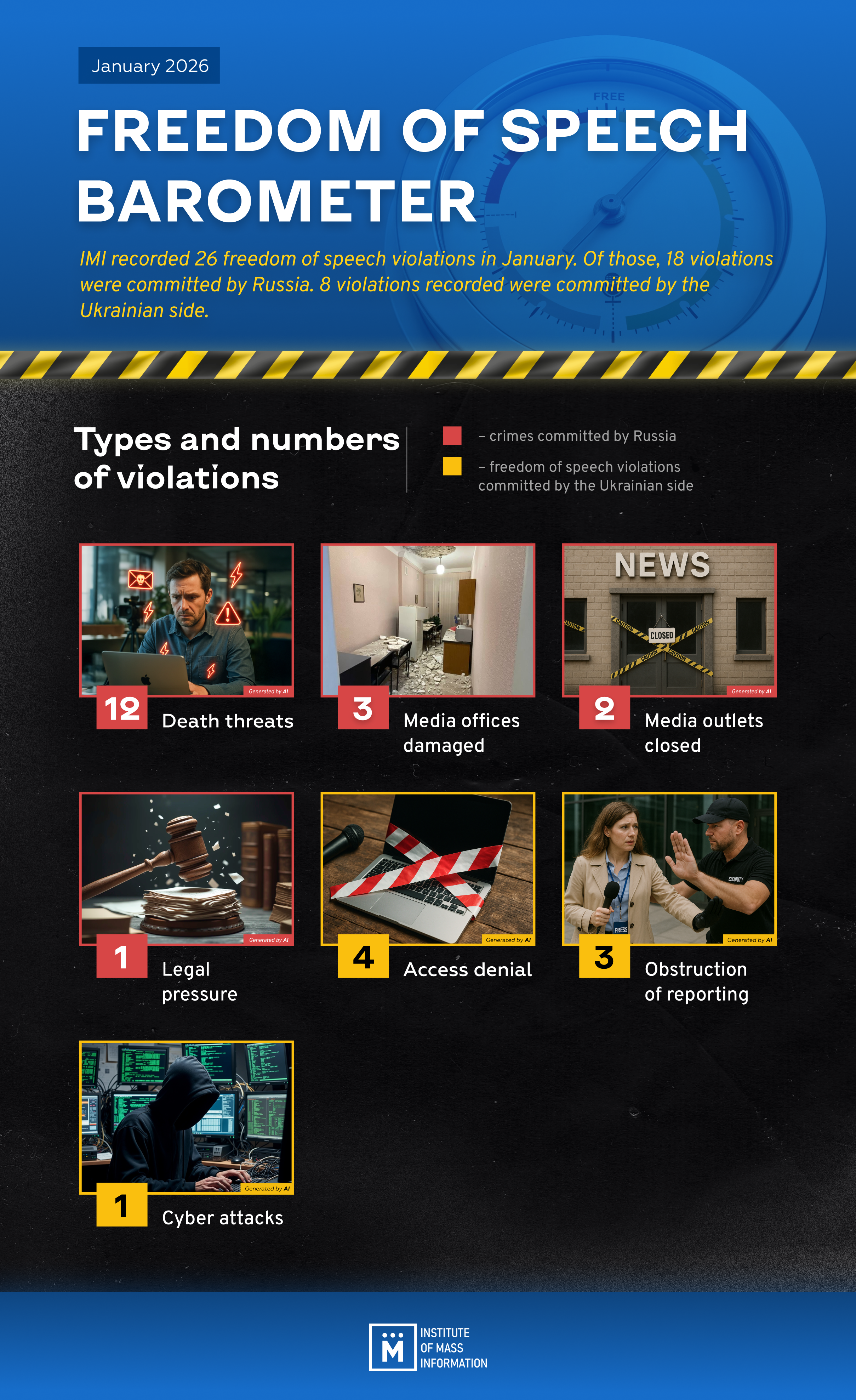
The Institute of Mass Information experts recorded 26 freedom of speech violations in Ukraine in January 2025. 18 were committed by Russia, according to the IMI’s monthly monitoring study Freedom of Speech Barometer.
Russia’s crimes against media and journalists in Ukraine included death threats and intimidation of journalists, damage to media offices, media outelts closing down, and legal pressure.
The death of three media workers turned UAF servicemembers was reported in January:
- Lana Chornohorska, journalist and UAF servicewoman (UAV pilot and navigator). Killed by a Russian drone in Ukraine’s South on 1 January 2026. She was a reporter with the Kharkiv-based news outlet Lyuk, activist, and artist before enlisting.
- Volodymyr Siniychuk, serviceman, photocorrespondent with the local newspaper Ridnyi Kray (Velyka Bahachka village, Poltava oblast). Killed in action in Donetsk oblast on 4 January 2026. He was drafted into the army on 20 December 2022, following the full-scale invasion.
- Yuriy Mihashko, serviceman, production designer at Novyi Kanal. Killed in action in Sumy oblast. Enlisted in the Defense Forces in March 2022.
Damaged media offices
Offices of three media organisations in Kyiv were damaged as a result of Russian strikes on Ukraine’s energy infrastructure:
- Realna Hazeta, relocated from Luhansk oblast;
- Institute of Mass Information;
- Television Toronto.
When heating was switched on after a long time of being disabled, the sudden temperature change burst the pipes, leading to flooding in the buildings. Technology and equipment was damaged; the offices are temporarily unusable.
Death threats to journalists (false bomb threats sent en masse)
Several Ukrainian news outlets received emails on 30 January claiming that bombs had been planted in their offices as well as buildings of some state bodies. The senders called themselves “soldiers” or “ex-sappers”, claiming to have installed hundreds of explosive devices and threatening to set them off over the course of several days. The letters were similar, each listing random addresses in Ukraine and abroad and baring the hallmarks of an attack campaign. IMI representatives Kateryna Sereda, Iryna Nebesna, and Valentyna Troyan received such messages, as well as the following news outlets: Vilne Radio (Anastasia Shybiko, Olena Rusinova), Farvater.Skhid (Anna Nikolayenko), MediaDokaz, Detector Media, 18000, Pershyi Kryvorizkyi, Kremenchutskyi Telegraf, Poltavska Khvylia and Poltavska Dumka.
Media outlets closing down
Print media outlets across Ukraine continue to close down due to the financial crisis and the impact of the full-scale war:
- Nashe Prydnistrovya, one of the oldest print newspapers in Vinnytsia oblast that had been in print for 95 years;
- he newspaper Nash Kray, based in Rozhyshche (Volyn oblast).
The reasons include the print run drop, growing delivery costs, loss of ad revenues, staffing shortages, and blackout-induced work complications. The news outlets say they may resume operations in the future.
Legal pressure
Russia has put Odesa-based investigative journalist and environmentalist Vladyslav Balinskyi on the international wanted list for his work tracking Russia’s war crimes and the environmental impact of its aggression. Balinskyi is charged with “spreading fake information about the Russian Armed Forces” and “damaging war memorials”; the case has been submitted to a court in Moscow.
IMI also recorded press freedom violations unrelated to Russia’s war on Ukraine. These included obstruction of reporting, denial of access to information, and cyber attacks.
Obstruction of reporting
- Journalists with the news outlets Nakypilo and Dumka were barred from entering a Nova Post terminal to film the aftermath of a Russian air strike. They were only granted access after the security company’s management intervened. The issue was the security letting journalists in selectively despite the situation being the same.
- Journalist Oksana Pidnebesna was was removed from an Odesa courtroom during an open hearing in the case of a pro-Russian group. The defense falsely claimed that the journalist was a witness in the case. She appealed against the decision and contacted the police, viewing this as obstruction of reporting.
- Dnipro City Council deputy Artem Khmelnykov kicked down the camera of freelance reporter Oleksandr Slavnyi, who wanted to get a comment from the official. An investigation has been opened under Article 171 Part 1 of the Criminal Code. The journalist filed a statement with the police, who entered the data into the URPI and are looking into the incident.
Access to public information
- The Odesa Oblast Military Administration refused to disclose the sums spent on the top officials’ and staff’s business trips to journalists, claiming the information was not public and could not be shared under martial law.
- Only reporters with local TV channels were invited to the introduction of the new Chernivtsi Oblast Military Administration chair.
- Poltava journalists have been unable to get a response from the city’s acting mayor Kateryna Yamshchykova and the Cirty Council’s first deputy chair Valeriy Parkhomenko regarding a proposed meeting with the latter. The journalists have questions regarding Parkhomenko’s work.
- 061.ua journalist Elmira Shahabudtdynova has been unable to get comments on war crime trials from the oblast prosecutor’s office since the release of her news story reporting on the financial declarations filed by a Zaporizhzhia oblast prosecutor. The prosecutor’s office said that disclosing the requested information would be “inappropriate” at the respective stages of the investigations, which affects coverage of the trials.
Cyber attacks
- The news website ZHAR.INFO was targeted in a three-day DDoS attack following several social media posts by the media outlet reporting on high-profile construction projects in Khmelnytskyi city. The attack aimed to access the website’s admin panel; the team believes the attack had to do with their reporting criticising the local authorities.
See the full list of freedom of speech violations below.
Russia’s crimes
Media offices damaged — 3
1. Television Toronto’s Kyiv office flooded: team rescues equipment, archive
20.01.2026 The Kyiv office of Television Toronto was flooded late on January 20, the news outlet reported in a comment to the Institute of Mass Information.
The flooding was caused by a water supply pipe that runs outside the building bursting. The security alarm went off at night, signaling the flooding. A security company staff arrived at the office urgently despite the curfew and the ongoing air strike; by that time the water had already spread to the office.
At about two in the morning, the team officially contacted the emergency services. However, it became clear by the morning that the flooding was intensifying and waiting for help to arrive any longer was not an option. Then the media outlet’s management decided to evacuate the equipment by themselves.
“The office was waterlogged for about three days. The utilities were not coping, we had to pump it out on our own twice,” the team said.
All of the equipment, documents, and staff’s personal belongings were rescued.
“We managed to evacuate and rescue everything that was in the office: all the equipment, all the papers and reporting documents for the organisation’s entire history, as well as the personal belongings of our team. Not a single piece of equipment, not a single document, not a single thing was lost despite the flood and the nightly missile strikes,” Television Toronto reported.
The office was damaged and is now unusable. The scale of damage has not yet been estimated: the landlord and the insurance company are assessing it and addressing the repairs.
The team plans to stay in the office after it is restored. They are working remotely for now and use another organisation’s premises to film.
2. Realna Hazeta’s Kyiv office damaged due to flooding, no heating
29.01.2026 The news website Realna Hazeta, formerly based in Luhansk and now relocated to Kyiv, is looking for a temporary new office because the apartment where the team used to work has been flooded and the building has no heating, Realna Hazeta chief editor Andriy Dykhtyarenko reported in a Facebook post.
Dykhtyarenko says that on the frostier days it was impossible to stay in the office for more than half an hour at a time. Still, the team continued to work there: recorded videos, explainers for the displaced, covering the situation in the occupied territories from their studio. “Absurd: I was in the studio filming a video about a utilities-related emergency in Alchevsk, all the while steam was coming out of my mouth, because at that moment I was in the middle of a utilities-related emergency in Kyiv,” said the chief editor ironically.
He explained that, just as in occupied Alchevsk, the water was not drained from the pipes in their building and the team was taking turns doing office duty for a whole month.
“We would heat up the batteries, get out in the middle of the night and drive there from our own cold and dark homes whenever somebody in the house chat would say that a neighbour’s batteries had burst and all our equipment could be floating around in icy water,” said Andriy Dykhtyarenko.
He said that the editorial team had spent some time working like this, hoping that the system would be fixed.
“And today we saw that we’ve waited long enough: now our office is flooded, too. And again we were lucky, there’s no damage yet in the room where our studio is. But now we will have to take out our equipment, because the weather is about to get frosty, the house still has no heating, so all these leaky pipes and batteries will freeze over and then they may burst again,” chief editor explained.
He stressed that the team would continue to work despite the issues with the utilities. There will be somewhat less video content in the near future and evolving as a news outlet will be more difficult in the state of chronic disaster.
“But we survived the occupation in 2014, in 2022, and we can not allow this freezing trial to kill us in 2026. As they say, we have gone through fire, water, and now the copper pipes (which burst from the frost). Greetings to the Russians who are trying to kill us. Not going to happen!” the chief editor added.
As for the work of the Kyiv utility services, he said that the problems of their building had been long ignored.
“And I feel very sorry for the people who live in this building permanently. And this nightmare continues. I would like to apologise to our partners and grantors, who have not been getting quick responses and reports from me these days. We are having it really hard now,” added Dykhtyarenko.
He also shared the bank details for those who want to support the news outlet with a donation.
30.01.2026 The Kyiv office of the Institute of Mass Information (IMI) flooded overnight on 30 January. The flooding damaged the rooms as well as the safety gear and power equipment that the civil society organisation offers to journalists. The office is now unfit for use and the equipment leases have been paused.
IMI director Oksana Romaniuk says that the accident occurred when the heating in the building, which had been out for a while due to Russian air strikes at Ukraine’s energy system, was switched back on. The pipes in the building could not withstand the sudden change in temperature and burst. This caused water to trickle down from the ceiling in the IMI office, pooling on the floor about one centimeter deep.
The flooding affcted the room where IMI stored the safety gear and power equipment issued to media professionals, such as bulletproof vests, helmets, first aid kits, and power stations. Office equipment and supplies were damaged by water as well.
“The flooding damaged the wiring; the office is now unfit for use and needs repairs at least on the electricity network. We are assessing the scale of the damage, the impact on the equipment, and the safety of the office,” said IMI director Oksana Romaniuk. “This incident showcases another tangible dimension of the war, which affects the infrastructure and the conditions the media have to work in.”
IMI continues to support Ukrainian journalism despite the circumstances. The media organisation will most likely be looking for a new office space in the near future, but for now it calls on everyone who can to support them by donating.
The Institute of Mass Information office also houses the Press Freedom Center run by Reporters Without Borders (RSF). The room used by the RSF team was also damaged by the flooding.
“The energy situation in Kyiv has reached catastrophic levels. The media are having to cope with repeated power outages, water leaks caused by the damage to the infrastructure, and extreme polar cold,” said RSF’s Regional Officer for Ukraine Pauline Maufrais. “The RSF Press Freedom Center, which operates with the support of RSF’s Ukrainian partner, the Institute of Mass Information (IMI), has also been affected. The damage has caused water leaks and the office is temporarily unusable. RSF supports IMI, which continues to operate despite the difficult situation, and credits the resilience of Ukrainian journalists who, despite the particularly difficult context, are resolutely carrying out their mission of informing society.”
Death threats — 12
1. IMI representative in Mykolaiv oblast receives bomb threats via email
30.01.2026 Kateryna Sereda, the Institute of Mass Information’s regional representative in Mykolaiv oblast, received bomb threats via email on 30 January.
She said she had received an email in the morning claiming that an explosive device had been planted in a building. The letter included a photo, allegedly of the device, but mentioned no address in Mykolaiv oblast.
National Police departments in 22 oblasts received over 2,000 bomb reports on 30 January. Addressees of the threats included Ukrainian media outlets.
2. IMI representative in Ternopil oblast receives bomb threats via email
30.01.2026 Iryna Nebesna, the Institute of Mass Information’s regional representative in Ternopil oblast, received several emails with bomb threats on 30 January.
She said that two letters of nearly identical content were sent to her personal email address: they featured claims about a planted explosive device and a list of addresses. Neither of the letters mentioned buildings in the oblast. Most of the listed addresses were in Kyiv.
The letters claimed to have planted bombs in two Ukrainian embassies abroad and news outlets in a neighboring oblasts, but the listed addresses were incorrect.
3. IMI representative in Luhansk oblast receives bomb threats via email
30.01.2026 Valentyna Troyan, the Institute of Mass Information representative in Luhansk oblast, received two emails with bomb threats on 30 January, she reported to IMI.
According to Troyan, the emails claimed that bombs had been installed in several buildings. An image of what appeared to be an explosive device was attached to one of the letters.
“This wave of threats was different is that the senders added buildings supposedly used by regional media to the listed objects,” she said.
Valentyna Troyan reported the letters to the Security Service of Ukraine.
National Police departments in 22 oblasts received over 2,000 bomb reports on 30 January. Addressees of the threats included Ukrainian media outlets.
4. Vilne Radio CEO receives bomb threats via email
30.01.2026 Anastasia Shybiko, CEO of Vilne Radio (formerly based in Bakhmut, Donetsk oblast), received emails claiming that bombs had been planted in the news outlet’s office and staff’s homes, she reported to Valentyna Troyan, the Institute of Mass Information representative in Luhansk oblast.
Anastasia Shybiko said that the most recent “bomb” letter her team received had arrived on 1 February. All of them arrived between 30 January 30 and 1 February.
“We found these letters on our main corporate inbox and in our personal inboxes. This time, journalist Olena Rusinova and me received the letters to our personal emails,” Vilne Radio CEO said.
Anastasia added that her team did not take such letters seriously.
“First of all, all our work is done in remote. Since our relocation from Bakhmut we don’t have the office which has been the subject of so many ‘bomb threats’. Second, these emails all follow the same set of clichés, they are all the same in content and structure. Third, this is a mass mailing campaign, and the other recipients’ addresses are not even hidden,” she said, adding that these were the reasons why her team had not contacted the police regarding this issue and saw no point in doing so.
“This is a run-of-the-mill, amateurish, and very cheap ‘campaign’ that aims to intimidate us or has some other purpose. But so far it has just been funny,” the journalist said.
5. Farvater.Skhid journalist receives bomb threats via email
30.01.2026 Anna Nikolayenko, a journalist with the news website Farvater.Skhid, received several emails with bomb threats in her corporate and personal inboxes on 30 January, she reported to Valentyna Troyan, the Institute of Mass Information representative in Luhansk oblast.
Nikolayenko added that she used to receive similar emails with threats while living in Luhansk oblast.
“But that was a long time ago. So I wasn’t surprised. But this was the first time since the full-scale invasion, as far as I remember. Identical letters arrived in both my personal and corporate inboxes on 30 January. However, I only noticed my letter on 4 February when looking through the spam folder,” Anna said.
She added that “such letters only make her smile and provoke no other emotion,” since it is unclear who they were intended for.
“Media professionals are people who know how to work with information, know what information hygiene is, and know how to tell fakes apart from truth. On the other hand, this can also be part of the information war. Such cases shouldn’t be ignored in silence,” the journalist said.
She added that this could have been a bad joke by a Ukrainian or a real Russian attempt to destabilise the already strained society in Ukraine. “After all, the email referred to institutions and organisations where bombs had supposedly been installed in the same fashion, and the idea was likely was that we as journalists would take certain action and report this to the police, which, in turn, would trigger a wave of rumour, panic, and other such things,” Anna Nikolayenko said.
She added that she has been in contact with the competent law enforcement bodies on this issue. The team is still coordinating regarding this matter and deciding on further action.
6. Kremenchuk-based news outlet receives bomb threats
30.01.2026 The news outlet MediaDokaz (based in Kremenchuk, Poltava oblast) received two emails threatening to detonate bombs on several locations on 30 January, chief editor Alyona Malichenko reported to Nadia Kucher, the Institute of Mass Information representative in Poltava oblast.
Malichenko said that the emails ended up in the spam folder, so the team was late to notice them.
The sender introduced themselves as a Ukrainian Armed Forces veteran and explosives specialist, claiming that about 500 explosive devices had been planted in administrative buildings, educational facilities, and crowded locations. The emails also contained threats to detonate the explosives on 30–31 January.
“And you will have 15 minutes to leave your building, otherwise you will die and there will be casualties among the civilian population,” the sender wrote in the email, says Alyona Malichenko.
The news outlet reported that the list of locations where “timed bombs were allegedly planted” included the following facilities: Koza Dereza (Lviv); Kyiv City Administration; MoD Intelligence Department; Ministry of Defense of Ukraine, SBU’s Kyiv HQ; Embassy of Ukraine in Montenegro (Podgorica); Tavria National University’s Kyiv College of Urban Economy; Firtka Publishing House (Ivano-Frankivsk); US Embassy in Ukraine.
7. Detector Media receives bomb threats
30.01.2026 Detector Media reports having received emails with bomb threats today, 30 January.
The news outlet writes that they received a total of six similar letters about bombs allegedly planted at different addresses.
One sender introduced themselves as a bomb-maker who “was wounded while serving in the Azov [Brigade]” and claimed to have planted “about 500 explosive devices” in administrative buildings, schools, daycares, and public spaces since 10 January, working together with “like-minded people.” The sender threatened to activate the timer on the devices at different times over the course of two days.
The letter, as usual, lists the addresses of various institutions and new outlets where bombs have supposedly been planted. These included the Ministry of Defense and the State Security Service, the Security Service of Ukraine, the US Embassy in Ukraine, the news website Gordon, and others.
8. Cherkasy-based news outlet 18000 receives bomb threats
30.01.2026 Cherkasy-based news website 18000 received two emails threatening to bomb their office, as well as several private and state institutions, early on 30 January, reports the Institute of Mass Information representative in Cherkasy oblast, Yelena Shchepak.
The news outlet says the they received the first letter at 9:46 am. The sender claimed to be a Kraken Regiment veteran, “a former miner and a disabled person.” The letter alleges that 500 explosive devices have been planted at various spots.
“I will detonate a bomb at your address today after lunch,” the sender wrote, adding that explosive devices had been planted in embassies, the Kyiv City Administration, the Ministry of Defense, and other buildings.
The next email arrived at 10:21 am. This time, the sender introduced themselves as a “disabled bomber.” This letter claimed that an explosive device had been planted at the news outlet’s office as well, adding that it had been placed “in a special container” so that police dogs would be unable to detect it. This time, the bomb was supposedly planted at the office of the Ternopil-based media outlet 20 Khvylyn.
However, 20 Khvylyn editor Natalia Burlaku told IMI that they had received no letters threatening to detonate any bombs and that the listed address was not theirs.
9. Pershyi Kryvorizkyi receives bomb threats via email
30.01.2026 The team of the news website Pershyi Kryvorizkyi received an email with bomb threats on 30 January. Their address was on the list of buildings where bombs had allegedly been planted, but the letter referred to “your educational establishment.” Because of this phrase, the team did not contact the police, the news outlet reports.
The sender, who claimed to be a former Ukrainian Armed Forces sapper, said they had planted bombs in administrative buildings, educational institutions, and crowded spots. The bombs had supposedly been installed at various institutions in Kyiv and Lviv as well.
The sender used highly emotional and manipulative vocabulary, introduced themselves as a former serviceman, and made accusations against the state authorities. The email contained threats and calls for immediate evacuation and claimed that the explosive devices were undetectable.
The news outlet’s editor Olena Smolina told Kateryna Lysiuk, the Institute of Mass Information representative, that the email featured a list of buildings that were supposedly located near their office, although in fact they were in other cities such as in Lviv, Kyiv, and even Rome.
Smolina said that the team had not called the police this time because they had received similar threats before, and that the police inspections found no explosive objects in those cases.
“Since this is not the first time we have received such threats, we would always call the police. The police would come and check, but everything was fine, no explosives were found. This time the letter said ‘a bomb has been planted at your educational establishment,’ that is, not a news outlet, but an educational institution. So this is some kind of automated email campaign. Which is why this time we did not even report it to the police so as not to distract them from urgent matters,” said Olena Smolina.
10. Kremenchutskyi Telegraf receives bomb threats via email
30.01.2026 Kremenchutskyi Telegraf, a news website based in Poltava oblast, received three emails claiming that bombs had been planted in their office building on 30 January, chief editor Lesya Lazorenko reported to Nadia Kucher, the Institute of Mass Information representative in Poltava oblast.
She said that her team had received an email whose sender claimed to be a former fighter of the UAF unit Kraken and said that a bomb had been planted in the team’s office building specifically. A photo of the supposed explosive device was attached to the letter.
The email also threatened mass bombings and contained a list of other facilities where the sender claimed to have planted explosives. These included administrative buildings, educational establishments, crowded locations, and state bodies in Ukraine and abroad.
“Starting 01/10/2026, my allies and I planted about 500 explosive devices in administrative buildings, schools, daycares, and places where people gather en masse; the timers on the bombs is set to activate at different times on 01/30/2026 to 01/31/2026, you will have 15 minutes left to leave the building, otherwise you will die and there will be casualties among the civilian population,” reads the letter sent to Kremenchutskyi Telegraf.
Lesya Lazorenko said that her team has been receiving bomb threats repeatedly, adding that most previous emails did not refer to their news outlet specifically but used general terms such as “in your building.”
11. Poltavska Khvylia receives bomb threats via email
30.01.2026 Poltavska Khvylia, a news website based in Poltava oblast, received three emails claiming that bombs had been planted in their office building on 30 January, founder and CEO Vitaliy Ulybin reported to Nadia Kucher, the Institute of Mass Information representative in Poltava oblast.
He said his team had received several similar emails with identical content. The letters claimed that a bomb had been planted at the building housing their editorial office and listed some other addresses unrelated to the news outlet.
“We received 5 emails, I think, from different addresses. They all said that our building had been mined. But then they listed completely random addresses,” he said.
12. Poltavska Dumka receives bomb threats via email
30.01.2026 Poltavska Dumka, a news website based in Poltava oblast, received three emails claiming that bombs had been planted in their office building on 30 January, chief editor Diana Strashko reported to Nadia Kucher, the Institute of Mass Information representative in Poltava oblast.
She said that her team had received three emails with threats. The sender did not refer to the news outlet by name, but said that receiving the letter meant there was a bomb planted in your building. The emails also listed several other facilities where the sender claimed to have installed explosive devices.
“The letter said that the sender had served as a miner in the Azov [Brigade], was severely wounded in action, and now the pension he receives from the state is not enough even to buy basic groceries for his family,” said Diana Strashko. She added that the letter listed addresses where explosives had been supposedly planted and did not mention Poltavska Dumka specifically.
“The letter only said that if we received the message it meant there was a bomb in our building and if we do not want to die we should leave immediately, that bombs had also been planted at some other addresses, in special containers that could not be detected by police dogs, that searching for the bombs was pointless, that the sender was a bomb-sweeper with 10 years of experience and knew their job very well,” said Diana Strashko.
Media outlets closing down — 2
1. Vinnytsia-based newspaper closes down after 95 years in print
07.01.2026 Nashe Prydnistrovya, one of the oldest print newspapers in Vinnytsia oblast (based in Murovany Kurylivtsi), is closing down, reports Mohyliv-Podilskyi.online.
The last issue (No. 48) was published on 10 December 2025. The team had to take this step due to economic difficulties and the war.
The newspaper was founded in April 1931. Operations were suspended during World War II and resumed in 1944 under the name Nasha Peremoha. Svitlana Kubliak was the newspaper’s chief editor for the last 22 years. “We are leaving, but we will come back…” she said about the closure.
“We delayed the sad moment of closing the newspaper long-term, hoping that something would change for the better. But things did not go as we wanted. The constantly rising prices for printing, energy, delieveries, post offices closing down and the post service downsizing, subscriptions dropping accelerated and greatly complicated the critical situation. And the war also made its terrible adjustments,” says Svitlana Kubliak.
The newspaper was printed on eight pages in color until February 2022. With the start of Russia’s full-scale war, they switched to four pages of black-and-white printing, but the team did not miss a single issue.
“Due to a lack of funds, we spent the first year of the war working on enthusiasm alone, without salaries. For the last three years, we received 0.25 percent of the minimum wage,” said Svitlana Kubliak.
Vinnytsia borders the unrecognised pro-Russian enclave “PMR” (“Transnistrian Moldavian Republic”), with Russians distributing propaganda newspapers free of charge, founding TV and radio broadcasters, and using mobile screens. Nashe Prydnistrovya being gon may leave part of the population, especially the elderly in Vinnytsia’s remote villages, in an information vacuum, notes the Institute of Mass Information’s regional representative.
2. Volyn newspaper Nash Kray goes out of print
20.01.2026 The newspaper Nash Kray, based in Rozhyshche (Volyn oblast), is going out of print in January 2026, editor Rayisa Matsiuk reported to the Institute of Mass Information’s regional representative Maya Holub.
Matsiuk said the editorial board was deciding whether to resume the newspaper’s operations or shut down permanently.
The suspension of operations was primarily caused by the significant drop in circulation and delivery costs rising. Namely, the circulation through Ukrposhta dropped from 2,500 to 600 copies, and the cost of delivery will be more than half the newspaper’s price starting 1 January.
The editor added that Ukrposhta has stopped the address delivery of print media, and most of their subscribers were elderly people. A further increase in the price, she said, could lead to an even greater drop in circulation.
The newspaper has also lost its ad revenue. “We didn’t just life off subscriptions, there was also advertising. The news outlet has had no advertisers since 2022, we have stopped earning money. Since the start of the full-scale war, there has been no greetings, eulogies, or advertising in general,” the editor said.
The media outlet also faced staffing difficulties. Only Rayisa Matsiuk remains on the staff, working as both the chief editor and accountant. “We worked for the minimum wage. We have not yet been able to find someone who would agree to work for the minimum wage,” she said.
Blackouts have become another problem. The team has no generator and has had to work in a cold office.
Nash Kray has been in print since 7 January 1945. The last issue was printed on 25 December 2025.
The National Council for Television and Radio Broadcasting registered the private business Nash Kray as a subject in the field of print media in 2024, with Rayisa Matsiuk as the beneficiary. The newspaper is a weekly reporting on society and politics; in particular, it covered the work of local authorities on the basis of agreements made.
According to Youcontrol, the news outlet’s total income amounted to 409,400 UAH in 2024 and the income from tenders was 233,951 UAH in 2025. The newspaper continues its reporting on social media: on Instagram and two Facebook pages, where Raisa Matsiuk uploads posts.
Legal pressure — 1
1. РФ оголосила в міжнародний розшук одеського журналіста Владислава Балінського
29.01.2026 Russia has put Odesa-based investigative journalist and environmentalist Vladyslav Balinskyi on the international wanted list, as per the statement by the National Ecology Center of Ukraine (NECU), released on 29 January 2026.
The NECU says that the persecution campaign targeting Balinskyi began in 2014, following his involvement in the think tank 2 May Group, which was independently investigating of the events in Odesa of 2 May 2014 debunking Russian propaganda. The persecution sharply intensified in 2022 as Balinskyi began tracking Russia’s war crimes and acts of ecocide.
The organisation says that Russian authorities and propaganda outlets have been spreading disinformation about Balinskyi for a long time, claiming his reporting and academic work was “espionage,” “sabotage,” or “academic hitmanship”.
Russia opened an investigation into him in absentia in 2025. In October 2025, the Moscow Prosecutor’s Office submitted the case for trial in absentia. Balinskyi is charged with two articles of the Russian Criminal Code:
- Article 207.3 (“spreading fake information about the Russian Armed Forces”) for his posts about the war crimes in Bucha and Irpin, air strikes along the Odesa coast, and missile and drone strikes at civilian infrastructure. The posts were made on Facebook and on the news website Zelenyi Lyst.
- Article 243.4 (“damaging war memorials”), referring to the removal of Soviet symbols from the Wings of Victory memorial in Odesa in September 2024.
The Basmanny District Court of Moscow tried Vladyslav Balinskyi’s case on 29 January 2026; Russia later put him on the international wanted list.
The NECU pointed out the overt public threats to physically eliminate Balinskyi by Russian Telegram channels, which openly call him the “next target.”
The National Ecology Center of Ukraine emphasised that Balinskyi was a key witness in war crime and ecocide cases, in particular the destruction of the Kakhovka HPP, the mass death of marine flora and fauna and the pollution of the Black Sea as a result of Russia’s actions. His academic articles and reporting were used to achieve international justice.
“His involvement in these cases makes him a crucial witness for future trials at the International Criminal Court,” the organisation noted, adding that Balinskyi’s prosecution is part of Russia’s systemic policy of eliminating witnesses to war crimes and ecocide.
The organisation called on the SBU and the Prosecutor General’s Office of Ukraine to take urgent action to ensure Balinskyi’s safety, and on international human rights organisations, the UN, the International Criminal Court, and EU bodies to document the case and provide legal support, security, and advocacy.
In a comment to the Institute of Mass Information representative in Odesa oblast, Vladyslav Balinskyi said that such a reaction from Russia is not unexpected. He explained that working as an expert in the fields of environmentalism and fighting propaganda traditionally trigger a sharply negative response from Russia, confirming that the war is being waged not just on the battlefield, but is clearly hybrid.
Balinskyi said that the environment issue particularly worries Russia as it enjoys high attention and trust in the world: international media report on the environmental impact of the war, academic institutions work with it, and a discussion about liability and possible reparations for ecocide is taking shape. This is why Russia has been consistently attacking actors in this field.
Balinskyi stressed that it was not just the propaganda resources targeting him, but also the Russian state bodies, “which mimick the judicial process while violating the basic principles of extraterritoriality and the rule of law.” The purpose of this action is to discredit him as a specialist and to shape the image of him as a “legitimate target.”
He added that Russian narratives are trying to present him as a “spy” who is hiding behind environmentalism to use satellite data, drones, and work in the Black Sea region. According to him, Russia especially focuses on Odesa and the Russian-speaking audience there, since the popular opinion in the South of Ukraine remains important for Russia. Russia has been purposefully constructing propaganda narratives for this audience, expecting them to help achieve their political goals.
Vladyslav Balinskyi is an Odesa-based journalist, chief editor of the news outlet Zelenyi Lyst, and hydrobiologist of the National Nature Park Tuzlivski Lymany and a manager of the international research project SUNDANSE (Horizon Europe) as part of the National Ecology Center of Ukraine.
Crimea — 1
1. Russian authorities in Crimea fine journalist Lenora Dyulber
12.01.2026 The Russian-installed authorities in Crimea have fined Lenora Dyulber, the host of the Crimean Tatar talk show Merkez, 33,000 rubles (almost 17,000 UAH). She was taken to Simferopol for an interrogation earlier, on 4 December 2025, after a search of her home. She was fined for “discrediting the Russian army” and “creating extremist material,” the human rights initiative “Tribunal. Crimean Episode” reported in a Telegram post on 12 January.
The initiative believes that the search in Dyulber’s home and her coerced trip to Simfropol in December 2025 were triggered by the available content on administrative offenses.
The human rights advocates pointed out the rulings by the Kyiv District Court of Simferopol concerning Lenora Dyulber and dated the day she was detained. According to the one of these rulings, her book “Crimean Tatars Amid the Political Environment Transformation” was discovered in the Franko Academic Library of Crimea; some experts found that the book contained “signs of justifying” the activities of the political and religious association Hizb ut-Tahrir and the Mejlis of the Crimean Tatar People, which are outlawed in the Russian Federation.
“Tribunal. Crimean Episode” notes that since the book is an academic work, the Russian authorities’ actions regarding Lenora Dyulber may be part of a persecution campaign targeting a group based on their ideology.
“This, in turn, constitutes a crime against humanity under the jurisdiction of the International Criminal Court and the Special Tribunal for the Crime of Aggression against Ukraine. Judge Valentina Kamynina adds two international crimes to her case, following the earlier 4 counts of ‘high treason’ under the national law,” the public initiative said.
Dyulber herself has said nothing about the prosecution.
Russian security forces in occupied Crimea searched the home of journalist and political scientist Lenora Dyulber and confiscated her computer on 4 December 2025. She was taken to Simferopol and released after a questioning.
The Verkhovna Rada Committee on Freedom of Speech has condemned the targeting of the Crimean Tatar journalist Lenora Dyulber by the Russian authorities in Crimea.
Lenora Dyulber is a political scientist, sociologist, journalist, and Crimean Tatar activist. She hosts the popular talk show Merkez and co-authored a sociological study “Crimean Tatars amid the Political Environment Transformation”.
The press freedom situation in Ukraine unrelated to Russia’s war
Physical aggression
Obstruction of legal reporting — 3
1. Reporters with 2 news outlets barred from filming aftermath of Russan strike near Kharkiv
13.01.2026 The security guards at a Nova Post terminal near Kharkiv, which was targeted in a Russian air strike on the night of 13 January, barred journalists with the news outlets Nakypilo and Dumka from entering the site to film the aftermath of the strike, reports Yulia Napolska, the Institute of Mass Information representative in Kharkiv oblast.
The shelling strike at the terminal killed four people and left six more with injuries.
Reporters arrived to the site in the morning to film the aftermath, but not everyone was granted access. Journalists with Suspilne Kharkiv entered the territory without any issues, while those with Dumka and Nakypilo had to remain outside of the facility.
Dumka‘s chief editor Yuriy Larin told the IMI representative that he and his colleague arrived at the Nova Post terminal’s main entrance in the morning and were denied access without explanation, the security citing the management’s position.
Since the property was private and a business has the right to restrict access to it, Larin says he began working from a permitted spot behind the line where the fence destroyed by an explosion used to be. He did not cross into the restrcted territory, provoked no conflict, and tuned in for a live report without issue.
Noticing a Suspilne Kharkiv filming crew on the terminal’s premises, Larin asked the security why journalists were being admitted selectively. They responded that that it was “internal press”, which was not true. The journalist openly said that he knew his colleagues and that granting access selectively would harm the company’s reputation.
All media representatives were only granted access after the security service management intervened. According to Larin, it was not the refusal itself that was the problem, but the unequal treatment of reporters in the same situation.
Nakypilo journalist Pavlo Pakhomenko told the IMI representative that he had been asked to leave the terminal premises and not to film anything.
The Nova Post press service explained to the IMI representative that the access restrictions were a response to an attempt to bypass the checkpoint while entering the facility’s premises.
The spokeswoman said that security could not allow unidentified people into the destroyed facility, as this would have been dangerous and a violation of their safety protocol.
“Following requests by the media outlets, we promptly coordinated with the security and first responders on site. Journalists are now allowed through the checkpoint after a document check. However, access to the inside of the building itself is prohibited for safety reasons. We apologise for the unfortunate situation that arose due to a misunderstanding. It is very important for us that the tragedy is properly covered in the media,” the Nova Post spokeswoman added.
2. Journalist Oksana Pidnebesna removed from Odesa courtroom during trial on pro-Russian group
15.01.2026 Syla Hromad journalist and chief editor Oksana Pidnebesna was removed from the Primorskyi District Court of Odesa on 15 January 2026 during an open hearing in the case of a pro-Russian group. The removal was requested by the defense, which claimed in their motion that the journalist was a witness in the case, Oksana Pidnebesna reported in a comment to the Institute of Mass Information regional representative in Odesa oblast.
The journalist says that as the hearing opened, the attorney of the suspect Oleh Maltsev filed a motion claiming that a person listed by the defense as a witness was in the courtroom and mentioning her by name. Podnebesna denied this, explaining that she had nothing to do with the proceedings and had learned about the case exclusively from official reports by the prosecutor’s office and the SBU, whch was why she was in court as a journalist.
“I tried to deny this motion, because I know nothing about this case at all. The judge was having none of it: he refused to listen to me and suggested that I leave the courtroom,” the journalist said.
Podnebesna declared in court that she considered such actions to be obstruction of reporting and announced her intention to contact the police. After leaving the courtroom, she did so by phone. The police took down her explanation and personal data and promised to register the statement in the Unified Register of Pre-Trial Investigations (URDR).
The journalist is convinced that her removal from the courtroom was a deliberate attempt to prevent independent media coverage of a high-profile trial.
“I believe that the pro-Russian group of nine people who were detained by the police last year, specifically as they tried to flee from Ukraine, is trying to fight independent media. They found a technicality to remove me from the courtroom at any cost,” she stressed.
In September 2024, the Odesa police detained the leaders of a group calling themselves “the Templars” on suspicion of creating illegal armed formations and attempting to seize power. The detainees included Oleh Maltsev and his ally Kostyantyn Slobodyaniuk. The court ruled to arrest them without bail.
In 2015, Oleh Maltsev publicly threatened journalists with Channel 7 and Tretiy Tsifrovyi TV who released an investigation mentioning him, announcing a “hunt” for them.
3. Dnipro official kicks down journalist’s camera: investigation opened
21.01.2026 Dnipro City Council deputy Artem Khmelnykov kicked down the camera of freelance reporter Oleksandr Slavnyi, who wanted to get a comment from the official. The Dnipro Oblast Prosecutor’s Office has opened an investigation into obstruction of legal reporting.
The incident occurred on 21 January before a plenary session in the City Council Hall, Oleksandr Slavnyi reported in a Facebook post and elaborated in a comment to Kateryna Lysiuk, the IMI representative in Dnipropetrovsk oblast.
“I wanted to ask deputy Artem Khmelnykov a question before the start of a Dnipro City Council session. Instead of answering, Artem Khmelnykov behaved aggressively, ripped the camera off the tripod and threw it on the floor,” the journalist wrote.
In the video posted by Slavnyi, the official first tells the journalist, “I’m not answering questions,” and then kicks the camera.
Oleksandr Slavnyi said in the comment to the IMI representative that Khmelnykov gave him no chance to ask his question. The reporter wanted to ask what action the deputy planned to take against officials suspected of embezzling over 14 million hryvnias.
Following the incident, the media professional called the police and filed a statement. He later learned that the data had been entered into the URPI.
The police have opened criminal law proceedings over obstruction of legal reporting (Article 171 Part 1 of the Criminal Code), report the Dnipropetrovsk Oblast Prosecutors.
Oleksandr Slavnyi told the IMI representative that Khmelnykov had later told him he was ready for litigation and blamed the journalist for attacking him.
Censorship, access to information
Access to information — 4
1. Odesa OMA withholds data on staff’s business trips from Nikcenter
12.01.2026 The Odesa Oblast Military Administration refused to disclose the sums spent on the top officials’ and staff’s business trips abroad taken during the martial law period to Nikcenter journalists, saying that preparing a response to their query would “require significant intellectual effort” and claiming that the requested data was not public information, Nikcenter reports.
The team was asking about officials’ trips abroad and the budget money spent for them in December 2025 for their upcoming news story.
On 12 January 2026, the Odesa OMA responded by refusing to provide any information, claiming that only “represented and documented” information that does not require “additional analytical work” could be provided upon request.
The administration added that fulfilling the request under martial law could have harmful consequences, because some of the Odesa Oblast Administration’s top officials are “servicepeople in the Security Service of Ukraine, and one of them was a serviceman in the Ukrainian Armed Forces in 2022–2023.”
The response did not explain what harm disclosing the data on officials’ business trips abroad could cause.
Volodymyr Zelenchuk, a lawyer at the Institute of Mass Information who reviewed the query and the response, believes that the Odesa Oblast Administration withheld public information from the journalists unlawfully.
“The information requested by journalists does not necessitate production of any new content, as it is reflected in the documents ordering the business trips, which are mandatory staffing paperwork. Even if journalists did not request the documents themselves (ideally), copying the requested information from the documents into the query response does not require ‘analysis, additional analytical work, additional justification’ or even ‘significant intellectual effort.’ The OMA’s arguments in denying that data on business trips is public information directly contradict established judicial practice,” the lawyer believes.
2. Only TV reporters invited to introduction of new Chernivtsi OMA chair
14.01.2026 Some media representatives were not invited to the introduction of the new Chernivtsi Oblast Military Administration char Ruslan Osypenko. Only reporters with local TV channels were present, while news websites and print media received no invites, reports Molodyi Bukovynets.
Olha Maksymiuk, chief editor at the media platform Shpalta, said in a comment to the Institute of Mass Information representatve Alyona Chorna that the OMA communications department had explained the selective approach by claiming that only TV channels capable of livestreaming and filming the speech were invited.
“However, the event was not broadcast live. They also claimed that the event’s main purpose was for the chair to meet community representatives and that a separate press conference was planned for the media. Shpalta hopes for high-quality communication with the new OMA chair and for continued ability to freely cover the work of the regional governing body,” says the journalist.
Molodyi Bukovynets editor Lyudmyla Osadchuk said that her news outlet had learned that an introductory event was expected and that only TV reporters would be present from their own sources. The journalist said that they had tried to discuss this with the OMA press service but got no response.
The Institute of Mass Information’s lawyer Volodymyr Zelenchuk says that, according to the Law of Ukraine “On Media”, all media entities, regardless of their type (audiovisual, print, online), have equal rights to receive information.
He stresses that unwarranted selective treatment violates this principle.
“Unfortunately, Ukrainian law has little to no mechanisms that would effectively protect this equality, especially when it comes to the underregulated methods of providing information (invitations to events, comments by officials, etc.). However, violation of the media equality principle should in any case entail consequences for the perpetrators, and state authorities should respond to these incidents,” the lawyer said.
Volodymyr Zelenchuk added that in this situation, journalists can submit a query to the OMA and ask which official was tasked with the decision-making related to inviting media to events. They can also address the OMA with a demand to explain the reasons why only TV reporters were invted.
A possible next step would be to file a complaint with the new OMA chair regarding the situation. Moreover, journalists have the right to file a group complaint with the President of Ukraine and the Cabinet of Ministers, i.e. the bodies appointing OMA chairs, with a request to establish a dialogue between the new administration chair and mass media representatives.
3. Poltava journalists say City Council has been ignoring them
20.01.2026 Poltava journalists have been trying for almost half a year to get a response from the city’s acting mayor Kateryna Yamshchykova and the Cirty Council’s first deputy chair Valeriy Parkhomenko regarding a proposed meeting with the latter, reports Nadia Kucher, the Institute of Mass Information representative in Poltava oblast.
Journalists have been working with the IMI hub Mediabaza Poltava since September 2025 to arrange a meeting with Valeriy Parkhomenko. They have questions regarding his use of working hours and City Council staff, the events for children he has held during air raids, and his efforts to pay for social media content promoting himself. Journalists also want to know where the money for this self-promotion comes from. Parkhomenko has previously stated that he plans to run for mayor.
Kolo chief editor Tetyana Tsirulnik said that the last interaction with Parkhomenko took place in October 2024 during a press conference where announced the start of his election campaign for Poltava mayor.
“Since then, he has avoided making comments in every possible way: both by phone and by replying to written queries. We have tried to get a comment from him in person after a staff meeting, asking him where the money he spends on Facebook advertising comes from; the conversation lasted 15 seconds as he was literally running to his office, locking the door behind him,” Tsirulnik said.
The team of the news website Poltavshchyna has also complained about Parkhomenko’s reluctance to speak with them. Journalist Anastasia Nedohorska said media workers were advised at a press conference in late August 2025 to address all questions about Parkhomenko directly to him. The news outlet has repeatedly contacted the City Council press office with a request for a meeting, but received no response.
“Our news outlet wrote to the City Council press office right away, asking them to organise an event so we could ask Parkhomenko questions, we have asked several times about the progress, but to no avail,” Nedohorska said.
She added that when her colleague asked Parkhomenko a question about his electric car charging in the City Council courtyard on his personal Facebook page, “he was blocked.”
IMI representative Nadia Kucher said that official requests for a meeting with Parkhomenko and the city’s top officials have remained unanswered.
“We sent an official letter to Valeriy Parkhomenko, but were completely ignored by him, there was no reply to the letter. Neither does he answer phone calls, and the reception office suggests we resolve everything through the Poltava City Council press office. Unofficially, the City Council has informed us verbally that Parkhomenko would meet with us ‘when he is ready,’” said Nadia Kucher.
The acting mayor of Poltava, Poltava City Council secretary Kateryna Yamshchykova also ignored the official letter asking her to facilitate a meeting between the official and journalists.
4. Zaporizhzhia prosecutors stop commenting war crime trials to 061.ua after critical reporting
29.01.2026 Elmira Shahabudtdynova, journalist with the Zaporizhzhia-based news outlet 061.ua, says she has been unable to get comments on war crime trials from the oblast prosecutor’s office since the release of her news story reporting on the financial declarations filed by Zaporizhzhia oblast prosecutor Yaroslav Mykhalchuk.
Elmira Shahabudtdynova reported this to Natalia Vyhovska, the Institute of Mass Information’s regional representative in Zaporizhzhia oblast.
Shahabudtdynova says that it was 9 January, the day the news story was released, when the prosecutor’s office started turning down 061.ua’s requests for comments about probes into Russian war crimes, essentially preventing the news outlet from reporting socially significant information.
According to the journalist, the press service says disclosing this information would be “inappropriate”, even though they had been willing to comment on cases in similar sircumstances and on the same trial stages.
The regional IMI representative Natalia Vyhovska received an official comment by the Zaporizhzhia Oblast Prosecutor’s Office chief of information policy, Daryna Kulichenko.
It said that the press service of the Zaporizhzhia Oblast Prosecutor’s Office is committed to the principles of openness and transparency in interaction with the media and was always willing to cooperate in order to provide objective informtaion to the public.
“The temporary restriction of comments . . . is nothing other than a necessary procedural decision to ensure the legality and effectiveness of investigations and to respect the rights of all parties in the proceedings,” said Daryna Kulichenko’s official comment.
As soon as on 27 January, Elmira Shahabudtdynova told the regional IMI representative the prosecutor’s office had declined to give her a comment once again on 22 January.
According to IMI director Oksana Romaniuk, a refusal to comment does not constitute obstruction in and of itself.
“But a systematic, selective, and obviously retaliatory refusal after a critical news story is very risky behavior on the part of the state body, which may point to unlawful obstruction of legal reporting (Article 171 of the Criminal Code). After all, the journalist asked for comments on basic details that are part of an open trial, such as the bail sum mentioned in a news report by the Prosecutor’s Office or the general logic of case categorisation by the court. This is definitely has nothing to do with the secrecy of investigation, and therefore has to be communicated as usual. Cookie-cutter replies like ‘it is inappropriate’ or ‘this is not the right time,’ without specifics, which have occurred consistently, seem to be a disproportionate restriction,” the IMI director said.
Online pressure
Cyber attacks — 1
1. ZHAR.INFO under DDoS attack after reporting on construction in Khmelnytskyi
07.01.2026 The news website ZHAR.INFO was targeted in a continuous DDoS attack on 4–6 January following several social media posts by the media outlet reporting on high-profile construction projects in Khmelnytskyi city (including a downtown recreation area), which could potentially harm the interests of local officials and developers, ZHAR.INFO founder and editor Maria Turchyna reports to Alyona Bereza, the regional Institute of Mass Information representative.
The DDoS attack aimed to access the website’s admin panel.
“The year began with attempts to hack our website. It lasted three days. At first, it looked like a regular search engine parsing. But a detailed analysis of logins showed clearly that 88% of requests were trying to access the site’s admin panel,” says Maria Turchyna.
She added that someone had spent three days purposefully trying to hack the password to the website’s admin panel. The team believes the attack has to do with their reporting.
“Recently, we released several investigations exposing the Khmelnytskyi City Council for essentially assisting ‘friendly’ developers. These stories triggered lively discussions on social media. Well, it seems that the claim that ‘no one reads you,’ which we have heard so insistently repeated at us as we tried to get comments in the Khmelnytskyi City Council recently, is not true,” added Maria Turchyna.
The attack was confirmed by the IT specialists assisting the news outlet and by the Digital Security Lab (Tsyfrolaba). Tsyfrolaba specialists also shared a list of recommendations for news outlets to further secure their sites.
Defending freedom of speech
The authorities’ response to press freedom violations — 1
1. Police opens probe into stalking of Yuriy Butusov
The police have opened proceedings over illegal stalking of journalist Yuriy Butusov, Detector Media reports, citing Butusov.
The proceedings were opened under two articles:
- illegal collection, storage, use or dissemination of confidential information about a person without their consent (Article 182 Part 1 of the CCU);
- any form of influence on a journalist aiming to preclude their reporting, committed by a group of persons upon their prior conspiracy (Article 171 Part 3 of the CCU).
The news outlet writes that on 18 December 2025, after it was reported that defendants in the energy corruption case (“Operation Midas”) were collecting intelligence on multiple people including Yuriy Butusov, his lawyer filed a statement reporting a crime with the Prosecutor General’s Office. The statement requested that the information be immediately entered into the Unified Register of Pre-Trial Investigations (URPI), a probe be opened, and the perpetrators be brought to justice.
The Prosecutor General’s Office reported later, on 29 December, that the statement had been sent to the NABU for fact-checking and the information had not been entered into the URPI yet.
As per Article 214 of the Criminal Procedure Code of Ukraine, the investigator, inquirer, and prosecutor have to enter data into the URPI immediately, no later than 24 hours after a statement is filed.
Yuriy Butusov’s lawyer filed a complaint with the Solomyanskyi District Court of Kyiv about the investigator’s inaction, and on 9 January the court ordered NABU to enter the data, initiate a pre-trial investigation, and provide the applicant with an extract from the register. The bureau complied with these requirements on 13 January.
As IMI reported, the suspects in the Midas graft case had compiled hundreds of “dossiers” on journalists, officialsm and NABU detectives; these included 10 journalists investigating corruption such as Yuriy Nikolov and Oleksa Shalayskyi.
NABU announced a special operation to expose corruption in the energy sector on 10 November 2025. The investigation revealed that the persons involved in a criminal organisation had built a large-scale scheme to influence strategic state-sector enterprises such as Energoatom.
On 15 December 2025, MP Yaroslav Yurchyshyn, Chairman of the Verkhovna Rada Committee on Freedom of Speech, published a list of journalists whose dossiers had been compiled by the suspects in the Midas case. He received the list from the National Anti-Corruption Bureau of Ukraine (NABU) and shared it with the Bureau’s permission.
The list included: Maryna Ansiforova (COSA Intelligence Solutions, LIGA.net), Yuriy Butusov (serviceman, Censor.net chief editor), Stanislav Rechynskyi (ORD chief editor), Volodymyr Fedoryn (Forbes Ukraine chief editor), Olha Chaika (Forbes Ukraine editor), Yuriy Nikolov (NashGroshi co-founder), Andriy Kulykov (Commission for Journalist Ethics chair). It also featured two late media workers: Dzerkalo Tyzhnia founder Volodymyr Mostovyi and investigator Oleksa Shalayskyi.