
On 20 February 2026, the Ukrainian civil society organisation Institute of Mass Information (IMI) turns 30. A few weeks earlier, our office was flooded after the batteries in the building burst from the sudden temperature change: the heating had been disabled for a long time due to Russian strikes targeting Ukraine’s energy grid. This has been happening to many Ukrainian media offices and households, so we are not complaining. And we are entering our new year with our power stations rescued, our plate carriers dried, and our first-aid kits reassembled, ready to be sent to journalists in any corner of the country at once.
Body armour for frontline reporters is what many media professionals know IMI for. If you are one of them, today we will tell you who else works here and what we have managed to do for the media in these 30 years.
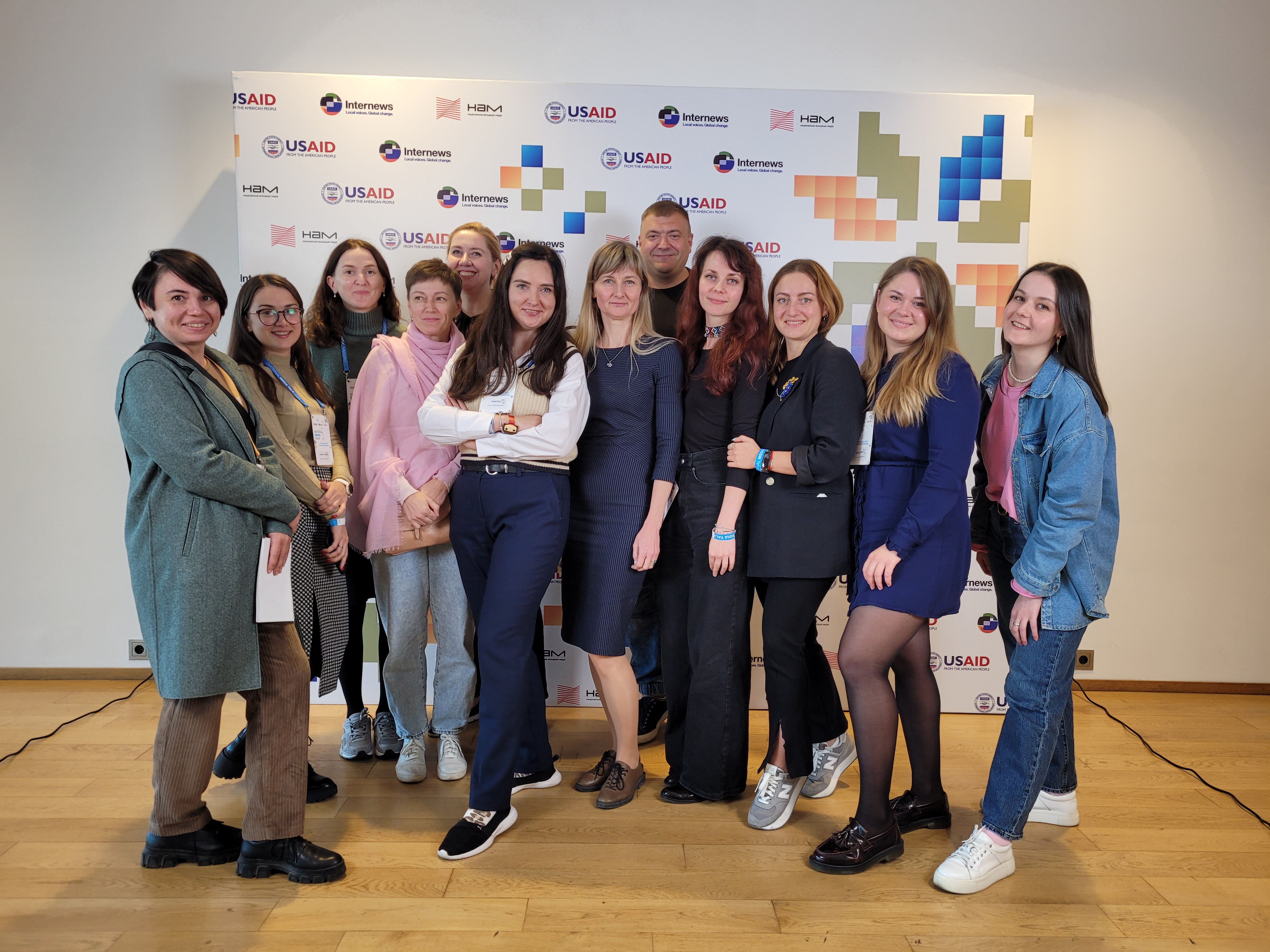
Have you tried taking a good photo of a whole group of people? Yeah, we weren’t quite successful, either. IMI archive
Tracking crimes against the media
Back in 2012, during Yanukovych’s presidency, our monitoring study, which would eventually become the Freedom of Speech Barometer, was born. Those were the times of censorship, of the authorities monopolising the media landscape and journalists’s rights being violated en masse, including through physical assault.
IMI has been consistently monitoring press freedom violations of freedom in Ukraine ever since. In 2022, a section tracking Russia’s crimes against the media and journalists was added to the study.
The monitoring study recorded 4689 crimes against journalists and the media in Ukraine committed by domestic actors and Russia before 2026. Of these, 870 crimes were committed by Russia after the start of the full-scale invasion.
Over the years, this data has become the basis for hundreds of investigations, human rights campaigns, and for international pressure on Russia. For instance, the Parliamentary Assembly of the Council of Europe adopted a resolution calling for increased pressure on Russia to ensure the release of illegally detained Ukrainian journalists. IMI was ivolved in the drafting of the resolution, which draws on the Institute of Mass Information’s list of 26 Ukrainian journalists detained by Russia.

Russian prison survivors Vladyslav Yesypenko (left) and Dmytro Khyliuk (right) next to the photo exhibition about Ukrainian media workers illegally detained by Russia, PACE HQ, photo by IMI
Russian forces have killed 132 media workers in Ukraine since 2014. Of these, 125 died in the course of the full-scale invasion, with 15 dying while reporting.
At least 112 Ukrainian and international journalists have been detained or taken hostage by pro-Russian and Russian forces since the start of the Russo–Ukrainian war in 2014.
332 Ukrainian media outlets have ceased operations due to the hostilities, occupation, shelling, and war-induced financial hardship.
IMI works with the Prosecutor General’s Office and other law enforcement bodies to ensure that those complicit in the crimes against the media are punished. Every month, we share new data on violations with law enforcers and monitor the progress of the investigations. A considerable number of probes into violations of journalists’ rights have been opened thanks to IMI’s efforts.
Moreover, IMI representatives have joined the expert board of the Verkhovna Rada Temporary Commission for the investigation of crimes against journalists and other media professionals committed by Russian armed forces.
IMI will release a full report on the four years of the full-scale war, featuring details and new evidence, on 24 February 2026.
Supporting the work of news outlets in wartime
Many journalists know IMI as “the place that lends bulletproof vests.” Which we don’t mind. But know that we offer not just bulletproof vests, helmets, and first aid kits, but also power stations, power banks, active headphones, and lots more. Most of the equipment is constantly in rotation, but the Safety Library is being updated all the time.
However, our Kyiv office and the equipment stored there were severely flooded in late January 2026: the heating pipes above us burst due to the air strikes, blackouts, and sub-zero weather. We are looking for a new office and new bulletproof vests in order to resume our high-quality assistance to media workers as soon as possible.
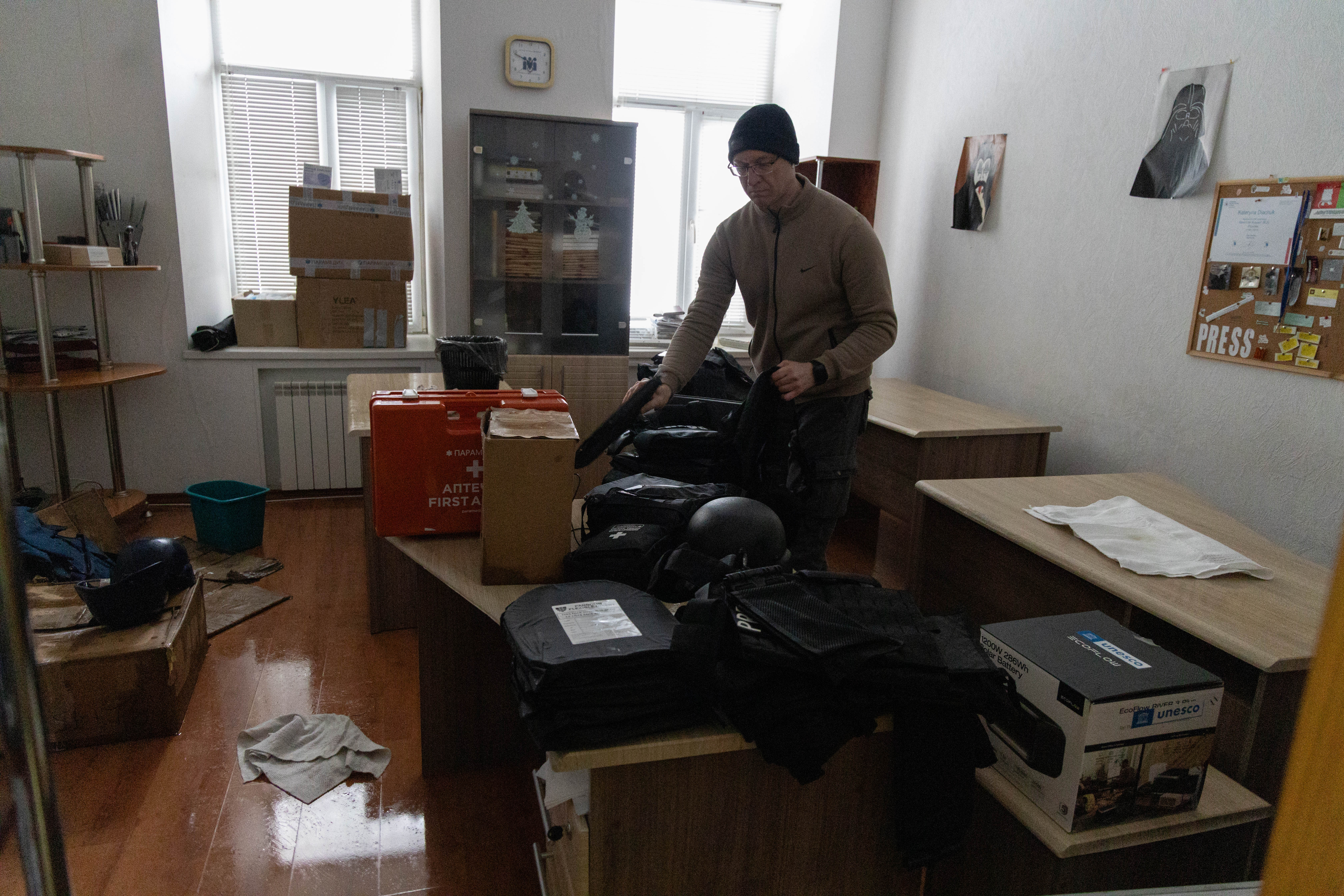
Saving the flooded office. IMI archive
Before the flooding, though (starting in 2014, but the work has been most active since 2022) media professionals made use of our equipment over 12,000 times:
- bulletproof vests and helmets — 6843 times;
- first-aid kits — 1855 times;
- tourniquets, ofther equipment for administering first aid and maintaining comfort and safety in emergencies — over 1110;
- generators, power stations, power banks — 1232;
- other technology and safety gear, satellite phones, gas masks, sleeping bags, tactical ballistic eyewear, water filters, active headphones, gadgets for reporting, etc. — 1023 times.
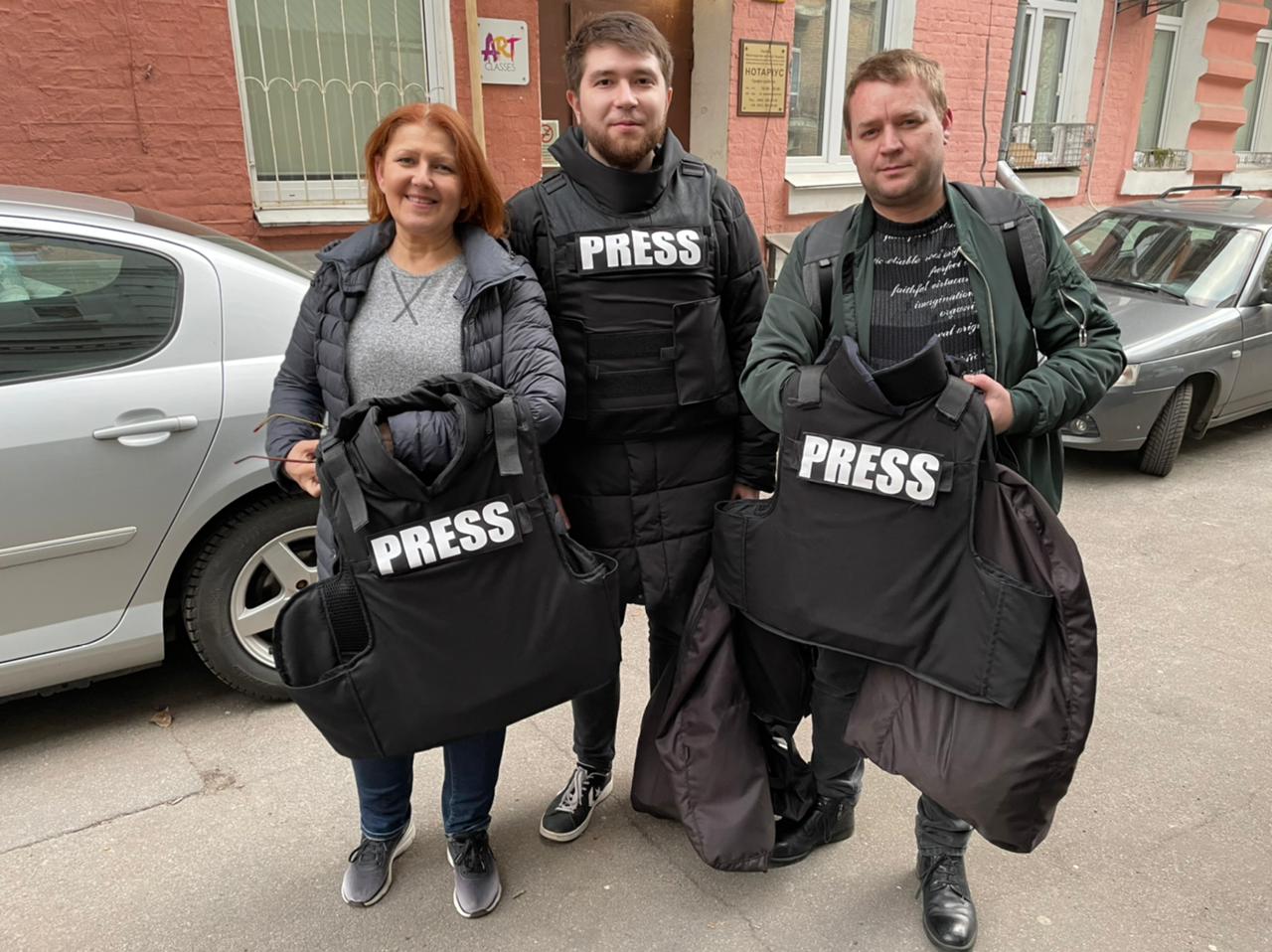
Dear colleagues geared up for a reporting trip. IMI archive
Visit our Mediabazas in 15 cities
In the fall of 2022, shortly after the start of Russia’s mass air strikes on Ukraine’s energy infrastructure, we launched the Mediabaza network to give journalists throughout Ukraine a space to work, equipped with electricity and Internet connection. Over time, the Mediabazas have transformed into training and education centers and simply a place where you can meet with your colleagues. As then, so now, the Mediabazas will give you a bulletproof vest, a helmet, and a first aid kit for a reporting trip to the front line.
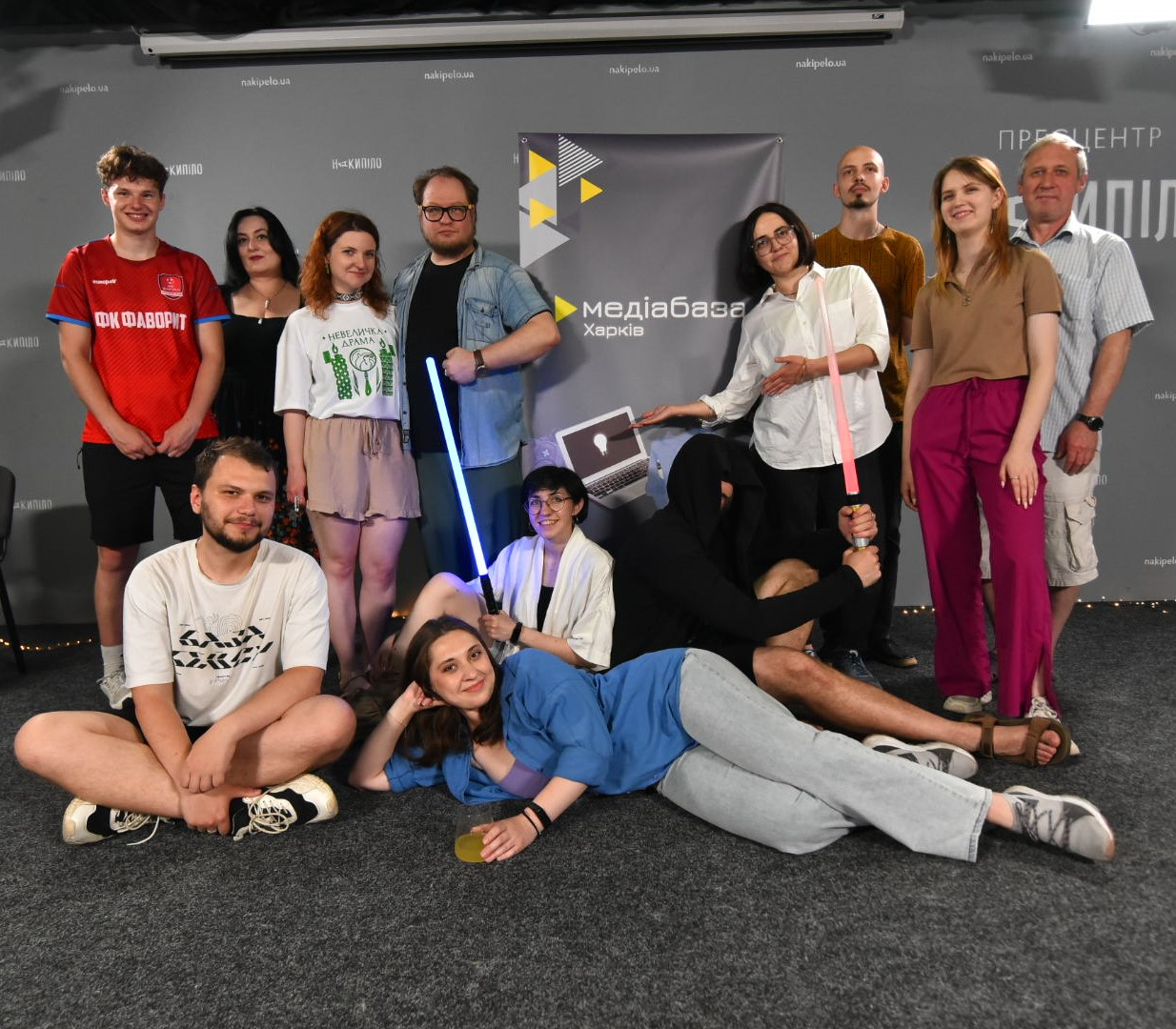
Mediabaza Kharkiv. You can work there, you can stand there, you can sit there or even lay down. Photo by Mediabaza Kharkiv
The network has grown to include 15 journalism hubs. However, one of them got ruined by Russian troops: on 17 November 2025, a Russian drone strike in Dnipro destroyed the Mediabaza and nearly all the equipment inside of it: bulletproof vests, helmets, power stations, solar panels, power banks, the Starlink terminal, the furniture, etc. The strike cost us 260 thousand hryvnias in damages, but what matters is that no one was injured.
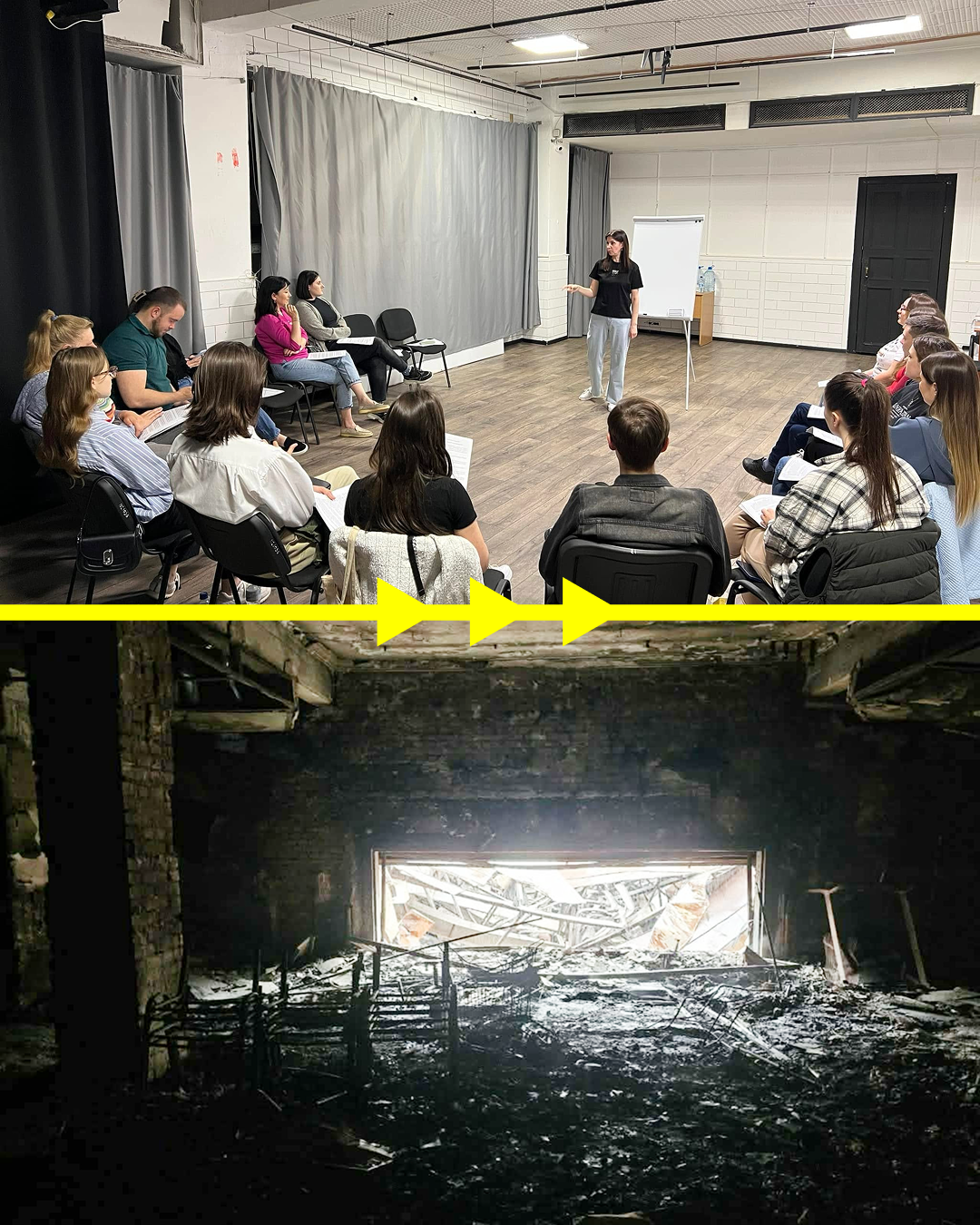
Mediabaza Dnipro before and after it was destroyed in a Russian drone strike
Over the years of the Mediabaza network’s existence:
- media professionals have used the hubs as co-working spaces 6767 times;
- our local colleagues gave 672 classes and networking events;
- which were attended by 11 066 people;
- media workers borrowed safety gear or energy equipment 703 times.
Visit the Institute of Mass Information’s Mediabazas in the following cities:
- Zhytomyr
- Chernihiv
- Sumy
- Kharkiv
- Slovyansk
- Poltava
- Dnipro (not restored yet, but you can attend online classes organised by it)
- Zaporizhzhia
- Kropyvnytskyi
- Mykolaiv
- Kherson (only issues equipment)
- Odesa
- Chernivtsi
- Khmelnytskyi
- Cherkasy
Giving mini-grants to independent news outlets
In addition to the full-scale war, the physical destruction of media offices, and the collapse of the advertising market, the Ukrainian media field faced the almost complete cessation of American funding in 2025. US programs, in particular USAID, accounted for the lion’s share of media projects in Ukraine. Almost the entire year passed in uncertainty and anxiety as to whether this or that news outlet would still exist tomorrow.
But the dark streak is over, other programs have emerged, in particular by the European Union. And IMI has grants to offer again: in 2026 we received applications from 222 news outlets and will soon select the winners.

We also like posting memes and various emotional support content. Follow us on social media (such as Facebook and Instagram) so you don’t miss it
The Institute of Mass Information gave a total of 480 grants to news outlets and media organisations since 2022.
55 more grants will soon be awarded to independent media outlets, enabling them to provide more high-quality reporting to their audience.
We have faith in Ukrainian journalism, and especially in regional news outlets that have unique expertise on the ground. We will continue to support independent news outlets that are changing the lives of their communities for the better and building democracy in Ukraine step by step every day.
Giving visibility to high-quality media outlets
It seems we did it. We convinced a large part of our society that it does matter where people learned this or that news. That you should know and support the high-quality media in your country and your community. But abov all, you should read, watch, and listen to them.
Yes, there are still many anonymous Telegram channels in our country with millions of subscribers, as well as propaganda pages on social media that masquerade as patriots, and dubious news outlets with dubious journalists. But as years go by, more and more news outlets are joining the List of Transparent and Responsible Media and the Map of Recommended Media Outlets. This proves that the number of those in the media field who truly work in the interests of society is growing more and more.
The List of Transparent and Responsible Media, known as the High Quality List, emerged in 2019. The demand for high-quality journalism has only grown since then, and in 2025, as many as 17 national news websites were included in the list. All of them successfully passed the screening for transparency, accountability, adherence to journalism standards, and clear ad labeling: the average level of compliance with standards is about 96%.
The real challenge, though, is finding high-quality media on the ground. There are almost 1,500 communities in Ukraine, almost every one with its own news outlets, large or small. Regional and local journalism is the media market’s superpower, as no one knows their audience as well and enjoyes as much trust as local journalists.
So in 2023, the Institute of Mass Information partnered with Detector Media to launch the Map of Recommended Media Outlets. It features news websites, TV channels, and radio stations from all over Ukraine. Four waves of monitoring later, there are as many as 253 media outlets on the Map: 193 news outlets, 8 investigation centers, 21 radio stations, and 31 TV channels. All of them are screened for transparency, adherence to professional standards, and journalism ethics.
Any news outlet can take the initiative, submit an application, and get checked for compliance with the standards. If their indicators are high, they will get featured on the Map. The next wave of screening is scheduled for April–May 2026, so don’t miss the announcement.
If a media outlet falls a little short of the standards, IMI experts are always happy to help. We have already consulted over 75 news websites, and many of them later made it onto the Map.
How do we know that this work is needed? Because our news about the High Quality List and the Map get crazy views and thousands of shares every time. It is important for readers to warn their friends that they should consume news from safe sources.
And because after each wave of monitoring, someone always asks us, “Why aren’t we on the List?” Media outlets want to be recognised as high-quality, as worthy of the audience’s trust. There is a financial aspect to this status, as well: donors have started to prioritise news outlets featured on the Map when selecting grantees. Thank you for your trust!
By the way, here is an explanation of how to get featured on the Map of Recommended Media Outlets.
And all this was made possible thanks to the people and organisations helping us through all these years
Above all, we thank our Defense Forces. It is thanks to them fighting daily that IMI can continue to work and fulfill our mission.
We thank the media professionals who put trust in IMI and share our belief that a free and democratic Ukraine is impossible without high-quality and independent media.
We thank our partners in state institutions and law enforcement bodies who use our Barometer, monitoring reports on Russia’s crimes, and IMI’s other material as practical tools, in particular to track and investigate crimes against journalists and the media.
Special thanks go to our volunteers, territorial defence forces, warehouse coordinators, experts in safety and security, AI, communications, and everything else, and to all the good people with whom we have worked throughout these years. Who carry, drive, guide us along and pick us up at various moments. It seems that thanks to these people no task is impossible.
And, of course, we thank our international partners: the Delegation of the European Union to Ukraine, Internews / Internews Network, Bureau of Democracy, Human Rights, and Labor (DRL), U.S. Department of State, U.S. Embassy in Ukraine, Embassy of the Kingdom of the Netherlands in Ukraine and the NFRP/Matra program (MATRA), Reporters Without Borders (RSF), Embassy of the United Kingdom in Ukraine and the Foreign, Commonwealth & Development Office (FCDO), Open Society Foundations and the Recovery Foundation, Embassy of the Czech Republic in Ukraine, UNESCO, Institute for War & Peace Reporting (IWPR), n-ost, Organized Crime and Corruption Reporting Project (OCCRP), Euromaidan-Warszawa, Freedom House, People in Need (PIN), The Sigrid Rausing Trust — and everyone who has supported IMI over these 30 years.
A donation to IMI is your contibution to press freedom.
The Institute of Mass Information(IMI) is a Ukrainian civil society organization specializing in the media, operating since 1996. IMI defends the rights of journalists, studies the media landscape and reports on media-related events, fights propaganda and disinformation, and provides media workers with safety equipment for trips to combat areas (since the start of the Russo–Ukrainian war in 2014).
IMI carries out the only monitoring study of freedom of speech in Ukraine, keeps a list of transparent and responsible online media outlets, and tracks Russia’s media crimes in the war on Ukraine. IMI has representatives in 20 oblasts of Ukraine and runs a network of Media Hubs that provide journalists with unfailing support. IMI’s partners include Reporters Without Borders (RSF); the organization is also a member of the International Freedom of Expression Exchange (IFEX).