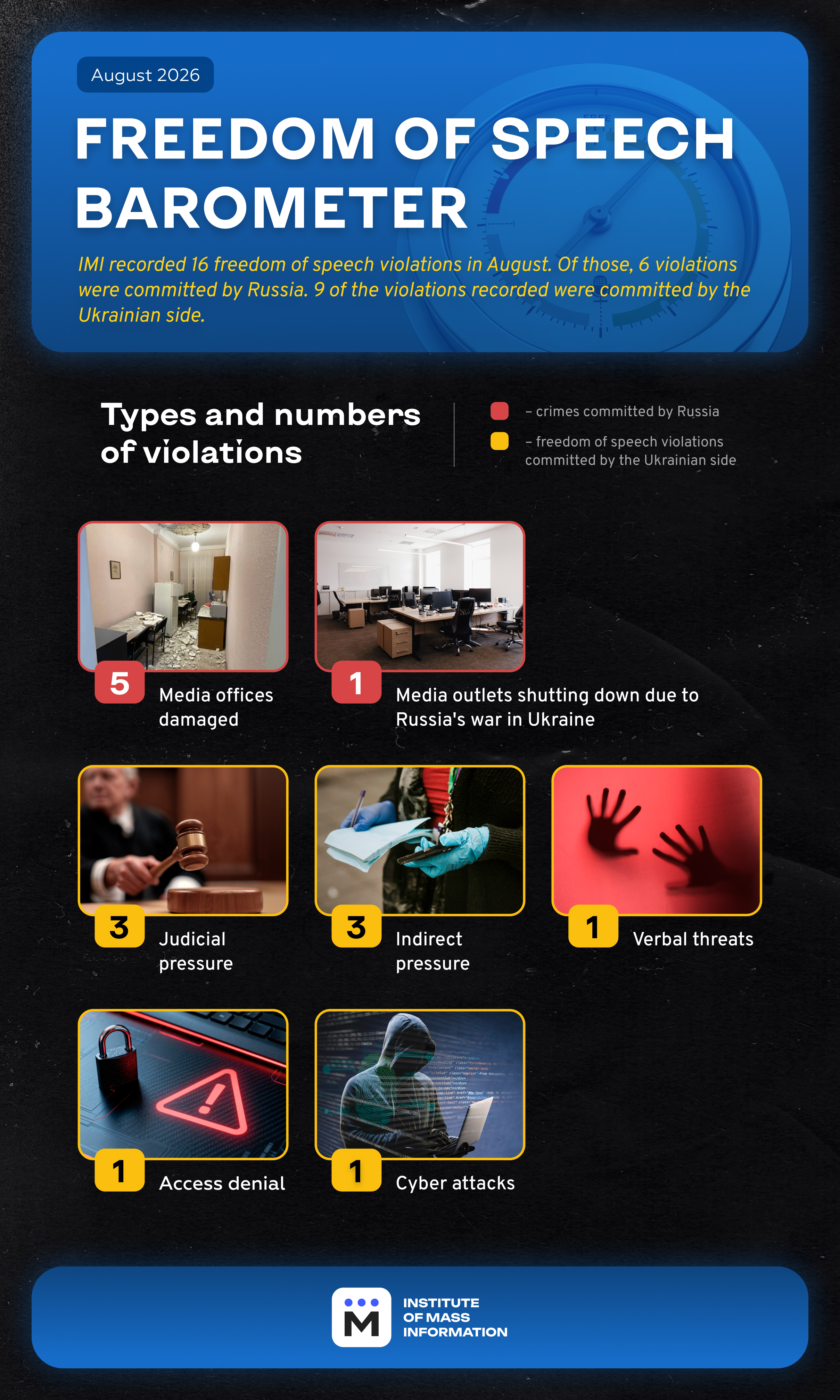
Experts at the Institute of Mass Information recorded 15 press freedom violations in Ukraine in August 2026. Six were related to Russia’s aggression while nine were committed by Ukrainian nationals and institutions, as evidenced by IMI’s monthly monitoring study, the Freedom of Speech Barometer.
The number of offenses recorded by IMI in the eight months of 2026 has already exceeded the number for the entire year 2025 (136 and 130, respectively). Of these, 67 cases were related to Russia’s aggression (compared to 41 in January – August of 2025) and 69 were violations by Ukrainian actors (compared to 38 in the same period of the previous year).
Of the 69 violations committed by Ukrainian nationals and institutions in 2026, most were obstruction of lawful reporting and denial of access to information (14 cases each). IMI also recorded 12 cases of online pressure (7 cyber attacks and 5 other instances), 9 cases of death threats, 9 cases of indirect pressure, and 9 cases of judicial pressure. We also recorded one assault and one instance of damage to a journalist’s property.
Compared to the findings for the entire year 2025, the indicators for obstruction of lawful reporting (14 vs. 13), denial of access to information (14 vs. 11), death threats (9 vs. 5), and judicial pressure (9 vs. 5) have already been exceeded. Indirect pressure is already at 2025 level (9 cases), while the number of cyber attacks is still lower (7 vs. 15).
Russia’s crimes
The deaths of two media workers turned UAF servicemembers were reported in August:
- Oleksandr Nazarenko, serviceman, chair of the Chernihiv branch of the National Union of Journalists of Ukraine and chief editor of the Mena-based newspaper Nashe Slovo. Killed in action in Sumy oblast on 26 August 2026. Nazarenko said he was not feeling well and was evacuated but did not make it to the hospital.
- Volodymyr Tyrtychnyi, UAF servicemember and media worker with Starlight Media. Drafted into the army in July 2024, declared missing in action on 14 November of that year. Confirmed dead on 28 August 2026.
READ MORE:
- Russia commits 971 crimes against media and journalists in Ukraine since 24 Feb 2022
- Full list of deceased journalists
Damage to media offices
- A Russian strike damaged the Visti Barvinkivshchyny office in central Barvinkove (Kharkiv oblast). The shock wave blasted out several windows and doors, damaged the walls and ceiling, and destroyed some furniture.
- Radio na Dotyk studio was damaged in a combined Russian strike on Zaporizhzhia. The panoramic windows were blasted out, a wall and the doors were damaged, and the rooms were littered with glass shards. The team was unharmed and continued to work.
- The office of the newspaper Visti Novovorontsovshchyny was damaged in the Russian drone strike in Novovorontsovka (Kherson oblast). The blast blew out the office’s windows and doors, littering the premises in glass shards. The team has evacuated the equipment and is looking for a new office.
- The office of the TV channel My Ukraina was damaged in a massive Russian strike on Kyiv. The windows in the office were blasted out and the newsroom sustained significant damage. The staff were unharmed and continued to work as usual.
- The building housing the office of the local newspaper Visti was damaged in a Russian air strike on Sloviansk (Donetsk oblast): windows, window frames, and grilles were blasted out and the entrance to the newsroom was destroyed.
Media outlets halting operations due to the war
- Kremenchutska Hazeta (Poltava oblast) has temporarily gone out of print due to the impact of the full-scale war, such as the decline in the advertising market and team members getting drafted. The news outlet’s website remains active.
Violations unrelated to Russia’s war against Ukraine
IMI recorded 9 infringements of journalists’ rights in August: death threats (1), denial of access to information (1), indirect pressure, specifically stalking of journalists (3), cyber attacks (1), and judicial pressure (3). The violations were committed in Kyiv city, Chernihiv, Lviv, Kharkiv, Volyn, and Vinnytsia oblasts by local officials, police officers, and private individuals.
Death threats
- Oboz.ua chief editor Lesia Hasych and journalist Olha Haniukova reported death threats following a news story about potential fundraiser fraud. A man claiming to be UAF veteran Serhiy Yaniuk demanded they take down the material, threatened the journalists and their families, and called for attacks on the newsroom. The police have opened an investigation into the death threats.
Access to information for journalists
- Chernihiv City Council has been withholding information about the funding for repair works in a local square from journalist Serhei Karas for more than three months. The Council only answered some of his questions, omitting others, such as the price for the repairs, the source of the funding, and whether there was tender bidding.
READ MORE:
- Freedom of Speech Barometer for July 2026
- Press freedom in Ukraine 2025 summarised: 130 violations, most committed by Russia
- Russia commits 971 crimes against media and journalists in Ukraine since 24 Feb 2022
- Censorship through civil lawsuits: the ZN.UA case suggests an emerging threat to journalism
Indirect pressure
- Hromadske’s Yevhen Shulhat was detained in Kyiv and taken to an enlistment office even though his military registration papers were in order, the team says. According to Hromadske, the police officers detaining him gave wrong names, used force against the journalist, and no footage from their body cameras was found later.
- Investigative journalist, Nashi Hroshi editor Yuriy Nikolov faced a wave of online attacks and criticism on social media after publicly comparing procurement prices for drones.
- Ukrainska Pravda’s Mykhailo Tkach reported a member of his investigations team facing two days of stalking in Lviv. The media outlet views this as pressure on a journalist and obstruction of their lawful reporting, calling on the police to identify the persons involved.
Cyber attacks
- The website of the Kharkiv-based news outlet Gwara was attacked by hackers: opening the website displayed a third-party page, malicious PHP files were discovered on the server, and some WordPress system files were altered. The team restored the website from backups; no material was lost.
Judicial pressure
- Dmytro Borzykh, former Deputy Prosecutor General for Military Prosecution, sued ZN.UA and journalist Inna Vedernikova over their investigation into the activities of a group of lawyers. He demanded retraction of reported information and nearly 500 thousand hryvnias in court fees. ZN.UA believes the lawsuit bears the hallmarks of a SLAPP.
- Maria Shynder, mother of late UAF servicemember Vasyl Shynder, is suing the news websites Depytaty? and My Vinnychany over their reporting about her son’s business activities: she demands the reported information be declared false, the news articles be taken down, and retractions be published.
- The investigative journalism centre Syla Pravdy received a letter from a Volyn Oblast Administration official warning them of potential criminal liability for their investigation into possible mistreatment of residents at a psychoneurological care home. IMI’s lawyer views these actions as pressure and an attempt to unlawfully influence the journalists.
See the full list of press freedom violations recorded in Ukraine in August 2026 below.
RUSSIA’S CRIMES
Damage to media offices — 5
1. Kharkiv oblast newsroom damaged in Russian strike
05.08.2026 A Russian strike damaged the Visti Barvinkivshchyny office in central Barvinkove (Kharkiv oblast) overnight on 5 August, the newspaper reported.
According to the team, a series of explosions went off right next to the building where they have worked for over 20 years. The shock wave blasted out several windows and doors, damaged the walls and ceiling, destroyed some furniture, and left the premises littered with glass shards. Documents and other things stored in the office were scattered about.
The team said that this was the second time their office had been affected in Russian strikes. The newsroom has previously been damaged in a strike in 2022. The team restored it and continued releasing the newspaper.
The administrative building housing the newspaper’s office sustained significant damage, too. In a neighbouring apartment block, some the windows were blown out and some balconies were damaged; a shop was affected as well.
Despite the damage sustained, the team said that they would continue with their work. The outlet reported that they had managed to preserve both the team and the equipment, so the newspaper would stay in circulation.
2. Russian strike in Zaporizhzhia damages local radio station
11.08.2026 Radio na Dotyk studio was damaged in a combined Russian strike on Zaporizhzhia overnight on 11 August. The panoramic windows were blasted out, and the wall and door between the studio and the guest room were damaged, chief editor Olha Vakalo reported to the Institute of Mass Information’s regional representative.
Vakalo said the studio’s panoramic windows suffered the most damage: they were blasted out completely. Soundproofing curtains that had been installed over the windows intercepted some of the glass shards, but fragments scattered across the room regardless.
“We have panoramic windows, and they’re completely ruined — blown out entirely. Thankfully, we have curtains, soundproofing curtains that were on those windows, and they held back some of it, so it scattered across the studio, but mostly ended up on the floor,” the chief editor said.
The wall between the guest room and the studio was also damaged, and part of the door between the two rooms was dislodged by the shock wave.
The room on the third floor where the team stored equipment boxes and other supplies was damaged as well. The windows and a door were blasted out there as well, and the room was littered with debris.
The team is now assessing the state of the equipment. Vakalo said it showed no visible damage on the outside, but was covered in dust and glass shards.
“We’ll be checking whether it still works. Thankfully, we’ve even got lights right now. We brought torches to sort through everything, but we have power, so we’re going through it with the lights on now,” the journalist said.
Despite the damage to the studio, none of the outlet’s team were hurt. “What matters is that everyone’s alive,” Vakalo said.
Because of the damage to the studio, the live stream planned for 11 August will go ahead in an unusual format.
“I think we’ll just go live from a phone,” the chief editor said.
She said that the team had notified the people who were supposed to speak on air that day that the station would be unable to work properly from the studio.
“Still, we’re hoping to keep working going forward,” Vakalo added.
3. Russian drone damages office of Beryslav district’s only newspaper
14.08.2026 The office of the newspaper Visti Novovorontsovshchyny was damaged in the Russian drone strike in Novovorontsovka (Kherson oblast) on 14 August, chief editor Iryna Telychko reported to Serhiy Nikitenko, the Institute of Mass Information’s regional representative.
Telychko said that a large Russian drone had exploded just a few metres away from the building housing the newsroom. No staff were in the office at the time of the blast, so no one was injured.
“We don’t know exactly what type of drone it was, but it was clearly a large one, because the explosion was incredibly powerful. It was a massive strike on the central part of the town,” Iryna Telychko said.
The blast blew out the office’s windows and doors, littering the premises in glass shards. Immediately after the strike, the team started working to salvage any surviving equipment, documents, and other things from the office.
“On the first day we quickly carried out the most valuable items, since there was a chance of a repeat strike, and today we continued evacuating the property,” she added.
Telychko said that local authorities were trying to swiftly address the aftermath of the attack. At the same time, the team is trying to find an alternative location to work from, since the damaged building has no electricity or internet connectivity.
As the IMI representative noted, Visti Novovorontsovshchyny now remains the only local media outlet in Beryslav district operating on-site on a permanent basis, and the only local print media outlet in Kherson oblast.
The safety situation in the Novovorontsovka community remains extremely difficult. Almost all municipalities in the community are within the “red zone.” Novovorontsovka is located on the bank of what once was the Kakhovka reservoir and faces daily Russian drone and artillery strikes.
4. My Ukraina TV office damaged in Russian strike on Kyiv
20.08.2026 The office of the TV channel My Ukraina was damaged in a massive Russian strike on Kyiv overnight on 20 August. The staff were unharmed, the channel reported.
The windows in the office were blasted out and the newsroom sustained significant damage. The shock wave also collapsed parts of the ceiling in the office hallways.
The channel’s team said they would continue to operate as usual despite the shelling.
“What matters is that all our people are alive. Everything else we’ll restore: repair the building, replace the equipment, rebuild the studio. And Ukrainians don’t need anyone to explain who the Russians are or what methods they use to wage war. A strike on our newsroom won’t intimidate us or force us into silence. We were working, we are working, and we will keep working,” stressed Ihor Petrenko, director of the My Ukraina media group.
5. Sloviansk newsroom damaged in Russian strike
26.08.2026 The building housing the office of the local newspaper Visti was damaged in a Russian air strike on Sloviansk (Donetsk oblast) on 26 August: windows, window frames, and grilles were blasted out and the entrance to the newsroom was destroyed, Karachun reports.
The state of the property inside the office (desktop computers, printers, scanners, furniture, etc.) is unclear as there is, for now, no way to check.
This marks the second major strike on Visti‘s office over the course of the Russo–Ukrainian war. The building was first damaged during the fighting in Sloviansk in the spring and summer of 2014. Back then, a shelling strike burst the building’s windows.
“A few days after Sloviansk was de-occupied [in July 2014 — Ed.], I walked into my office and didn’t recognise it. Shattered glass everywhere, remnants of window frames. The wind was blowing sheets of paper and newspaper issues around the office. There was a thick layer of dust on the desks… But within two weeks, we had resumed printing the newspaper,” said Visti chief editor Oleksandr Kulbaka.
According to him, the newsroom had continued operating and was a profitable enterprise up until the start of Russia’s full-scale invasion of Ukraine.
The relocated team now works remotely from various regions across Ukraine, including Odesa, Kyiv, Kharkiv, and Dnipropetrovsk oblasts.
The printing is done in Vinnytsia and delivered to Sloviansk via Nova Post. There, it is distributed to locals free of charge with the help of local authorities and volunteers.
On 10 September, Sloviansk’s Visti will mark its 109th anniversary. It is the oldest newspaper in Donetsk oblast.
Media outlets halting operations due to the war — 1
1. Kremenchutska Hazeta temporarily goes out of print
20.08.2026 Kremenchutska Hazeta (based in Kremenchuk, Poltava oblast) has temporarily gone out of print, chief editor Oleh Bulashev reported to IMI’s regional representative Nadia Kucher.
According to him, the decision to halt the release of the newspaper’s print edition was influenced by the impact of Russia’s full-scale war against Ukraine.
“Objective circumstances played a role: the decline in the advertising market, team members getting drafted, the general situation caused by the war,” Oleh Bulashev said.
The last print issue of Kremenchutska Hazeta came out on 13 August. The chief editor said that the team planned to use the pause in printing to rethink their operations, look for new ideas, and prepare new stories.
In the meantime, the newspaper will continue to operate online.
THE FREEDOM OF SPEECH SITUATION IN UKRAINE UNRELATED TO RUSSIA’S WAR
PHYSICAL AGGRESSION
Death threats, intimidation, persecution — 1
1. Oboz.ua faces pressure, threats over reporting on potential fundraiser fraud
19.08.2026 The news website Oboz.ua faced pressure and threats following a news story about potential fundraiser fraud. Chief editor Lesia Hasych and journalist Olha Haniukova have filed a statement with the police, Hasych reported to IMI journalist Valentyna Troyan.
Hasych said that the pressure was linked to a piece released on 26 September 2025, titled “Big Fraudulent Fundraising Campaign for a ‘UAF Servicewoman’ Exposed in Ukraine: Who Is Iryna Hotun and Why the Scandal is Escalating”. The publication cited information from Ukrainian Armed Forces colonel Anatoliy Shtefan, comments by other servicemembers and volunteers, and reports by other news outlets concerning violations likely committed in the course of the fundraising campaign in support of Hotun.
As Hasych recounted, a man introducing himself as Serhiy Yaniuk (call sign “Latvian”), a veteran of the Russo–Ukrainian war, started calling Olha Haniukova, the author of the news story, from a Latvian phone number on 8 August 2026. He also sent her video messages demanding that the article be taken down.
Hasych said he later switched his attention to her and her family, threatening to “ruin their lives” and to “play at war” with them. Yaniuk also filed a complaint with the Security Service of Ukraine (SBU), accusing her of committing a criminal offence. However, the journalist added, the SBU refused to enter the case into the Unified Register of Pre-Trial Investigations, citing the lack of a corpus delicti.
“I warned the senior editor and everyone else he might call about his intimidation campaign. I also filed a statement with the police and the SBU. I told him that we were willing to publish a comment and issue a correction if he shared any evidence, and asked him to email it to the editorial inbox. He replied that he’d send it right away, and a minute later a complaint against me, with the subject line ‘Lesia Hasych is an FSB agent’, arrived in our inbox; it claimed that I had committed a criminal offence by writing the news piece. The SBU refused to enter his complaint into the Unified Register of Pre-Trial Investigations, citing the absence of a corpus delicti,” Lesia Hasych explained.
Hasych added that she had no theories as to why the threats had started coming in now, a year after the news article was released.
Hasych said that the dubious fundraising campaign had been first reported by UAF colonel Anatoliy Shtefan. He later deleted his post. According to the team, he faced pressure and takedown demands as well.
Yaniuk later contacted Oboz.ua‘s senior editor, Orest Sokhar. The team agreed to temporarily take the article down in order to carry out additional fact-checking, and sent inquiries about Iryna Hotun’s work to the relevant authorities.
However, Hasych said, the pressure did not stop after that. Yaniuk posted a video on Facebook calling on fellow servicemembers to “attack the team,” and on 16 August summoned a police patrol to the news outlet’s office in Kyiv after filing a complaint.
On 10 August 2026, Lesia Hasych filed a statement with the police over obstruction of lawful reporting and death threats. She said that the statement had been registered.
During further checks, journalists found that in the autumn of 2025, Dim TV had also privated an episode of its programme featuring Iryna Hotun over reports concerning the questionable nature of her activities and fundraising campaigns. Available information suggests that Hotun had previously served in the Anti-Terrorist Operation (ATO) and holds veteran status, but was discharged from military service on health grounds. The bank card used for her fundraising campaign has since been blocked.
CENSORSHIP, ACCESS TO INFORMATION
Access to information for journalists — 1
1. Chernihiv City Council withholds source of square repairs funding
14.08.2026 Chernihiv City Council has been withholding information about the source of the funding for repair works in the Trump Square (previously known as Kazka Square) from local journalist Serhei Karas for more than three months, Karas reported to Andriy Kuzhel, the Institute of Mass Information’s representative in Chernihiv oblast.
Despite the journalist’s appeal to the Verkhovna Rada Commissioner for Human Rights, he is yet to receive the answers to his key questions: who allocated the funds, how much, and whether there was tender bidding.
Serhei Karas submitted a query for public information to Chernihiv City Council via the Government Contact Centre on 30 April 2026, asking about the construction work in the square: who was funding the repairs, what their total scope is, which budget — municipal or regional — the money was coming from, when the works began and are due to be completed, and whether the procurement had been carried out through the Prozorro system.
The City Council’s executive committee replied on 8 May, claiming that Karas’s letter did not meet the requirements for a query, hence they decided to process it as a citizen’s appeal instead: within one month, rather than the five-day period stipulated for public information queries.
However, the journalist said, even this extended deadline was not met. On 7 August, the City Council provided answers to some of the questions but not all. In the response, the City Council stated that the repairs on the square’s landscaping elements, including the pavement, had been performed as part of the sweeping repair works on an emergency sewer collector, and named the state-owned company Chernihiv Water Utility as the client.
However, the City Council disclosed no information as to the total sum spent, the source of the funding, or whether a tender bidding procedure had been carried out, which Karas said were the details he had been trying to learn through his query.
Volodymyr Zelenchuk, a lawyer with the Institute of Mass Information, believes that the executive committee should have provided the journalist with part of the requested information. In particular, the client for the works, their cost, and the timeframe for completion, since this information should be clearly listed in the documentation regarding the execution of the works.
Yet, Zelenchuk added, some of the questions contained in the query did require some investigation, and the answers to them are not reflected in documents or elsewhere, meaning they are subject to examination under the procedure for responding to citizens’ appeals.
In a blog post, Serhei Karas said that the City Council’s claim regarding the contractor for the works contradicts a public statement by City Council official Maryna Semenenko, who had previously stated that the repairs in the square were carried out following the review of an appeal by 267 local residents the City Council’s Housing and Communal Services Department and the municipal enterprise Zelenbud.
Serhei Karas filed a complaint with Larysa Shumna, representative of the Verkhovna Rada Commissioner for Human Rights in Chernihiv oblast, on 10 July and again on 12 August. He asked the representative to assist in obtaining the information and to hold City Council officials accountable for violating the law on access to public information. The Commissioner’s secretariat has reported that they are reviewing the complaint.
INDIRECT PRESSURE
Other instances of indirect pressure — 2
1. Policemen detaining Shulhat gave fake names; no bodycam footage remains — Hromadske
11.08.2026 The police officers who detained Hromadske journalist Yevheniy Shulhat on 27 July gave false names, and their body cameras were switched off, Hromadske reported after looking into the details of Shulhat’s detention.
The team discovered that the police and the journalist’s taxi driver had vicen different accounts as to why the vehicle was stopped, and that the names of the three police officers whom the police said had carried out the detention did not match the names given to the journalist. Moreover, the police were unable to produce any body camera footage from these officers.
According to Hromadske, police stopped the taxi carrying Yevheniy Shulhat through Kyiv and handcuffed him on 27 July. He was told he was being detained for violating army registration rules.
However, the team reports, the documents the journalist carried at the time showed that Shulhat had no recorded violations and was not listed as a wanted person.
Hromadske lawyer Illya Podvornyi explained that the army registration documents generated by the journalist in the Reserve+ app in May 2026 and again following his detention said that he was not in violation of any regulations and that such documents remained valid for one year from the date of issue. According to the lawyer, Shulhat had not been held administratively liable for violating registration rules and had not paid any fines.
“Since he had no obligation to take the military medical exam independently, had not been summoned to the enlistment office, had not been deemed ‘partially eligible’ for the draft, and no violations by him were officially recorded, the grounds for detention cited by the police are legally untenable, and the coercive action taken against Yevheniy Shulhat was unlawful,” the lawyer explained.
ЗShulhat says that he showed his documents to the police officers and consented to a pat-down search. The police initially confirmed in a comment to Ukrainska Pravda that their officers had checked the journalist and found that he had not taken the military medical exam, which was why he had been taken to an enlistment office. Later that evening, Kyiv police officially stated that the car had been stopped for a document check and claimed that Shulhat had refused to show his documents.
In response to a query by Hromadske, the police stated that Shulhat had been reported to the 102 emergency line during the check. The police said that Shulhat had failed to procure army registration documents, which was why he was asked to come to the Holosiivskyi district enlistment office.
The Hromadske team said that this version did not match the explanation given by the taxi company whose driver had been operating the vehicle carrying Shulhat. The company told Hromadske that the car had been stopped because of a faulty signal light, not because of a call to 102. The police only checked the passenger’s documents after the vehicle had been stopped and subsequently decided to detain the journalist.
The news outlet said that the police had not disclosed the caller or what their complaint concerning Shulhat was.
Shulhat reported that the detention was carried out by special-purpose police officers, who exerted physical force on him.
In the fragment of the conversation that Shulhat managed to record, the officers identify themselves as Ihor Mykolaiovych Serhiyenko and Mykola Serhiyovych Mykolaichuk. However, Hromadske was unable to find any mention of special-purpose police officers with these names in open sources, and the police later stated that the detention had been performed by three different officers. Hromadske lawyer Illya Podvornyi says that the law forbids law enforcers from giving false names while talking to a citizen.
Since the parties’ accounts of the event differ, Hromadske requested that the police share the body camera footage from the officers involved.
The police said that no such footage exists. The Kyiv City Police told Hromadske that an internal investigation into the matter was underway.
Shulhat has taken the military medical exam and has been drafted into the Ukrainian Armed Forces, having chosen the unit to serve in.
Yevheniy Shulhat specialises in investigating corruption. He has covered the work of the SBU (Security Service of Ukraine), the National Police, the Prosecutor’s Office, and customs authorities.
Hromadske says that the circumstances of the detention, the conflicting accounts of why the car was stopped, and the officers’ conduct, suggest purposeful pressure on the journalist. The team continues to look into the incident and is sending more queries to the police.
Hromadske reported on 27 July that their journalist Yevheniy Shulhat had been detained by Kyiv police and escorted to an enlistment office.
The Kyiv police reported that Shulhat had refused to show documents confirming his identity and military registration status, which prompted the police officers to detain him and take him to a disctrict enlistment office in the city to clarify his military registration status. As per the preliminary reports by the police, Shulhat did not take the prescribed physical exam by a military commission, either.
Shulhat was released from the enlistment center late on 27 July; he was issued a summons to take a physical examination mandatory for potential conscripts.
The Kyiv City enlistment center has confirmed that police had delivered Yevheniy Shulhat to one of their district staffing offices and that the subsequent check revealed that the journalist had not taken the prescribed medical examination.
2. Yuriy Nikolov targeted in online campaign after reporting on drone pricing
12.08.2026 Investigative journalist, Nashi Hroshi editor Yuriy Nikolov faced a wave of online attacks and criticism on social media after publicly comparing procurement prices for drones, Nikolov reported in an episode of the YouTube project Ye Pytannia. He explained how this attack differed from previous ones in a comment to ZMINA.
Nikolov said that the smear campaign had begun after he said that the prices for drones produced by Firepoint should be lowered and that the market should be opened up for a cheaper alternative. The journalist stressed that his aim was to save budget money in order to provide the Ukrainian Armed Forces with more weapons.
“I’m fighting for the possibility of bringing the prices down. I need us to have more drones at the front for the same amount of money. When you have a billion, you can spend it either on 100 drones or 200 drones. Which would you choose? We should be buying something cheaper for certain tasks and something more expensive for others, but we need to be able to buy more weapons for the tasks at hand,” Nikolov said.
The journalist said that actors in the defence sector and multiple Telegram channels then accused him of comparing incorrect drone specifications and alleged he lacked the experience to make such statements.
Nikolov believes that the posts attacking him aimed to help preserve the old system of procurement monopolies and to prevent public debate about pricing for drones and missiles. He added that he expects to face more pressure over his investigations in other areas.
In a comment to ZMINA, Yuriy Nikolov explained what, in his observation, made the latest online attack against him different from legitimate criticism.
“Criticism means analysing someone’s actions first and foremost. Constructive criticism is fact-based and assesses conduct, giving the person the opportunity to take the remarks into account and change their future behaviour. Criticism turns destructive when it shifts to purely emotional jabs at the target that aim to degrade them. And it turns into an attack when degrading the target becomes the job of trashy Telegram channels and other information outlets, where anyone can anonymously commission any text to be published,” he said.
At the same time, Nikolov stressed that his core message hadn’t changed: the state should be trying to buy more drones for the same sum. He explained that Ukraine’s budget was limited, so savings made in procurement allowed more weaponry to be purchased for the front’s needs.
Nikolov said he was advocating creating conditions that would encourage lower prices and competition among drone manufacturers.
“Right now, the arms manufacturer lobby is arguing that everything has to be done in secret, no tender bidding, because it’s a terrible secret; military procurement is so complex that nobody understands anything about it except a handful of people whom the defence industrial complex trusts. And it’s this complex that, by its very nature, has an interest in keeping the prices inflated. The defence-industrial complex is a business. And business is, first and foremost, focused on making a profit.
“Whereas different people entirely have an interest in getting more drones for the same amount of money — the consumers of the defence industrial complex’s output. So there’s a conflict of interest between these two groups, and that’s where the friction between them comes from. Sometimes it plays out as constructive criticism, sometimes as destructive criticism. And sometimes as expensive, well-funded online attacks,” the journalist explained.
Nikolov stressed that his goal was not to make Firepoint lower its prices. Instead, he considers it important to push for the creation of such a possibility through competition and tender bidding.
The journalist added that during the debate, his critics kept repeating the argument that different drones could not be compared. He believes that this was an attempt by defence sector actors to narrow down the group of people allowed to speak publicly about procurement and war economics.
Nikolov acknowledged that people who have worked in the defence sector for years have indeed accumulated considerable experience and knowledge. However, in his view, this doesn’t mean that only specialists are entitled to discuss the cost of weaponry and the efficient use of budget money.
The journalist explained that his goal was not to harm any particular manufacturer, but to enable the state to obtain more weaponry for the funds it has.
Nikolov suggested that the current wave of harsh criticism was not linked to the arms lobby alone, since people from other groups joined in it as well, including supporters of certain reformers in the government.
He is convinced that the attacks would intensify as his team continues to work on new investigations. Nikolov says he expects more attacks in the coming weeks, but that this will not derail his work. In his view, avoiding important topics simply because of possible criticism would mean doing nothing at all.
Stalking of journalists — 1
1. UP’s Mykhailo Tkach reports stalking of his colleague in Lviv
31.08.2026 Mykhailo Tkach, journalist and senior investigator at Ukrainska Pravda, says a member of his team has faced stalking in Lviv, Tkach reported in a Facebook post, sharing photos and video footage of the individuals who appeared to be carrying out surveillance.
Tkach said that the individuals had been following the journalist for two days.
“Dear ‘Democrats-Since-Childhood’, whose ‘outdoors crew’ got lost in Lviv near a member of Ukrainska Pravda‘s investigation team and has been wandering around them for two days now? Please, share some information about these guys — we’ll help their bosses get them back,” Mykhailo Tkach wrote.
The journalist called on the media community to share if anyone is able to identify the persons in the photos and asked his followers to share the post.
Ukrainska Pravda chief editor Sevgil Musaieva has also confirmed the stalking faced by an investigations team member in a Facebook post.
“I want to stress: unlawful surveillance of a journalist is pressure on the newsroom, obstruction of lawful reporting, and an overt threat to our colleague’s safety. We demand that the police identify these individuals and find out who ordered the surveillance. We will also be looking for answers ourselves,” the chief editor said.
She added that the stalking would not stop the team’s investigations, “but whoever ordered it should remember: secrets have a way of quickly becoming public.”
ONLINE PRESSURE
Cyber attacks on media outlets, journalists — 1
1. Kharkiv-based news website Gwara attacked by hackers
12.08.2026 The website of the Kharkiv-based news outlet Gwara was attacked by hackers on 12 August. Opening the website now displays a shop listing for a camera in Japanese instead of the publication’s usual content, chief editor Serhiy Prokopenko reported.
In a comment to the Institute of Mass Information’s regional representative Yuliya Napolska, he said that problems with the website’s operation began at 1pm. First, they saw the 404 error (Not Found) and received notifications of pages being edited in the website’s admin panel.
The newsroom immediately contacted the IT company that maintains the site.
Serhiy Prokopenko says that the website’s core system and plugins had been updated just a week earlier. The team runs such updates regularly to improve the website’s security.
The website was later restored. Prokopenko said that the unauthorised interference resulted in the website not displaying the outlet’s material and instead redirecting users to a third-party page.
Serhiy explained that the experts looking into the incident found many malicious PHP files on the server, which allowed the attackers to access the site and upload additional malicious code. Certain WordPress system files had also been altered.
The website has been restored from backups. According to Prokopenko, none of the outlet’s data or content was lost.
The Gwara team is now analysing the causes and circumstances of the attack. The outlet notes that the security protocols in place and the work of its tech support team helped restore the website.
JUDICIAL PRESSURE
Frivolous lawsuits against media outlets — 2
1. Ex-official sues ZN.UA for investigating him
10.08.2026 Dmytro Borzykh, former Deputy Prosecutor General for Military Prosecution, has filed a claim with Kyiv’s Pecherskyi District Court against ZN.UA and the website’s domestic politics editor Inna Vedernikova. Borzykh is seeking to declare information reported in the 22 April 2025 investigation “The Hacker Lawyers Case: How NABU Exposed the Parasites” (which concerned the so-called “Borzykh group”) and in several subsequent articles false, ZN.UA reports.
According to the outlet, some of Borzykh’s claims relate to him being mentioned as a suspect in the case prior to the conviction taking legal effect. He is also seeking to recover almost 500,000 hryvnias in legal costs from the defendants, of which 300,000 hryvnias are legal assistance fees.
The first hearing in the case is scheduled for 10 August.
The ZN.UA investigation concerned a case wherein NABU issued suspicion notices to three lawyers with the company Harantiya Vashykh Prav (lit. “your rights guaranteed”), including Dmytro Borzykh. According to NABU, they had obtained unauthorised access to the case files of at least 100 criminal law proceedings, including around 30 NABU cases involving high-profile corruption.
While the investigation was in progress, ZN.UA lawyers reached out to NABU, who confirmed that Dmytro Borzykh had been assigned a suspect in criminal law proceedings No. 52023000000000620.
Lawyer Yevhen Vorobyov, who represents ZN.UA in the case, believes the claim bears the hallmarks of a SLAPP (Strategic Lawsuit Against Public Participation), while Iryna Venediktova’s legal representative Roman Vasylniak has pointed out that the parties to the proceedings are on unequal footing.
The judge assigned to the case via automated case distribution system was replaced once at the plaintiff’s request and two more recused themselves until only two judges remained eligible for the case, suggesting a deliberate scheme to get a “convenient” judge assigned. ZN.UA has reported that Ruslan Kozlov, chairman of the Pecherskyi District Court, is the godfather to Borzykh’s child.
ZN.UA stresses that in their opinion, the lawsuit concerns the media’s right to cover socially important criminal law proceedings and the public’s right to know who is suspected of what in high-profile corruption cases.
The team believes that the current law, which prohibits the media to report a suspect or defendant’s name prior to convicion taking effect without the person’s consent, goes against the European press freedom standards. ZN.UA is convinced that if the media are not allowed to mention people implicated in corruption cases by name, society will have considerably fewer opportunities to oversee anti-corruption efforts.
“A tool is being created at the state level to allow persons impicated in top corruption cases to escape justice. This is not just ZN.UA’s problem. This concerns the entire media community and society,” the news outlet wrote.
The team added that they would defend their position in court and would continue to report socially important facts and name the people involved in them, because in doing so they are exercising the media’s right to report and society’s right to information.
2. Late serviceman’s mother sues two media outlets
31.08.2026 Maria Shynder, mother of late UAF servicemember Vasyl Shynder, is suing the news websites Depytaty? and My Vinnychany over their reporting. She is asking the court to declare the reported information about her son false, demanding that both news articles be taken down and a retraction be published, reports the Institute of Mass Information’s regional representative in Vinnytsia oblast, who reviewed the claim.
The Vinnytsia City Court opened general claim proceedings on 24 August 2026. A preliminary hearing has been scheduled for 23 September. The media outlets are preparing their responses to the claim.
Rather than filing two separate lawsuits, Shynder has opted for one civil law case. The listed defendants are Volodymyr Shynder (father of the late serviceman), the NGO Automaidan Vinnychchyna, the Depytaty? founder, the NGO Liha Spravedlyvosti Ukrainy, and the My Vinnychany founder.
The dispute concerns two news stories. On 2 April 2026, Depytaty? published a piece titled “A Sole Proprietor from Beyond the Grave: How a Fallen Hero Won Public Procurement Contracts in Khmilnyk”. The following day, the website My Vinnychany released an article titled “How a Soldier Killed in 2022 Won Millions in Government Tenders in Khmilnyk”.
The news concerned Vasyl Shynder’s activity as a sole proprietor after he went missing in action in Donetsk oblast in October 2022. The media outlets reported on a series of deals that were signed in the entrepreneur’s name in that time, the likely use of his digital signature, and a family dispute over the state payment made to the late soldier’s relatives.
The news articles cited Volodymyr Shynder, the servicemember’s father, as one of the sources. He shared documents, tables containing information about the deals, and copies of his complaints to law enforcement bodies with the journalists.
Maria Shynder disputes the claims set out in the news. In her statement of claim, she says that the status of a person missing under special circumstances did not cancel her son’s civil legal capacity, nor did it automatically invalidate his status as sole proprietor.
According to the claimant’s account, the entrepreneur’s obligations could have been fulfilled by hired employees and representatives. She also claims that the contracts in question were not signed using the digital signature, and that some of the transactions were direct purchases rather than competitive tenders.
Maria Shynder is asking the court to declare the information reported in both articles false, to order the websites’ founders to take down the news, and to publish a retraction. Under the claim’s demands, the retraction must remain publicly accessible for the same period of time the disputed articles were.
The claimant is also seeking 10,000 hryvnias in moral damages, to be paid in equal shares by Volodymyr Shynder and the two media outlets. The claim estimates the costs associated with the trial at 92,000 hryvnias.
According to the news outlets, Maria Shynder’s representatives did not approach them with requests to make clarifications or to post a retraction before filing the lawsuit.
Vasyl Shynder’s activities as a sole proprietor were later covered by other media outlets as well, including 20 Khvylyn. These outlets, however, are not listed as defendants in the case.
Other instances of judicial pressure — 1
1. Official threatens Syla Pravdy with criminal liability for upcoming investigation
31.08.2026 The investigative journalism centre Syla Pravdy received a letter from Oksana Hobod, director of the Volyn Oblast State Administration’s social work department, warning the team of possible criminal liability for their then-upcoming investigation into possible mistreatment of residents at a psychoneurological care home in Volyn oblast. An Institute of Mass Information lawyer considers the official’s actions to constitute pressure and an attempt to unlawfully influence the journalists.
The events are covered in a report on the Syla Pravdy YouTube channel and in comments provided to IMI by the news outlet’s representatives and officials.
On 29 August, the team released a piece titled “Pension Embezzlement and Exploitation of Residents: What’s Happening Behind the Walls of a Volyn Care Home”. The care home in question is run by the Volyn Oblast Council and houses 167 women with mental disabilities, around fifty of whom are officially recognised as legally capable.
Syla Pravdy reported that the facility’s director, Olena Misiuk, had made residents work on her private farm. The residents said they have weeded carrots, onions, and did other farm work, having been taken there in groups by the care home’s driver. Some were threatened with injections in the event of refusal.
The team also found the care home staff to be using the residents’ pensions in non-transparent ways.
While working the investigation, the journalists reached out openly to the institution’s management and to representatives of the relevant Oblast Administration department.
Natalka Koval, the investigation’s author, says that officials had commented on the facts discovered by Syla Pravdy, since they had known in advance that the journalists had visited the institution.
However, the day before the investigation’s release, the team received a letter from the Volyn Oblast State Administration, accusing the journalists of trespassing and mentioning potential liability under Article 182 of the Criminal Code of Ukraine (violation of privacy).
According to Natalka Koval, the administration’s letter claimed that the journalists should have contacted the care home’s director in advance to request permission to visit residents and interview them. The letter said that the journalist’s actions had involved unlawfully entering the facility’s premises, as well as blackmailing or exerting pressure on a legally incapacitated person.
“We didn’t deceive anyone to sneak in, and we got permission from an authorised person before speaking to the residents. And this kind of behaviour from officials is, to us, yet another sign that the care home itself and the relevant department have something to hide. They really don’t want anyone to ever find out what’s happening behind the walls of the Ruda Psychoneurological Care Home,” Natalka Koval commented.
Syla Pravdy told IMI that Oksana Hobod had not contacted the journalists again after the first letter.
“Right now, we’re waiting for the police, the Oblast State Administration leadership, and the Oblast Council to respond to the situation themselves. We’ve been in touch with the representative of the Human Rights Commissioner in Volyn oblast,” journalist Natalka Koval said.
Oksana Hobod told IMI’s representative that the situation needed further examination.
“We’ll set up a commission, check all the facts, and only then will we say anything,” she said.
Volyn Oblast Police spokeswoman Olha Buzuluk told IMI that no one from the Oblast State Administration had contacted the police over “trespassing” into the care home. Nor is there any ongoing investigation into the care home.
Institute of Mass Information lawyer Petro Stoinov believes that the the Volyn Oblast Administration officials’ actions may constitute pressure on the journalists and an attempt to unlawfully influence their work.
“The trespassing allegations have no legal grounds whatsoever. The psychoneurological care home is a communal institution funded from the oblast budget. The filming crew was on the care home’s premises openly, exercising their lawful right to gather information, and, crucially, had obtained consent to be present and to film directly from authorised representatives of the facility’s administration. So what we’re dealing with here is purely lawful reporting, not ‘trespassing,’” the lawyer said.
Petro Stoinov considers the threats of criminal liability to be groundless in this case, as well.
“Information about potential human rights violations, forced labour, and the non-transparent use of pensions at a communal institution is unquestionably a matter of public interest. Under Part 2, Article 29 of the Law of Ukraine ‘On Information,’ the public’s right to know these facts outweighs any potential harm from their disclosure. The care home is not the director’s private property, and letters of this kind from a government body have a clearly pronounced ‘chilling effect,’ aimed at censoring a topic of public importance,” IMI’s lawyer said.