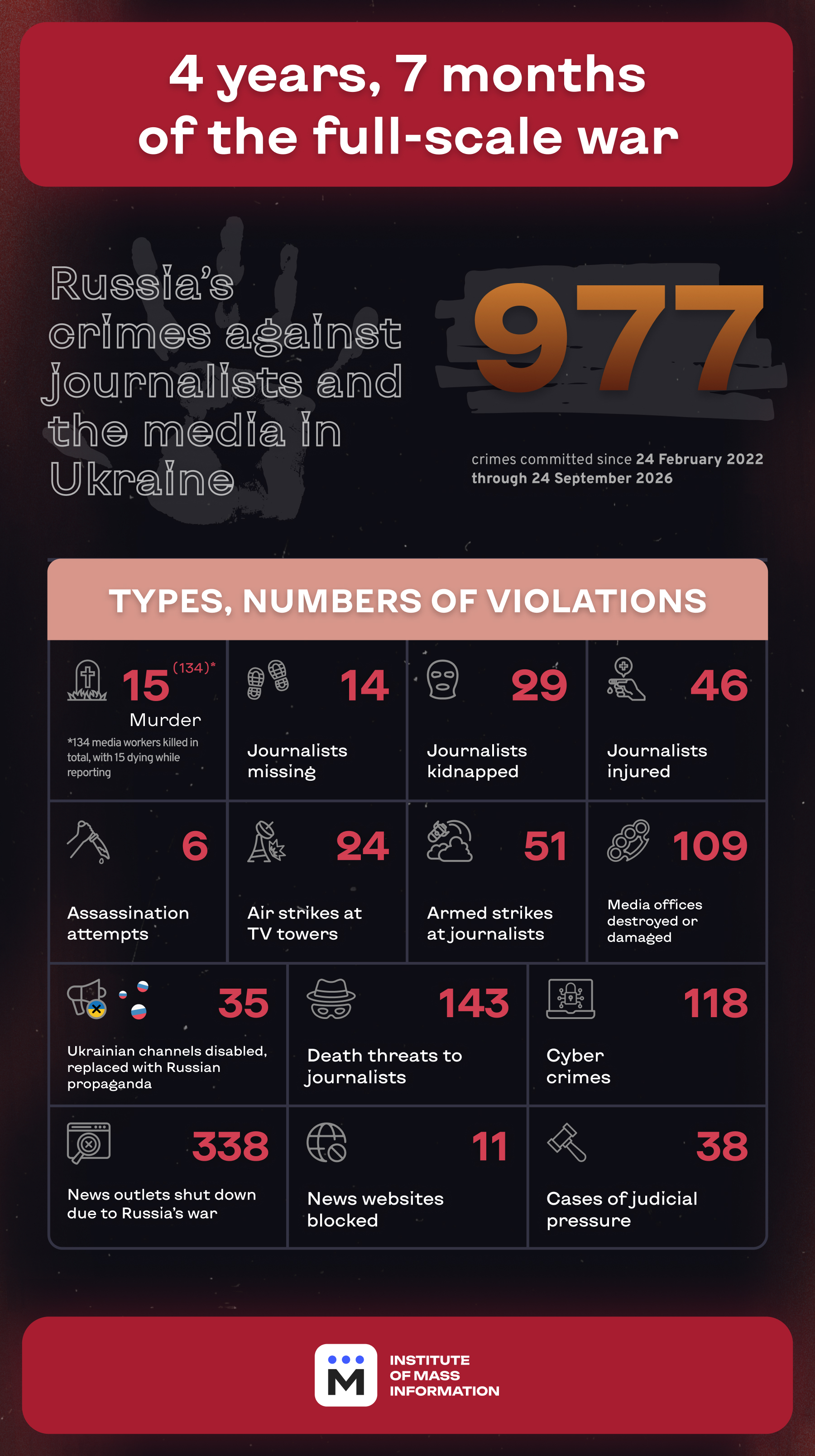
Russia committed 977 crimes against journalists and the media in Ukraine in the four years and seven months since the start of the full-scale war, as evidenced by the Monitoring Study of Russia’s Crimes Against Journalists and the Media, which the Institute of Mass Information has been carrying out since the first day of Russia’s invasion of Ukraine.
IMI recorded six new instances of Russia’s war negatively affecting the media in the period from 24 August to 24 September 2026, including damage to media offices, cyber crimes, and judicial pressure.
The total number of newsrooms damaged in the course of the war has thus risen to 109. IMI also recorded 38 instances of judicial pressure and 118 cyber crimes targeting Ukrainian media outlets throughout the duration of the full-scale war.
Media workers deceased
The deaths of three media workers turned UAF servicemembers were reported in August – September:
- Oleksandr Nazarenko, serviceman, chair of the Chernihiv branch of the National Union of Journalists of Ukraine and chief editor of the Mena-based newspaper Nashe Slovo. Killed in action in Sumy oblast on 26 August 2026. Nazarenko said he was not feeling well and was evacuated but did not make it to the hospital.
- Volodymyr Tyrtychnyi, UAF servicemember and media worker with Starlight Media. Drafted into the army in July 2024, declared missing in action on 14 November of that year. Confirmed dead on 28 August 2026.
- Ruslan Rudukan, UAF servicemember and journalist from Uman. Killed in action near Zarichne, Zaporizhzhia oblast, on 30 August 2026. Worked as a journalist at the oblast newspaper Pres-Tsentr for a long time before enlisting.
137 media professionals have been killed by Russian forces since the start of Russia’s full-scale invasion of Ukraine, with 15 dying while reporting.
Media offices damaged
- Visti, Slovyansk, Donetsk oblast. The building housing the newspaper’s office was damaged in a Russian air strike on 26 August: windows, window frames, and grilles were blasted out and the entrance to the newsroom was destroyed.
- We Ukraine TV and We Ukraine+, Kyiv city. Russia attacked the TV channels’ office on 8 September, damaging the newsroom and office rooms and injuring multiple people. We Ukraine was broadcasting live as part of the national telethon United News at the moment of the strike.
- Suspilne Dnipro‘s Kryvyi Rih bureau. The building was damaged in a Russian strike on 10 September. The shock wave blasted out the windows, damaged the doors, the ceiling, and furniture. The bureau staff were in a bomb shelter at the time of the strike and were unharmed.
- Obriyi Iziumshchyny, Izium, Kharkiv oblast. The Russian strike on 15 September damaged the newspaper’s office: the shock wave burst the windows and doors, making the building unfit for use. The two employees who were inside during the strike were unharmed.
Judicial pressure
- The Russia-installed “Zaporizhzhia Oblast Court” sentenced Iryna Levchenko, a journalist from Melitopol unlawfully detained in 2023, to 15 years in prison, having found her guilty of espionage. The Russian side claims that she had been sharing the locations of administrative buildings, occupation officials, and data on the movements of Russian military personnel and vehicles with Ukrainian forces.
Cyber crimes
- Russian hackers targeted the website of Freedom TV in a prolonged combined DDoS attack on 17 September. The website was completely inaccessible to users worldwide for 10 minutes.
See the full list of Russia’s crimes against media and journalists in Ukraine here.
The Institute of Mass Information (IMI) is a civil society organization specializing in the media, operating since 1996. IMI defends the rights of journalists, studies the media landscape and reports on media-related events, fights propaganda and disinformation, and provides media workers with safety equipment for trips to combat areas (since the start of the Russo–Ukrainian war in 2014).
IMI carries out the only monitoring study of freedom of speech in Ukraine, keeps a list of transparent and responsible online media outlets, and tracks Russia’s media crimes in the war on Ukraine. IMI has representatives in 20 oblasts of Ukraine and runs a network of Media Hubs that provide journalists with unfailing support. IMI’s partners include Reporters Without Borders (RSF); the organization is also a member of the International Freedom of Expression Exchange (IFEX).