
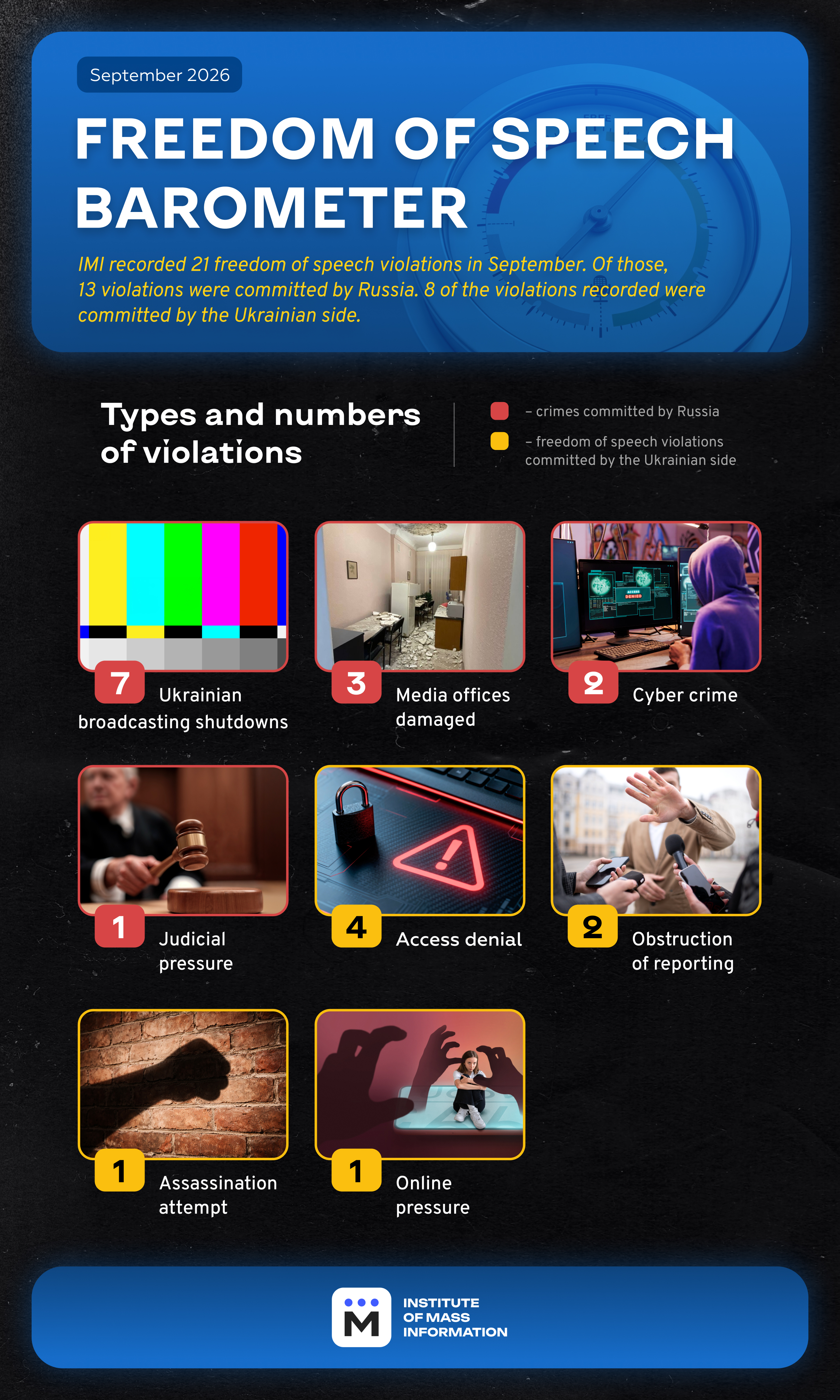
Experts at the Institute of Mass Information recorded 21 press freedom violations in Ukraine in September 2026. 13 were related to Russia’s aggression while eight were committed by Ukrainian nationals and institutions, as evidenced by IMI’s monthly monitoring study, the Freedom of Speech Barometer.
The deaths of three media workers were reported in September. Two of them, Ruslan Rudukan and Oleksiy Nurulin, were killed in action defending Ukraine. Maria Yivzhenko, formerly a journalist with NV Business, died in a Russian strike on a business centre in Kyiv.
RUSSIA’S CRIMES
Damage to media offices
- The offices of at least three Ukrainian news outlets were damaged in Russian attacks: We Ukraine TV and We Ukraine+ in Kyiv (the strike damaged the newsroom and staff’s offices and injured several people); Suspilne Dnipro (the shock wave damaged the broadcaster’s Kryvyi Rih bureau, blasting out the windows, damaging the doors, the ceiling, and furniture; the staff were unharmed); Obriyi Iziumshchyny in Izium (the shock wave burst the windows and doors, making the building unfit for use; the two employees who were inside during the strike were unharmed).
Judicial pressure
- The Russia-installed “Zaporizhzhia Oblast Court” sentenced Iryna Levchenko, a journalist from Melitopol unlawfully detained in 2023, to 15 years in prison, having found her guilty of “espionage”.
Cyber crimes
- IMI recorded two cyber crimes against Ukrainian media: Russian hackers targeted the website of Freedom TV in a prolonged combined DDoS attack, disrupting its operations and making it inaccessible for 10 minutes; NV also reported unknown individuals creating a fake “mirror” of their website to promote an AI-generated video containing disinformation about NABU searching the Defence Procurement Agency ex-chief. NABU has called the footage fake, stressing that content like this suggested that Russia was using cutting edge technology in the information war.
Disabling Ukrainian broadcasting
- At least seven Ukrainian news organisations reported disruption or halting of their operations following Russian strikes on data centres, telecom and other infrastructure in Kyiv on 26 September: Novyny.LIVE, Priamyi, Suspilne, Channel 5, Armiya TV, Kolo, and Konkurent Ukraina. These media outlets experienced TV signal and T2 broadcasting disruption and website functioning issues.
Violations unrelated to Russia’s war against Ukraine
IMI recorded eight press freedom violations committed by Ukrainian nationals and institutions and unrelated to Russo–Ukrainian war in September. Most of these cases (four) concerned denial of access to information, the rest included obstruction of reporting (two), an assassination attempt, and one instance of online pressure.
The infringements were recorded in Kyiv city, Chernihiv, Rivne, Vinnytsia, and Chernivtsi oblasts and committed by officials of local or national authorities, law enforcement bodies, private individuals, or business representatives.
Assassination attempt
- The Security Service of Ukraine (SBU) has issued a suspicion notice to a man for commissioning a physical attack on a Pryluky-based blogger Oleksandr Lesyk: the perpetrators were supposed to shoot him in the limbs and douse him with sulfuric acid. The attempt was prevented at the preparation stage. The blogger criticised the local authorities, reported on corruption and criminal law probes into persons with ties to officials.
Obstruction of reporting
- Two instances of obstruction were recorded: local officials in Rivne covered up the camera used by Chetverta Vlada journalists, demanded they show their IDs and prevented them from asking questions during a public report by acting mayor Viktor Shakyrzian; and staff of the State Emergency Service (SES) HQ in Vinnytsia prevented 20 Khvylyn journalist Vitaliy Pavlovskyi from leaving the premises after he finished carrying out his task there. The police have opened an obstruction investigation into the incident, assigning victim status to Pavlovskyi.
Access to information for journalists
- IMI recorded four cases of journalists facing denial of access to information: The Kyiv Independent’s Danylo Mokryk filed a complaint with the Verkhovna Rada Commissioner for Human Rights against Ukraine’s President’s Office (PO) over their refusal to publish his online petition calling for a press conference with Volodymyr Zelenskyi; Chernivtsi prosecutors and police refused to provide IMI representative Alyona Chorna with information about an investigation into potential embezzlement of budget funds allocated for the renovation of bomb shelters in the city, citing investigation secrecy; Molodyi Bukovynets journalist Liudmyla Osadchuk tried to get information about the renovation progress at the Chernivtsi Oblast Hospital’s infectious diseases ward twice, but was turned down despite officials’ promises to share the data; ZHAR.INFO’s Maria Turchyna contacted the Verkhovna Rada Commissioner for Human Rights over a state-owned company refusing to disclose documents concerning a tender consultant involved in procurement for a bomb shelter construction project.
Online pressure
- Texty journalist Lyubov Velychko was targeted in a smear campaign while investigating a network of social media accounts and bloggers opposing the mobilisation effort and discrediting the UAF.
See the full monitoring report below.
Russia’s crimes
Damage to media offices — 3
1. We Ukraine TV office attacked again with casualties
08.09.2026 Russia targeted the office of the TV channels We Ukraine and We Ukraine+ in an air strike during the day on 8 September. The newsroom and staff offices suffered the most damage. There are casualties, My Ukraina reported.
At the moment of the attack, We Ukraine was broadcasting live as part of the national telethon United News.
Rescuers and paramedics are working at the site of the strike. Those injured are receiving the necessary assistance. More information on the impact of the strike will be reported later.
The attack occurred during the day, following a massive overnight strike on Kyiv.
2. Suspilne Dnipro bureau damaged in Russian strike on Kryvyi Rih
10.09.2026 A Russian strike on Kryvyi Rih (Dnipropetrovsk oblast) overnight on 10 September damaged the building housing Suspilne Dnipro‘s local bureau. The bureau staff were unharmed, senior administrator Iryna Zvonkina reported to Kateryna Lysiuk, the Institute of Mass Information’s regional representative in Dnipropetrovsk oblast.
Zvonkina said that a Russian Shahed drone had struck a residential area in Kryvyi Rih a block away from the bureau’s building. The shock wave blasted out 48 windows and damaged doors, the ceiling, and furniture.
She added that the explosion occurred shortly after midnight, while staff were in a bomb shelter due to the mass attack on the city.
“The security police called me almost right away and said that our building had been damaged, that it was ‘horror, windows falling out, everything’s rattling.’ And I immediately informed the branch management about our situation,” Iryna Zvonkina recounted.
The shock wave damaged windows on both floors of the building, along the entire perimeter. A total of 48 windows were blasted out or damaged, the bureau administrator added.
“The impact was so great that, aside from the windows, all the locked office doors were ripped out along with the frames, the suspended ceiling collapsed in some places, the ceiling structure itself was warped out of shape, and furniture was damaged,” Iryna Zvonkina said.
This is the second time since the start of the full-scale invasion that Suspilne Dnipro‘s Kryvyi Rih bureau has been damaged in a Russian strike. The building was first damaged on 8 September 2023, following a Russian strike nearby. At the time, the bureau’s windows were also blown out and its walls and cladding damaged. No staff were injured.
3. Newspaper office damaged in Russian strike on Izium
15.09.2026 A Russian strike on Izium (Kharkiv oblast) on 15 September 2026 has inflicted significant damage on the office of the newspaper Obriyi Iziumshchyny. Two employees were on site at the time. They were unharmed. The newsroom is switching to remote work and plans to continue releasing the newspaper, as reported on their website.
Chief editor Kostiantyn Hryhorenko said that staff had been proofreading material to get the latest issue ready for print at the time of the attack. The explosion occurred roughly 10 metres away from the newsroom’s building. The employees in the room managed to drop to the floor, which the team believes helped them avoid injury. The shock wave burst the windows and doors. Because of the damage, the office is now unfit for normal work.
Despite the impact of the strike, the team will continue working on new issues remotely. The newspaper will stay in print for as long as the safety situation allows.
“Obriyi Iziumshchyny is staying with Izium. We’re working. We’re writing. We’re printing the newspaper,” Hryhorenko said.
This is the second Russian strike to hit the news outlet’s office in the past year and a half. The previous time, the newsroom was destroyed by a ballistic missile on 4 February 2025. The office had to be rebuilt almost from scratch following the strike, Suspilne reported.
Judicial pressure — 1
1. Russia sentences Iryna Levchenko to 15 years in jail for “espionage”
04.09.2026 The Russia-installed “Zaporizhzhia Oblast Court” has sentenced Iryna Levchenko, a journalist from Melitopol unlawfully detained in 2023, to 15 years in prison, having found her guilty of espionage, as was reported on the court’s website and on Telegram channel on 4 September. News of the verdict emerged at 9am.
The court reported that Iryna Levchenko remained in occupied Melitopol after the start of the full-scale invasion and did not renounce her Ukrainian citizenship.
“By using the Telegram messenger app to make contact with a resident of territory controlled by the UAF, the woman agreed to assist Ukraine’s intelligence services by passing on information about the locations of administrative buildings and staff of Russian state bodies, as well as the movement routes of Russian Armed Forces personnel, military vehicles, weaponry, and other troops and military formations on the territory of Zaporizhzhia oblast,” the statement reads.
The Russian authorities claim that in February 2023 she “passed on information about Russian state ministries and agencies, including those within the security bloc, along with their addresses and staff lists.”
“Passing on this information to the Ukrainian side could have led to these strategic locations being targeted in strikes. At the same time, she did not delete the aforementioned information from the memory of the mobile phone she owned, continuing to store it until her criminal activity was stopped by officers of Russia’s FSB Directorate in Zaporizhzhia oblast,” the occupation court stated.
Iryna Levchenko was convicted under Article 276 of the Russian Criminal Code (“Espionage”), specifically “the transfer, collection, or storage, with intent to pass on to the enemy, of information that could be used against the Russian Armed Forces — that is, espionage, if such acts are committed by a foreign national.”
The “Zaporizhzhia Oblast Court” found the retired journalist guilty and sentenced her to 15 years in jail.
The name of the judge who handed down the verdict is unknown. In the video posted on the occupation court’s Telegram channel, his face is blurred out.
According to the Russian propaganda outlet TASS, Iryna Levchenko was arrested and her case investigated by FSB officers.
As IMI has reported, Melitopol-based journalist Iryna Levchenko, unlawfully detained in 2023, was regularly transported by Russian occupation forces from a Donetsk pre-trial detention centre to occupied Melitopol for investigative procedures.
According to RIA Pivden, the journalist’s case had been completely inaccessible to outsiders, with even her lawyer denied full access to it.
Cyber crimes — 2
1. Freedom TV website attacked by Russian hackers
17.09.2026 Russian hackers targeted the website of Freedom TV (part of the state-owned company Multimedia Platform for International Broadcasting) in a prolonged combined DDoS attack on 17 September 2026, the TV channel reported.
The website received multiple waves of malicious requests throughout the day, which significantly slowed down its operation and affected the timeliness of news feed updates and other posts. The website was completely inaccessible to users worldwide for 10 minutes.
According to the outlet, the attack targeted the Freedom website specifically. The malicious requests came from IP addresses technically identified as originating in the US. The attack also affected the speed of the content management system, which slowed down the release of news and other content.
Technicians with the company quickly restored the website’s operation. Ukraine’s other international resources, such as the Dim TV website, the digital portal The Gaze, and the web versions of the FREEДОМ and UATV mobile apps, remained operational throughout the attack.
2. NV reports clone of their website promoting AI-generated clip of NABU search
25.09.2026 The team of the news website NV (Nastoyashchee Vremya) says that unknown individuals have created a fake “mirror” of their website to promote an AI-generated video containing disinformation about “Defence Procurement Agency ex-chief being searched”, as per the two statements by NV and National Anti-Corruption Bureau (NABU).
The team says the attackers copied the NV.ua website onto a third-party domain, nvukraine.com. On 23 September, the forged website posted a fake news piece in several languages (including Ukrainian and English), mimicking NV’s design, name, and branding.
NV’s owner, Media-DK, has stressed that they had no ties whatsoever to the domain in question. The company added that they were taking legal and technical action to stop the unlawful use of the brand and the promotion of fake news under the outlet’s name.
An AI-generated video showing boxes of cash accompanied by provocative captions claiming that “NABU has searched the former chief of the Defence Procurement Agency” has gained some traction online in the meantime.
NABU has officially denied these reports and confirmed that the footage is was a fake created using AI tools.
The anti-graft agency stressed that content like this suggested that Russia was using cutting edge technology in the information war.
NABU believes that the attack primarily aimed to discredit independent anti-corrup
Disabling Ukrainian broadcasting — 7
1. Novyny.LIVE halts broadcasting due to Russian strikes
26.09.2026 Ukrainian news outlet Novyny.LIVE had to halt broadcasting due to connectivity disruptions following a Russian attack on Kyiv’s infrastructure. Works to restore the network and stabilise the signal are underway, Novyny.LIVE reported.
The team said that Russian strikes on telecom providers’ infrastructure in Kyiv had caused disruptions to some of their services and affected their broadcasting.
Tech team is now working to resolve the issues and restore the network’s operation. Once the signal is stabilised, Novyny.LIVE will resume broadcasting and the team will go back to working as usual.
2. Priamyi website offline due to Russian strike on data centre
26.09.2026 Russian forces have struck a Kyiv data centre housing the server for the Priamyi website. The website has gone offline as a result, Priamyi reported in a Facebook post.
It is unclear when the website will be fully restored.
Earlier on 26 September, Ukrainian news outlet Novyny.LIVE had to halt broadcasting due to connectivity disruptions following a Russian attack on Kyiv’s infrastructure.
3. Russian strike on Cosmonova data centre causes video playback issues on Suspilne website
26.09.2026 Suspilne website is experiencing video playvack issues due to a Russian strike on the Cosmonova data centre in Kyiv, which damaged the building and the backbone network, though the staff were unharmed, Suspilne reported, citing official statements by Cosmonova.
The company said that a repeat strike on 25 September had knocked out their core network and data centre and that some customers may experience disruptions to internet access and related services as a result.
Since Cosmonova provides the technology for Suspilne’s online streaming, this affected the video playback on the broadcaster’s platforms.
All customer data was preserved thanks to geographic redundancy. The company’s techn team is working to restore services from backup remote sites in safe locations.
4. Channel 5 live on YouTube but experiences TV signal issues
26.09.2026 Channel 5 remains live on YouTube but is experiencing problems with TV signal retransmission, executive editor Iryna Herasymova reported to IMI journalist Valentyna Troyan.
“Channel 5 continues broadcasting on our YouTube channel. There are currently issues with the TV signal. We’re looking into the causes,” Iryna Herasymova said in comments to IMI.
The Channel 5 office in Kyiv was damaged in a Russian overnight strike on 6 July 2026. The attack resulted in severe material damage but none of the employees were injured. 60 to 80% of the channel’s equipment was damaged in the strike; the team lacks the capabilities to go on air from their current studio.
5. Armiya TV halts broadcasting due to Russian strikes
26.09.2026 Armiya TV is temporarily off air due to technical problems caused by Russian shelling, Armiya TV — Ukraine’s Army Television reported in a Facebook post.
“Armiya TV is temporarily off air due to technical issues caused by enemy shelling. We remain available on YouTube and social media,” the channel’s official statement reads.
6. Poltava-based news website offline due to Russian attack on Kyiv
28.09.2026 The Poltava-based news website Kolo is offline due to a severe outage at the data centre of their hosting provider that occurred following a Russian attack on Kyiv on 26 September, chief editor Tetiana Tsirulnik reported in a Facebook post.
Tsirulnik cited the provider as stating that their specialists had already accessed the data centre. She clarified that it was located within Ukraine.
“However, it’s still not safe to switch the equipment back on there. The company reported that data backups had been preserved and were being deployed on other equipment located abroad. Still, the state of the data stored on the affected servers can only be checked once it’s safe to do so,” Tetiana Tsirulnik wrote.
According to her, Kolo is not the only client affected in the incident. Others have reported that their resources were unavailable as well.
“The provider hasn’t given an exact answer as to when service would be restored, and hasn’t shared any recovery timeframe either. Our website is currently offline, but we hope it will be back up and running soon,” Tsirulnik added.
In comments to IMI, she clarified that the website had been down since 26 September.
7. Konkurent Ukraina went off air following Russian attack on Kyiv infrastructure
28.09.2026 Konkurent Ukraina TV briefly halted T2 broadcasting to Russian attacks on infrastructure in Kyiv on 26 September, the channel’s director Oleksandra Kurtieieva reported in a Facebook post.
She said that Russian strikes on data centres and telecom infrastructure led to the channel fully stopping their broadcasting on 26 September.
In the meantime, the channel’s streams were available on Konkurent Ukraina‘s official YouTube channel.
Oleksandra Kurtieieva later confirmed that the signal had been restored and the channel was back on air on T2.
Konkurent Ukraina TV began broadcasting on the nationwide digital T platform on 25 May 2025. The channel is based in Lutsk alongside the regional channel Konkurent Volyn.
According to YouControl, the LLC Content Management Group is run by Oleksandra Kurtieieva and was founded by Taras Shkiter, who also founded the project behind the news agency Konkurent and is the deputy chair of Volyn Oblast Administration.
As reported by the Volyn Oblast Administration, he was a co-founder of the SVIDOMI Civil Society Movement and headed it in 2018 – 2024.
THE PRESS FREEDOM SITUATION IN UKRAINE UNRELATED TO RUSSIA’S WAR
Physical assault
Assassination attempt — 1
1. SBU issues suspicion notice to man who commissioned attack on Chernihiv blogger
15.09.2026 The Security Service of Ukraine (SBU) has issued a suspicion notice to a man for commissioning a physical attack on a blogger from Chernihiv oblast, according to a statement by the SBU.
The SBU reported that the person who commissioned the attack instructed the perpetrators to shoot the blogger in the limbs with a firearm and douse him with sulfuric acid. The attempt was prevented at the preparation stage.
The blogger in question is probably Oleksandr Lesyk, based in Pryluky. On 28 August, Pryluky City Council official Yevhenia Averianova reported that Lesyk had been severely beaten and hospitalised in serious condition. In a video posted later, the blogger, showing no visible injuries, claimed the incident had been a “special operation” to save his life.
Lesyk has consistently and sharply criticised local authorities for more than a year, most notably Pryluky Mayor Olha Popenko, City Council deputies, and communal companies. Together with Yevhenia Averianova, he filmed content criticising Popenko for her ties to MP Valeriy Dubil (“Batkivshchyna” party), and reproted on the case against the Mayor’s son, Yaroslav Popenko, who is accused of drug trafficking. On 28 August, the day Lesyk was attacked, the Pryluky City-District Court suspended proceedings in Popenko’s case due to his being drafted into the UAF.
The attack was most likely commissioned by Oleh Averianov, a former deputy head of the State Emergency Service and Yevhenia Averianova’s ex-husband. This aligns with the description of the suspect provided by the SBU: the Chernihiv Court of Appeal sentenced Averianov to seven years in prison for car theft in 2024, and allegedly has also commissioned attacks on the chairman and two other judges of that court. As reported by Ekonomichna Pravda, Oleh Averianov and Valeriy Dubil are business partners.
According to the SBU, the suspect (presumably Oleh Averianov) also organised and sponsored the preparation of other high-profile crimes while hiding abroad, such as the sabotage of a construction crane near a residential building in Chernihiv, an explosion at an enlistment office in the Prykarpattia region, and arson attacks on the private homes of multiple judges. All of these crimes were prevented at the preparation stage.
The individual is charged with a completed attempt at a terrorist act, attempted deliberate grievous bodily harm, preparations to destroy a judge’s property through arson or explosion, and large-scale embezzlement. The investigation is being carried out by the Kyiv Oblast Prosecutor’s Office.
Obstruction of lawful reporting — 2
1. Chetverta Vlada reports obstruction by city council staff
10.09.2026 The investigative journalism agency Chetverta Vlada says that their journalists faced obstruction by Rivne City Council staff during acting mayor Viktor Shakyrzian’s public report on 1 September.
According to the team, Maria Savchuk, director of the communal institution Rivne Development Agency, tried to cover the agency’s camera with her hand throughout the event, while journalist Anastasia Savliuk was asked to show her press ID and was not allowed to ask a question.
Viktor Shakyrzian was giving a report on the work done by Rivne City Council over the first half of 2026. Chetverta Vlada crew were filming the official’s speech on a phone mounted on a tripod.
In comments to the Institute of Mass Information, journalist Anastasia Savliuk said Maria Savchuk’s actions prevented them from filming and working properly during the event.
“She kept coming up to the camera and covering it with her hand whenever we tried to film. Later, when I wanted to ask Viktor Shakyrzian a question, instead of giving me a chance to do so, they started discussing whether I was working officially and asking why I wasn’t wearing a badge. I showed my press ID, but still wasn’t allowed to ask my question during the report itself,” the journalist recounted.
Footage published by Chetverta Vlada shows Anastasia Savliuk introducing herself and starting to ask a question, at which point Viktor Shakyrzian interrupts her and asks whether she is working officially. After she answers yes, and Maria Savchuk asks why the journalist isn’t wearing a badge. The journalist then showed her press ID.
Ultimately, the news outlet’s journalists were only able to ask their questions after the event had finished.
Anastasia Savliuk added that following the event, city government representatives gave the journalists information regarding Shakyrzian’s whereabouts that turned out to be inaccurate.
“So I believe our work was being obstructed. Whether these specific actions amount to a legal offence is a question for lawyers to answer,” Anastasia commented.
Meanwhile, the team remarked, there were other journalists in the hall who were not wearing badges, but City Council officials did not ask them to show their credentials. In addition, the event was public, meaning that anyone, not only the reporters, was allowed to ask Shakyrzian a question.
Anastasia Savliuk believes that requirements were applied to Chetverta Vlada that were not applied to representatives of other media outlets.
“Other media representatives weren’t checked on whether they were ‘working officially,’ weren’t asked to show their press credentials, and their right to be present at the event wasn’t questioned. They were able to ask their questions directly during the report, whereas we were effectively denied that opportunity. On top of that, the officials, including Maria Savchuk, had a generally condescending attitude towards us,” the journalist said.
According to Anastasia, the team believes that this treatment has to do with the fact that members of Viktor Shakyrzian’s team have repeatedly been subjects of Chetverta Vlada investigations.
The newsroom plans to discuss the situation with their lawyers, show them the footage, and ask them to assess the actions of those who obstructed their work.
“After that, we’ll decide whether there are grounds for action and where exactly to turn. If the lawyers identify signs of obstruction of lawful reporting, we’ll consider approaching the relevant authorities. But generally speaking, based on our team’s experience, the police either can’t or won’t investigate offences under Article 171 of the Criminal Code unless a journalist was physically beaten,” Anastasia Savliuk said.
Maria Savchuk runs the communal institution Rivne Development Agency. She is also a co-founder of the NGO Rivne Razom Women’s Platform, linked to the organisation and the party of the same name, Rivne Razom, under whose banner Viktor Shakyrzian came to power in Rivne.
Hanna Kalaur, IMI’s representative in Rivne oblast, has reached out to Maria Savchuk for a comment on her conduct during the event, asking her to explain why the requirement to show press credentials was directed specifically at Chetverta Vlada journalists. The question was sent via a messenger app.
Maria Savchuk responded to the message three days later, denying that Chetverta Vlada‘s journalists had been treated with bias or otherwise differently because of their affiliation with that outlet, or that there had been any intention to obstruct their reporting.
“Regarding the episode captured in the posted footage: at one point, the phone that was being used for filming was placed directly in front of the moderator, very close to their face. At that moment, I didn’t know who the device belonged to, so I asked whose camera it was. My hand movement was a situational reaction to the device’s placement specifically, not an attempt to stop or restrict the filming. I made no demand for the filming to stop,” Maria Savchuk said.
Savchuk said that once things became clear, her question about the ID had aimed to “dentify the media representative” and had not been a requirement or condition for access to the event.
The official added that Chetverta Vlada‘s representatives had continued filming, asked their questions, and received a comment.
“There was no instruction from me to stop filming, to leave the event, or any attempt to deny them the opportunity to ask their question,” Maria Savchuk commented.
She also said that CCTV footage was recorded within the co-working space, meaning that the events were documented with timestamps, which, Maria Savchuk said, made it possible to establish the timeline objectively rather than relying solely on isolated fragments or subjective assessments by the persons involved.
2. Vinnytsia SES detains journalist
19.09.2026 The staff of the State Emergency Service (SES) HQ in Vinnytsia blocked Vitaliy Pavlovskyi, a journalist with the local outlet 20 Khvylyn, from leaving the premises on 12 September, the journalist reported to the Institute of Mass Information’s regional representative in Vinnytsia oblast.
Vinnytsia police have opened proceedings over the obstruction of lawful reporting (Article 171 of the Criminal Code of Ukraine), granting the media professional victim status in the case.
The journalist was carrying out an editorial assignment, looking into reports by readers about trees around the building being felled, a fountain removed, and large-scale construction being carried out.
The journalist told IMI’s representative that he had identified himself right away upon entering the premises and showed his press ID. Having filmed the necessary material and completed his journalist work, Pavlovskyi intended to leave the place and repeatedly told SES staff so directly.
Despite this, he was not allowed to leave the grounds. He found the checkpoint gates and the main exit to be locked and an alternative exit blocked. The media professional said that SES staff effectively detained him inside by force without due process. The staff have said they were following orders from their superiors.
Pavlovskyi had to call the police to leave the premises. The team that responded to the call classified the staff members’ actions as obstruction of reporting and entered the information into the Unified Register of Pre-Trial Investigations.
The Vinnytsia Oblast National Police HQ explained to the IMI representative that since the individuals involved in the case are SES employees (part of the Ministry of Internal Affairs system), the case files would be forwarded to the State Bureau of Investigation’s regional office for investigation.
Censorship, access to information
Access to information for journalists — 4
1. Mokryk complains to Commissioner over PO’s refusal to post petition to Zelenskyi
02.09.2026 The Kyiv Independent journalist Danylo Mokryk has filed a complaint with the Verkhovna Rada Commissioner for Human Rights against Ukraine’s President’s Office (PO) over their refusal to publish his online petition calling for a press conference with Volodymyr Zelenskyi. Danylo Mokryk reported this in a Facebook post.
The journalist said that the complaint had been prompted by the PO’s refusal to publish the petition or to explain who was behind the decision and what legal requirements the petition supposedly failed to meet. He added that the President’s Office had not responded to his request to see a copy of the ruling saying that the petition was invalid.
“In the complaint, I’m asking, among other things, for administrative penalties for the PO officials responsible for these violations of the right to petition and the right of access to information. The Commissioner has such powers. The fact that, having blocked my petition, the President’s Office went ahead and published a different petition on the same topic of a press conference, essentially identical in content (which I happily signed), just further confirms just how arbitrary Bankova’s decisions on petitions are,” Danylo Mokryk said.
The journalist stressed that he considered it necessary to stand up for his own rights in dealings with state bodies in order to prevent similar violations from happening again in the future.
President Zelensky last held a press conference following the “Ukraine. Year 2025” forum in February 2025. There have been no large-scale, open press conferences with the President that would involve a broad range of Ukrainian media outlets — a concern journalists have previously raised.
On 27 August 2026, a petition calling for a separate, open press conference with Zelensky involving independent and critically minded media outlets was published on the President’s website.
The petition was also backed by Yaroslav Yurchyshyn, chair of the Verkhovna Rada Committee on Freedom of Speech, who said that society needed direct dialogue with the President and that the largely one-way communication format of evening addresses no longer met public demand.
On 1 September 2026, journalists from several independent Ukrainian media outlets recorded a video with questions they would like to put to Zelenskyi. They said they did this because they had no opportunity to ask him these questions in person at an open press conference.
2. Chernivtsi police and prosecutor withhold info on bomb shelter renovations from IMI rep
10.09.2026 Chernivtsi prosecutors and police have refused to provide journalist and Institute of Mass Information’s regional representative Alyona Chorna with requested information about the proceedings concerning potential misappropriation and embezzlement of budget funds allocated for the renovation of bomb shelters in the city. The law enforcement bodis cited pre-trial investigation secrecy in both responses.
IMI’s representative first approached the Prosecutor’s Office with a query about the progress of the investigation. In particular, she asked if there were any suspects, what were the likely damages, what action had been taken to recover them, and what was the procedural status of the proceedings.
The Prosecutor’s Office confirmed that the investigation was ongoing, carried out by investigators at the Chernivtsi District Police, with procedural oversight provided by prosecutors with the Chernivtsi District Prosecutor’s Office. No further details were provided, with reference made to Article 222 of the Criminal Procedure Code of Ukraine.
Following this, the journalist submitted a follow-up query to the police. The police likewise confirmed that the investigation was ongoing, but provided no further information, citing the secrecy of the pre-trial investigation.
“This is a socially important issue, since it concerns the use of budget funds and the state of bomb shelters, which is a matter of people’s safety. Journalists with Molodyi Bukovynets investigated the situation and exposed problems with shelters renovated for budget money. The Prosecutor’s Office later opened a probe into the matter. Nearly a year on, it’s important to understand what the investigation has found. I wasn’t asking for case files or information that could harm the investigation — just openly available information. Instead, the Prosecutor’s Office and the police effectively just told me that they were working on it,” Alyona Chorna said.
Institute of Mass Information lawyer Volodymyr Zelenchuk notes that citing Article 222 of the Criminal Procedure Code does not automatically entitle authorities to deny journalists information of public importance.
“Furthermore, under the requirements of the Law ‘On Access to Public Information,’ access to information about the management of budget funds, procurement, possession and use of communal property, or the status and findings of inspections and internal investigations into violations in these areas cannot be restricted. The caveat within this provision, regarding cases where disclosing information could harm national security, defence, or efforts to investigate or prevent a crime, no longer applies here. Given this, the District Prosecutor’s Office or the investigative units should have properly carried out the three-part test and provided at least some of the information,” Volodymyr Zelenchuk said.
According to him, Ukraine’s Criminal Procedure Code grants an investigator or prosecutor the right to independently determine the scope of information that may be disclosed or made public.
“The investigation should take into account the public interest in facts concerning the misuse of budget funds, and identify the information whose disclosure would not be detrimental to the investigation. Of course, this doesn’t mean providing full and exhaustive answers to every question journalists ask, but the investigation should still have provided a bare minimum of information about the probe’s progress, if only because this information is also an indicator of their own work, for which they are accountable to society. In this case, an outright refusal could very well be regarded as unlawful withholding of information,” IMI’s lawyer noted.
3. Chernivtsi Oblast Hospital withholds renovation data from journalist
15.09.2026 Journalist Liudmyla Osadchuk of the Chernivtsi-based outlet Molodyi Bukovynets tried to get information about the renovation progress at the Chernivtsi Oblast Hospital’s infectious diseases ward twice, but was turned down, the journalist reported in a blog post on the outlet’s website.
Osadchuk said she had wanted to know what stage the budget-funded repairs were at, but received no response from those responsible for the work. First, the hospital’s director general, Dmytro Dombrovskyi, cancelled their meeting at the last minute, explaining that Vitaliy Bondar, deputy chair of Chernivtsi Oblast Military Administration, had learned of the journalist’s visit and officials had decided to first hold an “internal meeting” before sharing any information with the press.
Liudmyla Osadchuk said that she had come back to the site two weeks later and tried to speak with the director of the contractor firm carrying out the works. He, however, advised her to contact the client commissioning the work — the Oblast Military Administration’s Large-Scale Construction Department. In a phone conversation, the department head asked the journalist to submit a formal query and claimed that Osadchuk had “violated the law,” without specifying which law he meant.
Molodyi Bukovynets team approached Ruslan Osypenko, chair of Chernivtsi Oblast Military Administration, and the department in question, asking why the journalist had not been provided information about the progress of the renovations, the use of budget funds, and the completion timeline for the works.
In comments to IMI’s regional representative, Liudmyla Osadchuk said that following the release of the piece, officials at Chernivtsi Oblast Military Administration had responded to the newsroom’s inquiry and promised to share all the necessary information regarding the progress of the repair work and the use of budget money.
Earlier, the Human Rights Commissioner opened proceedings following a complaint by journalist Danylo Mokryk, who said the President’s Office had refused to disclose the information he had requested.
4. ZHAR.INFO reports state-owned company’s refusal to disclose tender documents
25.09.2026 ZHAR.INFO journalist Maria Turchyna has contacted the Verkhovna Rada Commissioner for Human Rights over the state-owned company Khmelnytskyi Oblast Procurement Service refusing to disclose documents concerning a tender consultant involved in procurement for a bomb shelter construction project. The Commissioner will open proceedings to review the complaint, Maria Turchyna reported to Alyona Bereza, the Institute of Mass Information’s representative in Khmelnytskyi oblast. She shared copies of her query to the company, the company’s response, and the complaint filed with the Commissioner.
Maria Turchyna submitted a query for information to the company on 21 July 2026, asking for contracts or other documents relating to tender consultations in two procurements for the construction of a bomb shelter for Horodok Lyceum No. 2. In her query, the journalist pointed out that the tender documentation stipulated that the consultant’s services would be paid for by the procurement winner, in the amount of 130,000 hryvnias excluding VAT.
In a response dated 28 July, the company claimed that the requested documents were unrelated to the use of budget funds and were not of public interest. It also cited a confidentiality clause in the signed contract. The journalist did not receive any documents signed with the consultants.
On 1 September, Maria Turchyna filed a complaint with the Commissioner, believing the refusal violated her right to access public information.
Turchyna said that she needed the documents to identify the tender consultant, the terms of their involvement, and the reason why it was the procurement winner who was supposed to pay for their services.
Oksana Kizaieva, the Commissioner’s representative in Khmelnytskyi oblast, responsed with an official letter saying that the complaint would be reviewed as part of the Commissioner’s proceedings.
“In order to fully and comprehensively clarify all the details set out in your complaint, and given the need for additional oversight measures, the further review of the complaint will be carried out as part of proceedings by the Commissioner,” the letter states.
Kizaieva promised that the journalist would be notified of the outcome later.
Online pressure
Other instances of online pressure — 1
1. Texty journalist reports smear campaign
10.09.2026 Texty journalist Lyubov Velychko was targeted in a smear campaign while investigating a network of social media accounts and bloggers opposing the mobilisation effort and discrediting the Ukrainian Armed Forces, Velychko reported to Institute of Mass Information (IMI) journalist Valentyna Troyan.
Velychko said she had compiled databases of the accounts and figures she was examining for her upcoming piece and sent them questions to ensure their right to respond. Most did not reply, and several of the subjects, following this exchange, launched a public campaign against the journalist, even though the investigation itself has not yet been released.
“I get the impression that people want to smear me for no reason at all. Simply for doing my job and wanting to inform society about the processes taking place in the media landscape,” Velychko said.
The journalist said the attack began with a story posted by blogger Anton Hura. He asked his audience whether Velychko enlisting in the army herself would count as a “pro-draft call.”
Following this, blogger Vladyslav Smyrnov made a Facebook post and a YouTube video throwing accusations at her and telling her what she should be doing instead. Velychko documented the initial instances of pressure through the NGO Women in Media.
Later, the website UA News posted some material about her. Velychko says the website released “their own investigation” containing mostly inaccurate information.
The journalist said that the bloggers she was investigating have a combined audience of around 7 million subscribers across various platforms, which makes her worried for her own safety.
“These personalities are behaving extremely aggressively and provocatively. Analysing their content, I have found that a great many of them sync their messaging with Russian propaganda channels. My hypothesis is that these people are coordinating with Russian actors and that these attacks may have to do with Russia’s resistance to anyone exposing networks like this,” Velychko explained.
The journalist added that members of the network constantly quoted and defended one another, attending court hearings whenever suspicion notices were issued to some of them. Some of these bloggers, she added, already faced suspicion of criminal offences, including obstructing the work of the UAF and offences related to high treason.
So far, the journalist has documented instances of misogyny, degradation, and bullying. She has not yet contacted the police, but plans to file a report if there are any overt threats to her life and wellbeing.
Defending freedom of speech
The authorities’ response to press freedom violations — 2
1. SBU issues suspicion notice to man who commissioned attack on Chernihiv blogger
15.09.2026 The Security Service of Ukraine (SBU) has issued a suspicion notice to a man for commissioning a physical attack on a blogger from Chernihiv oblast, according to a statement by the SBU.
The SBU reported that the person who commissioned the attack instructed the perpetrators to shoot the blogger in the limbs with a firearm and douse him with sulfuric acid. The attempt was prevented at the preparation stage.
The blogger in question is probably Oleksandr Lesyk, based in Pryluky. On 28 August, Pryluky City Council official Yevhenia Averianova reported that Lesyk had been severely beaten and hospitalised in serious condition. In a video posted later, the blogger, showing no visible injuries, claimed the incident had been a “special operation” to save his life.
Lesyk has consistently and sharply criticised local authorities for more than a year, most notably Pryluky Mayor Olha Popenko, City Council deputies, and communal companies. Together with Yevhenia Averianova, he filmed content criticising Popenko for her ties to MP Valeriy Dubil (“Batkivshchyna” party), and reproted on the case against the Mayor’s son, Yaroslav Popenko, who is accused of drug trafficking. On 28 August, the day Lesyk was attacked, the Pryluky City-District Court suspended proceedings in Popenko’s case due to his being drafted into the UAF.
The attack was most likely commissioned by Oleh Averianov, a former deputy head of the State Emergency Service and Yevhenia Averianova’s ex-husband. This aligns with the description of the suspect provided by the SBU: the Chernihiv Court of Appeal sentenced Averianov to seven years in prison for car theft in 2024, and allegedly has also commissioned attacks on the chairman and two other judges of that court. As reported by Ekonomichna Pravda, Oleh Averianov and Valeriy Dubil are business partners.
According to the SBU, the suspect (presumably Oleh Averianov) also organised and sponsored the preparation of other high-profile crimes while hiding abroad, such as the sabotage of a construction crane near a residential building in Chernihiv, an explosion at an enlistment office in the Prykarpattia region, and arson attacks on the private homes of multiple judges. All of these crimes were prevented at the preparation stage.
The individual is charged with a completed attempt at a terrorist act, attempted deliberate grievous bodily harm, preparations to destroy a judge’s property through arson or explosion, and large-scale embezzlement. The investigation is being carried out by the Kyiv Oblast Prosecutor’s Office.
2. SBI to investigate Vinnytsia SES detaining a journalist
19.09.2026 Vinnytsia police have opened proceedings over the obstruction of lawful reporting (Article 171 of the Criminal Code of Ukraine) faced by Vitaliy Pavlovskyi, a journalist with the local outlet 20 Khvylyn. Investigators have granted the media professional victim status in the case, says the Institute of Mass Information’s regional representative in Vinnytsia oblast.
The incident took place 12 September, on the grounds of the State Emergency Service (SES) HQ in Vinnytsia oblast. The journalist was carrying out an editorial assignment, looking into reports by readers about trees around the building being felled, a fountain removed, and large-scale construction being carried out.
The journalist told IMI’s representative that he had identified himself right away upon entering the premises and showed his press ID. Having filmed the necessary material and completed his journalist work, Pavlovskyi intended to leave the place and repeatedly told SES staff so directly.
Despite this, he was not allowed to leave the grounds. He found the checkpoint gates and the main exit to be locked and an alternative exit blocked. The media professional said that SES staff effectively detained him inside by force without due process. The staff have said they were following orders from their superiors.
Pavlovskyi had to call the police to leave the premises. The team that responded to the call classified the staff members’ actions as obstruction of reporting and entered the information into the Unified Register of Pre-Trial Investigations.
The Vinnytsia Oblast National Police HQ explained to the IMI representative that since the individuals involved in the case are SES employees (part of the Ministry of Internal Affairs system), the case files would be forwarded to the State Bureau of Investigation’s regional office for investigation.