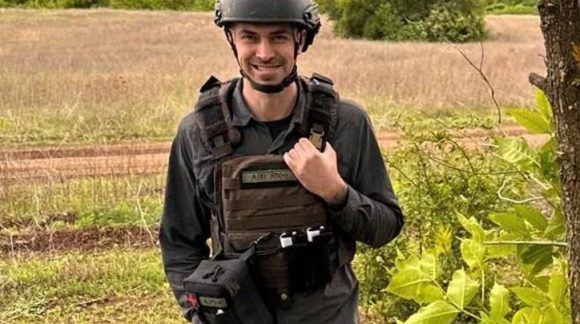

Suspilne Kherson team is working from a rented basement due to constant Russian shelling and targeting of journalists by Russian drones. The basement is now the safest place in the city for the media professionals, Suspilne Kherson manager Mykhailo Svarychevskyi said on 11 February during a meeting between the parliamentary Humanitarian and Information Policy Committee and the Verkhovna Rada’s Temporary Commission to Investigate Crimes against Journalists and Other Media Professionals Committed by Russian Troops, ZMINA reports.
The meeting took place as part of the discussion “Russia’s War Crimes on Ukrainian Territory and Crimes Against Journalists: Suspilne’s Example”.
Svarychevskyi said that Kherson was occupied on 1 March 2022. As soon as late 2 March, five armed soldiers entered the news outlet’s premises and took over the building. The video surveillance system was immediately disabled and the team lost access to the location. Clips that surfaced later on social media showed tripwires installed around the building, unlcear whether for combat or training purposes.
The Russian forces used the Suspilne office as headquarters for their own broadcasting company Tavria TV and started broadcasting their propaganda from Suspilne’s studios.
The Russian troops also searched for local journalists, presumably to create a media outlet subordinate to them and control the information space.
A month after the pro-occupation broadcaster was launched, Suspilne Kherson engineer Oleksiy Vorontsov was kidnapped from his own home at night.
“Oleksiy was detained in a basement for a month, where he was tortured and used as a test subject for various drugs. Then one day they simply threw him out downtown, undressed,” said Mykhailo Svarychevskyi.
It was only three days after the deoccupation of Kherson city on 11 November 2022, when the mine disposal work was completed, that the team was able to enter the building. Only furniture and safes remained inside: the equipment, studios, and machinery were completely looted.
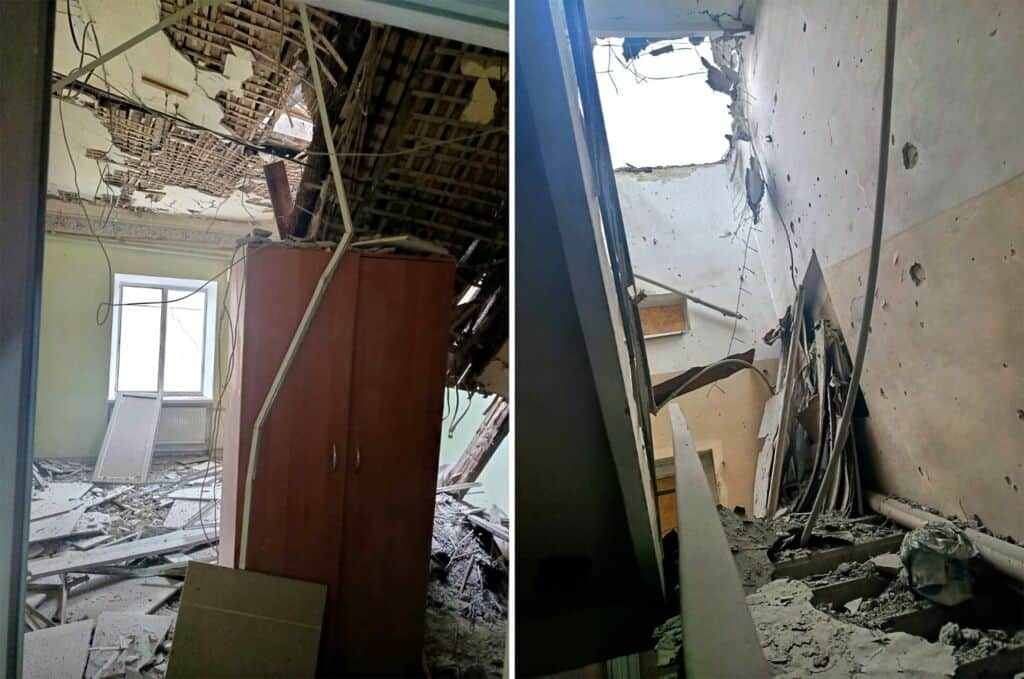
According to Svarichevskyi, peaceful life lasted about ten days, with continuous shelling starting later and continuing to this day. The Suspilne Kherson buildings were affected about ten times: all the windows were broken, the facades were damaged, the roofs were destroyed, the premises became unusable.
Svarychevskyi also mentioned his wounded colleagues. Cameraman Volodymyr Chepynoha was chased by a drone in central Kherson. There was no direct strike, but an explosion nearby resulted in him breaking a leg, suffering burns and skin damage.
The team’s senior engineer Vadym Khomenko was injured by a petal-type mine that the Russian troops have been scattering throughout the city from drones. He suffered an explosive injury and bone fractures, but is already able to move on his own after surgery and rehabilitation.
About 40% of the Suspilne Kherson staff remain in Kherson today. The journalists work in shifts, coordinate with the troops and the police, use drone detectors, film reports quickly and go back to the shelter immediately.
“Being in any part of the city is a risk to one’s life. The enemy is just across the river, and there are no guarantees of safety for our employees or any civilians today,” Svarychevskyi stressed.
Previously
While Kherson city was under occupation, the Russian troops looted the Suspilne Kherson office and used it as headquarters for their own propaganda channel Tavria TV.
The Russian forces took over the Suspilne Kherson office on 3 March 2022, mined the premises and disabled the Ukrainian TV signal.
The Kherson Regional Prosecutor’s Office opened an investigation into the seizure and mining by Russian security forces of the building of the Kherson branch of the Public Broadcaster. The proceedings have been opened under Art. 341, Part 1, Art. 438 of the Criminal Code of Ukraine – seizure of state or public buildings, structures, as well as violation of the laws and customs of war.