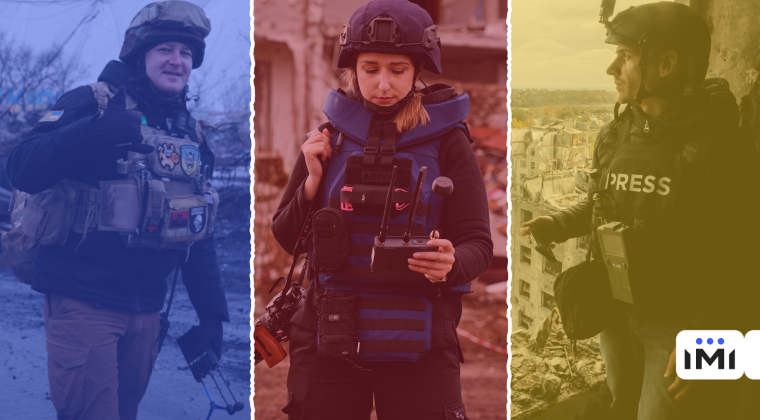

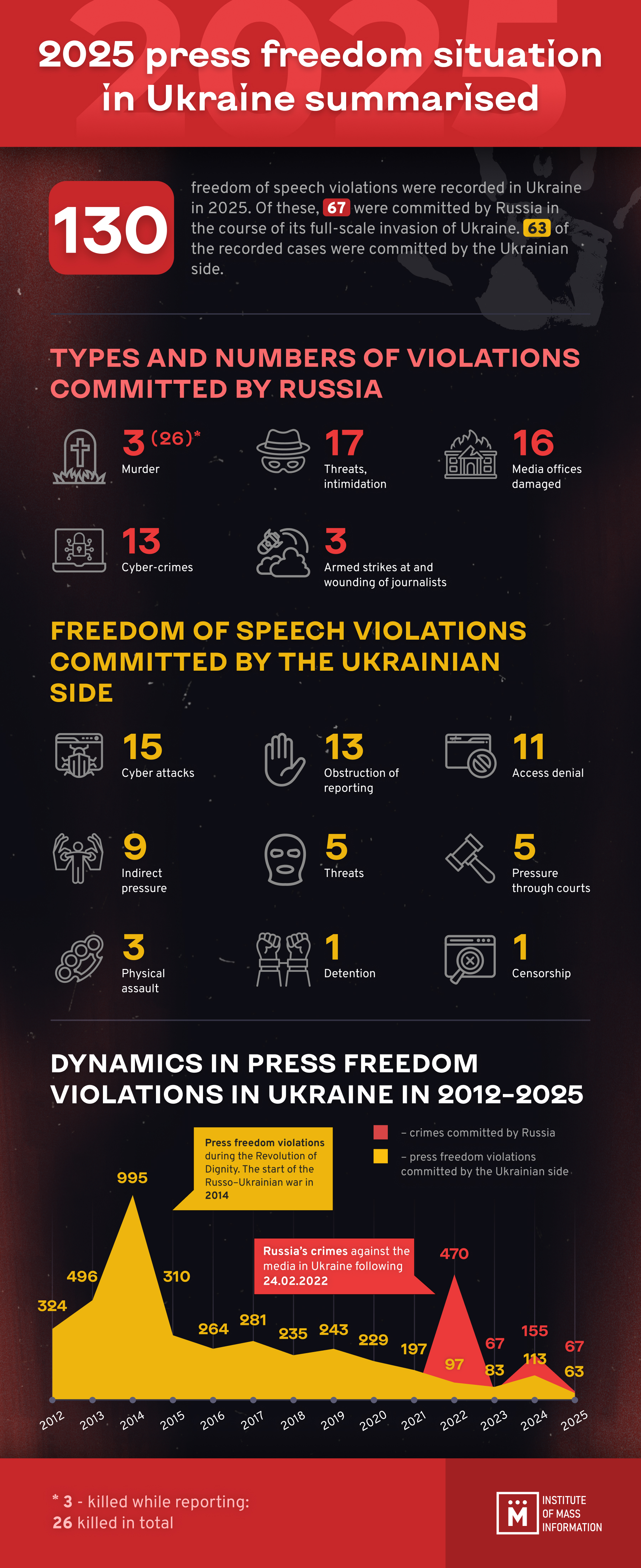
A total of 130 freedom of speech violations were recorded in Ukraine in 2025. Of these, 67 were committed by Russia in the course of its full-scale invasion of Ukraine, as evidenced by the monitoring study Freedom of Speech Barometer by the Institute of Mass Information (IMI).
For comparison: IMI recorded 268 press freedom violations in Ukraine in 2024, with 155 committed by Russia as part of the full-scale invasion. While the number of Russia’s crimes has dropped, a trend has emerged in 2025 of Russian troops deliberately targeting journalists with Lancet or FPV-type drones.
According to IMI’s data, 26 media professionals were killed in the course of Russia’s aggression against Ukraine in 2025 (24 died in 2024), including two women.
Three media workers were killed in Russian drone strikes while reporting:
- Antoni Lallican, French photojournalist, died in a Russian drone strike near Druzhkivka, Donetsk oblast, on 3 October 2025. He has been documenting Russia’s invasion of Ukraine since 2022.
- Alyona Hramova (Hubanova), war reporter with the Ukrainian international channel Freedom TV. Died in a Russian Lancet drone strike in Kramatorsk (Donetsk oblast) on October 23, 2025.
- Yevhen Karmazin, cameraman with the Ukrainian international channel Freedom TV. Died in a Russian Lancet drone strike in Kramatorsk (Donetsk oblast) on October 23, 2025.
22 media professionals were killed in action, with some previously considered missing and their deaths confirmed as late as 2025. For instance, former Fakty journalist Yaroslav Shapochka had been considered missing since March 2023. His death was reported in February 2025.
Ukrinform journalist Tetyana Kulyk died as a civilian casualty when a Russian drone hit her house in Bucha district (Kyiv oblast).
Russian air strikes destroyed or damaged at least 16 media offices in 6 oblasts (both those adjacent to the frontline and away from it) in 2025. The Russian forces also targeted TV towers in Chernihiv and Dnipro, disrupting the broadcasting in these regions.
Moreover, Russian forces have continued to intimidate and threaten journalists. IMI recorded anonymous bomb threats sent to at least 13 news outlets across Ukraine in January–March 2025.
Other Russian crimes recorded in Ukraine in 2025 included:
- attempts to assassinate media professionals;
- armed strikes at and wounding of journalists;
- threats to and intimidation of journalists;
- cyber-crimes;
- news outlets shutting down due to the war;
- pressure through courts.
IMI recorded Russian cyber-attacks targeting both national and regional media outlets in Ukraine. These cyber-attacks were systematic and included DDoS attacks, website hacks, phishing, and impersonation (such as mass-mailing Russian spam on behalf of Ukrainska Pravda). The goal was to limit people’s access to independent information, share fake news, harvest data or pressure journalists psychologically. There are grounds to believe organisations affiliated with Russian special services were involved.
Russia has continued to persecute Ukrainian media workers in the occupied territories en masse for their pro-Ukrainian views. In 2025, Russian courts sentenced Heorhiy Levchenko, Vladyslav Hershon, Yana Suvorova (admins of the Telegram channels RIA Melitopol and Melitopol Is Ukraine), and Vilen Temeryanov (citizen journalist from Crimea) to 14 to 16 years in prison.
IMI experts recorded Russian crimes against media and journalists in 13 regions across Ukraine, including those close to the frontline as well as those located further away.
Russian forces in Crimea consistently pressure Crimean Tatar journalists. The media professionals are being persecuted for their reporting: arrested in absentia (Krym.Realii’s Oleksina Dorohan), fined as “foreign agents” and issued repeated warnings (Lutfiye Zudiyeva), searched and detained for questioning (Lenora Dyulber). These cases demonstrate that journalists in Crimea face systemic pressure and encroachment on their rights.
Freedom of speech violations committed by Ukrainian citizens
IMI experts recorded 63 freedom of speech violations committed by Ukrainian citizens in 2025. This is fewer than in 2024, when IMI recorded 113 such violations. For comparison, 83 cases were recorded in 2023, a total of 97 in 2022, 197 in 2021, and 229 in 2020.
Most violations committed by Ukrainians in 2025 belonged to the following categories:
- cyber-attacks – 15 (compared to 23 in 2024, 11 in 2023);
- obstruction of legal reporting – 13 (21 in 2024, 29 in 2023);
- denial of access to public information – 11 (18 in 2024, 20 in 2023);
- indirect pressure – 9 (19 in 2024, 3 in 2023);
- threats and pressure through courts – 5 each;
- physical assault – 3 cases.
Most violations of journalists’ professional rights in 2025 were committed by individuals, local government bodies, officials, and law enforcers.
The year’s high-profile cases included:
- surveillance and stalking of investigative journalists with hromadske, Bihus.Info, Kyiv Independent.
Violations were recorded in 20 regions across Ukraine. As usual, most were committed in Kyiv city and oblast (26 cases). Poltava and Khmelnytskyi oblasts ranked second (4 cases each), followed by Dnipropetrovsk, Kirovohrad, and Rivne (3 cases each).
Read more about the press freedom situation in Ukraine in the Freedom of Speech Barometer section of the IMI website.
The Institute of Mass Information (IMI) is a civil society organization specializing in the media, operating since 1996. IMI defends the rights of journalists, studies the media landscape and reports on media-related events, fights propaganda and disinformation, and provides media workers with safety equipment for trips to combat areas (since the start of the Russo–Ukrainian war in 2014).
IMI carries out the only monitoring study of freedom of speech in Ukraine, keeps a list of transparent and responsible online media outlets, and tracks Russia’s media crimes in the war on Ukraine. IMI has representatives in 20 oblasts of Ukraine and runs a network of Media Hubs that provide journalists with unfailing support. IMI’s partners include Reporters Without Borders (RSF); the organization is also a member of the International Freedom of Expression Exchange (IFEX).