

Ukraine’s energy infrastructure has been at its limit following Russia’s strikes on the power grid. Ukrainian authorities reported on 3 February that hundreds of apartment buildings in Kyiv were left without heating, while residents in some areas were experiencing power, heat, and water outages all at once.
Russia’s systematic targeting of Ukraine’s energy system and the harsh weather have resulted in cities across Ukraine facing a difficult situation in terms of electricity, heat, and water supply. IMI lawyers, as well as officials, view such strikes as a crime against humanity. The Geneva Convention (Protocol I) also defines them as a war crime.
Really though, one does not need to read international conventions or consult with lawyers to understand the scale and purpose of these crimes. They need only imagine spending frosty winter nights with no power, heating, or water. It becomes obvious that Russia is targeting not infrastructure elements, but people. The Institute of Mass Information studied what reasonings of what is rather clearly a crime against humanity Russian propagandists have been offering to their citizens.
Denying the obvious
Focusing on coverage of Ukraine’s energy crisis while perusing Russian Telegram channels shows a typical pattern. They admit the strikes occurred, but deny that civilians were the target. Or significantly downplay of the impact on civilians.
For instance, the Russian pro-war channel Zloy Proof first reports strikes at the CHPP-4, CHPP-5, and CHPP-6 in Kyiv and the 750 kV Kyivska substation, and then comes in with “follow-ups”, saying that the affected facilities were “critical military infrastructure.” The person running this Telegram channel claims that Kyiv residents complaining about the utility collapse in the city is “Khokhols’ propaganda,” adding that they do not believe it, and calling on their audience not to believe it either. The propagandist concludes by saying that they do not care at all what is happening to Ukrainians, because they are tired of “feeling sorry for the brother nation.”
This channel alleges that footage of Kyivans sleeping in the subway is staged and is “Ukrainian propaganda at work.” According to them, this is fake news meant for the Western press: supposedly, to fish for more financial aid.
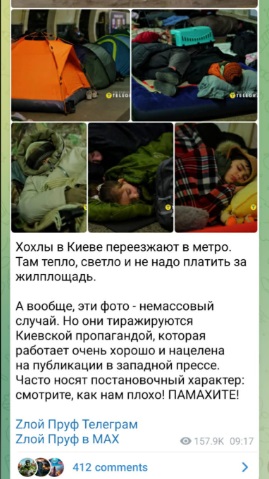
“Khokhols in Kyiv are moving to the subway. It’s warm and well-lit, and you don’t have to pay rent. Really though, these photos are not a widespread phenomenon. But Kyiv’s propaganda, which works very well and whose goal is news in the Western press, is peddling them. They are often staged: look how miserable we are! HALP!”
Screenshot from Zloy Proof on Telegram
Russian propaganda now acts as moral anesthesia for the domestic audience. The strikes on the energy grid are framed not as violence against civilians but as just another operation against the Ukrainian army, nothing wrong with that.
To take another example, Russian propagandist Vladimir Soloviev claims in his Telegram posts that the strikes do not affect civilians but are targeting “the energy and transportation facilities used by the Ukrainian Armed Forces.” He is trying to “reclassify” civilian objects as legitimate military targets while offering no facts, evidence, or specifics to justify it. Saying the magic words “the UAF are using them” is enough for the Russians to automatically absolve themselves of responsibility (in their imagination, of course).
Soloviev’s fellow propagandist Zakhar Prilepin repeats the same talking point, claiming that Russian strikes on the Ukrainian energy grid are not terrorism against civilians but only aim to “disable the military enterprises.”
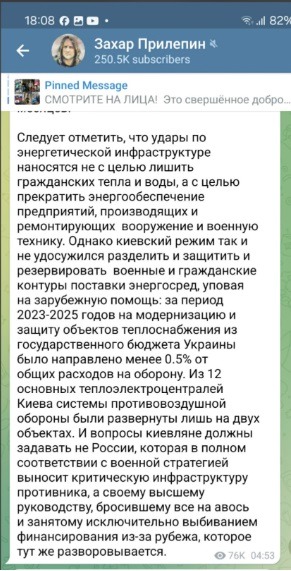
“It should be remarked that the energy grid strikes aim not to leave the civilians with no heat or water but to disable the power supply to the enterprises producing and repairing weapons and military vehicles. However, the Kyiv regime still has done nothing to draw the lines between military and civilian supply chains or to defend and reserve them, relying on international aid: less than 0.5% of Ukraine’s defense spending in 2023–2025 was allocated for upgrading and fortifying heating facilities. Air defense systems were only installed in two out of 12 major combined heat and power plants in Kyiv. And it’s not Russia, who is disabling the enemy’s critical infrastructure in full accordance with warfare strategy, that the Kyivans should take their questions to, but their own top officials, who have left everything to chance and devote all their time to angling for funding from abroad, which gets embezzled immediately.”
Screenshot from Zakhar Prilepin on Telegram
Yet no propagandist can explain how exactly a strike influenced the battlefield situation. And they all keep quiet about their crimes’ terrible impact on the civilian population.
The Russian pro-state Telegram channel Voenkor Kotenok also writes that the energy crisis in Ukraine is an “overstatement.” It claims that if civilian energy infrastructure had really been affected, it could not have been repaired so quickly. Voenkor Kotenok claims to have analysed their own classified data (of unclear origin, but the Russian audience is undemanding) and found that in reality the damage to civilians was insignificant and Ukrainians simply “cry a lot.”
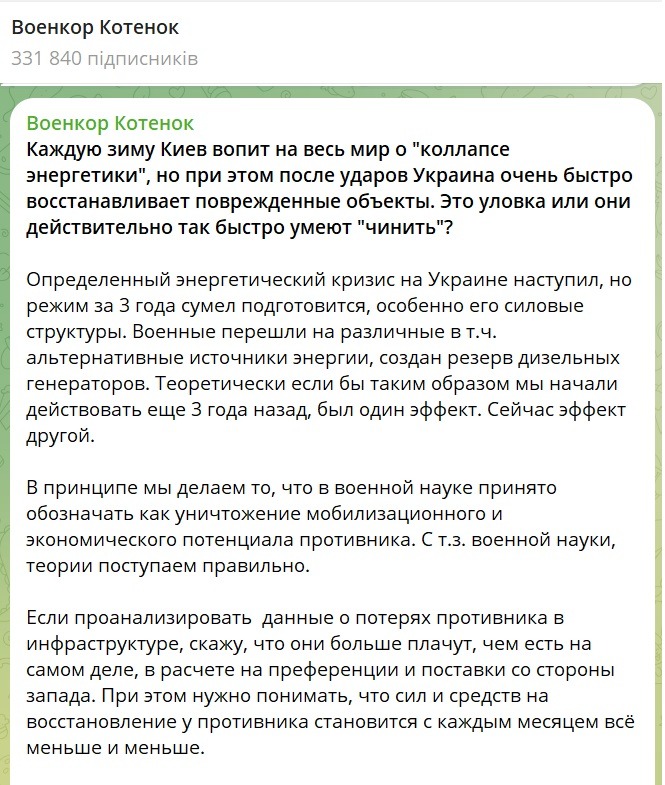
“Every winter Kyiv is yowling about an ‘energy grid collapse’ to the entire world, yet Ukraine is very quick to repair the damaged facilities after the strikes. Is this a ruse or are they really this fast at fixing things?
“Ukraine has been facing an energy crisis to some extent, but the regime, especially its enforcement bodies, was able to adapt in these 3 years. The military has switched to various energy sources, incl. alternative ones, and a diesel generator reserve has been created. In theory, if we started doing things like this 3 years back, we’d have one effect. Now the effect is different.
“We are basically doing what the science of warfare generally defines as crushing the enemy’s mobilisation and economy capabilities. As far as warfare is concerned, we are doing it right.
“Having analysed the data on the enemy’s losses in terms of infrastructure, I can say that they’re crying louder than warranted, counting for preferential treatment and supplies from the West. We should realise that the enemy’s energy and means for repairs are dwindling with every month.”
Screenshot from Voenkor Kotenok on Telegram
The absolution mechanism
This rhetoric is meant for several audiences at once and aims to cover up the crimes. For the domestic consumer in Russia, the propagandists’ claims work as an anesthetic against moral discomfort. Here, have a potion mixed following the recipe: “We are targeting the military, not civilians.” Treat your cognitive dissonance and stay in denial of the obvious fact that your country is a bloody aggressor and you are part of the aggressive machine.
For the audience abroad and those who have doubts, Russian propaganda creates a fog of uncertainty. This is war, therefore everything is complicated and even the word “crime” can be diluted down to a debatable label now.
Lastly, this is preparation for the future. They are preventively shaping their version of the story so that diplomats, loyal “experts” and perhaps, someday, their representatives in international courts have something to parrot whenever they have to justify or whitewash the strikes that have had a very serious impact on Ukraine’s population.
This absolution mechanism is built in several stages. First, admitting that there were strikes. In this way, propagandists create an impression of “honesty.” Next, redefining the targets as “military facilities” and downplaying the consequences. Instead of saying straightforwardly, “We struck the city,” they keep it impersonal: “The strikes do not affect civilians, only military targets.” Next, discrediting testimonies by civilians (claiming they are “staged” or “Ukrainian propaganda,” etc.). Finally comes the moral inversion: the aggressor ends up in a “defensive” position (“it was a military necessity”).
In essence, these methods are meant to sow doubt in what is obvious, to blur the line between civilian and military targets, and to numb the empathy for the victims.
We can see clearly that what is happening is not occasional strikes at individual targets but a purposeful strategy: to inflict maximum damage on Ukraine by making the basic survival conditions significantly worse and depriving the people of heating, light, and water at a time when the winter is harshest. This strategy involves making the Russian audience numb to the strikes with the help of language tricks and claims that the affected facilities were “military targets.”
The propaganda channels on Telegram do nothing to prove the military necessity of the strikes and say nothing of proportionality. Instead they offer a primitive universal alibi, dismiss the testimonies by Ukrainian civilians and blame the victim. As a result, the fight is taking place on two levels at once:
- on the ground, where people are freezing in the dark;
- in the information space, where one side tries to call the darkness a “necessary operation.”
It is very important to call a spade a spade and track the impact of Russian crimes: this will prevent Russian propaganda from replacing reality. Strikes that predictably turn entire cities’ worth of people into hostages of the cold are an attack on civilians. No matter how many times Russian terrorists repeat that “this is not about the people.”