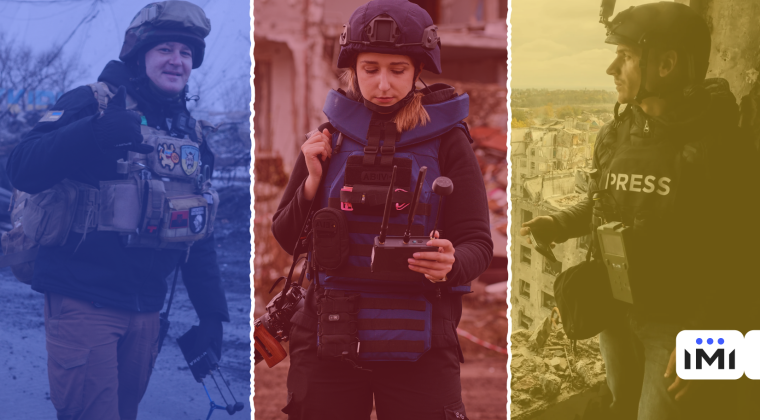
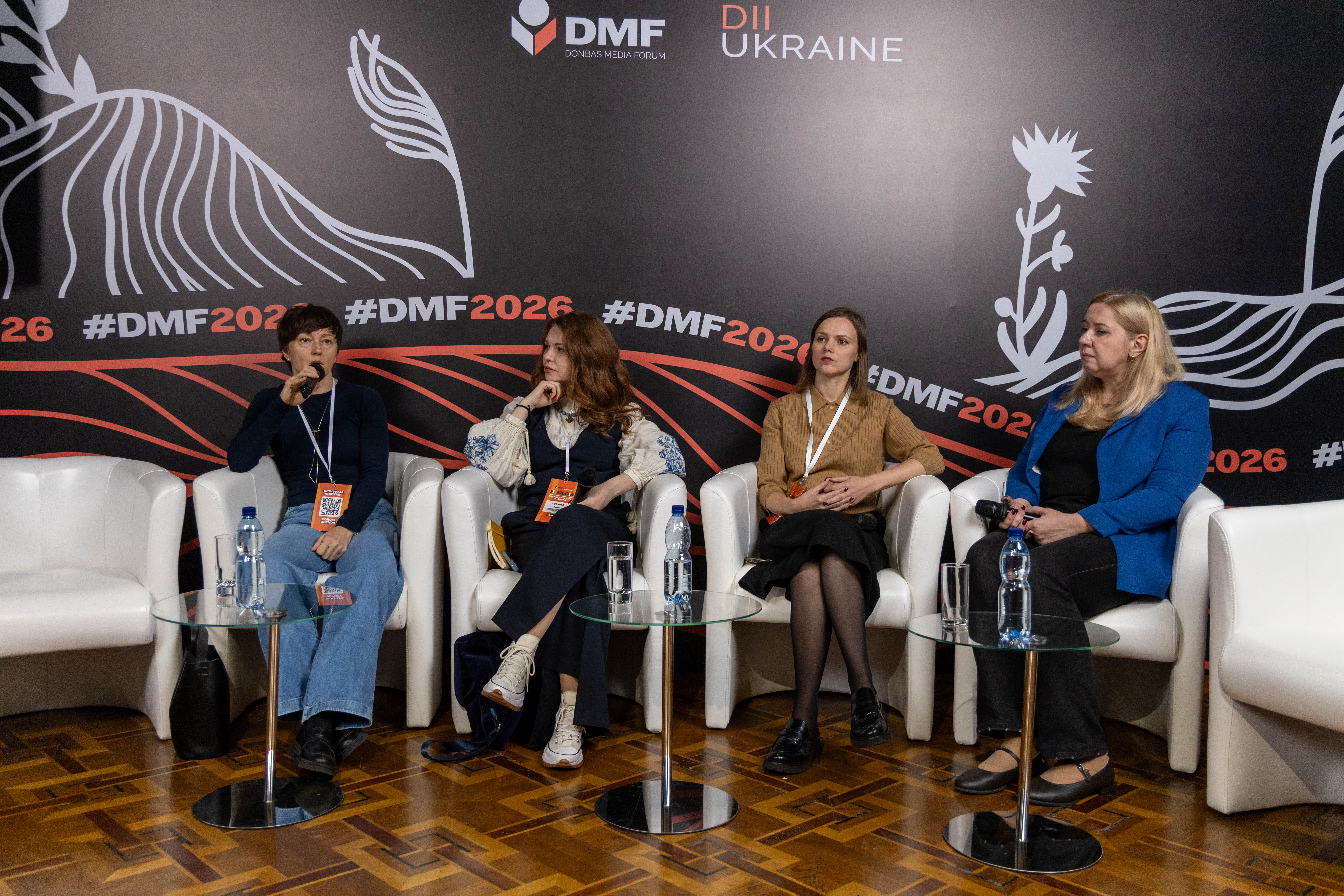
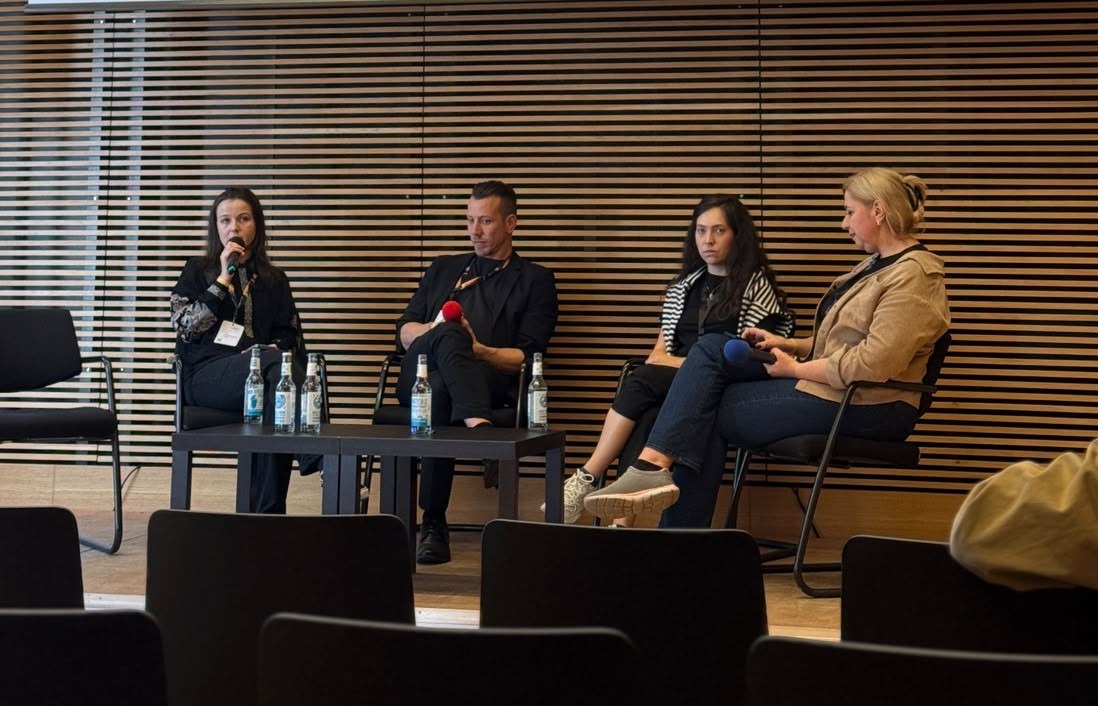
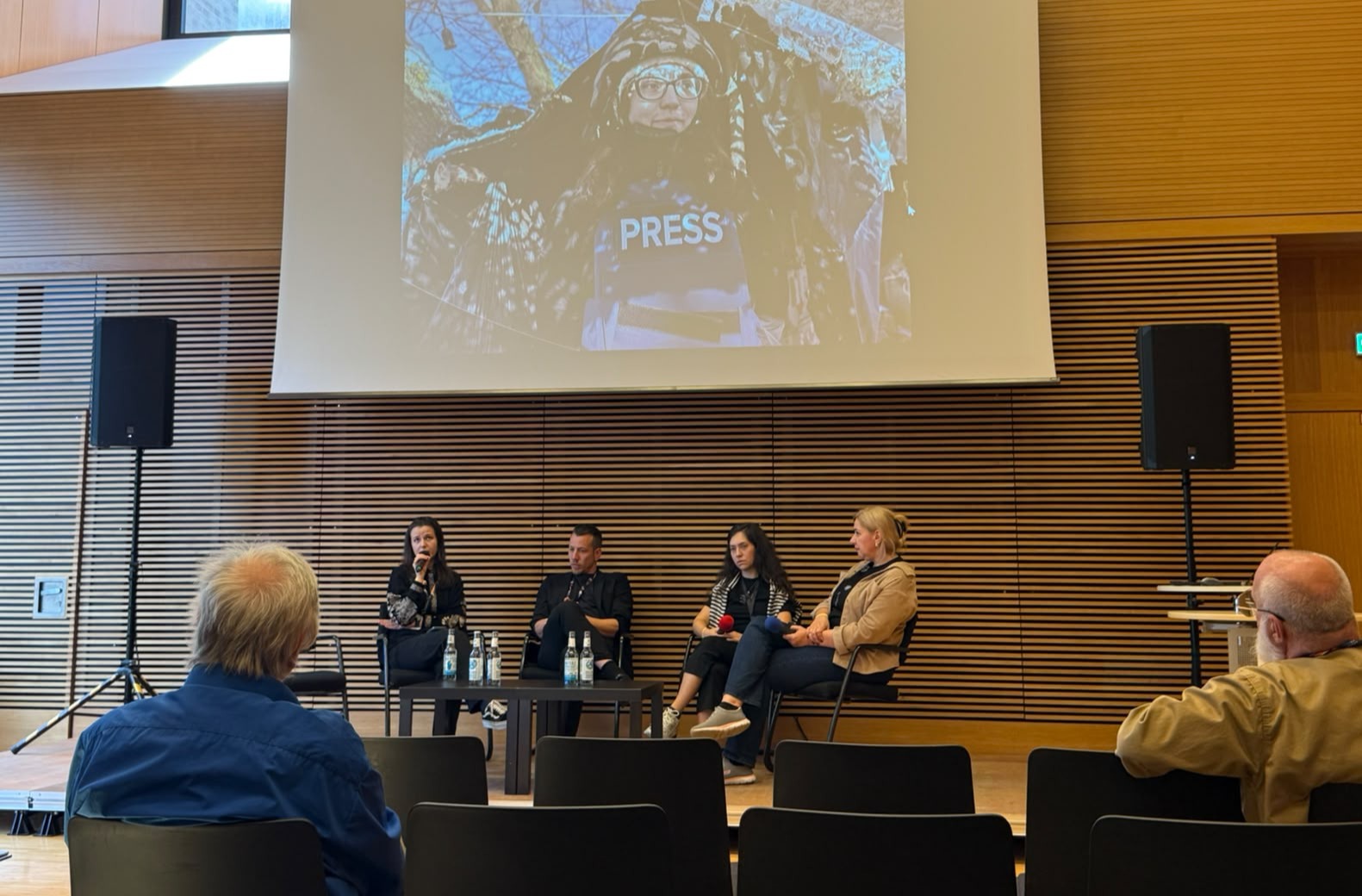
In Ukraine, a flak vest and a bright “PRESS” label no longer protect journalists. Drones have changed the battlefield and battlefield reporting. This was the key message of the panel “Journalist Safety in the Age of Drones. Lessons from Ukraine“, held by the Institute of Mass Information (IMI) at the b° future festival in Bonn on 3 October.
Exactly a year earlier, a Russian drone killed French photojournalist Antoni Lallican in eastern Ukraine and severely wounded his Ukrainian colleague Heorhii Ivanchenko. According to IMI, 142 media workers have been killed in Ukraine since the start of the full-scale invasion and up to the date of writing, including 15 who died while reporting. 15 more were deceased as civilian casualties and 112 were killed in action while defending their homeland.
“When the war started, we were relying on international protocols: wear a blue bulletproof vest, mark yourself as press, identify yourself everywhere, and artillery is your biggest threat. But everything has changed,” said IMI Director Oksana Romaniuk.
Drones are killing frontline reporting
Diana Butsko, a hromadske journalist, started reporting from the front line in June 2022. She remembers the winter when the battle for Bakhmut was unfolding, when journalists could simply drive to the front line, step out of the car and talk to soldiers.
“When I think about 2022, it was like a dream, like another world,” she said.
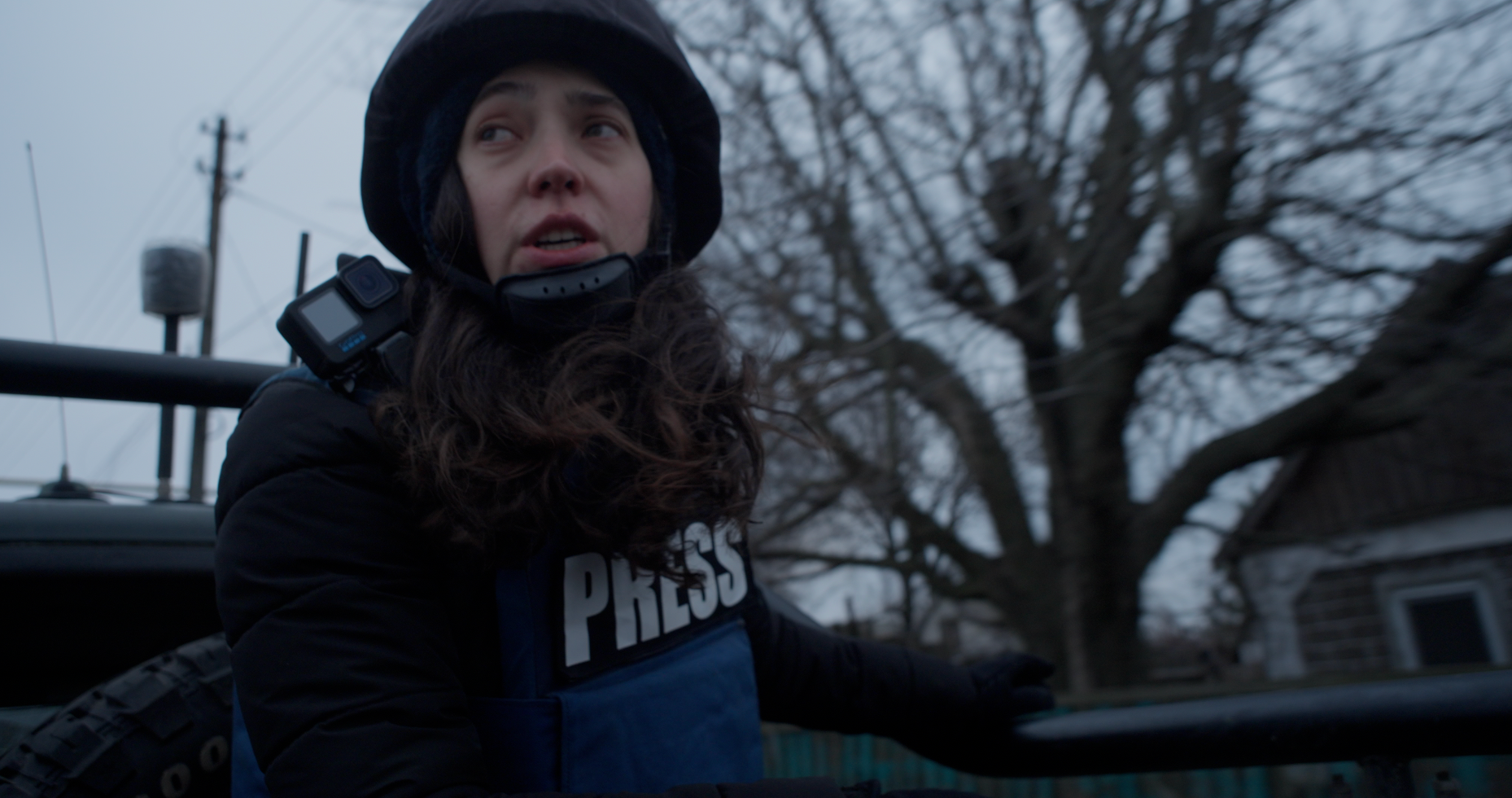
Today a car can only take a reporter so far. On her latest trip, a week before the festival, Butsko’s crew drove a few kilometres, switched to quad bikes for about 10 km and covered the rest on foot, walking around 24 km a day while carrying their equipment. “If you are reporting from the front line, you definitely better go to the gym,” she said.
The reason is drones. A drone’s reach now defines the kill zone, spanning 10 to 20 km from line zero, and within it anything that moves is a target. Instead of trenches, journalists increasingly end up in battalion headquarters, watching the battlefield on commanders’ screens.
“That is a big pain for me, because I want to show the soldiers who are holding the line,” Butsko said. “Drones are killing frontline reporting.”
She warned that this problem is not specific to Ukraine: drone warfare is spreading to every battlefield, and terrorist groups are getting access to drones as well.
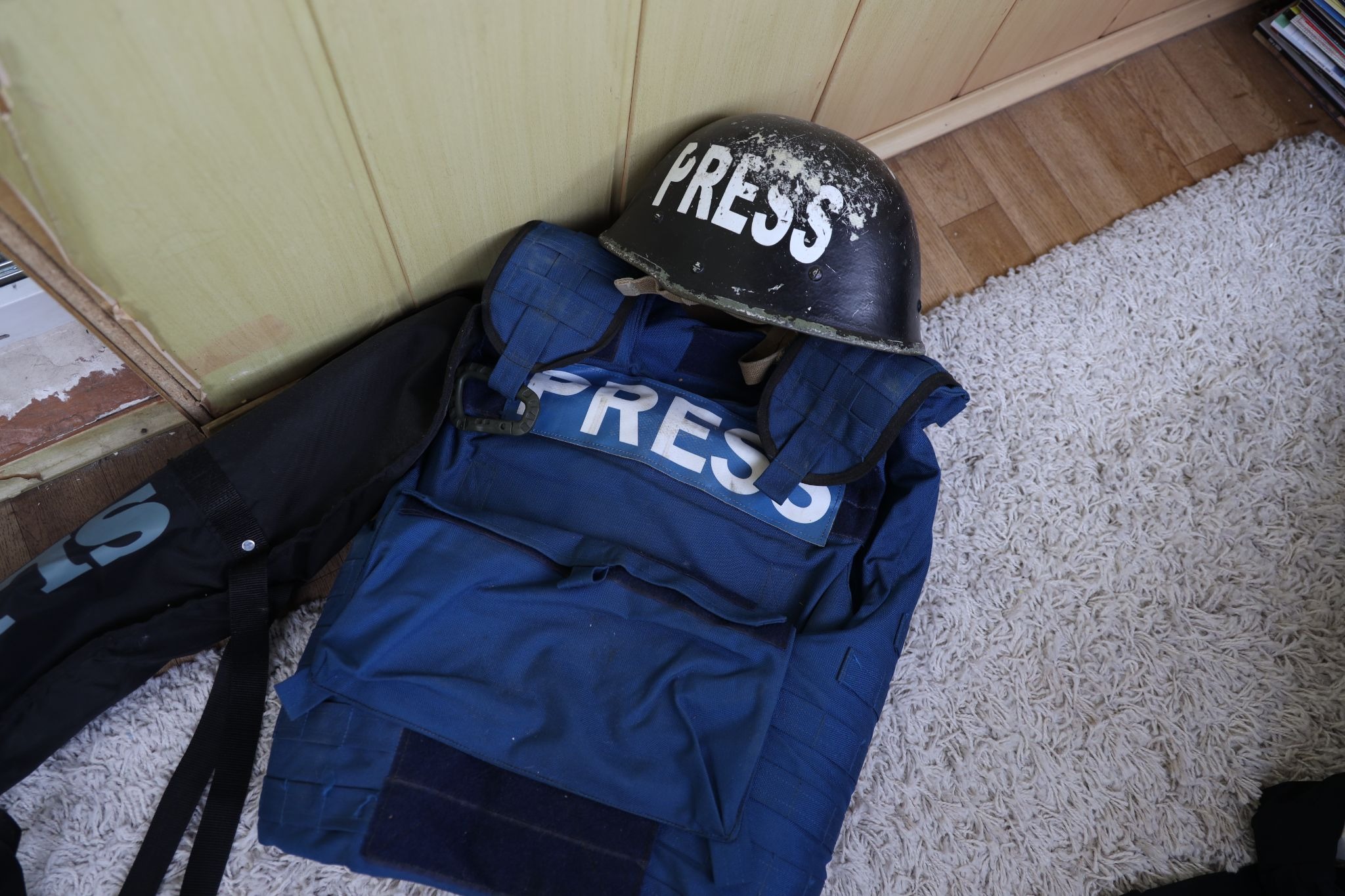
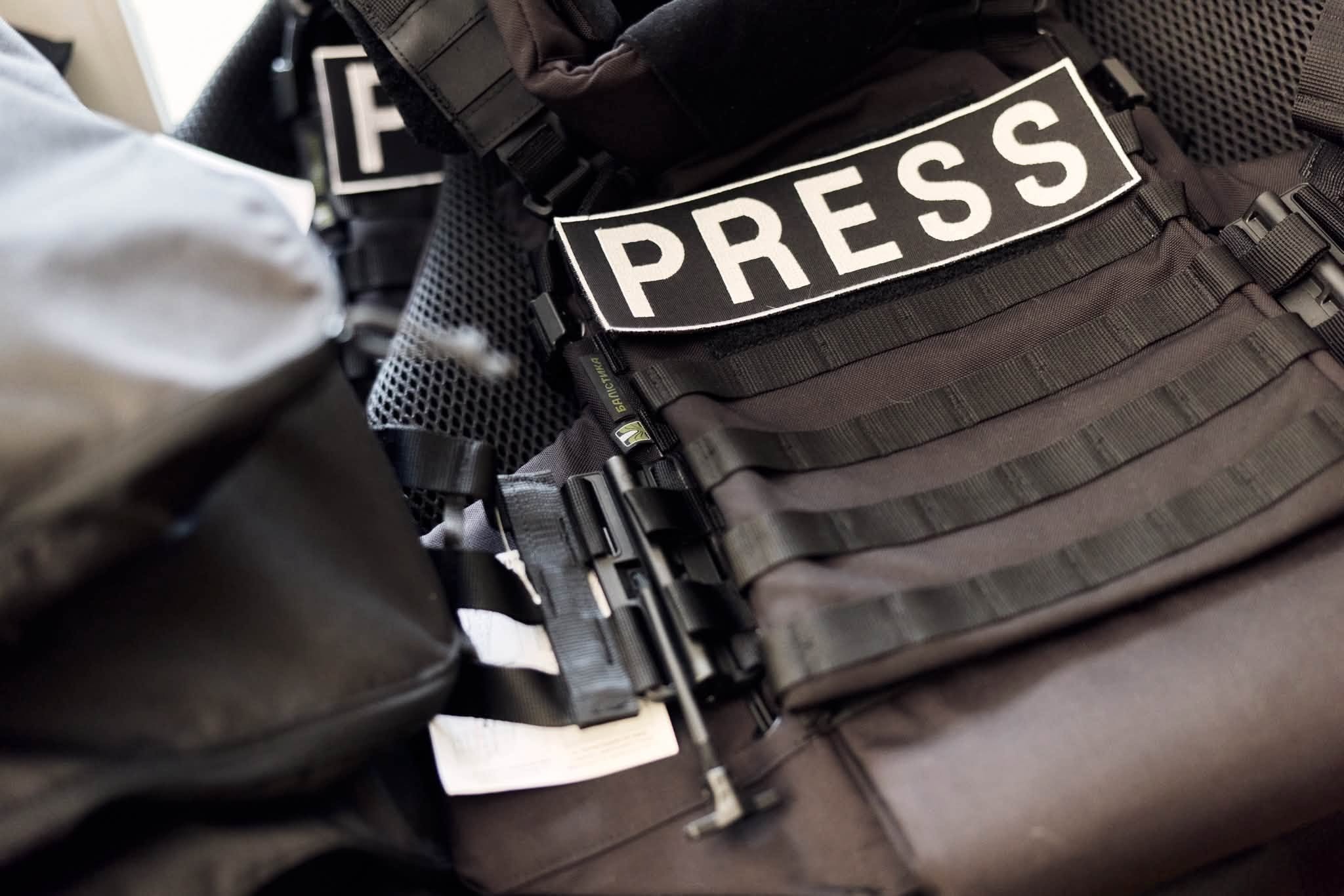
PRESS insignia as an invitation to strike
Patrick Enssle, a German reporter with military background, was blunt about the old advice to mark vehicles and vests with “PRESS”.
“This is probably the best invitation you can give for a drone to come at you,” he said. “Wearing press insignia brings you nothing, and not only in Ukraine. Even though it’s written in international law, forget about it, especially on the Russian side.”
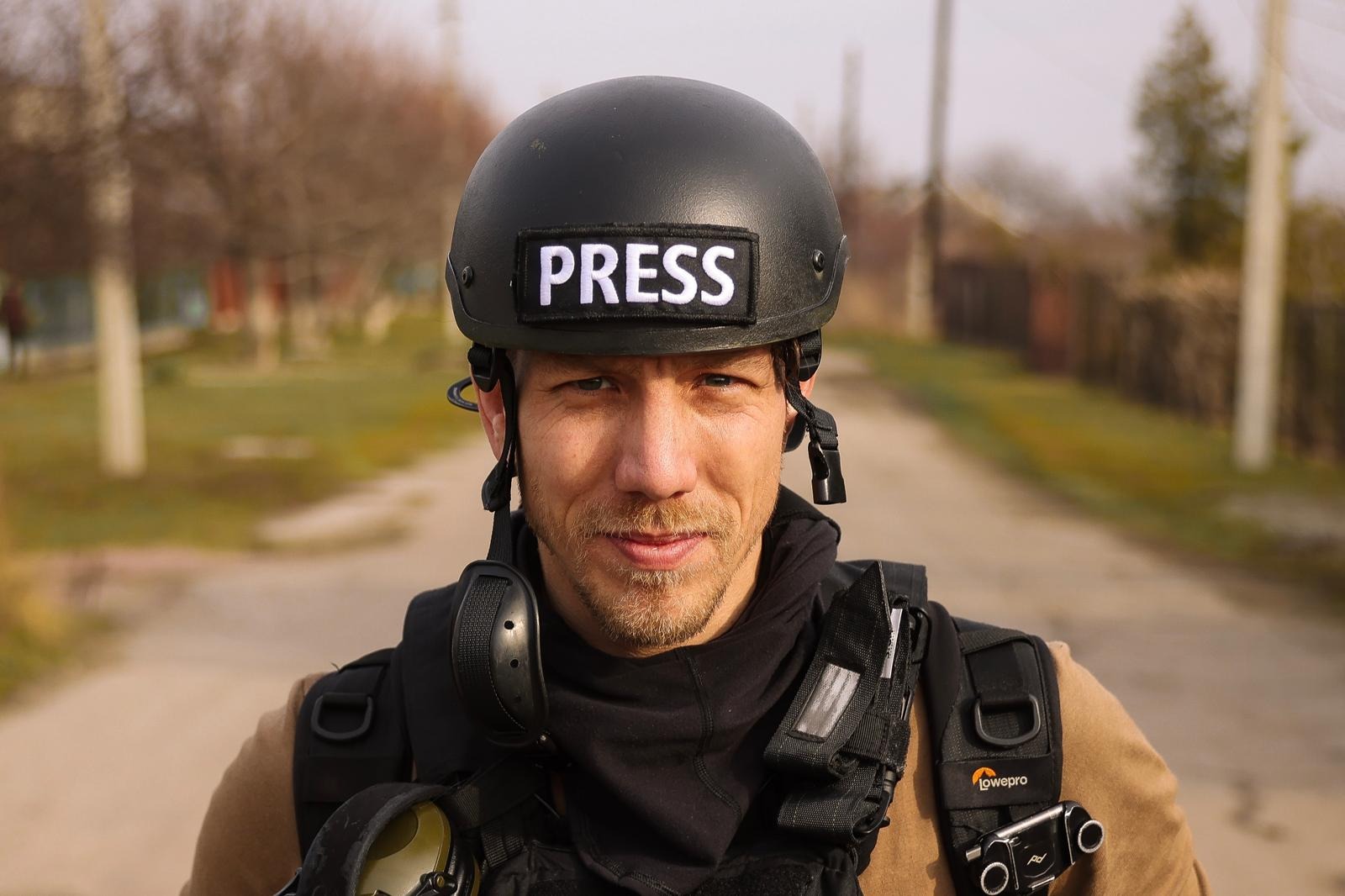
He explained that Russian drone operators who have lost their original target while running low on battery look for any other target nearby. After soldiers come people in uniform, such as firefighters, police, and evacuation teams; then reporters, “because we have media impact”; and then civilians.
IMI Deputy Director and Head of Communications Hanna Chabarai described the resulting situation as total impunity.
“A drone operator sees precisely what he is targeting. He sees every press sign, every camera on you,” she said. “The Geneva Conventions say that deliberately targeting a journalist is a war crime, but the drone operator knows that no one will come after him. So the safety of journalists is in the journalists’ own hands.”
Kevlar, drone detectors, net guns
The gear has had to evolve as fast as the threat did. Enssle said the classic vest with ceramic plates is built to withstand gunfire, which journalists rarely face now. Instead the main danger is shrapnel from drones, so he has switched to Kevlar armour that covers as much of the body as possible.
The battlefield soundscape, he said, is a constant buzz of drones overhead. Is it a surveillance drone or an attack drone? Is it Ukrainian? Has it spotted you? On one recent mission, his crew had to take cover in the bushes three or four times. “You need to see yourself from this predator’s view, like a bird, and you are a mouse on the ground,” he said. “There are just two things you can do: hide and take cover.”
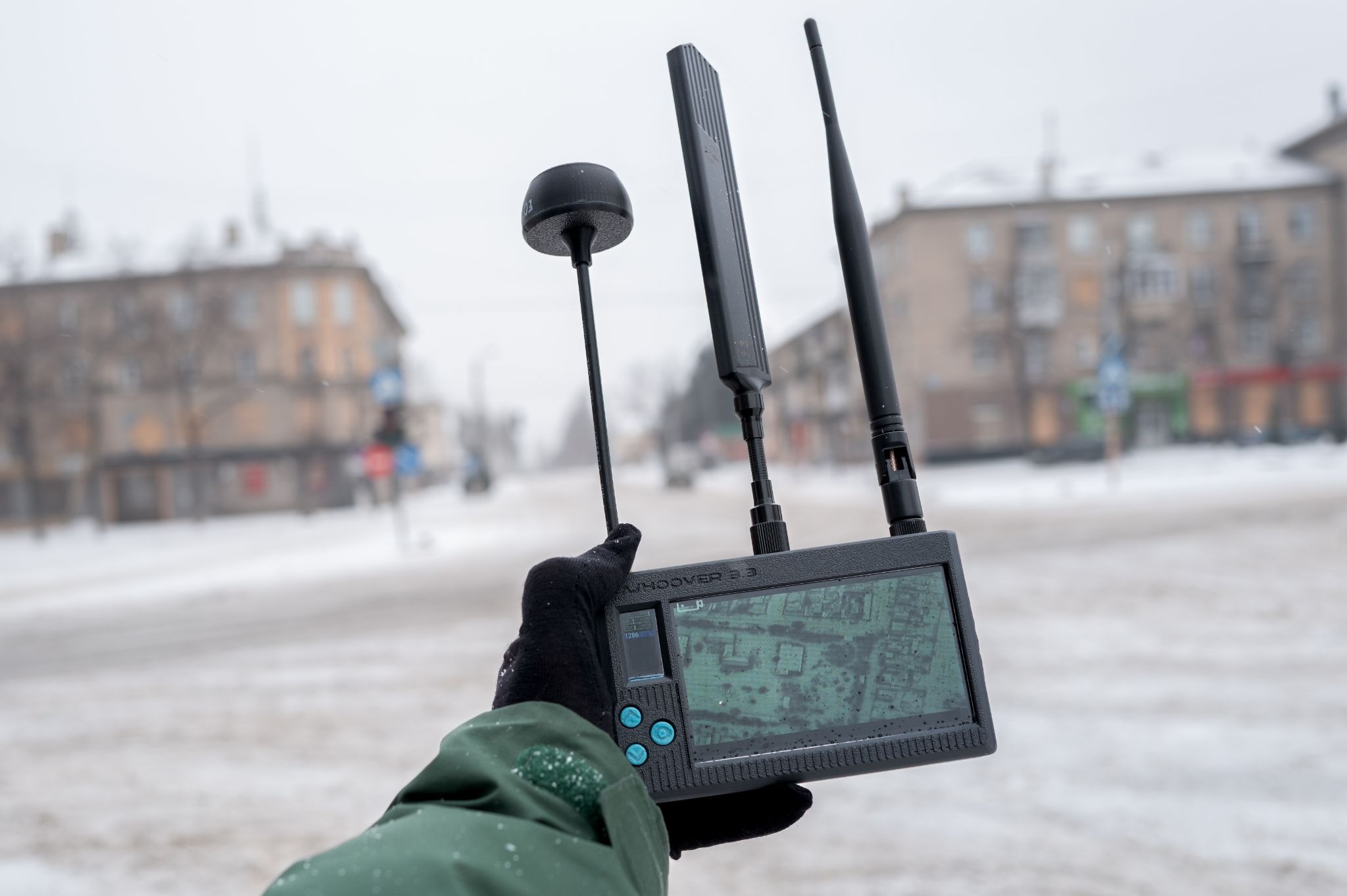
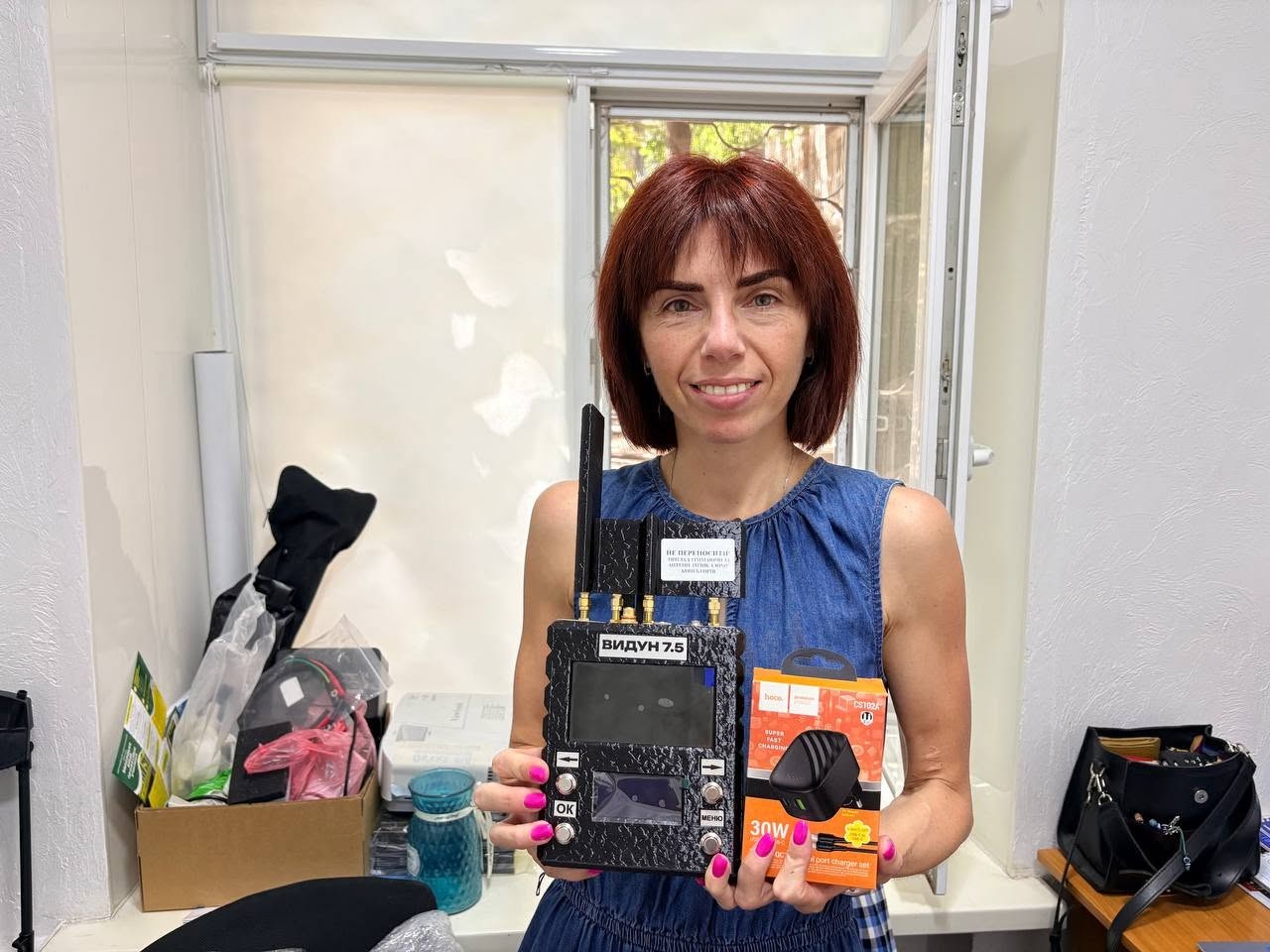
Drone detectors help, but they do not guarantee anything. A detector scans radio frequencies to catch the link between a drone and its pilot, and the range in use keeps shifting. A new frequency can appear overnight. Fiber-optic drones cannot be detected or jammed at all. On his last day on the battlefield, Enssle saw the barely visible thread of a fiber-optic cable outside his window. “I realised: okay, this has just arrived here. It can change from one day to the next.”
He now also carries a net gun, a small device that is legal in Ukraine but not in Germany. “It’s the very last line of defense,” he said. The drone still comes down, but may land a little further away, “which can save your life.”
Butsko said learning to use a detector takes about a day, thanks to video tutorials by manufacturers, but it is only one part of preparation. She relies heavily on the units she is embedded with, which have far better situational awareness, and on planning: “Discuss the logistics ten times with the person you are going to the front line with.”
Those who come to get you out
Enssle was bluntly critical of some well-known reporters with privately owned media outlets in Germany, whom he described as untrained and poorly equipped. “The good desperado times are definitely over,” he said.
It is never just the journalist taking the risk, he stressed. If something goes wrong on the battlefield, it is not a foreign army that evacuates you. It is Ukrainian medics and evacuation teams. “You are risking at least another four to eight people just to get you out of there,” he said, adding that the drive to a safer place was the most dangerous stage.
The three levels of responsibility
Romaniuk framed journalist safety as a responsibility shared at three levels. The first is personal: a reporter has to be prepared, trained, and properly equipped. The second lies with media organisations, news teams, and media NGOs. The third lies with governments and international institutions.
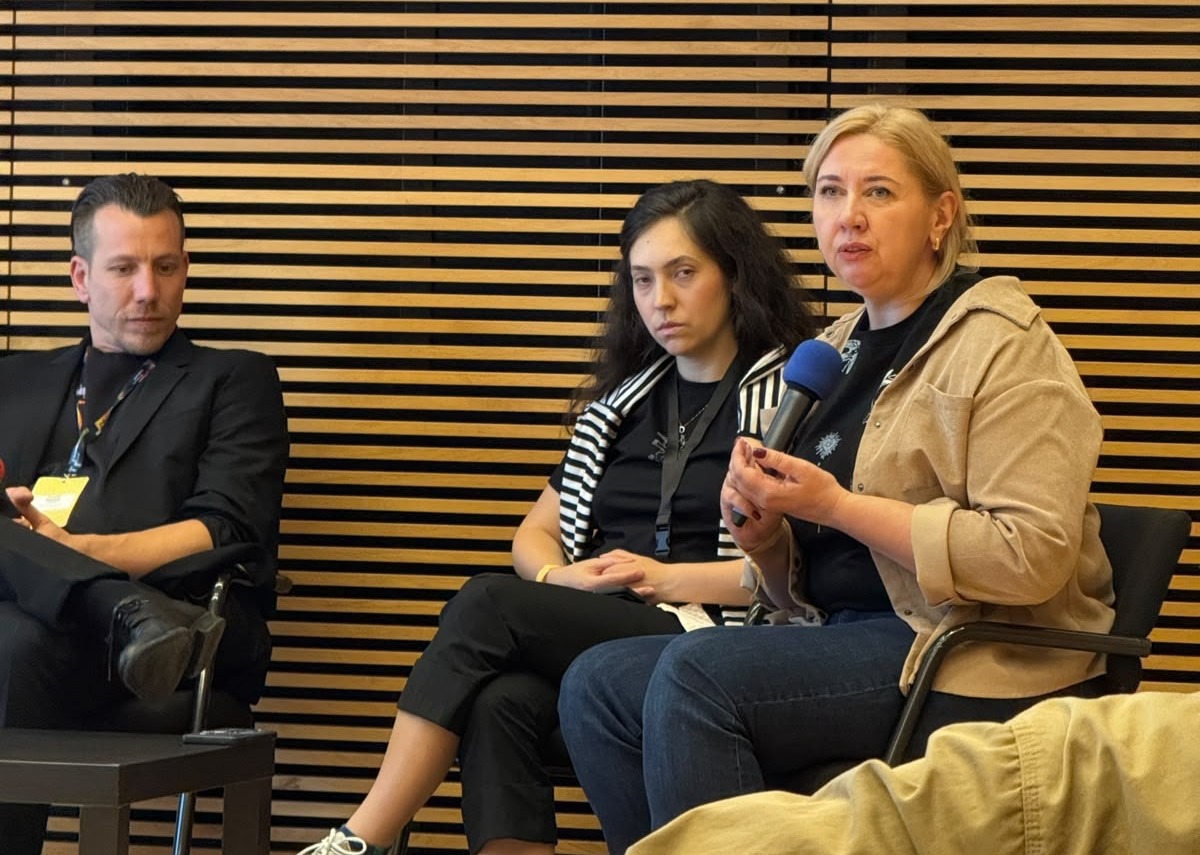
At the organisations level, IMI offers body armour, helmets, first aid kits, and drone detectors to journalists. Chabarai said that detectors had been a hard sell for a long time.
“We have had some issues with drone detectors, because earlier our international donors were hesitant about them. Drone detectors were something strange, a grey zone in the protocols. Donors thought it was military equipment, so they couldn’t fund it,” she said.
“Drone detectors were regarded as something you should never take into your hands, as if your hands would fall off,” Romaniuk added.
That is changing. IMI bought 27 drone detectors through a joint fundraising campaign with The Kyiv Independent, and international organisations, including UNESCO, have started to invest in them as well.
Small outlets feel the gap most acutely. Speaking from the audience, Anastasia Rudenko, who leads the Ukrainian solutions journalism outlet Rubryka, said her team had no safety instructor or drone detector, yet their reporters still made trips to frontline regions. International outlets have insurance, drivers, and safety protocols; local media do not.
“That’s why I think the model of a locally grounded media ecosystem, where organisations like the Institute of Mass Information support other independent media outlets, is so important,” she said.
“There is no picture that could stop the war”
The discussion turned to the ethics of reporting about grief. Chabarai spoke about Kyiv-based photographers coordinating through a group chat after each strike: they have agreed among themselves not to take pictures of dead bodies or vulnerable people and not to show the faces of children.
Images of the dead still circulate, often shared with a conviction that the world must see this. “After four and a half years, we can say that the world doesn’t really want to see it,” Chabarai said. “Who reacts is the relatives and friends who recognise the people or their houses. They are shocked and traumatised.” IMI’s advice is clear: don’t post such images. “There is no picture that could stop the war. We used to think there was.”
Enssle, who teaches media ethics in German schools, gave an example of a line being crossed. A Ukrainian prisoner of war was executed, and his mother learned about it when she saw the footage on Facebook. Three days later, she was giving an interview to Axel Springer. “People in such cases are very vulnerable. They want to share their grief, and you take advantage of it,” he said. “For me, this is an absolute no-go.” He said that even when a year has passed since the loss, he and his partner weigh carefully whether an interview might retraumatise the person.
The toll of the job
For Butsko, strikes on civilians are a more difficult topic to report on than battlefield developments. “It’s much easier to report from the front line than to talk to an elderly lady who lost everything in her apartment, or a mother who has just lost her son after a missile hit their home,” she said. “I would take 100 days under drones over reporting these stories.”
Asked how journalists coped, she described the weight as coming from several directions at once: the job itself, having friends and relatives in the army, and nightly strikes on Kyiv that deprive you of proper sleep. Instead, people in Kyiv spend their nights in underground shelters crowded with people and pets. Going to therapy, joining retreat programs in the Carpathians, and simply talking to her loved ones helps. “Don’t be alone with all these horrors,” she said. “We all have a shared experience, and it helps to talk it through.”
Romaniuk, who leads a team of almost 60 people, said IMI tries to stay flexible and lets staff take a day off when they need it. “But we still pay the price on the physical level all the time.”
Attention wanes
Enssle said waning interest is a natural pattern in every long war, but it shapes what reaches audiences. In 2022 and 2023, a freelancer could sell almost any story from Ukraine. Now German broadcasters want a German angle. “Without a German angle, you can forget your story right away,” he said, even if it is a most heartwrenching story about a child.
Public broadcasters abide by strict safety rules that keep their crews away from the most dangerous areas. That, he argued, is why outlets such as Axel Springer, which operate with fewer limits, have become so prominent in German coverage of the war.
What needs to change
Hanna Chabarai said that donors and media outlet owners should make room for drone detectors in their budgets. Safety coaches and newsrooms need to update their training and start teaching journalists what sounds drones make, where to take cover, how to use detectors and how to avoid detection. Governments and international organisations should treat drone strikes on journalists as war crimes, collect evidence, identify the army units responsible, and bring them to account.
“Maybe then the word PRESS will mean protection again,” Chabarai said. “I want to see us all someday watching Russian war criminals receive their sentences.”
Asked what kind of reporting from Ukraine would help sustain support in Germany, Romaniuk called for two parallel tracks of coverage. The first should show what Russia is doing: the strikes on civilians, warehouses, bridges and schools. She said she has been keeping her son at home instead of going to school for fear he would not get to a bomb shelter in time. The second track should show action: the solidarity, networking, and resilience counteracting Russia’s fearmongering propaganda.
“People are fed up with these stories. We are fed up with them too,” she said. “Yes, we are slowly dying, but we are fighting. We still have solidarity, we still have hope, and we want to show you that we are part of your world.”
We also recommend reading the Institute of Mass Information’s explainer as to why outdated international humanitarian law provisions no longer protect journalists.
The Institute of Mass Information (IMI) is a Ukrainian non-governmental organization specialising in the media, operating since 1996. IMI defends the rights of journalists, studies the media landscape and reports on media-related events, fights propaganda and disinformation, and provides media workers with safety equipment for trips to combat areas (since the start of the Russo–Ukrainian war in 2014).
IMI carries out the only monitoring study of freedom of speech in Ukraine, keeps a list of transparent and responsible online media outlets, and tracks Russia’s media crimes in the war on Ukraine. IMI has representatives in 20 oblasts of Ukraine and runs a network of Media Hubs that provide journalists with unfailing support. IMI’s partners include Reporters Without Borders (RSF); the organization is also a member of the International Freedom of Expression Exchange (IFEX).