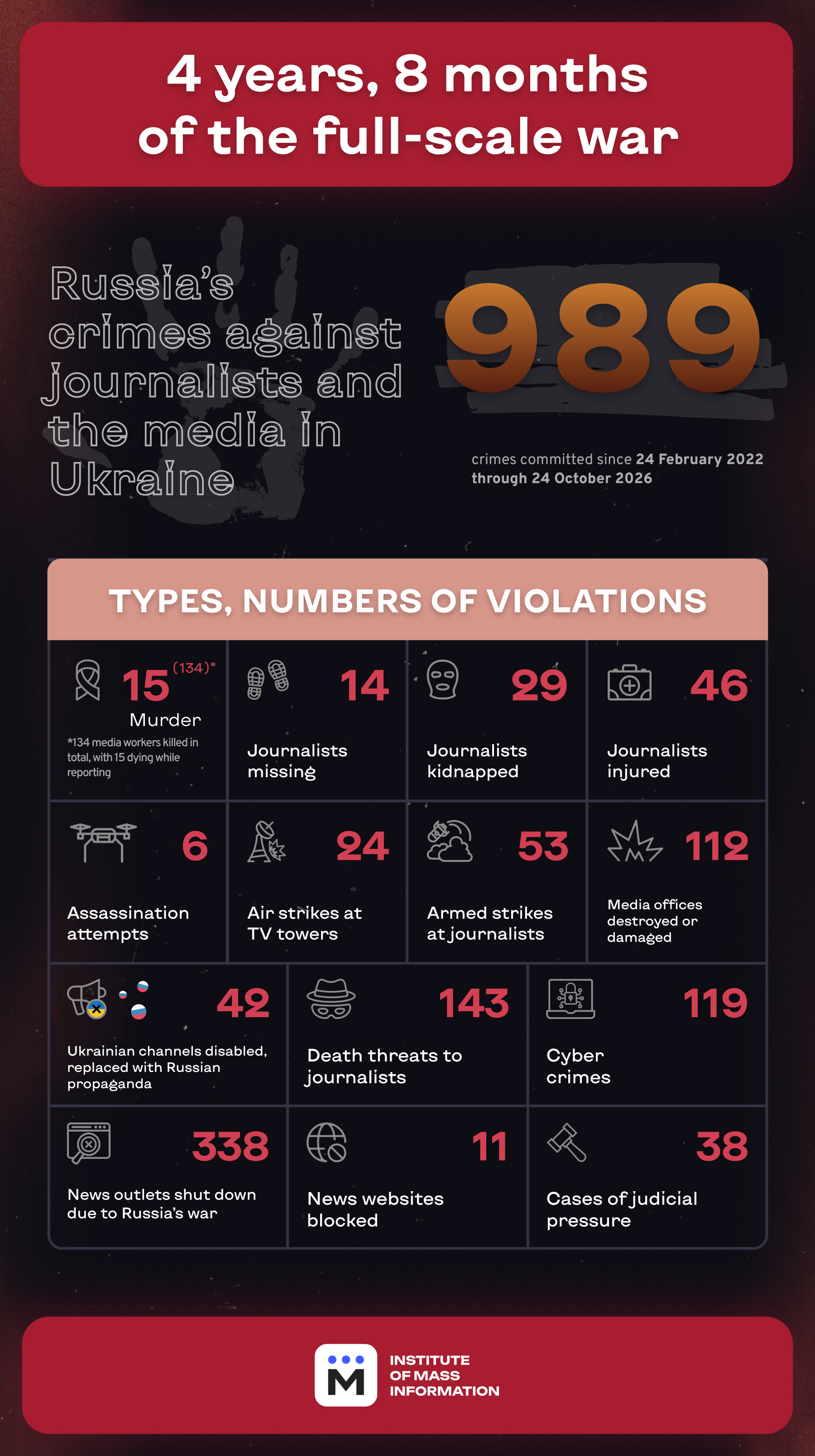
Russia has committed 989 crimes against journalists and the media in Ukraine in the four years and eight months since the start of the full-scale invasion, as evidenced by the Monitoring Study of Russia’s Crimes Against Journalists and the Media, which the Institute of Mass Information has been carrying out since the first day of Russia’s invasion of Ukraine.
IMI recorded 12 new instances of Russia’s war negatively affecting Ukrainian media in the period from 24 September to 24 October 2026, including a drone attack on a filming crew, a media office being damaged in an air strike, cyber-crimes and disruptions of Ukrainian TV broadcasting.
Media workers killed
Six media professionals were reported dead in September–October. Five of them were killed in action and one died as a civilian casualty.
Two media workers had long been considered missing in action. Samuil Proskuriakov, who contributed to UNN, Zaborona, Hromadske, and Babel, went missing in 2022. Dmytro Khyzhniak, host at Hit FM and TV-5, had been considered missing since 2024. They were only officially declared dead in 2026.
Serviceman Oleksiy Nurulin, who used to be a senior mobile TV station engineer at 1+1 Media, died in hospital in September. Vasyl Velychko, a cameraman with the Poltava-based TV channels IRT Poltava and Misto Plus turned UAF servicemember, was killed on 16 October.
UAF serviceman and YouTube blogger Kyrylo Soloshenko was killed in action on 15 October 2026. He rose to popularity on YouTube in 2014–2016, producing his own videos and collaborating with other bloggers who were popular at the time.
Maria Yivzhenko, former contributor to NV Business, was a civilian killed in a Russian strike on a business centre in Kyiv.
143 media professionals have been killed by Russian forces since the start of Russia’s full-scale invasion of Ukraine, with 15 dying while reporting.
Air strikes on journalists
- A Suspilne Zaporizhzhia filming crew came under attack by Russian FPV drones in Kushuhum village (seven kilometres south of Zaporizhzhia city) while documenting the aftermath of earlier strikes. The journalists were unable to leave the village for over three hours, and a drone hit next to their car.
Damage to media offices
- The Suspilne Zaporizhzhia office was damaged in a Russian ballistic missile strike in Zaporizhzhia city: the shock wave blasted out windows and doors in the building. The team were unharmed, as there was no one inside at the time of the attack.
- A Russian strike on Kyiv overnight on 19 October inflicted significant damage on the office of the newspaper Zakon i Biznes. The shock wave blasted out all the windows, destroyed the interior walls, and damaged the equipment and furniture in the office. None of the newsroom’s staff were in the office at the time.
- A Russian drone targeted the office of the private broadcaster Vizyt TV in Kremenchuk, Poltava oblast, causing significant damage to the building and starting a fire. The damage to equipment and infrastructure forced the channel to temporarily stop producing news, though they remained on air. The seven employees were in shelter during the attack. No one was injured.
Cyber-crimes
- Unknown individuals created a fake “mirror” of the NV website to promote an AI-generated video containing disinformation about NABU searching the Defence Procurement Agency ex-chief. NABU has called the footage fake, stressing that content like this suggested that Russia was using cutting edge technology in the information war.
Disabling Ukrainian broadcasting
- Russian strikes on data centres, telecom facilities and other infrastructure in Kyiv on 26 September disrupted or temporarily halted operations of at least seven Ukrainian newsrooms: Novyny.LIVE, Priamyi, Suspilne, Channel 5, Armiya TV, Kolo, Konkurent.Ukraina. The news outlets experienced TV signal problems, temporarily went off air, or stopped broadcasting on T2; their websites went offline or had video playback issues.
View the full list of Russia’s crimes against the Ukrainian media and journalists here.
The Institute of Mass Information (IMI) is a Ukrainian civil society organization specializing in the media, operating since 1996. IMI defends the rights of journalists, studies the media landscape and reports on media-related events, fights propaganda and disinformation, and provides media workers with safety equipment for trips to combat areas (since the start of the Russo–Ukrainian war in 2014).
IMI carries out the only monitoring study of freedom of speech in Ukraine, keeps a list of transparent and responsible online media outlets, and tracks Russia’s media crimes in the war on Ukraine. IMI has representatives in 20 oblasts of Ukraine and runs a network of Media Hubs that provide journalists with unfailing support. IMI’s partners include Reporters Without Borders (RSF); the organization is also a member of the International Freedom of Expression Exchange (IFEX).