The investigative journalism agency Chetverta Vlada says that their journalists faced obstruction by Rivne City Council staff during acting mayor Viktor Shakyrzian’s public report on 1 September.
According to the team, Maria Savchuk, director of the communal institution Rivne Development Agency, tried to cover the agency’s camera with her hand throughout the event, while journalist Anastasia Savliuk was asked to show her press ID and was not allowed to ask a question.
Viktor Shakyrzian was giving a report on the work done by Rivne City Council over the first half of 2026. Chetverta Vlada crew were filming the official’s speech on a phone mounted on a tripod.
In comments to the Institute of Mass Information, journalist Anastasia Savliuk said Maria Savchuk’s actions prevented them from filming and working properly during the event.
“She kept coming up to the camera and covering it with her hand whenever we tried to film. Later, when I wanted to ask Viktor Shakyrzian a question, instead of giving me a chance to do so, they started discussing whether I was working officially and asking why I wasn’t wearing a badge. I showed my press ID, but still wasn’t allowed to ask my question during the report itself,” the journalist recounted.
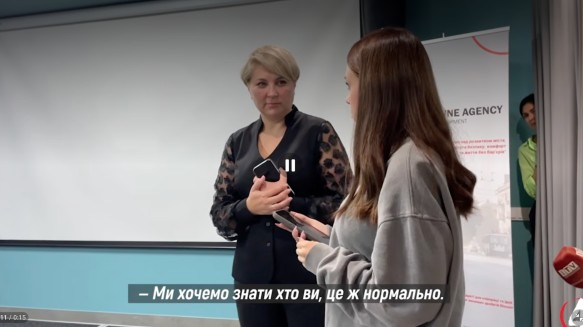
Footage published by Chetverta Vlada shows Anastasia Savliuk introducing herself and starting to ask a question, at which point Viktor Shakyrzian interrupts her and asks whether she is working officially. After she answers yes, and Maria Savchuk asks why the journalist isn’t wearing a badge. The journalist then showed her press ID.
Ultimately, the news outlet’s journalists were only able to ask their questions after the event had finished.
Anastasia Savliuk added that following the event, city government representatives gave the journalists information regarding Shakyrzian’s whereabouts that turned out to be inaccurate.
“So I believe our work was being obstructed. Whether these specific actions amount to a legal offence is a question for lawyers to answer,” Anastasia commented.
Meanwhile, the team remarked, there were other journalists in the hall who were not wearing badges, but City Council officials did not ask them to show their credentials. In addition, the event was public, meaning that anyone, not only the reporters, was allowed to ask Shakyrzian a question.
Anastasia Savliuk believes that requirements were applied to Chetverta Vlada that were not applied to representatives of other media outlets.
“Other media representatives weren’t checked on whether they were ‘working officially,’ weren’t asked to show their press credentials, and their right to be present at the event wasn’t questioned. They were able to ask their questions directly during the report, whereas we were effectively denied that opportunity. On top of that, the officials, including Maria Savchuk, had a generally condescending attitude towards us,” the journalist said.
According to Anastasia, the team believes that this treatment has to do with the fact that members of Viktor Shakyrzian’s team have repeatedly been subjects of Chetverta Vlada investigations.
The newsroom plans to discuss the situation with their lawyers, show them the footage, and ask them to assess the actions of those who obstructed their work.
“After that, we’ll decide whether there are grounds for action and where exactly to turn. If the lawyers identify signs of obstruction of lawful reporting, we’ll consider approaching the relevant authorities. But generally speaking, based on our team’s experience, the police either can’t or won’t investigate offences under Article 171 of the Criminal Code unless a journalist was physically beaten,” Anastasia Savliuk said.
Maria Savchuk runs the communal institution Rivne Development Agency. She is also a co-founder of the NGO Rivne Razom Women’s Platform, linked to the organisation and the party of the same name, Rivne Razom, under whose banner Viktor Shakyrzian came to power in Rivne.
Hanna Kalaur, IMI’s representative in Rivne oblast, has reached out to Maria Savchuk for a comment on her conduct during the event, asking her to explain why the requirement to show press credentials was directed specifically at Chetverta Vlada journalists. The question was sent via a messenger app.
Maria Savchuk responded to the message three days later, denying that Chetverta Vlada‘s journalists had been treated with bias or otherwise differently because of their affiliation with that outlet, or that there had been any intention to obstruct their reporting.
“Regarding the episode captured in the posted footage: at one point, the phone that was being used for filming was placed directly in front of the moderator, very close to their face. At that moment, I didn’t know who the device belonged to, so I asked whose camera it was. My hand movement was a situational reaction to the device’s placement specifically, not an attempt to stop or restrict the filming. I made no demand for the filming to stop,” Maria Savchuk said.
Savchuk said that once things became clear, her question about the ID had aimed to “dentify the media representative” and had not been a requirement or condition for access to the event.
The official added that Chetverta Vlada‘s representatives had continued filming, asked their questions, and received a comment.
“There was no instruction from me to stop filming, to leave the event, or any attempt to deny them the opportunity to ask their question,” Maria Savchuk commented.
She also said that CCTV footage was recorded within the co-working space, meaning that the events were documented with timestamps, which, Maria Savchuk said, made it possible to establish the timeline objectively rather than relying solely on isolated fragments or subjective assessments by the persons involved.