

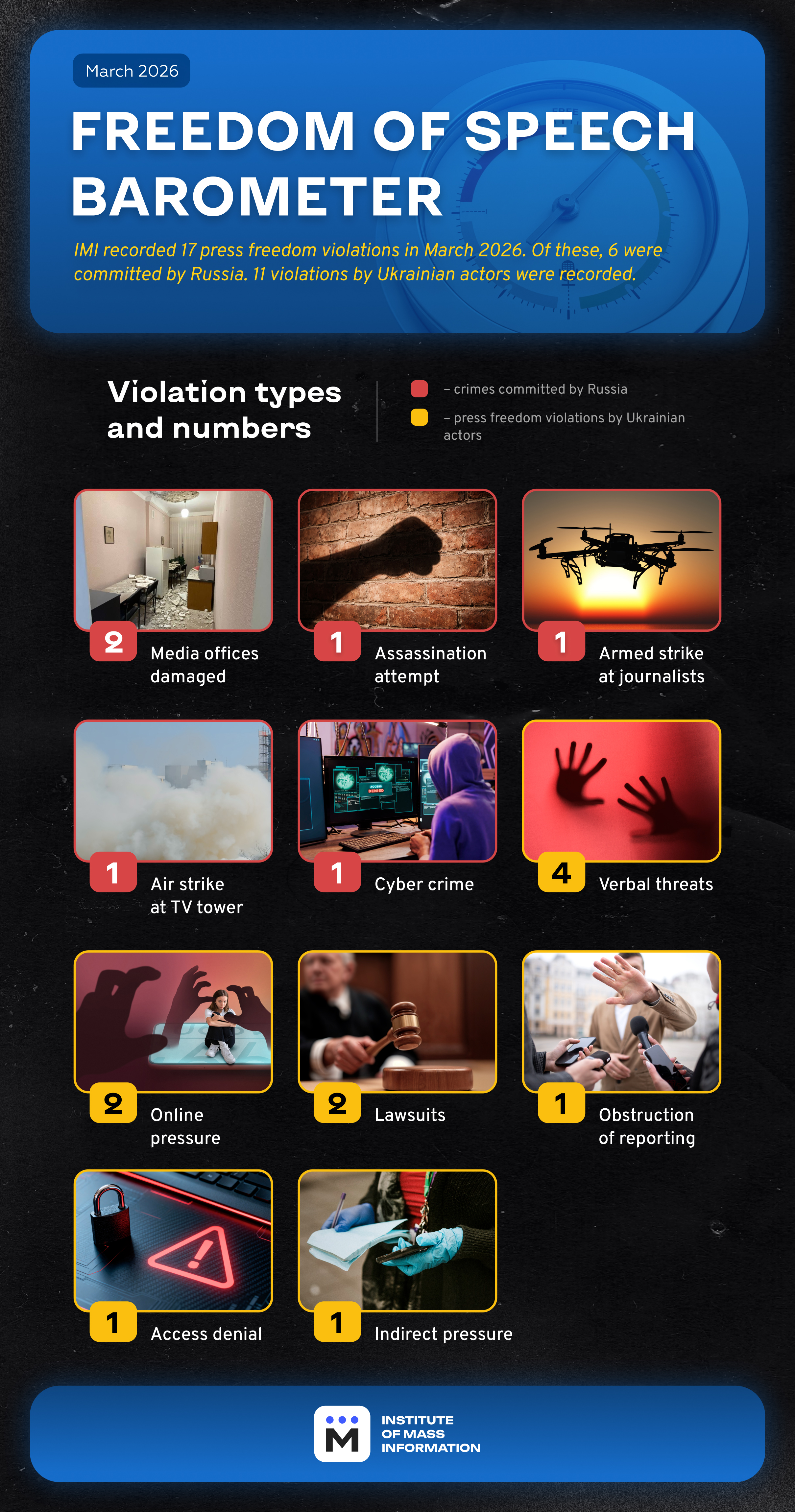
The Institute of Mass Information experts recorded 17 freedom of speech violations in Ukraine in March 2026. Six were committed by Russia, as evidenced by IMI’s monthly monitoring study Freedom of Speech Barometer.
Russia’s crimes against media and journalists in Ukraine included assassination attempts, destruction and damage of media offices, and cyber crimes.
The deaths of three media workers turned UAF servicemembers were reported in March:
- Volodymyr Fomichenko-Zakutskyi, formerly the marketing director at Zaborona Media. His death was officially announced on 10 March. It is reported that he was killed in action on 26 February 2026 near Pokrovsk (Donetsk oblast).
- Arthur Petrov, media professional and soldier, killed while helping evacuate the wounded in Kupyansk-Vuzlovyi (Kharkiv oblast) on 18 March 2026.
- Yevheniy Solovey, serviceman and TSN cameraman. Joined 1+1 Media in 2011. Killed in action on 27 March 2026.
Assassination attempt
- A Suspilne Dnipro filming crew was able to escape a Russian FPV drone following them thanks to being equipped with a drone detector. The crew was working in Demuryne village (Dnipropetrovsk oblast). The journalists reported that the FPV drone had been circling right above them and are convinced that they had been targeted deliberately.
Armed strikes at journalists
- A Suspilne Dnipro filming crew came under Russian mortar fire in Kapulivka (Dnipropetrovsk oblast). The reporters were filming a news story accompanied by police when Russian troops opened fire: the shells dropped 50–100 meters away from them. The crew managed to escape, no one was injured.
Destruction or damage to media offices
- The buildings housing the Suspilne Odesa office were damaged in a Russian air strike. One of the buildings was hit by a Shahed drone and is beyond repair. There were no casualties, but the windows in most rooms shattered and the rooms themselves are damaged.
- The office of the newspaper Mezhivskyi Merydian was destroyed in a Russian guided bomb strike in Mezhova village (Dnipropetrovsk oblast), which is located 12 km away from the front line. The team continues to work and make new issues of the newspaper despite losing the office.
Air strikes at TV towers
- Russian drones hit the TV tower and a Concern for Radio Broadcasting, Radio Communications, and Television (CRRT) facility during a strike in Kryvyi Rih (Dnipropetrovsk oblast). The digital broadcasting signal in the city went down as a result of the strike.
Cyber crimes
- The news website Novyny Donbasu was targeted in an intense cyber-attack by Russian hackers, resulting in data being compromised and the website temporarily going down. Some archive material was restorred, but the website’s operations have been complicated.
IMI also recorded press freedom violations unrelated to Russia’s war on Ukraine. These included verbal threats to journalists and obstruction of reporting, denial of access to public information, online and indirect pressure, and lawsuits against news outlets. Violations were recorded in Kyiv city, Khmelnytskyi, Mykolaiv, Odesa, Lviv, and Volyn oblast and were committed by local government bodies, private individuals, servicemembers, etc.
Obstruction of legal reporting
- Zhar.Info journalist Alyona Bereza was barred from attending the a hearing at the State Inspectorate for Architecture and Urban Planning. Officials cited regulations and the defendant’s request as reasons for the refusal, but the procedure says such hearings should be open to the media.
Verbal threats, intimidation of journalists
- Journalist Olha Khudetska received violent threats after reporting on the non-transparent spending of donation money by the Hospitallers Medical Battalion.
- War correspondent Anna Kaliuzhna received over 150 abusive messages after a post criticising the command of the Ukrainian Armed Forces, including messages questioning her professionalism and misogynistic comments, which she views as pressure and attempted intimidation.
- Suspilne Mykolaiv journalists were threatened over their reporting about the suspect in a murder trial. The threats referred to possible attacks on the journalists and damaged to their proterty during an upcoming hearing.
- The commander of the Advanced Company within HUR’s International Legion threatened The Kyiv Independent reporter Jared Goyette and Brazilian SBT correspondent Sergio Utsch, who investigated the death of the Brazilian volunteer Bruno Gabriel Leal da Silva.
Access to information
- The Mykolaiv Alumina Plant refused to provide MykVisti with information about the salary of the company’s director, claiming their query was “unclear.”
Indirect pressure
- The Odesa-based news website Antykoruptsiynyi Vymir reported systemic pressure by businessman Heorhiy Sedykh after the release of their news story about public procurement in the Usatove community. The businessman continued to demand the takedown of their news story even after the media outlet shared his perspective in a separate material. The team views this as an attempt to curtail the reporting of publically important information.
Online pressure
- Mykolaiv-based news website MykVisti recorded uncommon technical activity, which slowed the website down. The content was saved, internal systems were not affected, and the attacks were likely carried out via distributed bot networks.
- Hromadske journalist Denys Bulavin faced online harassment following the release of his article about attacks on servicemembers working in territorial enlistment centers.
Legal pressure
- Lawyer Oleksiy Shevchuk sued NGL.media, demanding 100 thousand hryvnias in moral damages. The lawsuit was triggered by the news outlet’s Facebook post saying that NGL.media was joining a statement by civil society organisations demanding Shevchuk’s withdrawal from the competition commission that is to select candidates for the Specialised Anti-Corruption Prosecutor’s Office.
- Mykhailo Bukharov, CEO of the Lutsk-based company Vennagro (Spetskomuntekh), sued the Investigative Journalistm Center “Syla Pravdy”. He demanded that information reported the news story “Why a Lutsk company that sold over 160 million worth of equipment to state institutions is going bankrupt” be declared false and certain passages quoting the company’s co-founder Vadym Venislavskyi be retracted.
See the full list of press freedom violations in Ukraine in March 2026 below.
Russia’s crimes
Assassination attempts — 1
1. Suspilne Dnipro crew escapes Russian drone thanks to drone detector
17.03.2026 A Suspilne Dnipro filming crew was able to escape a Russian FPV drone following them thanks to being equipped with a drone detector. The incident happened in Demuryne village (Dnipropetrovsk oblast) on 17 March, correspondent Roman Mykhalchuk reported to the regional Institute of Mass Information representative Kateryna Lysiuk.
The crew included Roman Mykhalchuk, cameraman Danyil Nikolayenko, and driver Vasyl Tynnyi. They were going to Demuryne to film a news story about the life of locals who remain in the village.
According to DeepState, the village is located approximately 13 km away from the front line.
“After the filming session, when we got into the car, we had barely driven a few meters, maybe 10, when our Chuyka [the drone detector] went off, which actually helped us: it intercepted the ‘picture’ from the drone. I saw the train station on the detector screen — they have a train station there that is no longer in use — and we were literally next to it, maybe 100 meters away at most. We quickly drove the car right under a tree. Because there was nowhere to hide there,” said Suspilne Dnipro correspondent Roman Mykhalchuk.
Having stopped the car, the crew ran outside and heard a drone circling nearby. The journalists hid between a tree and a damaged fence. Roman Mykhalchuk says this was the only place where they could take cover. The nearest shelter was at the destroyed train station, but it crossing the several dozen meters to reach it would have been extremely dangerous.
The correspondent said that the FPV drone had been circling right above them and the crew was certain that the drone had been targeting them specifically.
“The FPV drone was circling right above us, we heard it all. We filmed everything, we recorded it all. There was no one around except us. The village is almost deserted, and what’s more, it was the very edge of the village, beyond was a field, some abandoned buildings, an abandoned factory that had been bombed… And the closest village was a few kilometers away. We realised that it was definitely following us, because we were the only people on that street, and the only car,” Roman Mykhalchuk said.
The filming crew had to hide for about five minutes. Later, the journalists heard an explosion nearby.
“It circled above us for some time and then, apparently, fell down and exploded. We heard this buzzing, there was no dive sound, just an explosion, and the buzzing stopped. As soon as there was silence, we ran as fast as we could from there. It fell down maybe 100 meters away from us or even closer,” added Suspilne Dnipro cameraman Danyil Nikolayenko.
All members of the filming crew were wearing protective gear with PRESS markings.
“FPVs are flying around that place all the time, on top of the guided bombs and Shaheds. The locals told us that the drones were hunting down cars. We ourselves saw two completely burned-out cars at the edge of the village. And here was our car, with us wearing ‘body armor’ inscribed PRESS… The FPV drone operator definitely saw all this and clearly aimed the drone at us. In my opinion, this was a deliberate attack on us as media workers,” added Roman Mykhalchuk.
Armed strikes at journalists — 1
1. Suspilne Dnipro crew comes under mortar fire
30.03.2026 A Suspilne Dnipro filming crew came under Russian mortar fire in Kapulivka (Dnipropetrovsk oblast) on 30 March, the broadcaster’s correspondent Roman Mykhalchuk reported to Kateryna Lysiuk, the Institute of Mass Information’s regional representative.
Roman Mykhalchuk and Danyil Nikolayenko were filming a news story about civilians living in the Nikopol district. The crew was about to film a standup (a clip with the reporter standing in front of the camera) when mortars started going off in the occupied part of the neighbouring Zaporizhzhia oblast.
“We were accompanied by police officers. We drove with them to the riverbank to quickly film the aftermath of Russian strikes in the coastal zone. And as we were recording a standup, mortarmen started firing at us from the occupied part of Zaporizhzhia oblast. The Russians must have seen the police car and us wearing bulletproof vests and helmets through their optics. We heard the whistle of a shell that hit the middle of the street about 100 meters away from us. Taking cover was not an option, because it happened in a matter of seconds. Compared to an FPV drone, this was much scarier, because you don’t know exactly where it will hit,” said Roman Mykhalchuk.
The media workers dropped on the ground and waited out the first explosions, then ran to the police car and drove off. However, the shelling did not stop, adds cameraman Danyil Nikolayenko.
“We got into the police car and another shell dropped nearby. We got out of there as fast as we could. The police say they were shooting at us because they (the Russian troops, — Ed.) had spotted a police car and people with their Mavics,” said Danyil Nikolayenko.
The mortar shell exploded 50 meters away from the car, Roman Mykhalchuk said. None of the journalists or police officers were injured.
Destruction or damage to media offices — 2
1. Suspilne Odesa buildings damaged in Russian strike
28.03.2026 The buildings housing Suspilne‘s Odesa branch were damaged in a Russian air strike on 28 March 2026. One of the buildings was hit by a Shahed drone and is beyond repair. There were no casualties; the team continues to work, Suspilne reports.
The broadcaster added that other buildings also sustained damage and had broken windows.
“The windows in absolutely all office rooms are gone and there is damage inside the rooms, including the Suspilne Academy. Fortunately, none of the staff were injured,” said Suspilne Odesa manager Nazariy Maksymchuk.
Olena Holda, chief editor at Suspilne Odesa and Suspilne’s southern hub, said that the team had been instructed on such emergencies. Yet “it is impossible to be actually prepared for such a situation,” she added.
“However, our filming equipment was stored in safe places, so the team continues to work as usual,” she said.
The TV channel’s producer Olena Kvasha told the Institute of Mass Information representative in Odesa oblast that the team was doing clean-up and assessing the damage.
She added that most of the equipment was intact, as the staff stored it in their homes or in safe places.
For now, the team continues to work and does not plan to pause content production. They are working to restore their offices to a functional state.
“We work as a team. The support from our viewers, subscribers, and listeners makes us very happy. We are receiving many offers of help — we are sincerely grateful to everyone,” Kvasha said.
2. Newspaper office destroyed in Russian guided bomb strike
29.03.2026 The office of the newspaper Mezhivskyi Merydian was destroyed in a Russian guided bomb strike in Mezhova village (Dnipropetrovsk oblast) late on 29 March, the newspaper reported.
The team said that a Russian guided bomb, likely a KAB-500, was dropped on the two-story building housing the office. Multiple buildings on neighboring streets were destroyed and damaged as well.
“A two-story HOME… that’s right, HOME… for many generations of Mezhova journalists, where news, articles, stories were born every week since 1983… It no longer exists… It was literally razed to the ground,” the media outlet wrote.
This is the third strike that has affected the newspaper in recent months; private houses and shops on the surrounding streets were destroyed and damaged as well.
The village is located 12 kilometers away from the front line.
The team said that the newspaper remained one of the few media outlets in the frontline region that have continued to work, as opposed to closing down, relocating, or completely migrating to social media as many other local news outlets did.
“From 24 February 2022 and through 2025, not a single issue was cancelled… We reached our readers every week… Today we work on a different schedule, but with 12-page issues in colour… Even now… The next Mezhivskyi Merydian issue, No. 12,219, was signed to go to print on 28 March, the day before the office building was gone…” the team wrote.
Air strikes at TV towers — 1
1. Russian drone strike at TV tower disrupts digital broadcasting in Kryvyi Rih
06.03.2026 Russian drones hit the TV tower and a Concern for Radio Broadcasting, Radio Communications, and Television (CRRT) facility during the overnight strike in Kryvyi Rih (Dnipropetrovsk oblast) on 6 March. The digital broadcasting signal in the city went down as a result of the strike, Olena Demchenko, Dnipropetrovsk oblast representative of the National Council for Television and Radio Broadcasting, reported to Kateryna Lysiuk, regional representative of the Institute of Mass Information (IMI).
Demchenko said that the strikes had damaged both the TV and radio tower itself and the building next to it. Some of the equipment might have survived, but all power supply to the facility was disabled for safety reasons while the prosecutors, police, SBU, and the military are working on site.
“All the equipment there is damaged, and what might have stayed intact has been switched off. Because all power supply to [the TV tower] has been disabled to ensure safety. As of now, I can’t speak to the extent of the damage if quick restoration is possible, because the Concern’s staff haven’t been allowed there yet to see it all,” said Olena Demchenko.
The CRRT’s Technical Director Serhiy Semerey told IMI that the facility was hit by three drones. According to him, Russian troops are purposefully targeting telecom objects.
“In this case, it was three Shahed drones, two of which hit our tower in Kryvyi Rih and one hit an infrastructure facility. As of now, all means of broadcasting, both radio and television, are damaged. For now [as of 2:30 p.m., – Ed.] we have managed to restore several radio programs, but digital television is doing much worse, because the fleet of receiving antennas has been destroyed completely,” said Serhiy Semerey.
At the moment when the drones attacked the facility, the staff were in a bomb shelter, so there were no casualties, he added.
The digital television equipment was in the damaged TV tower. All transmitters are now off due to the power outage and the damage. Ther is no signal in the city from any digital television multiplexes: MX-1, MX-2, MX-3 and MX-5, each of which can include up to 32 TV channels. As a result, about 130 national and local T2 broadcasters are temporarily unavailable.
“Well, in terms of local broadcasters we only have Rudana there. The rest are those included in the multiplexes, but as for the local ones, it’s only Pershyi Miskyi and Rudana,” said Olena Demchenko.
The damage to the CRRT equipment resulted in three radio stations temporarily going off air: Lux FM (91.6 FM), Classic Radio (103.2 FM), and Power FM (103.6 FM). The local stations Megapolis and Radio Kryvbas have backup transmitters and have already resumed broadcasting.
Olena Demchenko also added that CRRT technicians have not yet been allowed to enter the facility, so they have not been able to assess the scale of the damage or determine which equipment needs to be repaired. Until then, digital television broadcasting in Kryvyi Rih will remain disabled, and the work of some radio stations will be suspended.
Cyber crimes — 1
1. Novyny Donbasu attacked by Russian hackers
18.03.2026 The news website Novyny Donbasu was targeted in an intense cyber-attack by Russian hackers, resulting in the website temporarily going down, chief editor Yulia Didenko reported to Yulia Harkusha, the Institute of Mass Information representative in Donetsk oblast.
Didenko said that the hackers accessed and administrator’s account and through it the contributor database and the news archive. The website has been partially restored, but the team was only able to recover archive material from 25 February 2025 and later.
CERT-UA (Computer Emergency Response Team of Ukraine), the cyberdefense team of the State Special Communications Department in Donetsk oblast, and the Security Service of Ukraine are helping to restore the website.
The hacker group “Cyber Sickle” has claimed responsibility for the cyber-attack, claiming that the website had been destroyed. The hackers called Novyny Donbasu a “psychological warfare tool” and said that they had “dealt a blow to an anti-Russian disinformation mouthpiece that has been poisoning the information space for many years.”
“We have penetrated the protected perimeters and downloaded the site’s full database, including archives, contributor lists, and technical information. This is our trophy and proof of their crimes. Liquidation. After analyzing and downloading the data, the servers and the database were destroyed irretrievably. The website will never reopen. Broadcast stopped. This resource has been sowing hatred for years, weaponising its content. We have stopped this information dumpster once and for all,” the cybercriminals’ statement reads.
The hackers posted a message on the website stating that it had been liquidated: “The website Novyny Donbasu has been liquidated. Your ‘news’ is a weapon of lies that misinforms the healthy population of Russia and Ukraine. The entire database has been destroyed. The information dumpster has ceased to exist.”
The Russian hackers also threaten to continue to destroy “any website, any structure that works to disinform and divide.”
Yulia Didenko said that this is not the first cyberattack the website has sustained.
“At the beginning of the full-scale invasion, when Ukrainian sites were being hacked through banner advertising, we were also affected: they posted a huge banner of the St. George ribbon on the main page. This is a very serious problem, but also a sign that we, as an independent media outler, pose a real threat to Russia, because we have been continuously working for our audience under occupation since 2014,” she added.
Novyny Donbasu has been operating since 2003, and covering war and occupation-related news since the beginning of the Russian invasion in 2014. The website now reports news not only from Donetsk oblast, but also from the regions that border Russia or are in the combat zone.
The press freedom situation in Ukraine unrelated to Russia’s war
Physical aggression
Obstruction of legal reporting — 1
1. Journalist barred from attending state inspectorate hearing, calls police
18.03.2026 Alyona Bereza, journalist with the Khmelnytskyi-based news website ZHAR.INFO, was barred from attending the a hearing at the State Inspectorate for Architecture and Urban Planning (SIAUP) on 18 March, Alyona Bereza reported to the Institute of Mass Information.
According to the journalist, the decision was made by the SIAUP chief inspector of construction supervision, Yulia Mazur. The official claimed that as per her regulations, such hearings are not supposed to involve outsiders and that the defendant in the case was unwilling to have journalists present.
“Having been denied, we said that we would call the police and report it as obstruction of professional journalism. So we did. We filed a statement and an explanation. The police responded quickly, but for some reason, after talking with the official, they started trying to explain to us in more detail why we had not been allowed in, which seemed quite odd,” said Alyona Bereza.
Nevertheless, the police took down the details and heard the journalists’ explanation. So far, the news outlet has not been notified of any proceedings having been opened. In case they refuse, the team will file a complaint with the court.
The Institute of Mass Information’s lawyer Volodymyr Zelenchuk believes the incident may consitute obstruction of legal reporting.
According to him, the procedure for imposing fines for urban planning offenses, which regulates the trials in such cases, does not bar journalists or any other persons from attending the hearings.
“Moreover, the procedure clearly requires that the hearings be open. Combined with journalists’ right to access information and to unhindered access to government bodies’ premises and open events hosted by these bodies, the absence of a clause that would limit third party access to such SIAUP hearings gives every reason to believe that the denial was unlawful. Therefore, there are indeed signs that obstruction of the journalist’s legal reporting may have taken place in this case,” the lawyer explained.
Verbal threats and intimidation of journalists — 4
1. Journalist threatened over posts about Hospitallers Battalion
09.03.2026 Journalist, blogger Olha Khudetska is receiving violent threats after writing an X thread about the non-transparent spending of donation money by the Hospitallers Medical Battalion.
Khudetska reported this in a comment to the Institute of Mass Information journalist Valentyna Troyan.
Khudetska does not plan to contact the police about this. “I don’t see the point. I don’t know of any cases where online threats were successfully investigated,” the journalist said.
The threats, screenshots of which Khudetska posted, included those of physical retaliation such as “breaking her legs.”
When asked who exactly could be behind the threats, Olha Khudetska said she did not rule out that it could be people who believed that in this way they were defending the battalion’s commander, MP Yana Zinkevych.
On the other hand, it could also be the Russians, who often try to play up the tensions within Ukrainian society. “There could be different actors here,” the journalist added.
Olha Khudetska said that after she posted about the threats on Facebook, Yana Zinkevych wrote a post saying she did not approve of such efforts.
“But this did not cool things down. It’s just that instead of ‘I will break your legs,’ they now write I should ‘burn in hell,’ ‘prepare for trouble when I meet you,’” Olha Khudetska said.
2. War correspondent swarmed with abuse after criticising Syrskyi
09.03.2026 War correspondent Anna Kaliuzhna received over 150 abusive messages after a post criticising the command of the Ukrainian Armed Forces, Kaliuzhna reported in a Facebook post on 6 March.
The journalist said she had received more than 150 private texts over the cours of the night and half a day. Most of them contained insults and degrading comments about her journalistic work. Kaliuzhna added that the messages were mostly coming from empty or private accounts.
Most of the senders called themselves “225 servicemen” (probably referring to the assault regiment No. 225. – Ed.). Anna Kaliuzhna observed that most comments were misogynistic, including messages such as “go make me a sandwich” or “off to the kitchen.”
Some also questioned her professionalism, writing, “Do you even know how to work?” or “You weren’t here with us.”
Kaliuzhna added that some of the messages were identical in content, which may indicate that they were a coordinated effort.
“It is telling that after the assault brigade No. 3 incident making threats is no longer recommended, you see. Just pressure. I am attaching the harshest one,” the journalist added.
Anna Kaliuzhna believes the abuse was triggered by her post criticising the UAF Commander-in-Chief, Oleksandr Syrskyi, and casting doubt on the legality of the assault regiment No. 225 expansion.
The journalist also cited numerous complaints of mistreatment of servicemembers, which had been previously publicly reported by the military commissioner Olha Reshetylova.
Kaliuzhna said in a comment to Detector Media that she had not yet recorded any direct threats, but many messages degraded her professional experience and accused her of “working for the enemy”. The journalist stressed that the post mainly cited public information that had been reported by various media outlets before.
The criticism in the post was primarily directed the unit command and not its servicemembers. Kaliuzhna added that none of the Regiment No. 225 servicement whom she knew had texted her personally.
The journalist views the situation as an attempt to pressure and intimidate her. She is tracking all the messages and plans to consult with lawyers about possibly contacting the police.
The communications team of the assault regiment No. 225 told Detector Media that the unit’s command had given no orders to respond to the journalist’s post. They said that they had not taken any action in response to what they called a “smear campaign” targeting the unit.
The regiment added that they were willing to check the reports of potentially offensive messages if a corresponding appeal with evidence is submitted.
3. Suspilne Mykolaiv journalists threatened after reporting on murder investigation
18.03.2026 Ihor Bloshko, employee of the municipal company Mykolaivvodokanal (Mykolaiv Water Utility), activist, and former law enforcement officer, threatened Suspilne Mykolaiv journalists, claiming that the people of Plyushchivka village may attack them for their reporting on the stance of Bashtanka mayor Oleksandr Berehovyi regarding the conflict with Plyushchivka mayor, Viktor Prokopchuk, who is suspected of murdering his colleague Svitlana Vanzhula, reports Kateryna Sereda, the Institute of Mass Information representative in Mykolaiv oblast.
The incident in Plushchivka occurred on 17 March, when an argument erupted between the village mayor and his colleague, ending in the former taking the hunting rifle from his office and shooting the woman in the head three times, as reported by the Mykolaiv Oblast Prosecutor’s Office.
Ihor Bloshko made a Facebook post defending Viktor Prokopchuk, who also serves in the army. He explained the village mayor’s actions by claiming that the victim, Svitlana Vanzhula, had provoked Prokopchuk and acted in the interests of Bashtanka’s mayor.
In his comment to Suspilne, Berehovyi denied having a conflict with Prokopchuk and said that Svitlana Vanzhula was de-facto performing the mayor’s duries while he served in the Ukrainian Armed Forces.
Ihor Bloshko, who, according his declaration, is also a journalist with Ukrpres-Info, claimed that Suspilne had reported false information and warned the journalists that “lies like that” may get their cameras crushed in the courtroom.
“And you, journalists at Suspilne Mykolaiv, will probably be attending the hearing where a measure of restraint for Viktor Prokopchuk will be chosen. Take care lest the other people present at the hearing smash your cameras against your heads. It’s a big shame that lies are a norm of life,” said Ihor Bloshko in his video address.
Suspilne Mykolaiv chief editor Oleksandra Malevych said in a comment to IMI that their news story was well-balanced and showcased different parties’ views on the reasons for the conflict. She considers Ihor Bloshko’s words as threats against journalists, which may lead to liability under criminal law.
IMI’s lawyer Volodymyr Zelenchuk agreed that Bloshko’s statement constitute an implicit threat.
“Ihor Bloshko’s words, albeit phrased as a warning, in reality consitute an implicit threat. This is suggested by the condescending tone in his addressing the journalists and by his putting the journalists in opposition with the village’s residents, which makes the threat all the more realistic,” the lawyer said.
The court hearing in question took place in Bashtanka on 18 March. Journalists with Suspilne Mykolaiv and MykVisti were present.
MykVisti reporter Alisa Melikadamian told the IMI representative that the hearing was attended by many people who had come to support the suspect and tried to block her way to the courtroom, but did not succeed.
26.03.2026 The command of the International Legion within the Defense Intelligence Department of Ukraine (HUR) has ordered an internal investigation into threats made by the commander of the Advanced Company unit to journalists investigating the death of the company’s recruit Bruno Gabriel Leal da Silva, who was allegedly beaten to death, hromadske reports, citing The Kyiv Independent, which reached out to HUR and received a response.badly bruised and battered body the next morning, laid out in the snow by the room known as “the container” at the base.
According to the journalists, the commander of the Advanced Company, Leanderson Paulino, posted Instagram stories accusing the reporters behind the investigation into the volunteer’s death (The Kyiv Independent correspondent Jared Goyette and Brazilian SBT correspondent Sergio Utsch) of “taking Russian money.”
He posted Goyette’s photo, at one point saying, “Hang in there kid, it’s just getting started.” He has also promised that the reporters would be “identified” and “located” so they could be confronted in person.
HUR said that the International Legion’s command had ordered an internal probe into these threats, stressing that the Legion respected freedom of speech.
“The Legion maintains open, constructive interaction with journalists and does not tolerate instances of pressure on media representatives, obstruction of journalistic activities, or threats, which cannot be justified by either military status or wartime conditions,” HUR said in a written response.
The department added that all servicemen “are obliged to comply with the legislation of Ukraine, the norms of military ethics, and the rules of public communication,” and “any manifestations of threats, pressure, or unlawful behavior toward media representatives are unacceptable and do not correspond to the principles of service.”
Journalist Sergio Utsch said he viewed Paulino’s threats as especially serious because they could be read as speaking for the Ukrainian military. In response to Paulino’s claims about “Russian money”, Utsch explained his professional credibility was not in question, pointing to his three decades as a professional journalist, including 12 years covering the war in Ukraine.
According to the investigation, Bruno Gabriel Leal da Silva, 23, came to Ukraine as a volunteer and wanted to sign the contract with the Advanced Company, one of the Revanche Tactical Group units under HUR’s International Legion. He appears to have changed his mind later and was trying to leave Ukraine.
On 29 December 2025 he returned to the Company’s Kyiv base intoxicated. The Advanced Company’s supervisors made him spar while wearing boxing gloves against another soldier at the base as punishment for violating the unit’s rules.
A former serviceman of the Company says that afterwards Leal da Silva returned to the sleeping area “in a normal state” and in no pain. However, a group of soldiers later took him to a small room known as “the container”, former fellow fighters say. Witnesses say they heard the man screaming for about 40 minutes as he was being beaten.
The next morning, several servicement saw “badly bruised and battered body” of Leal da Silva laid out in the snow by “the container” near the entrance to the base. They say Leal da Silva was undressed from the waist up and had rope prints on his writsts and torso.
HUR confirmed that at the time of death Leal da Silva was staying in a temporary deployment site as a candidate and had not yet signed the contract.
The Kyiv police reported on Telegram in February 2026 that the death of Bruno Gabriel Leal da Silva was under investigation as manslaughter.
Leal da Silva’s mother said that her son had trusted the Advanced Company command despite having no military background and that he had been taking medication for anxiety and depression. She said that the unit had paid for the young man’s flight to Ukraine, which he could not have afforded by himself.
“He trusted them. They lured my son into going. Just as they took him there (to Ukraine), they should bring him back (to Brazil),” the woman added.
Censorship, topic guidelines, access to information
Access to information for journalists — 1
1. Mykolaiv Alumina Plant refuses to disclose CEO’s salary to MykVisti
16.03.2026 The Mykolaiv Alumina Plant, previously confiscated into state ownership, refused to provide MykVisti journalist Yulia Boychenko with information about the salary of the company’s director, Boychenko reported in a comment to the Institute of Mass Information.
In January, Yulia Boychenko submitted a query to the State Property Fund of Ukraine, which owns 100% of the company’s assets, asking for information about the 2025 salary of the plant’s director, Oleksiy Medvid, broken down into the official salary, the allowances, the bonuses, the material assistance, other additional payments (specified) for each month separately.
The State Property Fund forwarded the query to the Mykolaiv Alumina Plant, which holds the requested information. However, the team received no response to the request within the time period established by the Law “On Access to Public Information”.
The news outlet received a reply as late as March, signed by the plant’s director Oleksiy Medvid, saying that the company had not received the copy of MykVisty’s request from the State Property Fund and thus “do not understand the details of the requested information.”
However, it added that “the requested information can be obtained from the public section of the Unified State Register of Declarations of Persons Authorized to Perform State or Local Self-Government Functions, which is open and publicly available.” This essentially disproves that the company did not understand what information was being requested.
The news outlet told IMI that they did not rule out suing to obtain answers to the query.
The Institute of Mass Information’s lawyer Volodymyr Zelenchuk said that in this case, both the missed response deadline and the groundless refusal to provide answers would warrant litigation.
“Article 22 of the Law ‘On Access to Public Information’ does not say a query may be declined due to a lack of understanding of the details of the requested information. The sender of the reply seems to understand there details, since they suggested contacting the Register of Declarations, which, according to Part 2 of Article 22 of the Law ‘On Access to Public Information’, consitutes an unlawful refusal to provide information,” the IMI lawyer said.
Indirect pressure
Other instances of indirect pressure — 1
1. Odesa-based media outlet faces pressure after reporting on public procurement
20.03.2026 The Odesa-based news website Antykoruptsiynyi Vymir reports systemic pressure by businessman Heorhiy Sedykh after the release of their news story about public procurement in the Usatove community. The businessman continued to demand the takedown of their news story even after the media outlet shared his perspective in a separate material, chief editor Olena Kravchenko reported to the Institute of Mass Information representative in Odesa oblast.
She said that following the release of the news story “New businessman, old customers: a newly registered sole trader was contracted to repair an Odesa oblast lyceum”, the businessman had sent at least five letters to the editorial office, demanding the news story be removed and retracted.
The editor stressed that the businessman had ignored the journalist’s request and did not take the opportunity to share his perspective before the investigation’s release. In his letters, Heorhiy Sedykh also asked that the news outlet publish a retraction, which the team did voluntarily in the article “Entrepreneur featured in Antykoruptsiynyi Vymir news sends comment”, where Sedykh was able to make his point of view public.
“In my opinion, Mr. Sedykh is not behaving like a person who wants to defend his dignity or reputation. He ignored the request for information and essentially declined the opportunity to share his perspective. Instead, he has already sent several letters demanding we take down the article and write that he had committed no violation, even though we did not claim he had,” said Olena Kravchenko.
In response to the businessman’s demands, Antykoruptsiynyi Vymir team said that they considered such actions as pressure on the media outlet and an attempt to limit the dissemination of socially important information.
Online pressure
Cyber crimes — 1
1. MykVisti reports cyber-attack on their website
20.03.2026 Mykolaiv-based news website MykVisti has been targeted in a cyber-attack, director Oleh Dereniuha reported in a Facebook post and in a comment to the Institute of Mass Information.
He said the website might be unstable or slower than usual because of the attack.
“The MykVisti website may be unstable or slower than usual now. We are recording atypical technical activity on the resource, which prompts suspicion of a digital attack, and it’s affecting the page loading speed and makes certain sections unavailable,” Oleh Dereniuha said.
He added that the team was working with the technicians to stabilise the website and identify the reasons of the suspicious activity.
“Editorial content has been saved, nothing suggests that access has been lost or data compromised. The team continues to work,” Oleh Dereniuha wrote.
In a comment to IMI, Dereniuha added that as of the morning of 20 March, there was no suspicious activity on the website, but the technicians were taking action to boost protection.
“As of now, the MykVisti website has stabilised: the technical team continues to monitor previously recorded atypical activity such as attempts to scan and access individual services, that were blocked by safeguard mechanisms. No signs of interference with internal systems, server infrastructure overload, database failures, or loss of editorial materials have been recorded, the resource is working as usual, and additional action is being taken to strengthen protection,” said Oleh Dereniuha.
He added that the suspicious activity could not be linked to any specific country yet, since the attacks were carried out via distributed bot networks from IP addresses in different parts of the world.
Ukrainian media have been targeted in repeated cyber-attacks recently. For instance, the news outlet Novyny Donbasu sustained an intense cyberattack by Russian hackers, with the website temporarily going down as a result.
Earlier, MykVisti journalist Yulia Boychenko received a message that appeared to be an event invitation and contained a phishing link disguised as a registration form.
Other instances of online pressure — 1
1. Hromadske journalist faces harrassment after reporting on enlistment centers
17.03.2026 Hromadske journalist Denys Bulavin faced online harassment following the release of his article about attacks on servicemembers working in territorial enlistment centers, Bulavin reported to the Institute of Mass Information journalist Valentina Troyan.
Bulavin said he did not know who exactly was behind the campaign targeting him, but had been prepared for such a response, aware that the subject was contentious. The journalist said that both bots and real social media users who oppose the mobilization effort were writing abusive comments about him.
“I don’t know who exactly is behind the harassment attempts. The comments are coming both from bots and users that are negative about the mobilization effort in general. The Telegram channel Kapitan Luhanskyi, which has 70,000 subscribers, especially caught my attention. It is run by blogger Andriy Serebrianskyi, known as ‘Andriy Luhanskyi,’” Bulavin said.
According to the Center for Countering Disinformation, Andriy Luhanskyi left Ukraine after the start of Russia’s full-scale invasion and has been using his social media to peddle narratives that align with Russian propaganda, in particular smearing the mobilization effort.
“In 2025, the NSDC (National Security and Defense Council – ed.) introduced sanctions against him, and YouTube blocked his channels. So it is clear why Luhanskyi made a post about me,” Denys Bulavin remarked.
After the article was released, posts containing the same screenshot of his Facebook post appeared on Luhanskyi’s Telegram channel, Threads, and X pages, Bulavin said.
“Some accounts also spread manipulative claims that I was exempt from the draft. This is not true: I am not,” the journalist emphasised.
He explained that he defines the comments and posts about himself as abusive and defamatory content with value judgments by the commentators.
“There is no liability for this, because this is an expression of people’s personal opinion,” he said, adding that he had been prepared for such a response to his reporting.
“I was prepared that by taking on a contentious topic that Russian propaganda often manipulates, I might encounter a similar response,” Bulavin said.
On 16 March 2026, Hromadske released an article by Denys Bulavin: “Servicemembers working in enlistment centers are being beaten, stabbed, and run over with cars. How can they protect themselves?” In the article, he discussed attacks on enlistment center employees, the investigations into the attacks, and the consequences faced by the attackers. Within a day, the Telegram channel Kapitan Luhanskyi made a post about Denys Bulavin. The post itself contained no obscenities, just ironically commented on the journalist’s looks. However, the comments to the post contained calls for physical violence against the media professional, including beating. Denys shared screenshots of the comments on Facebook and added, “The way they are trying to harrass me for not being afraid to take up this topic is fascinating to watch.”
Legal pressure
Frivolous lawsuits against media outlets — 1
1. Lawyer sues NGL.media, demands UAH 100,000
04.03.2026 Lawyer Oleksiy Shevchuk has sued the news outlet NGL.media and is demanding 100 thousand hryvnias in moral damages, NGL.media team reported in a Facebook post.
The lawsuit targets the NGO Lvivska Hrupa (NGL.media’s publisher), accusing it of defamation and demanding that information the news website reported be declared unreliable, retracted, and taken down and moral damage be compensated.
The team says that the lawsuit was triggered by their Facebook post saying that NGL.media was joining a statement by civil society organisations demanding Shevchuk’s withdrawal from the competition commission that is to select candidates for the Specialised Anti-Corruption Prosecutor’s Office.
“Well, if he wants to go to court, go to court we will. Besides organisational and financial costs, participating in the trial will give us some benefits, too. We will be able to access certain documents that will shed even more light on Shevchuk’s involvement in the abuses of the Shlyakh system and the humanitarian aid embezzled in the first months of the big war. We will definitely share all these findings with you,” NGL.media said.
The total sum demanded in the lawsuit is UAH 112,121.50. Of this, UAH 100,000 is claimed as compensation for moral damage, and UAH 12,121.50 as compensation of court fees.
According to the court’s note, the lawsuit was received on 3 March 2026.
In January 2026, several civil society organisations and news outlets addressed Prosecutor General Ruslan Kravchenko asking to cancel the appointment of lawyer Oleksiy Shevchuk to the competition commission that will be selecting top officials for the Specialized Anti-Corruption Prosecutor’s Office. They argued that the lawyer did not meet the integrity and reputation requirements outlined by the law. Shevchuk has been repeatedly banned or suspended from practicing law for suspected involvement in schemes to smuggle conscripts abroad, has supported “dictatorial bills”, and has a dubious background in terms of media coverage and political work. The organisations believe that Shevchuk’s involvement undermined the legitimacy of the competition. They demanded that his appointment be cancelled and he be replaced as a member of the commission.
Oleksiy Shevchuk has been featured in multiple articles by NGL.media. Namely, in the investigation into abuses of the Shlyakh system. Journalists found out that most of the organisations adding volunteers to the database had ties to him as a freelance advisor to the head of the Lviv OMA at the time.
Oleksiy Shevchuk was also mentioned in reports about the disappearance of almost 10 thousand tactical first-aid kits supplied to the UAF by the US in Lviv. NGL.media tried to get his comment on the shipment, but their requests were ignored.
The news outlet has also reported on the 19 December 2023 decision by the Qualification and Disciplinary Commission of the Bar (QDC) in Kyiv oblast to deprive Shevchuk of the right to practice law due to ethical violations.
2. Vennagro CEO sues Syla Pravdy
20.03.2026 Mykhailo Bukharov, CEO of the Lutsk-based company Vennagro (Spetskomuntekh) has sued the Investigative Journalistm Center “Syla Pravdy”. He demands that information reported the news story “Why a Lutsk company that sold over 160 million worth of equipment to state institutions is going bankrupt” be declared false and certain passages quoting the company’s co-founder Vadym Venislavskyi be retracted.
The plaintiff also demands 10,000 hryvnias in moral damages from the news outlet and another 40,000 hryvnias from Vadym Venislavskyi, Syla Pravdy reported, citing the Lutsk City and District Court ruling.
The lawsuit was triggered by a 4 December 2025 article by Syla Pravdy‘s Iryna Kravchuk, which discussed the start of Vennagro’s bankruptcy procedure. The company had been in business for over eight years, according to YouControl.
The company’s CEO, Mykhailo Bukharov, believes that some statements in the article, in particular the comments by the company’s co-founder Vadym Venislavskyi, are false and should be retracted.
Syla Pravdy said they had asked Bukharov to comment on the company’s financial situation and the corporate conflict between the co-founders, but he had refused.
The case is scheduled for 21 April 2026. Lawyers with the Institute for Regional Press Development (IRPD) will be representing Syla Pravdy.
IRPD lawyer Oksana Maksymeniuk considers the lawsuit to be frivolous. According to her, the plaintiff demands a refutation of the value judgments and assumptions expressed by the company’s co-founder in response to journalists’ requests to comment on the situation. Moreover, the author of the news article was not involved in the case, and part of the claims are unenforceable, in the lawyer’s opinion.
Defending freedom of speech
The authorities’ response to press freedom violations — 1
1. Police opens investigation into death threats to Anna Kaliuzhna
20.03.2026 War correspondent Anna Kaliuzhna, who was targeted an online harrassment campaign in early March and recently reported being intimidated by a passerby on the street, filed a statement with the police, who have opened a case under Article 129 of the Criminal Code of Ukraine (“Death threats”), Kaliuzhna told Detector Media.
“This article is in no way related to journalism. Despite the fact that the statement is in part about the online harrassment, which is totally [related] to my reporting. I will be motioning for re-qualification, because this one does not reflect what is happening. And I will be contacting lawyers. An organisation has offered me. I am currently working on this. I have a combat brigade waiting for me in a high-priority area, but unfortunately I have to deal with all this instead,” Kaliuzhna said.
Anna Kaliuzhna reported on the threats on the street on 17 March 2026 in a Facebook post.
She said that a man who was later found to be a former prisoner told her: “Anya, Anya, Anya, maybe shut your mouth already… Is that clear?” To which she had replied, “No, I won’t.”
“Interestingly, he said that he had been imprisoned for organising an crime group. Even though that’s not true. I won’t shut my mouth, you ghouls,” Kaliuzhna said.
On 6 March 2026, war correspondent Anna Kaliuzhna reported receiving over 150 abusive messages after a post criticising the command of the Ukrainian Armed Forces. Reporters Without Borders urged the Ukrainian government to investigate the cyber-bullying campaign against Anna Kaliuzhna.