
The International Humanitarian Law (IHL), and specifically the Geneva Conventions of 1949 and their Additional Protocols, was created at a time when threats to civilians were mostly indiscriminate or visually limited. They included artillery strikes covering large areas, air bombings, and direct armed clashes along the frontline.
Today we are witnessing a “digital transformation” of war crimes, which substantially changes the attack cycle, argues Petro Stoinov, a lawyer at the Institute of Mass Information.
While a war crime used to often come as a consequence of indiscriminate attacks (artillery, mortar fire), today it is becoming a high-tech process involving three digital processes (target identification, algorithmisation, remote control and hit confirmation). It was once assumed that a civilian may be harmed as collacteral damage, but the digitisation of warfare has removed the randomness aspect. Now, every drone strike is a deliberate act of choosing the target, with a digital interface confirming the choice.
Which has led to the protected person status of journalists (stipulated by Article 79 of Additional Protocol I) becoming a legal fiction in the reality of the Russia–Ukraine war. Furthermore, outdated interpretation of the IHL by the international community transforms legal protection into a trap where refusing modern safety measures essentially turns reporters into unwilling sacrifices.
Do PRESS labels ensure safety or attacks on journalists?
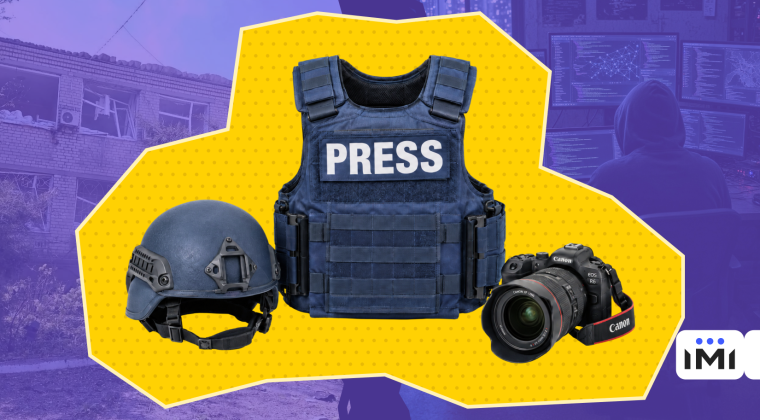
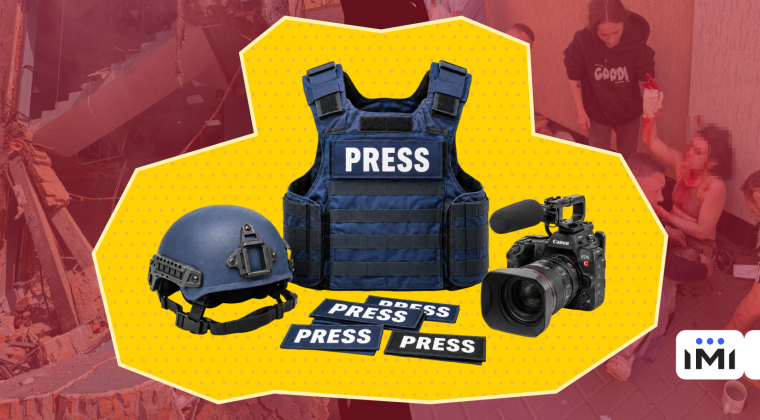
The classic interpretation of IHL, outlined in Article 79 of Additional Protocol I, is based on the assumption that a journalist is a civilian on a risky work trip. By this logic, wearing identifiers (a blue flak vest, a helmet, PRESS labels) should guarantee their safety. However, in the context of Russia’s full-scale technological aggression, this assumption is in conflict with the basic right to life (Article 2 of the ECHR and Article 3 of the Universal Declaration on Human Rights).
The problem is that the identifiers no longer work as protection and have instead become target indicators. When the aggressor consistently uses high-precision systems to spot and then eliminate media crews, the law’s requirement for reporters to make themselves “noticeable” becomes a suicide order.
Yevhenia Kravchuk, Chairperson of the PACE Committee on Culture, Science, Education and Media and member of the Committee on Equality and Non-Discrimination, said so on 27 March: “We have heard reports of this from media professionals themselves, and have just received confirmation from law enforcers, [Human Rights Commissioner] Dmytro Lubinets, and the Coordination Headquarters for POW treatment during a meeting of our temporarily investigative commission. A bulletproof vest saying PRESS does not protect but makes the wearer a target. Russia is deliberately ignoring the immunity of the press and exterminating those recording its crimes.”
Any clause (including that on reporter labeling) should in theory serve the aim of protecting the subject. If following the formal procedure (wearing PRESS labels) leads to the protected subject being killed, the clause becomes legally worthless. IMI insists that when journalists are being hunted, a right to tactical anonymity (wearing no identifiers) is a legal fulfillment of a journalist’s obligation to take precautions to protect themselves. This follows from AP I Article 57, which says that all practical precautions to minimise civilian casualties shall be taken. International institutions that insist on mandatory labelling in “grey zones” essentially make war crimes more likely to occur.
The evolution of passive safety and the stubborn international community
Another significant problem is international donors’ reluctance to provide journalists with protective gear. Whenever we mention electronic warfare systems, frequency detectors, or anti-drone rifles (that “shoot” electronic signals), their knee-jerk reaction is to enter caution mode and file these devices as “dual-use goods” or even “lethal aid”. Their key argument against delivering this equipment is that it may flag the journalist as directly participating in hostilities (DPH); however, as per the ICRC commentary to AP I Article 51, direct participation means acts of war which by their nature or purpose are likely to cause actual harm to the personnel and equipment of the enemy armed forces. For an action to amount to DPH, it must be aimed at harming the enemy’s military operations or personnel. A journalist is not integrated into the Armed Forces’ air defense or electronic warfare system. They act autonomously. Their protective equipment does not share data about potential targets with the army or help them aim their strikes. It is a private precaution. International law (e.g. the Rome Statute and the Commentaries on the Geneva Conventions) acknowledges that a civilian does not lose their protected status for using violence to defend against an unlawful attack on themselves or others. Since attacking a journalist (who is not taking part in combat operations) is first and foremost a war crime, the action the media professional takes to stop this crime (jam the drone’s signal) is justified and does not impact their non-combatant status. Overall, we can say that electronic warfare systems, anti-drone rifles, and drone detectors are a reasonable extention of the permitted safety gear and banning them is against the spirit of the Geneva Conventions.
First, we should consider the legal and technical nature of these devices. In international law, a weapon is a device designed to inflict physical harm, injury, or death on the adversary’s personnel. Drone detectors and electronic warfare systems are not constructed as munitions. A detector is a passive radio receiver only capable of catching a signal. Common sense says that a ban on drone detectors is as absurd as banning rear-view mirrors on journalist’s cars. It is a situational awareness tool that has no impact on the ongoing combat operations; it merely allows a civilian to exercise their right to avoid danger, as stipulated by Article 58 of Additional Protocol I.
The status of electronic warfare systems and anti-drone rifles is more complex, but legally transparent. International organisations often erroneously count them as means of warfare. However, IHL clearly deliniates between offensive and defensive weapons. An anti-drone rifle does not shoot kinetic ammo: it generates pulses that jam control frequencies, causing connection failure. It is a non-lethal means of preventing a war crime. Since a journalist is a protected person, any attack on them (including a suicide drone strike) is unlawful. Ergo, the use of an electronic warfare system by a journalist can not be considered as “participation in hostilities”, since the aim is to stop an unlawful act against a civilian. It is a technical means of threat prevention akin to wearing a bulletproof vest or a helmet.
We should also analyse the banned goods lists. No international convention (including the Hague Conventions and the Convention on Certain Conventional Weapons) lists electronic warfare systems as prohibited to civilians in conflict zones. Moreover, IHL does not even ban civilians from carrying small firearms for self-defense. If the law permits owning a gun to defend against marauders without losing the civilian status, a ban on non-lethal technology such as electronic warfare systems that protects against high-tech murder is legally nonsensical. Electronic warfare systems do not kill the drone operator or damage military infrastructure: they merely make an area temporarily out of reah for a specific murder weapon.
Finally, we arrive at the conclusion that anti-drone defense means are “digital armour”. Bulletproof vests used to be considered military gear but have since become a staple for the media. Today, as drones become the primary threat, an electronic warfare dome is becoming a staple in much the same way. Donors who deny journalists this equipment essentially deny their right to effective protection, forcing them to rely on outdated passive armour that is insufficient against modern threats. This is not mere formalism: it is a denial of the right to live. The international community must acknowledge that if a device does not kill but only prevents murder, it can not serve as grounds for designating someone as a combatant. It is a means of humanitarian protection, and anyone who truly wishes to minimise civilian casualties is obligated to help journalists procure it.
CONCLUSION
The most cynical aspect of IHL as it is practiced today is prioritising. The system we have now is designed to register crimes post-factum rather than to prevent them. The international community invests millions in documenting the murders of journalists, in the work of forensic experts and prosecutors, but obstructs the flow of devices that would have helped these journalists survive.
We have ended up in a situation where a “pure” legal status is valued above human life. An international bureaucrat believes it is better to have a dead journalist whose status of a civilian victim is indisputable than a live journalist who used an anti-drone rifle to disable a murder device and thus “soiled” their non-combatant status.
This is a fundamental violation of the humanism principle, i.e. that of preserving life. What we are seeing today is a willingness to sacrifice people for the sake of procedural purity. The journalist becomes a sacred sacrifice whose death only serves to give international institutions another chance to exress deep concern and update their war crime statistics.
Petro Stoinov, lawyer at the Institute of Mass Information