
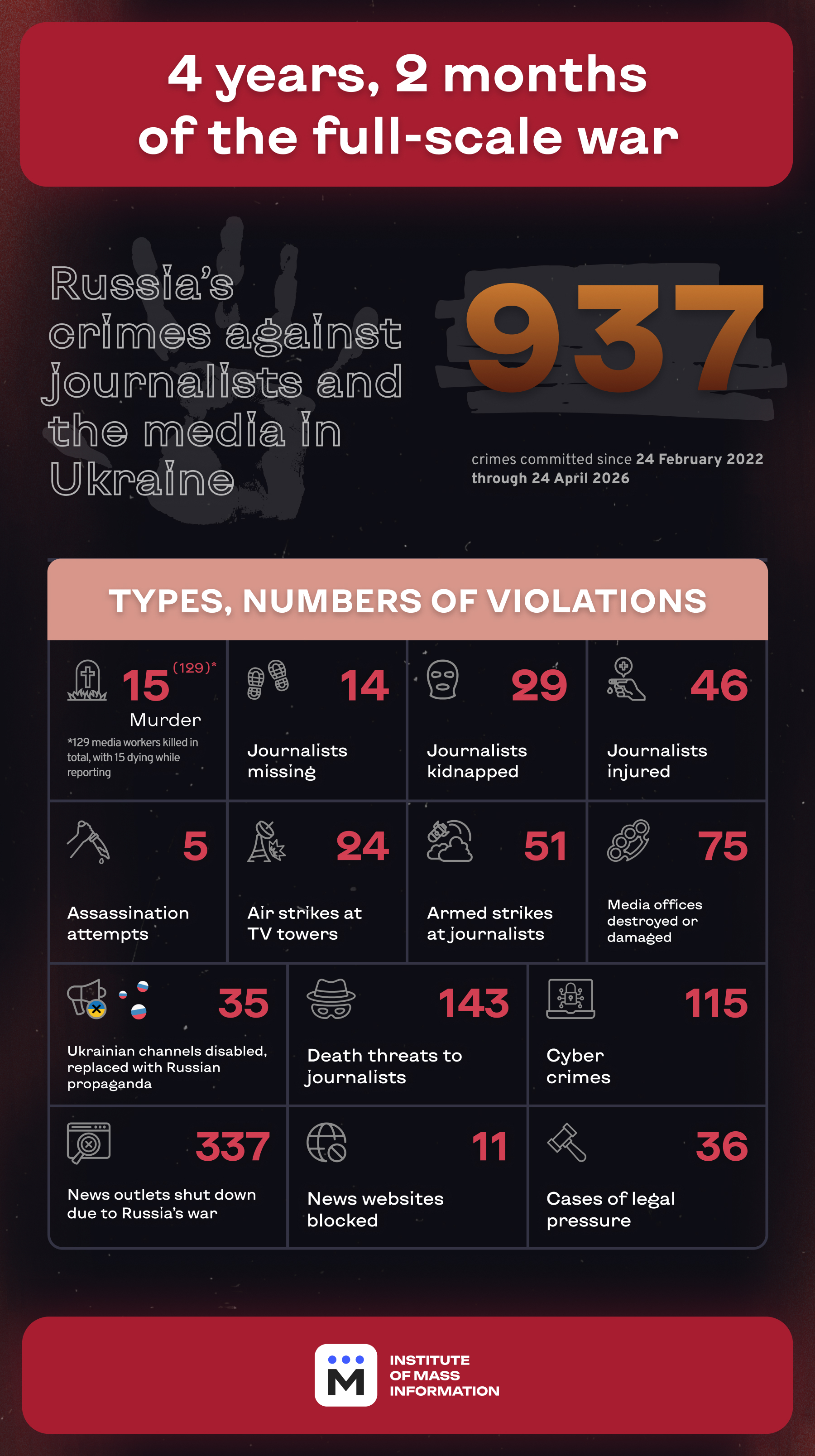
Russia committed 937 crimes against journalists and the media in Ukraine in the four years and two months since the start of the full-scale war, as evidenced by the Monitoring Study of Russia’s Crimes Against Journalists and the Media, which the Institute of Mass Information has been carrying out since the first day of Russia’s invasion of Ukraine.
The latest findings suggest that Russia committed nine new crimes in the period from 24 March to 24 April 2026 alone, including armed strikes at journalists, damage and destruction of media offices, cyber crimes, and legal pressure.
The Institute of Mass Information has updated the total statistics to include the findings of a recent study (carried out in April), which recorded 27 more instances of Ukrainian media offices coming under Russian fire.
The deaths of three media professionals who had been defending Ukraine in the ranks of the UAF were reported in March–April:
- Arthur Petrov, media worker and servicemember who was killed while helping evacuate the wounded in Kupyansk-Vuzlovyi on 18 March 2026.
- Yevheniy Solovey, TSN cameraman and servicemember. Joined 1+1 Media in 2011. Killed in action on 27 March 2026.
- Ihor Malakhov, filmmaker and servicemember who had been considered missing since 2023. Killed in combat near Stepove village (Donetsk oblast, close to Avdiivka) on 29 December 2023. His body was identified by DNA in 2026.
Armed strikes at journalists
- A Suspilne Dnipro filming crew came under Russian mortar fire in Kapulivka (Dnipropetrovsk oblast). The reporters were filming a news story accompanied by police when Russian troops opened fire: the shells dropped 50–100 meters away from them. The crew managed to escape, no one was injured.
Destruction or damage to media offices
- The buildings housing the Suspilne Odesa office were damaged in a Russian air strike. One of the buildings was hit by a Shahed drone and is beyond repair. There were no casualties, but the windows in most rooms shattered and the rooms themselves were damaged.
- The office of the newspaper Mezhivskyi Merydian was destroyed in a Russian guided bomb strike in Mezhova village (Dnipropetrovsk oblast), which is located 12 km away from the front line. The team continues to work and make new issues of the newspaper despite losing the office.
- A Russian strike in Pryluky (Chernihiv oblast) on 7 April damaged the city council building. Reporters with Pryluky TV, who were in the building at the time of the attack, evacuated to a bomb shelter in time and were unharmed. However, the team lost two full sets of video equipment in the strike.
- The Dnipro-based radio station Europe Plus Dnipro temporarily went off air after a Russian strike in the city on 15 April. A Shahed drone hit the building where the radio station’s office is located, causing them to stop broadcasting for half a day.
Cyber crimes
- The website of the Kharkiv-based news outlet Nakypilo was targeted by hackers based in Russia. The perpetrators tried to overload the website with requests. The page stayed online and no data was compromised.
- The Kropyvnytskyi-based regional newspaper Kirovohradska Pravda lost access to their Instagram account, which had over 25,000 followers. The profile is now unavailable and empty. The team does not rule out Russian involvement.
Legal pressure
- A Russian court sentenced the Institute of Mass Information (IMI) expert Iryna Zemlyana in absentia to 13 years in prison for allegedly attacking Sergei Andreev, the Russian Ambassador to Poland, in Warsaw in 2022. Iryna Zemlyana says that the ruling is politically motivated and is part of a pressure campaign against her; according to her, the charges are entirely fabricated. She was also charged with promoting “fakes” about the Russian army.
- A court in Russia sentenced Ukrainian journalist Oleksiy Homon in absentia to 9 years in prison on terrorism charges.
See the full list of Russia’s crimes against press freedom in Ukraine here.
The Institute of Mass Information (IMI) is a civil society organization specializing in the media, operating since 1996. IMI defends the rights of journalists, studies the media landscape and reports on media-related events, fights propaganda and disinformation, and provides media workers with safety equipment for trips to combat areas (since the start of the Russo–Ukrainian war in 2014).IMI carries out the only monitoring study of freedom of speech in Ukraine, keeps a list of transparent and responsible online media outlets, and tracks Russia’s media crimes in the war on Ukraine. IMI has representatives in 20 oblasts of Ukraine and runs a network of Media Hubs that provide journalists with unfailing support. IMI’s partners include Reporters Without Borders (RSF); the organization is also a member of the International Freedom of Expression Exchange (IFEX).