
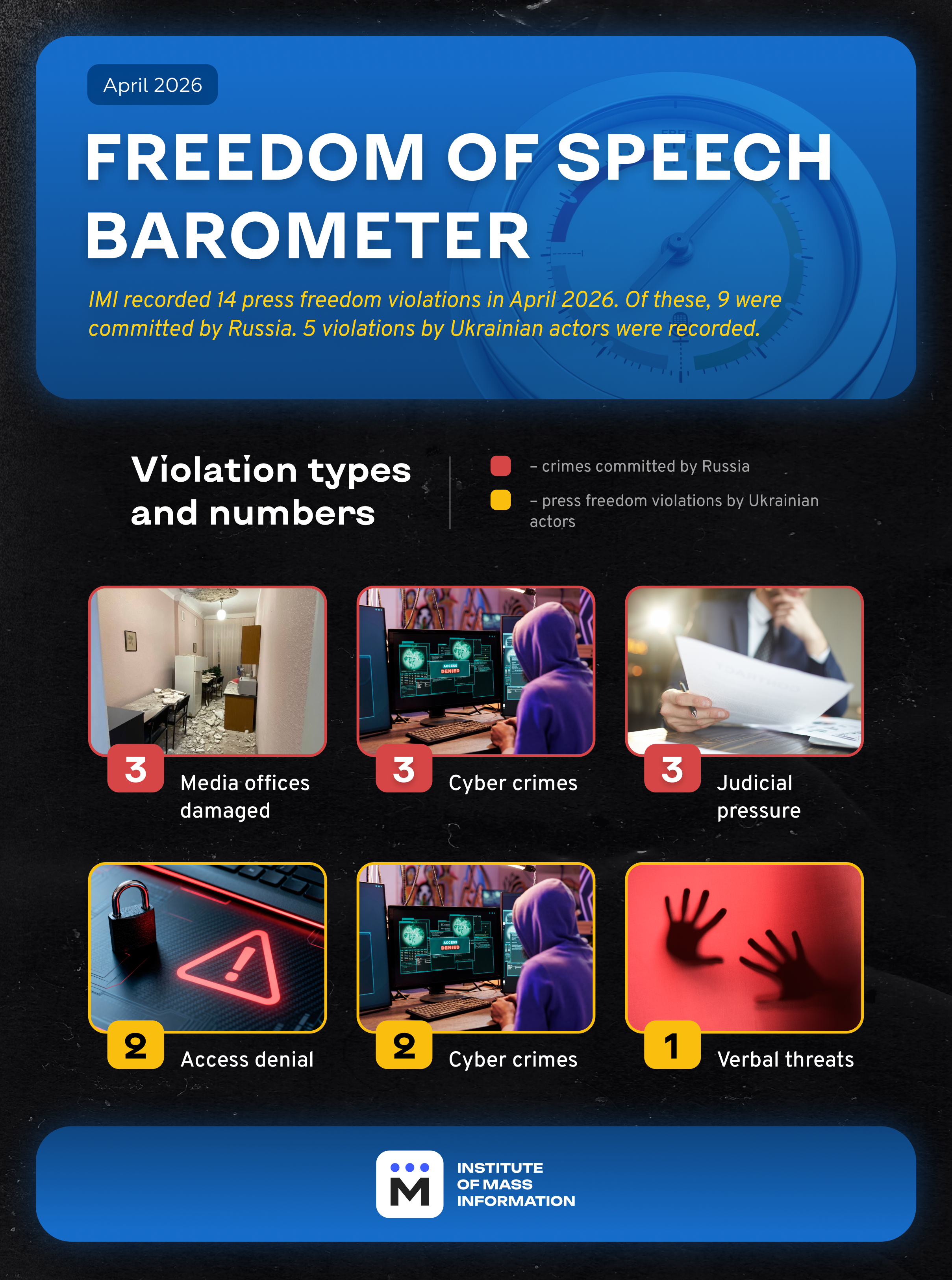
The Institute of Mass Information experts recorded 14 freedom of speech violations in Ukraine in April 2026. Nine were committed by Russia, as evidenced by IMI’s monthly monitoring study, the Freedom of Speech Barometer.
Russia’s crimes against the media and journalists in Ukraine included destruction of and damage to media offices, cyber crimes, and judicial pressure.
The deaths of two media workers turned UAF servicemembers* were reported in April:
- Ihor Malakhov, filmmaker and servicemember who had been considered missing since 2023. Killed in combat near Stepove village (Donetsk oblast, close to Avdiivka) on 29 December 2023. His body was identified by DNA in 2026.
- Viktoria Bobrova, UAF servicewoman and 2+2 TV casting director; press officer with the Mountain Assault Brigade No. 10 “Edelweiss”.
Destruction of and damage to media offices
- A Russian strike in Pryluky (Chernihiv oblast) on 7 April damaged the city council building. Reporters with Pryluky TV, who were in the building at the time of the attack, evacuated to a bomb shelter in time and were unharmed. However, the team lost two full sets of video equipment in the strike.
- The Dnipro-based radio station Europe Plus Dnipro temporarily went off air after a Russian strike in the city on 15 April. A Shahed drone hit the building where the radio station’s office is located, causing them to stop broadcasting for half a day.
Cyber crimes
- The website of the Kharkiv-based news outlet Nakypilo was targeted by hackers based in Russia. The perpetrators tried to overload the website with requests. The page stayed online and no data was compromised.
- The Kropyvnytskyi-based regional newspaper Kirovohradska Pravda lost access to their Instagram account, which had over 25,000 followers. The profile is now unavailable and empty. The team does not rule out Russian involvement.
- Russian hackers attacked the Freedom TV internal communication system, briefly accessing the channel’s corporate chat. Logins of some staff members were posted online along with screenshots of some official correspondence. A Russian hacker group has claimed responsibility for the attack.
Judicial pressure
- A Russian court sentenced the Institute of Mass Information (IMI) expert Iryna Zemlyana in absentia to 13 years in prison for allegedly attacking Sergei Andreev, the Russian Ambassador to Poland, in Warsaw in 2022. Iryna Zemlyana says that the ruling is politically motivated and is part of a pressure campaign against her; according to her, the charges are entirely fabricated. She was also charged with promoting “fakes” about the Russian army.
- A court in Russia sentenced Ukrainian journalist Oleksiy Homon in absentia to 9 years in prison on terrorism charges.
- A Russian court sentenced Oleksandr Malyshev, an administrator of the Telegram channel Melitopol is Ukraine, to 26 years in a high-security prison. He was found guilty of involvement in a terrorist group, espionage, and terrorism.
IMI also recorded press freedom violations unrelated to Russia’s war on Ukraine. These included verbal threats to journalists, restriction of access to public information, and cyber attacks. Violations were recorded in Kyiv city, Poltava and Mykolaiv oblasts and were committed by local government bodies and private individuals.
Verbal threats
- TSN reported violent threats to their journalist Olha Myronchuk following the release of her investigation about religious organisations operating in Ukraine on the news outlet’s YouTube channel. The journalist received a series of intimidating anonymous calls and messages, some of which involved violent threats. TSN viewed this as pressure and contacted the police.
Access to information for journalists
- The Poltava Oblast Council charged Nadia Kucher, the regional IMI representative, 6,500 hryvnias for copies of documents she had requested in her query about the budget money spent on media coverage of the government’s work. IMI believes such demands to be unlawful, as the requested information was a public interest and concerned budget expenditures.
- The Mykolaiv City Council issued an invoice for UAH 2,980 to regional IMI representative Kateryna Sereda for making copies of documents she had requested. According to the City Council’s calculations, providing a full response to her query would involve making copies of nearly 900 pages. IMI considers this, too, to be denial of access to public information, as this concerns budget expenditures.
Cyber attacks
- The news website ZN.ua was targeted in a DDoS attack. This resulted in disruptions in the website’s operations as the media outlet’s tech support team worked on restoring access.
- Bihus.Info journalist Svitlana Stetsenko was targeted in an online harassment campaign following the release of her investigation into the U420 network. She contacted the police over the dangerous psychotropic substances her investigation revealed, but did not report the harassment or verbal threats.
See the full list of freedom of speech violations committed in Ukraine in April below.
Russia’s crimes
Destruction of or damage to media offices — 3
1. Russian strike in Pryluky destroys local TV channel’s equipment; journalists unharmed
07.04.2026 A Russian strike in Pryluky (Chernihiv oblast) on 7 April damaged the city council building. Reporters with Pryluky TV, who were in the building at the time of the attack, evacuated to a bomb shelter in time and were unharmed. However, the team lost two full sets of video equipment, Pryluky TV director Iryna Pavliutina reports to Andriy Kuzhel, the Institute of Mass Information’s regional representative.
Pavliutina says that the reporter crew was in the City Council on an editorial assignment, filming an executive committee meeting; they were supposed to cover a round table discussion later, which is why they brought two sets of cameras with them to use them at the same time.
“We were at the epicenter of the events, right in the City Council. When the air raid alert went off – and as the alert was still going off – there was the first explosion, in another building. We all immediately went downstairs to the bomb shelter. The most we could do was save the people,” said Pavliutina.
The cameras, tripods, microphones, and chargers remained in the building and were destroyed in the attack. The director said that she was drafting a police statement including a list of lost property.
“The cameras were destroyed, but people were unharmed, thank God. The people are fine,” she stressed.
The team now uses mobile phones for filming. The camera at the TV channel’s studio survived, but it is not suitable for filming on the ground.
The Pryluky deputy mayor reported that the City Council have been declared unusable for the time being.
2. Radio Europe Plus Dnipro goes off air after Russian strike
15.04.2026 The Dnipro-based radio station Europe Plus Dnipro temporarily went off air after a Russian strike in the city on 15 April, the station’s director Yulia Lavrynets reported to Kateryna Lutsiuk, the Institute of Mass Information representative in Dnipropetrovsk oblast.
Lavrynets said that a Shahed drone had hit the building where the radio station’s office is located, causing them to stop their broadcasting for half a day.
“The studio is located in a different wing of the building. But because of the fire and the smoke, the power supply to the entire block was cut off. For about half a day, people were not allowed into the building due to the heavy smoke. After they started letting people in, I went to the studio and saw that everything was more or less fine. No one was injured, and the equipment was intact,” Yulia Lavrynets said.
Olena Demchenko, the National Council for Television and Radio Broadcasting representative in Dnipropetrovsk oblast, said there had been fears that the radio station would not be able to resume broadcasting due to damage to the studio and equipment.
“When [the broadcaster’s staff] got there, they saw that several windows in the office had been damaged and the doors had been blasted out. It was hard to assess the state of the equipment that was in the room: visually it was intact, but a fire had been extinguished there, and the rooms were full of smoke. They could not check it right away due to the blackout in the building,” said Demchenko.
The radio station managed to resume broadcasting about half a day later. According to Yulia Lavrynets, one window and door were damaged in the room of the radio station itself.
“One window and door are damaged, if we are talking about our radio station’s premises specifically. If we are talking about the building in general, then one wing of it was badly damaged, all five stories,” said Yulia Lavrynets.
3. Izium newspaper editor says their office still in disrepair after 2022 air strike
24.04.2026 Obriyi Iziumshchyny (Kharkiv oblast) chief editor Kostyantyn Hryhorenko told the Institute of Mass Information’s regional representative Yulia Napolska that the building that used to host their office is yet to be repaired after the 2022 air strike.
Hryhorenko said that Russian troops had struck central Izium in early March 2022, damaging the office building: 11 windows and two doors were broken, and the roof was damaged.
The office was looted after the strike: about 10 thousand dollars worth of equipment was stolen. Hryhorenko added that Russian soldiers had lived in the building while the city was occupied.
Konstantin Hryhorenko said that the team had repeatedly boarded up the broken windows themselves, which had been broken again twice, and had also installed an awning over the roof. The building where the office was located is a local historical monument which Obriyi Iziumshchyny has rented for 20 years.
Cyber crimes — 3
1. Russian hackers attempt to hack Nakypilo website
08.04.2026 The website of the Kharkiv-based news outlet Nakypilo was targeted by hackers on 5 April. The attack was carried out from Russian territory, reports Yulia Napolska, the Institute of Mass Information representative in Kharkiv oblast and Nakypilo production director.
Napolska says that the attack was carried out through the website’s order form: all notifications were sent to her email inbox and watch. The team received 500 requests within two hours and over 2 thousand in a day.
Yulia Napolska says that Russia has been repeatedly attacking the news outlet and trying to make the website difficult to access.
Nakypilo chief editor Olena Leptuha said in a comment to IMI that the 5 April attack was targeted the comment form, with about 100 requests recorded.
She said that the attackers had used typical SQL-injection queries that are used to search for vulnerabilities in websites. All these attempts were thwarted; they did not affect the website’s work and no data were leaked or compromised.
Leptuha added that the administrator’s notification system had been triggered during the attack, prompting him to block the Russian IP addresses behind the attack.
“Our comments are disabled, but the attackers tried to target the old service records, which still had a feature for submitting comments for moderation,” Olena Leptuha said.
2. Kropyvnytskyi newspaper loses access to Instagram account, suspects Russian involvement
16.04.2026 The team of the Kropyvnytskyi-based regional newspaper Kirovohradska Pravda has lost access to their Instagram account, which had over 25,000 followers. The team does not rule out Russian involvement in the incident, owner and chief editor Olena Sidorova told Pavlo Lisnychenko, the Institute of Mass Information representative in Kirovohrad oblast, in an exclusive comment.
Sidorova said that the page had become unavailable late on 16 April and the administrators had been “kicked out” of the profile. The profile page looks empty now, with no followers or posts displayed.
“We have already tried all available login options, but to no avail. Surprisingly, neither two-factor authentication nor other safeguards against hacking worked. We have contacted the tech support and hope to restore access to our page,” said Olena Sidorova.
She added that losing the account is a serious problem for the team, since they have been actively developing this channel for a long time; moreover, the newspaper has obligations to advertisers.
The chief editor said that the news outlet believes the account loss was retaliation for their reporting.
“Since we are a print publication, we actively report war-related news, in particular those related to the military operations and personnel, on social media. We have repeatedly been barraged with critical comments by pro-Russian bots, so we assume that our page getting blocked may be related to this,” she concluded.
3. Russian hackers access Freedom TV corporate chat, leak data
24.04.2026 Russian hackers attacked the Freedom TV internal communication system on 14 April, briefly accessing the channel’s corporate chat, Freedom TV reports.
As a result of the attack, logins of some journalists, editors, and other staff of the state-owned Multimedia Platform for International Broadcasting (MPIB) were posted online along with screenshots of some official correspondence.
A Russian hacker group has claimed responsibility for the attack.
The MPIB’s technical services and state authorities are working together to address the impact of the attack.
Judicial pressure — 3
1. Russia sentences IMI expert Iryna Zemlyana to 13 years in prison; Zemlyana says charges are false
11.04.2026 The Moscow City Court (Russia) has sentenced the Institute of Mass Information (IMI) media expert Iryna Zemlyana to 13 years in a low-security prison in absentia for allegedly attacking Sergei Andreev, the Russian Ambassador to Poland, in Warsaw in 2022. Iryna Zemlyana says that the ruling is politically motivated and is part of a pressure campaign against her; according to her, the charges are entirely fabricated.
The Russian news outlet Mediazona reported on the ruling on 10 March.
Zemlyana was found guilty under three articles of the Russian Criminal Code:
- attacking a representative of a foreign state with the aim of complicating international relations (Part 2 of Article 360);
- inciting hatred and enmity through violent means (Parts “a” and “c” of Part 2 of Article 282);
- promoting “fakes” about the Russian army (Part “d” of Part 2 of Article 207.3).
The Prosecutor General’s Office of Russia claimed that Zemlyana and “other unidentified persons” assaulted the Russian ambassador during a wreath-laying ceremony at the Soviet soldiers’ cemetery in Warsaw on 9 May 2022. The investigation alleged that the “attackers” doused the diplomat with red liquid and tore off his glasses and the St. George’s ribbon he was wearing.
Zemlyana was also charged with promoting “fake news” for two social media posts about the Russian troops’ crimes in Ukraine she made in 2022–2024.
As IMI reported, Iryna Zemlyana denies dousing the ambassador and other charges. She says she only splashed herself, and not the official, with beetroot juice during the protest. Zemlyana explains that the act was supposed to symbolise the blood of Ukrainians who are dying because of Russia’s war on Ukraine. The media expert stresses that the case against her was fabricated, adding that the Polish police did not find her guilty in this incident.
Earlier, on 4 March 2024, the Basmanny District Court of Moscow (Russia) arrested Iryna Zemlyana in absentia on these frivolous charges against her. She has said that the arrest was based on a false accusation and the probe into the “dousing” of the Russian ambassador to Poland in the spring of 2022 was entirely fabricated.
Iryna Zemlyana said in a comment to the Institute of Mass Information that the ruling was political and passed part of a pressure campaign targeting journalists, activists, and Ukrainians in general.
“Clearly, this ruling is a political signal, not real justice. This ruling and thousands of similar ones are part of a wider campaign of pressure and intimidation, as well as smearing journalists, activists, and all Ukrainian citizens. The case is entirely fabricated: just look at the footage and the photos to see that I did not do this. Moreover, the Polish law enforcement system acquitted me,” Iryna said.
“Such rulings in absentia are an attempt to intimidate and discredit. They are yet another proof that Russia can not remain in its current form after the war ends and Ukraine wins. The system there needs to be overhauled completely. Otherwise, it will continue to persecute thousands of people like me,” she added.
2. Russia sentences Ukrainian journalist Oleksiy Homon to 9 years in prison
15.04.2026 Russia’s Western District Military Court No. 2 sentenced Ukrainian journalist Oleksiy Homon in absentia to 9 years in prison on terrorism charges. The ruling was passed on 15 April 2026, Mediazona reports.
According to the news outlet, the prosecution was triggered by Homon’s two interviews with former “What? Where? When?” player and journalist Rovshan Askerov.
The Russian investigation claims that in the first interview, released in January 2023, the two called for an assassination of Russia’s political leadership, and claims that Homon encouraged listeners to sponsor terrorism in the second one, published in July 2024.
Both interviews were released on the Dmytro Gordon YouTube channel.
Oleksiy Homon graduated the Karazin University of Kharkiv, majoring in journalism. He is a former host and correspondent with Novyny and UA: Pershyi.
3. Russia sentences Zaporizhzhia Telegram channel admin to 26 years in prison
29.04.2026 The Southern District Military Court of Rostov-on-Don (Russia) has sentenced Oleksandr Malyshev, an administrator of the Telegram channel Melitopol is Ukraine, to 26 years in a high-security prison. He was found guilty of involvement in a terrorist group, espionage, and terrorism, the court’s press service reported on 28 April. Several Russian state-affiliated media outlets and Telegram channels, including TASS and Kommersant, also posted about the court ruling.
According to Russian media, the Melitopol is Ukraine admin was accused of “committing a terrorist act: launching a missile and bomb strike by Ukrainian military formations”. As per court’s press service, Oleksandr was found to blame for the fact that “in February 2023, Oleksandr Malyshev, using a Telegram channel, a feedback Telegram channel, a chatbot, and visual surveillance, collected and verified information… about the use of buildings and constructions to learn if Russian Armed Forces servicemen, other troops, military formations, or law enforcers were stationed there,” which resulted in “the locations of Russian FSB units in Zaporizhzhia oblast and the Rosgvardia Directorate in Zaporizhzhia oblast being targeted in a missile and bomb strike, with the buildings being completely destroyed or partially damaged.”
According to the Russian court, Oleksandr Malyshev, 27, has been sentenced to 26 years in a high-security colony and will serve the first five years of the term in prison. This is the harshest sentence that a Russian court has imposed on a Ukrainian Telegram channel administrator in this case.
The freedom of speech situation in Ukraine unrelated to Russia’s war
Physical aggression
Threats, intimidation, persecution — 1
1. TSN reports threats to their journalist
01.04.2026 TSN reported violent threats to their journalist Olha Myronchuk following the release of her investigation about religious organisations operating in Ukraine on the news outlet’s YouTube channel. The TV channel’s statement was released on 1 April 2026.
The journalist received a series of intimidating anonymous calls and messages, some of which involved violent threats.
“Our colleagues carefully responded to these signals: they initiated additional verification of the reports and asked for comments from the parties mentioned in the investigation. At the time of publication, no response had been received. Instead, the unknown individuals later switched to overt threats with regards to the investigation in question,” TSN.ua reported.
The news outlet emphasised that they considered such actions to be unacceptable pressure on journalists and a real threat to their safety.
The editorial team filed a corresponding statement with the police; reported the intimidation to relevant institutions; continued internal analysis and fine-tuning of the investigation; reached out to representatives of the religious organisations affected by the reporting.
“They, like us, are shocked by the threats and confirmed a shared position: violence and intimidation in any form are unacceptable. Namely, this is the opinion of the Religious Administration of Ukraine’s Muslims ‘Ummah’, as well as Said Ismagilov, chaplain of the Medical Battalion No. 2, lieutenant of the UAG Chaplaincy Service. Like the TSN.ua team, they advocate dialogue, mutual respect, and preventing any form of aggression,” the statement said.
The media outlet added that they did not rule out that the threats and pressure on journalists may be part of a provocation aimed at sowing discord in Ukrainian society.
Censorship, agenda guidelines, access to information
Access to information for journalists — 2
1. Poltava Oblast Council charges IMI representative 6,500 UAH for contract copies
30.04.2026 The Poltava Oblast Council charged Nadia Kucher, the regional Institute of Mass Information representative, 6,500 hryvnias for copies of documents she had requested in her query about the budget money spent on media coverage of the government’s work, Nadia Kucher reports.
In her query, the IMI representative asked for copies of contracts with media outlets signed in 2025-2026 and related certificates of completion. The Poltava Oblast Council responded by providing some of the requested information: 10 pages containing two contracts with IRT-Poltava TV and an invoice for 6,476 hryvnias 85 kopiykas.
“The requested information takes up a total of 1955 pages. According to clauses 2 and 3 of Article 21 of the Law of Ukraine ‘On Access to Public Information’, if fulfilling an information query involves making copies of documents exceeding 10 pages, the requester has to to reimburse the actual costs of copying and printing,” the Council’s response stated.
Institute of Mass Information lawyer Volodymyr Zelenchuk believes that the Poltava Oblast Council’s reimbursement demand was unlawful, since the requested information was of public interest.
“The Law ‘On Access to Public Information’ provides for reimbursement of costs for copying or printing documents provided in response to a request, if their volume exceeds 10 pages. The person requesting information is relieved of the obligation to reimburse such costs if the information they requested concerns their person or is of public interest,” commented Volodymyr Zelenchuk. He added that “public interest” was not exhaustively defined in the law, but the information requested by Nadia Kucher was needed to strengthen the authorities’ accountabiliy to the public and ensure the transparency of decision-making by the government, hence it can be considered of public interest and no fee should be charged for making copies of these documents.
2. Mykolaiv City Council charges IMI representative 3,000 hryvnias for contract copies
29.04.2026 The Mykolaiv City Council issued an invoice for UAH 2,980.35 to regional Institute of Mass Information representative Kateryna Sereda for making copies of documents she requested, Kateryna Sereda reports.
In her query, Sereda had asked for data on the budget funds spent on media coverage of the government’s work in 2025 and 2026, in particular for copies of contracts with media outlets, inlcuding all annexes, certificates of completion, and payment paperwork.
The City Council first said they were extending the query processing period to 20 business days due to the large amount of requested information.
Later, in the response signed by Mykolaiv’s first deputy mayor Vitaliy Lukov, the Council included 10 pages of the requested documents and said that Sereda would have to pay for the rest in accordance with the established procedure.
Institute of Mass Information lawyer Volodymyr Zelenchuk believes that the demand was unlawful, since the requested information was of public interest.
“The Law ‘On Access to Public Information’ provides for reimbursement of costs for copying or printing documents provided in response to a request if their volume exceeds 10 pages. The person requesting information is relieved of the obligation to reimburse such costs if the information they requested concerns their person or is of public interest,” Volodymyr Zelenchuk commented.
He explained that, even though “public interest” was not exhaustively defined in the law, case law outlines the criteria for it.
“However, the Supreme Administrative Court plenum listed the criteria for assessing whether information is of public interest in its resolution No. 10 dated 29 September 2016. The very fact that journalists express interest in certain issues may point to public interest. The resolution also lists information that contributes to improving the government’s accountability and oversight, in particular by ensuring transparency of decision-making processes or contributes to efficient oversight over the reception and spending of budget money, the disposal of state- or municipally owned property, and the distribution of social benefits as grounds for considering certain information as socially necessary,” the lawyer said.
Zelenchuk added that information on the spending of budget money on media coverage can be considered of public interest and no fee should be charged for making copies of these documents.
Online pressure
Cyber attacks — 1
1. ZN.ua reports DDoS attack on their website
02.04.2026 The news website ZN.ua was targeted in a DDoS attack, the team reported on Telegram on 2 April.
“The attack was considerable in scale, so restoration will take time. Our technicians are now working to eliminate the problems and are trying to restore the servers quickly,” the team said.
The website was online at the time of publication.
Other instances of online pressure — 1
1. Bihus.Info journalist reports drug trafficking to police, faces online harassment
07.04.2026 Bihus.Info journalist Svitlana Stetsenko, who faced online harassment following the release of her investigation “The Truth About U420 ‘Souvenirs’: Expertise Findings”, contacted the police over the dangerous psychotropic substances her investigation revealed, but did not report the harassment and verbal threats targeting her, Stetsenko tells the Institute of Mass Information journalist Valentyna Troyan.
“I did contact the National Police, but not about the harrassment, because that has stopped by now (at least in private messages). I asked them to open a criminal law investigation into the dangerous psychotropic substances discovered during the journalistic investigation,” Stetsenko said.
She said that individuals involved with the U420 network had tried to contact her between the announcement of the investigation and its full release.
“They said through intermediaries that they would ‘sue us.’ And they even wanted to meet. But after the video was released, they seemed to have changed their mind for some reason. I think it could have been an attempt to make us ‘change our mind’ about releasing the video. However, it did not influence our plans. It was personally important for me to tell this story,” Svitlana Stetsenko said.
She added that after the investigation was released, overnight on 2 April, a coordinated social media campaign targeting her began.
“It was a mass attack by bots with comments on nearly all social media platforms, as if by the numbers: Instagram, Threads, YouTube. They went like, ‘U420 sells legal cannabis, not what you are alleging here,’ ‘you would be better off doing something about gambling and alcohol and leave legal marijuana alone.’ Which, of course, is not true, because we have official confirmation from the Ministry of Internal Affairs laboratory, which clearly states, ‘A particularly dangerous substance outlawed by the Cabinet of Ministers has been detected,’” said Svitlana Stetsenko.
She added that she had also received abusive private messages containing obscene language, but she did not take them to be violent threats.
“[This was] aggression (which is absolutely not normal!), but nothing more,” she said.
The day following the release of the investigation saw a wave of online comments accusing the journalist of corruption and claiming the evidence was insufficient.
“Unfortunately, hate and public attempts to smear the investigation’s author or the entire team are nothing new in our line of work. However, thanks to our experience, this online attack, this kind of pressure, did not have the result that the ‘attackers’ expected. Meaning, this did not stop me or the team,” Stetsenko said.
She added that she was unsure if the attacks had stopped or would resume in the future, since her work on the subject continued.
“Right now our lawyers and I are doing all in our power to get the National Police to respond to our investigation accordingly,” Svitlana Stetsenko said.
Defending freedom of speech
The authorities’ response to press freedom violations — 2
1. Court dismisses dental polyclinic director’s claims against Konkurent
03.04.2026 The Lutsk City and District Court of Volyn oblast dismissed the claims by the Lutsk City Dental Polyclinic director Lyubov Yakovchuk, who sued the media outelt Konkurent and demanded 100 thousand hryvnias of compensation for moral damage.
The ruling was passed on 3 March 2026 and posted on the website of the Unified Register of Court Rulings.
The trial has been dragging on since 2023 and involved a linguistic examination.
As reported earlier, Lyubov Yakovchuk sued Konkurent in 2023 for 100 thousand hryvnias in moral damages. The plaintiff also demanded that information reported by the news outlet be declared misleading and the team be ordered to take the news articles down and publish a retraction.
The disputed news stories were released between 19 September and 21 October 2023:
- “Scandalous Lyubov Yakovchuk becomes Lutsk Dental Polyclinic director (photo)”;
- “Scandal at Lutsk Dental Polyclinic: incompetent ‘admin’ hired instead of manager”;
- “Lutsk Dental Polyclinic plans to relocate dentists: what problems this poses to doctors and patients”;
- “Lutsk Dental Polyclinic charges combatants for free services (photo)”;
- “Lutsk Dental Polyclinic diretor holds her position illegally”.
The court concluded that these articles were critical and contained the team’s personal assessments and beliefs regarding Lyubov Yakovchuk. According to the court ruling, the linguistic expertise confirmed that critical statements regarding the dental polyclinic director were presented as value judgments.
Specifically, the court said that one factual statement from the 19 September 2023 news story, “As a reminder, the appointment of a new medical director, Lyubov Yakovchuk–Kachmar, sparked a scandal among the staff of the municipal dental polyclinic” does not constitute dissemination of misinformation about the plaintiff. Several conflicts with the clinic’s staff did occur after the plaintiff was appointed and as a result of her work, which the article discusses.
The court added that the limits of permissible criticism regarding the dental polyclinic director as a public figure are considerably wider than those for a private person, and concluded that the claims for retraction of misleading information in these articles are unfounded and cannot be satisfied.
2. Police to investigate threats targeting TSN.ua journalist
07.04.2026 The police have opened a probe into the threats targeting a TSN.ua journalist, as reported on the National Police website and confirmed by TSN.ua.
“It has been established that after the release of a journalistic investigation, the head of the television project started receiving threats from unknown persons during telephone conversations,” the police said.
The case was filed under “threats or violence against a journalist” (Part 1, Article 345-1 of the Criminal Code of Ukraine).
Earlier, TSN had reported violent threats to their journalist Olha Myronchuk following the release of her investigation about religious organisations operating in Ukraine on the news outlet’s YouTube channel.
Other instances of press freedom defense — 1
1. Court dismisses Dnipro official’s lawsuit against Slidstvo.Info
15.04.2026 The Podilskyi District Court of Kyiv dismissed the lawsuit by the Dnipro City Council Secretary Oleksandr Sanzhara against Slidstvo.Info, who featured him in a journalistic investigation. The ruling was passed on 30 March 2026, Slidstvo.Info reports.
In the lawsuit, Sanzhara requested that the journalists’ actions be declared unlawful and the team be ordered to publish his response to the investigation, which revealed that the official used a private jet potentially worth over $100,000 for business trips to Europe. According to Slidstvo.Info, the jet in question is a 2002 Piper 28-161 Warrior, which was listed in Sanzhara’s property declaration.
The journalists’ lawyer, Oksana Maksymeniuk, said that the plaintiff had demanded they publish his comment on the investigation, which contained value judgments, despite the investigation already featuring extensive comments by him.
She added that Sanzhara considered the news outlet’s refusal to do so to be illegal even though the law does not require it, since the right to reply only applies to misleading — that is, inaccurate or incomplete — information.
“In our opinion, the court weighed the arguments presented by the defendant. With new media laws being passed, journalists should be more responsible when receiving comments from persons featured in their investigations. At the same time, it is worth noting that the right to reply only applies to misleading information, namely information that is inaccurate or incomplete,” explains media lawyer Oksana Maksymeniuk.
She considers this lawsuit to be an instance of SLAPP, i.e. an attempt to put pressure on journalists, since the plaintiff filed two similar motions contesting the video and the article.
In October 2025, Slidstvo.Info and OCCRP reported that the aircraft declared by Sanzhara had been making regular flights around Europe.
According to their data, in recent years, these flights have coincided with Sanzhara’s trips abroad ordered by his boss, Borys Filatov. The journalists identified a total of four such trips by the official, amounting to 61 days total, over the past year and a half.