
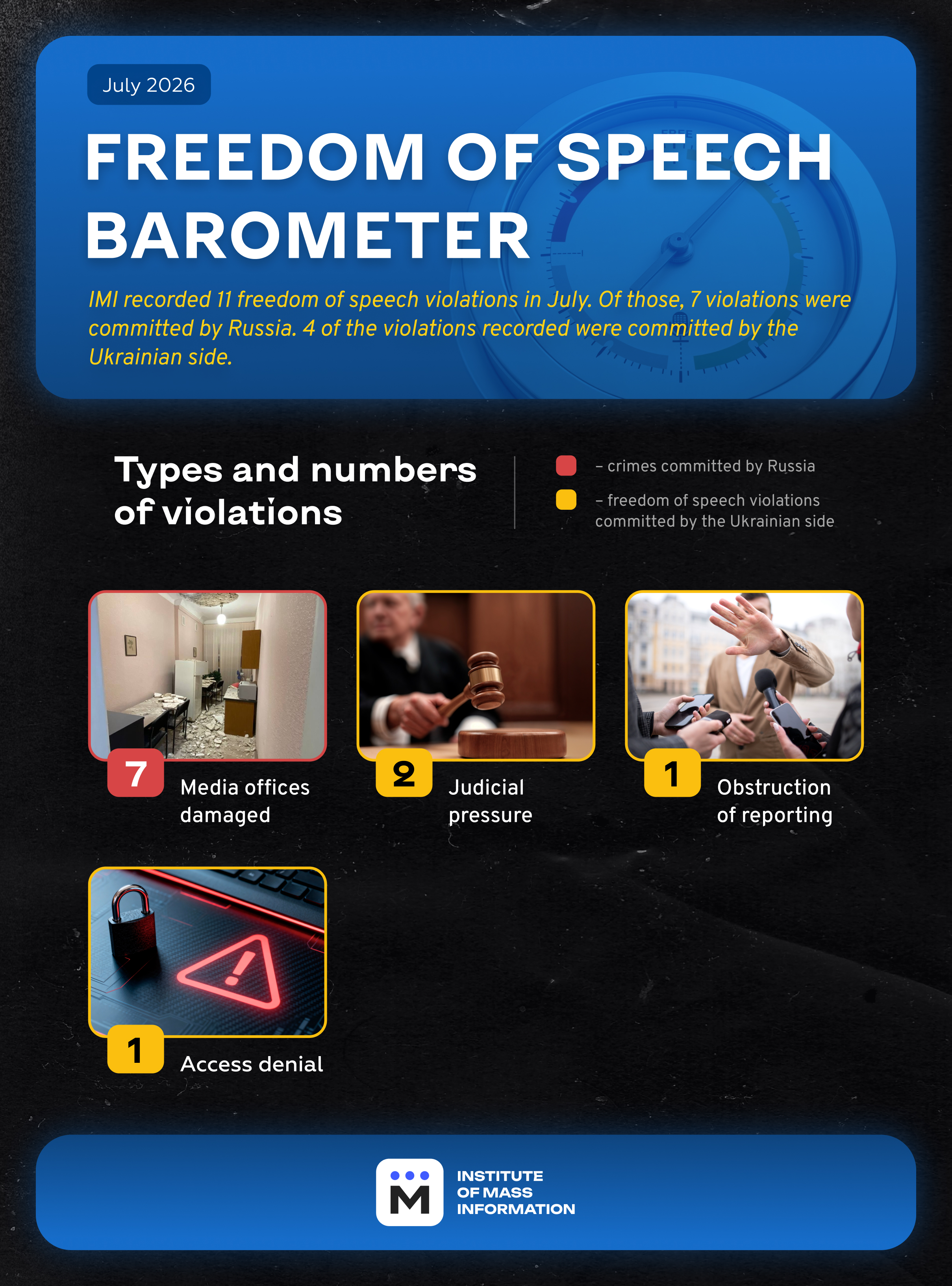
The Institute of Mass Information recorded 11 press freedom violations in Ukraine in July 2026. Seven were committed by Russia, as evidenced by IMI’s monthly monitoring study, the Freedom of Speech Barometer.
Russia’s crimes against the media and journalists included destruction of and damage to media offices.
The death of two media worker turned UAF servicemembers was reported in July:
- Oleksandr Vernihorov, cameraman with several Dnipro-based TV channels turned serviceman. Killed in action in Kharkiv oblast on 28 June 2026.
- Ivan Trembovetskyi, UAF serviceman, managing editor with TET TV, 2+2 TV. Killed in action in Sumy oblast.
Media offices & property destroyed or damaged
- The Islandiya TV studio was damaged in the Russian air strike of 2 July. A security guard was killed.
- The editorial office of Novyny Kramatorskoho Rayonu suffered significant damage as a result of a Russian airstrike in Kramatorsk on July 5.
- The office of the newspaper Novyny Kramatorska was also severely damaged in the 5 July air strike in Kramatorsk, Donetsk oblast.
- The Channel 5 office in Kyiv was damaged in a Russian overnight strike on 6 July. The channel went off air.
- The Russian attack on Sumy overnight on 17 July damaged the office and studio of the local news website Kordon.Media. The blast wave tore out the entrance door and studio door fasteners. Some plaster flaked off the walls and some things fell down.
- The office of the Zaporizhzhia-based news outlet inform.zp.ua was damaged in a Russian strike. The shock wave broke the window grilles in the building and caused ceiling collapse in some rooms.
- The 23 July Russian air strike in Bilopillya, Sumy oblast, affected the office of the local newspaper Bilopilshchyna, damaging the roof, the ceiling, furniture, and computer equipment.
Offenses unrelated to Russia’s war in Ukraine
In July IMI recorded four press freedom violations unrelated to Russia’s war against Ukraine. These included instances of judicial pressure, obstruction of reporting, and denial of access to information. The incidents occurred in Kyiv city and oblast (2), Odesa (1), and Rivne (1). The violations were committed by private security guards, the Odesa Oblast Military Administration, the Pecherskyi District Court of Kyiv, and the Rivne City Enlistment Office.
Obstruction. An Ukrainska Pravda filming crew was attacked by security guards at a resort complex in Koncha-Zaspa (Kyiv oblast) while reporting. The guards sprayed them with green dye. The police have opened an investigation into obstruction of reporting.
Denial of access to information. The Odesa OMA refused to tell Nikcenter journalists how much money from national and local budgets had been spent on fortification construction in the oblast, citing security. IMI lawyers believe the denial to be unlawful, since some of the requested information should be publicly available.
A court ban on releasing an investigation. The Pechersk District Court of Kyiv banned Slidstvo.Info and the Anti-Corruption Action Center from releasing and distributing an investigation into the real estate owned by the State Bureau of Investigation (SBI) director’s brother. The two organisations have called the ruling an attack on freedom of speech and are appealing it.
Judicial pressure. Chetverta Vlada chief editor Volodymyr Torbich said that the Rivne City Enlistment Office had unlawfully placed him on a wanted list for violating mobilisation law. He believes the move is linked to his reporting, and media lawyers have pointed out potential due process violations.
Read the full monitoring study below:
Russia’s crimes
Media offices & property destroyed or damaged — 7
1. Islandiya TV damaged in Russian air strike, security guard killed
02.07.2026 The Islandiya TV studio was damaged in the Russian air strike of 2 July. A security guard was killed, Islandiya TV reported.
“The Russians have destroyed our studio. Surprising that this only happened now. Unfortunately, a security guard, Uncle Vova, was killed; he was a good man, it’s a shame. He used to commute here from Sumy oblast. Condolences to his family and friends,” the channel’s post says.
The Kyiv City Military Administration chair Timur Tkachenko reported in a Telegram post that the Russian strike at Kyiv overnight on 2 July killed 13 people and injured 86.
The attack also may have caused temporary disruption in the operation of some Vodafone Ukraine services.
2. Another Kramatorsk-based newspaper office destroyed in Russian air strike
05.07.2026 The editorial office of Novyny Kramatorskoho Rayonu suffered significant damage as a result of a Russian airstrike on Kramatorsk (Donetsk region) on July 5, chief editor Andriy Hryn reported in a Facebook post and on the newspaper’s website.
The Novyny Kramatorska office, located in the same building, was damaged along with Novyny Kramatorskoho Rayonu.
Hryn said a comment to Yulia Harksusha, the regional Institute of Mass Information representative, that this was the second time the editorial offices had been targeted in Russian strike. After the previous attacks, the team restored the office on their own, installing new windows, repairing the doors, and cleaning up the debris. Then the blast wave had damaged the windows, doors, furniture, and equipment.
“Of course, no one will be working in the office anymore. To be honest, the Novyny Kramatorska team has been working remotely for a while now. We have also been working mostly remotely, but stopped by the editorial office every now and then to pick up equipment, documents, and discuss work-related issues,” he told the IMI representative.
Hryn said that the destruction was much more severe this time: all the windows in the building burst, all the doors were broken, and the walls in some rooms were partially destroyed.
He added that the team would no longer work in the office. Still, he has no plans to evacuate from Kramatorsk yet, while the Novyny Kramatorska team relocated to a different city back at the beginning of the full-scale invasion.
“It is impossible to even get into the office now: the doors to the upper floor are blocked after the explosion, so we cannot even fully assess all the damage yet. As for evacuation… Despite everything, it is probably too early for me to talk about it just yet. For now, we continue to work to the extent we’re able. And then we will see how the situation unfolds,” said Andriy Hryn.
3. Kramatorsk newspaper office destroyed in Russian air strike
05.07.2026 The office of the newspaper Novyny Kramatorska (Donetsk oblast) was severely damaged in the Russian air strike on 5 July, Novyny Kramatorskoho Raionu reported.
The media outlet said that this was not the first attack on the building housing the office. During the previous strike, the blast wave had damaged the windows, doors, furniture, and equipment. This time the destruction was much more extensive.
The blast blew out and damaged the recently restored windows once again. The building’s facade, the staircase, the common hallway windows and the door to the floor where the editorial office is located were also affected. Staff are now unable to enter the premises to fully assess the extent of the damage.
“The offices of the newspapers Novyny Kramatorska and Pryvit, which were located in the Household Life Building at 19-A Druzhby Street, were almost completely destroyed by Russian air bombs. Russia must bear responsibility for this. The deaths of hundreds of thousands of Ukrainians, hundreds of thousands of broken destinies, hundreds of thousands of destroyed buildings and apartments are on Russia’s record, on the Russians’s conscience. I wish them the same,” said Novyny Kramatorska founder Oleksandr Tolstohuzov.
4. Channel 5 goes off air after Russian strike damages Kyiv office
06.07.2026 The Channel 5 office in Kyiv was damaged in a Russian overnight strike on 6 July, the channel reported.
The team remarked that this was the second Russian strike within a year to affect the company’s Kyiv office. The attack resulted in severe material damage but none of the employees were injured.
The shelling affected key content production facilities. The premises, including the studio, suffered severe damage. Some of the filming equipment was also destroyed, along with journalists’ workplaces in office.
Due to significant damage to technology, the team has switched to another mode of broadcasting. Channel 5 will be unable to go back on air quickly, but the team continues their work on YouTube.
The company reminded that their Kyiv office had previously been attacked on 10 July 2025.
Channel 5 presenter Anna Miroshnychenko commented on the impact of the strike, posting a photo of the destroyed studio where daytime broadcasts had been supposed to take place on Facebook.
“The workplace. Broadcast hours could have been spent at this desk today starting at 12. This is the second time that Channel 5’s office has been targeted. We have already been attacked exactly a year ago, on 10 July. None of our colleagues were injured. But the studio is battered, some of the equipment has been destroyed, along with our workplaces. It is very painful to see this a second time,” Miroshnychenko wrote.
Despite the severe infrastructure damage, the broadcaster’s team continues to work. The journalists have already gone live on YouTube.
5. Kordon.Media office damaged in Russian strike at Sumy
17.07.2026 The Russian attack on Sumy overnight on 17 July damaged the office and studio of the local news website Kordon.Media, executive director Alyona Yatsyna reported to Olha Panfilova, the Institute of Mass Information representative in Sumy oblast.
The Russian forces struck the city with five guided aerial bombs.
Yatsyna says that one window in the office burst. Another double-glazed window survived thanks to the armored film, but the blast wave tore out the frame fasteners, so the window has to be replaced. The shock wave also tore out the anchors of the entrance door to the office and the studio door.
Inside, some plaster has flaked off the walls and some things have fallen down. The editorial equipment survived, only the printer having suffered minor damage.
“We feel the most sorry for our office cat Odin. He is 11 years old, he was very scared. The KAB-500 exploded about 100 meters away from the office, so the explosion was extremely powerful. The cat is very stressed now,” said Alyona Yatsyna.
The Kordon.Media team is addressing the impact of the strike on their own. The staff have already cleaned the premises, replaced the furniture, and are working to restore the entrance door and replace the damaged windows as soon as possible.
“So far, we have been able to cover the costs with our own editorial fund, but the constant shelling and the growing extent of the damage has meant that these resources have been rapidly depleting in recent weeks. That is why we are already thinking about including the emergency fund costs in grant applications, if possible, or looking for additional funding specifically for post-strike recovery and ensuring the team operates without interruption,” said Alyona Yatsyna.
6. Inform.zp.ua office damaged in Russian guided bomb strike
21.07.2026 The office of the Zaporizhzhia-based news outlet inform.zp.ua was damaged in a Russian strike on 21 July, chief editor Eric Brynza reported to Natalia Vyhovska, the Institute of Mass Information representative in Zaporizhzhia oblast.
Brynza said that during Russian troops used three guided aerial bombs (KAB) in the morning attack. One dropped near the editorial office, breaking the window grilles in the building and causing ceiling collapse in some rooms.
“We were attacked with three KABs in the morning. One fell near a high-rise building, and the other two hit warehouses, all 300 meters away from our office. The building shuddered, the window grilles were blasted out, the ceiling in some rooms collapsed. Everyone was safe and unharmed, but we were in shock,” the journalist said.
Cars in the parking lot near the media outlet’s office were also damaged by the shock wave; journalists discovered numerous bomb fragments in the area near the office.
Three people were killed and 13 were injured in Zaporizhzhia in the 21 July guided bomb strike.
7. Bilopillya-based newspaper’s office damaged in Russian strike
23.07.2026 The 23 July Russian air strike in Bilopillya, Sumy oblast, damaged the office of the local newspaper Bilopilshchyna.
Chief editor Natalia Kalinichenko spoke to Olha Panfilova, the Institute of Mass Information representative in the oblast, about the attack.
Kalinichenko said this was not the first time their office had been damaged in Russian attacks.
“There have been several hits. We’ve had ‘Molniyas’ landing on our roof, there has been mortar shelling nearby. But this time they hit the roof of our office specifically. Our equipment was in that room, we did the typesetting there,” said Natalia Kalinichenko.
The strike damaged the roof and ceiling of the building, as well as furniture and computer equipment.
The editor said that most of their team had relocated to Sumy back in 2025. Only one employee remained in Bilopillya to receive announcements and advertisements, as well as do on-the-ground reporting. He was at work on the day of the strike, but had gone home shortly before the building was hit, so he was unharmed.
Natalia Kalinichenko plans to inspect the premises in the coming days and carry away everything that can still be rescued. They will find a new workplace or the employee remaining in Bilopillya.
“Besides the constant strikes, there is little to no mobile connectivity in Bilopillya. If we have any, it is only thanks to the fiber-optic Internet,” Natalia added.
The building in which the office was located is over a hundred years old. It served as the Bilopilshchyna headquarters since the end of World War II. The newspaper itself is 107 years old: the first issue was released in June 1920.
Crimea — 1
1. Journalist Anton Naumliuk declared “foreign agent” in Russia as Crimean Solidarity member
27.07.2026 The Russian Ministry of Justice has added journalist, Graty co-founder Anton Naumliuk to the list of participants in the Crimean Solidarity movement, declaring him a “foreign agent”, Naumliuk reported in a Facebook post.
“The Russian Ministry of Justice has expanded the list of Crimean Solidarity participants assigned foreign agents status. Now the number of participants has grown to 137 and all of them are essentially declared foreign agents. All of us, because I’m also counted among them,” the journalist wrote.
He said that this move did not change much for him personally, because the had been facing pressure by Russian law enforcement bodies and regulators for years for his reporting on repression in Crimea.
Naumliuk said that he had been investigated back in 2016 on suspicion of “justifying terrorism” for his coverage of the persecution of Crimean Muslims. In 2021, Roskomnadzor tried to have a video taken down and Graty’s YouTube channel blocked due to a courtroom news report on the “second Bağçasaray Hizb ut-Tahrir Group”, and in June 2022, the Prosecutor General’s Office of Russia blocked the news outlet’s website.
“And in 2026, Crimean Solidarity is first declared a foreign agent, then the movement announces they are shutting down to somehow protect their members, and then I am included in their number. I see a certain consistency in all this, since 2016,” Naumliuk commented.
The journalist added that he had been considering ways to “make reporting on Crimea-related topics relevant and consistent again” in response to the actions by the occupation authorities.
As reported earlier, Russia has expanded the list of Crimean Solidarity “participants” to 137 people. On 26 June 2026, the movement announced they would cease operations after being included in the “foreign agents” list by the Russian Ministry of Justice.
The ministry claimed that Crimean Solidarity had “interacted with participants of international terrorist organisations” and cooperated “with the state authorities of Ukraine.”
The press freedom situation in Ukraine unrelated to Russia’s war
Physical aggression
Obstruction of legal reporting — 1
1. Ukrainska Pravda crew attacked at resort complex near Kyiv
09.07.2026 An Ukrainska Pravda filming crew was attacked by security guards at the resort complex Edem Kyiv, where Lviv businessman and former MP Ihor Kryvetskyi stayed at the time, late on 9 July, Ukrainska Pravda reported, citing their chief investigator Mykhailo Tkach.
“Yesterday evening (9 July — ed.), during a celebration for Ihor Kryvetskyi at the resort complex Edem Kyiv, security guards attacked the Ukrainska Pravda filming crew using dye spray. Thank God the dye didn’t get into the cameraman’s or driver’s eyes,” Tkach said.
He added that he had filed a report with the police.
“We expect a swift and objective response from law enforcement,” the journalist said.
National Police spokeswoman Yuliya Hirdvilis told Ukrainska Pravda that the Kyiv oblast police had entered the data from the journalist’s statement into the Unified Register of Pre-Trial Investigations under Part 1, Article 171 (“Obstruction of the lawful reporting”).
She added that law enforcement officers were looking into the incident and that investigative efforts were under way.
According to the outlet, Kryvetskyi opened a new five-star hotel, Edem Kyiv, in Koncha-Zaspa near Kyiv in 2025.
Censorship, access to information
Access to information for journalists — 1
1. Odesa OMA refuses to disclose fortification expenses to Nikcenter
16.07.2026 The Odesa Oblast Military Administration (OMA) refused to tell Mykolaiv-based investigative journalism center Nikcenter how much money from national and local budgets had been spent on fortification construction in the oblast, the news outlet reports.
The journalists submitted a query to the Odesa Military Administration to learn how much money has been allocated for the construction of fortifications in the oblast in the entire full-scale war period. The team sought to show that the fortification of the area and defense efforts in Odesa oblast have been ongoing since 2022 and are not related to fake reports of Russia’s plans to encircle Odessa.
The team did not ask for the exact location of the fortifications, their coordinates, technical characteristics, maps, or other data that could undermine the state’s security or defense capabilities if reported. Nikcenter stressed that disclosing the fortification expenditures would facilitate public oversight of budget spending, preventing possible embezzlement and corruption risks, and the government’s accountability.
Still, the Odesa OMA refused to disclose the requested information, calling it “classified expenses”. The administration claimed that the decision to restrict access to these data met the requirements set out in the law, citing national security, territorial integrity, and public order concerns.
Volodymyr Zelenchuk, a lawyer at the Institute of Mass Information, believes that the Odesa OMA erroneously equated funding for fortification construction with funding for the organising and management of defense efforts. He called the refusal unlawful.
This is not the first time that Nikcenter has faced denial of access to information by the Odesa OMA. Previously, the administration refused to disclose the sums spent on the top officials’ and staff’s business trips abroad taken during the martial law period to Nikcenter journalists.
Earlier, the Odesa OMA refused to share the list of persons who were nominated for state awards during the war with Nikcenter journalists, calling the news outlet’s queries “paperwork terrorism.”
Judicial pressure
Frivolous lawsuits against media outlets — 1
1. Court bans Slidstvo.Info from releasing investigation into SBI director’s brother
07.07.2026 The Pechersk District Court of Kyiv has banned Slidstvo.Info, the Anti-Corruption Action Center (ANTAC), and journalist Alina Stryzhak from releasing and distributing an investigation into 143 real estate properties that the journalists discovered to be owned by the State Bureau of Investigation (SBI) director’s brother, Oleksandr Sukhachov.
The ruling was passed on 6 July 2026, Slidstvo.Info and ANTAC reported.
Both organisations said that they viewed this as pressure on journalists and an attack on freedom of speech. The journalists will appeal the court’s ruling and seek to release the investigation.
ANTAC reported that Judge Serhiy Vovk had taken action to grant the claim even before it was filed, meaning that the court had not yet tried the case on the merits, since no statement of claim had been submitted yet.
At the same time, the court ruling suggests that the plaintiff only planned to request that ANTAC and Slidstvo.Info be banned from collecting and distributing information about the applicant and the SBI director, Oleksiy Sukhachov.
Slidstvo.Info journalist Maksym Savchuk, who co-authored the investigation, said that the team had worked together with ANTAC for several months investigating Oleksandr Sukhachov.
“We found many interesting things, such as 143 apartments and office spaces that have been or were owned by the elder Sukhachov, and also discovered threads leading to the State Bureau of Investigation, which is run by his brother Oleksiy Sukhachov,” the journalist said.
Savchuk said that about two weeks prior, ANTAC journalist Alina Stryzhak had reached out to the SBI director, asking him to comment on the facts discovered by the journalists. LLC Parkovyi-2, which the team found to be affiliated with Oleksandr Sukhachov, received a similar query.
However, instead of responding to the question, the company filed a statement with the Pecherskyi District Court of Kyiv on 3 July. Judge Serhiy Vovk granted it on 6 July.
“From this ruling we understand that the applicants are preparing a lawsuit targeting our investigation which is not even finished yet. And I think they are banning us from reporting anything on the business operations of the SBI director’s brother to ensure it is never finished. They are probably very well aware of how much interesting and socially important things we have found,” said Slidstvo.Info’s founding editor Anna Babinets.
ANTAC believes that the court’s ruling sets a dangerous precedent and may be used to curtail future investigations.
“This court decision is a very dangerous precedent. It directly restricts freedom of speech and bans the release of a socially important investigation. We are convinced that they are simply using ANTAC and Slidstvo.Info to test out a tool to prohibit journalists from exposing corruption. Failure to comply with this ruling will get us fined, possibly even prosecuted under criminal law, and will have multiple other consequences. We will definitely be appealing it,” said ANTAC CEO Daria Kaleniuk.
Judge Vovk ruled that posting Oleksandr Sukhachov’s property status, the details of his acquisition of real estate, and the source of the money involved online could inflict irreversible harm on an individual that could not be mitigated after the investigation is released. In addition, the court believes that this would lead to the disclosure of Parkovyi-2’s commercial secrets. The resolution adds that the SBI director’s brother had not given the journalists permission to disclose information about the 143 real estate properties owned by him.
Other instances of judicial pressure — 1
1. Chetverta Vlada chief editor reports pressure by enlistment office
09.07.2026 Volodymyr Torbich, chief editor of the investigative journalism agency Chetverta Vlada, says that the Rivne City Enlistment Office has placed him on a wanted list for violating mobilisation law despite the fact that the deadline for notifying the office that he was no longer eligible for draft exemption has not yet passed, Chetverta Vlada reports.
Torbich believes the enlistment authority’s move is a deliberate attack that may be linked to his reporting.
The agency reports that Volodymyr Torbich’s mother died on 4 July; caring for her had been the grounds for his draft exemption application. He learned that, under the law, he had seven days to notify the enlistment office that he was no longer eligible for exemption.
Torbich says he received notice that he was wanted late on 7 July: the day of Chetverta Vlada‘s 20th anniversary, and shortly after the outlet had shared a satirical collage on social media about various instances of local officials being impicated in corruption. By the night of 8 July, a notice that the enlistment office was searching for him had already appeared in the Reserve+ app.
Chief editor adds that the notice was soon followed by a message alleging that he was in violation of the law for refusing to take a military medical exam. Torbich maintains, however, that he was never served with a referral for the exam. What’s more, he had previously been told, via Reserve+, that he was not required to take one while his draft exemption remained valid.
Volodymyr Torbich believes the enlistment authority’s actions amount to a deliberate attack linked to the outlet’s reporting. In his view, the “wanted” status could be an attempt to discredit him, complicate any potential draft exemption (“reservation”), or restrict his ability to get a role matching his specialisation of choice in the army.
The journalist suggested that some of the politicians or businessmen covered by the outlet may have influenced officials at the enlistment office. He said that this could have been why he was declared wanted ahead of the established deadline — 12 July.
Lawyer Tetyana Veremiy, whom the agency consulted, believes that pressure on the media cannot be ruled out in this situation. She explained that a draft-eligible person has a seven-day period to report any status changes, either through a digital account or by coming to the enlistment office in person. Only then, she said, can the office begin a review procedure and decide on cancelling one’s draft exemption.
Media lawyer Yevhen Vorobyov likewise believes that Torbich’s premature placement on the wanted list may be in violation of the law. According to him, grounds for concluding that a person liable for military service is dodging the draft only arise after the person has been properly summoned, served with a referral, and it has been confirmed that they failed or refused to come or did not take the medical examination within the set time frame.
Chetverta Vlada reached out for comment to Vitaliy Plakhotniuk, head of the Rivne City Enlistment Office. He said he could not comment on the situation without “objective data,” and suggested the outlet send a formal query so that the office could look into the matter and provide a response.
Defending press freedom
Response by the media community — 3
1. Media Movement’s statement on recent systemic pressure on investigative journalism
08.07.2026 The Media Movement, along with the media and human rights organisations endorsing this statement, expresses concern over the signs of systemic pressure on investigative journalism by law enforcement bodies and calls for open communication on the part of the State Bureau of Investigation, and for the authorities and courts to strictly observe the press freedom guarantees.
Two events have occurred in Ukraine in the past few days which, in our opinion, point to a disturbing trend of exerting pressure on media outlets investigating the work of state and law enforcement institutions.
On 7 July, the State Bureau of Investigation searched the homes of Babel co-founder Oleksiy Babenko and his relatives, as well as at the office of Vyriy Industries, a company owned by Babenko. No official statement explaining the grounds for the law enforcers’ attention to Vyriy Industries and its owner has been issued, but the Babel team believes that it may be related to their high-profile investigation into the deaths and torture of servicemembers in the Skelia Assault Regiment. In particular, the journalists have pointed out that the searches had been preceded by a large-scale smear campaign targeting Babel and Oleksiy Babenko. Posts by anonymous Telegram channels and websites of dubious reputation alleged that Babenko had been willfully acting to undermine Ukraine’s defense capabilities. There was also a false report of the authorities raiding Babenko’s apartment and discovering a large amount of cash there shortly before the searches actually took place.
Prior to this, a Skelia Regiment serviceman, Mykola “Kyianyn” Kharkhan, posted a video calling Kateryna Lykhohlyad, the journalist who wrote the investigation, a “whorenalist,” accusing her of corruption, and threatening that she would have to “puke the money up later.” Moreover, some of the comments under the video could be viewed as threats of retaliation, physical and sexual assault. These statements likely aim to create an intimidating environment for the journalist, such as, “These are some pretty girls, the Moscow rapists will like them,” or “Journalists reporting unverified information and smearing the name of the best unit of the Ukrainian Armed Forces … should be tied to an ATV themselves,” etc. Babel chief editor Kateryna Kobernyk said after the investigation was released, both she and Kateryna Lykhohlyad had to hire security, which affected their lives.
Meanwhile on 6 July, the Pechersky District Court of Kyiv (Judge Serhiy Vovk) banned the Anti-Corruption Action Center, Slidstvo.Info, and journalist Alina Stryzhak from releasing an investigation into the real estate ownership, monetary transactions, and investments of the Kharkiv-based businessman Oleksandr Sukhachov, the brother of State Bureau of Investigation director Oleksiy Sukhachov. The ban was imposed as a measure to secure the lawsuit even before the lawsuit was filed, based on a statement by the LLC Parkovyi-2, a company affiliated with Oleksandr Sukhachov, submitted in response to the journalist’s request for a comment. This is a preemptive ban on an investigation not yet released, passed within one business day, serving the interests of one party only, with the defendant absent and before the proceedings were opened. This incident has the characteristics of a SLAPP (strategic lawsuit against public participation), and the mechanism itself is disproportionate and legally questionable in view of Article 34 of the Constitution and Article 10 of the Convention for the Protection of Human Rights and Fundamental Freedoms.
Taken together, these events — the sudden and undercommunicated action against the Babel co-owner and the court ban on the investigation into people with ties to the State Bureau of Investigation — suggest an effort to exert pressure on the media in order to curtail socially important investigations, namely those regarding violations of the law and human rights in the Defense Forces and possible corruption risks in the law enforcement system.
We call on the State Bureau of Investigation to openly disclose the reasons for searching Oleksiy Babenko’s apartment and his company’s office to the public.
We warn the authorities, law enforcement bodies, and individual representatives of the Defense Forces against any attempts to exert pressure on Babel, in particular through its owner. The Babel team has said that the law enforcer’s actions regarding their co-founder would not affect the progress of the ongoing investigation into Skelia.
We call on the Defense Forces command to express their position on the threats to media workers made by a Skelia Regiment servicemember, and to guarantee that journalists with Babel and other media outlets investigating alleged violations of the law and human rights in the army face no pressure or violence.
We call on law enforcement bodies to ensure an effective investigation into the threats of physical and sexual violence made against Babel journalists, and to carry out a proper legal assessment of these statements.
We emphasise that the preemptive court ban on the release of an investigation that has not yet been published is a direct restriction on freedom of speech and a dangerous precedent. We call on the Court of Appeal to overturn the Pechersk Court ruling and on the courts to refrain from normalising this practice. We remind you that Ukraine has undertaken to introduce anti-SLAPP legislation in accordance with EU standards by 2027, and that rulings that hinder the work of journalists even before publication go against the state’s European integration obligations.
2. 8 news outlets publish investigation court banned Slidstvo.Info from releasing
17.07.2026 Early on 17 July, eight Ukrainian media outlets simultaneously published an investigation into the 143 real estate properties which journalists have discovered to be owned by the State Bureau of Investigation (SBI) director’s brother, Slidstvo.Info reports.
The investigation was prepared by Slidstvo.Info journalists and the Anti-Corruption Action Centre (ANTAC), but the Pecherskyi District Court of Kyiv banned them from releasing it.
In a show of solidarity with their colleagues, several news outlets joined forces to form “Initiative 143” (named after the number of the businessman’s real estate properties covered in the investigation). Journalists have described the court’s ruling as an outright act of censorship.
The Initiative was joined by Ukrainska Pravda, Suspilne, Skhemy (RFE/RL), Hromadske, Dzerkalo Tyzhnia, NV, Bihus.Info, and TV Toronto. All of them published the investigation simultaneously.
The investigation was prepared by journalists with Slidstvo.Info along ANTAC. However, on 6 July, Kyiv’s Pecherskyi District Court banned Slidstvo.Info, ANTAC, and journalist Alina Stryzhak from reporting a body of information about property owned by the SBI director’s brother even before the material was released. This ban sparked public outcry and drew statements from both Ukrainian and international organisations.
“The following text is published as part of ‘Initiative 143’ — an act of solidarity by Ukrainian media professionals who have decided to support their colleagues at Slidstvo.Info and ANTAC. Since this ban appears to be an outright act of censorship, we, along with the other participants in the initiative, consider it necessary to release the investigation,” reads the note accompanying the publications.
Slidstvo.Info’s founding editor Anna Babinets described the move as an unprecedented display of professional solidarity.
“Our colleagues are taking a risk by releasing a banned investigation, because if the authorities have gone this far in suppressing freedom of speech against our team and ANTAC, what’s going to stop them from exerting pressure on others? I am sincerely grateful to my colleagues for this show of solidarity. It demonstrates that we’re all rallying around the same values: truth, freedom of speech, and quality journalism,” Babinets said.
ANTAC’s Executive Director Daria Kaleniuk stressed, “This investigation is yet another piece of evidence that Ukraine needs an SBI reform and an independent selection process for the Bureau’s director — as the EU has demanded.”
3. Ukrainian NGOs call on government to allocate UAH 3,8 bln to Suspilne in 2027
20.07.2026 Ukraine’s civil society organisations called on the government to ensure adequate funding for Suspilne Broadcasting in 2027: UAH 3,8 bln, which amounts to 0.2% of the total budget expenditure from the previous year excluding security and defence spending.
The organisations released a statement to this effect, which the Institute of Mass Information endorsed.
The statement stresses that over the 10 years of its existence, Suspilne Boradcasting has transformed into a modern multimedia corporation “delivering content 24/7 from and to every corner of Ukraine.”
Still, despite all the reforms and evolution, the lack of consistent state funding remains an issue undermining its independence.
The organisations emphasised that producing Ukrainain content was a strategic task on par with military defense of the country.
“The fighting in the media space — the cognitive warfare — is just as much a part of this war, no less frightening or deadly than drones and guided bombs. . . . Producing domestic content in the Ukrainian language must rank as a priority second only to producing weapons. . . . Ukraine must also be invested in clearing the benchmark clusters on its path to European integration, and ensuring Suspilne’s financial and institutional independence is one such benchmark,” the statement reads.
The organisations called for Suspilne to be granted UAH 3,8 bln in funding, as stipulated by law.
“This sum would allow Suspilne to not merely keep functioning, but to invest more in producing domestic content, both through Suspilne itself and through independent producers adhering to Suspilne’s standards. We firmly believe that adequate funding for Suspilne, and for the media and culture sector as a whole, is a long-term investment — one that will, among other things, help Ukraine overcome the impact of the war in the future,” the statement concludes.