
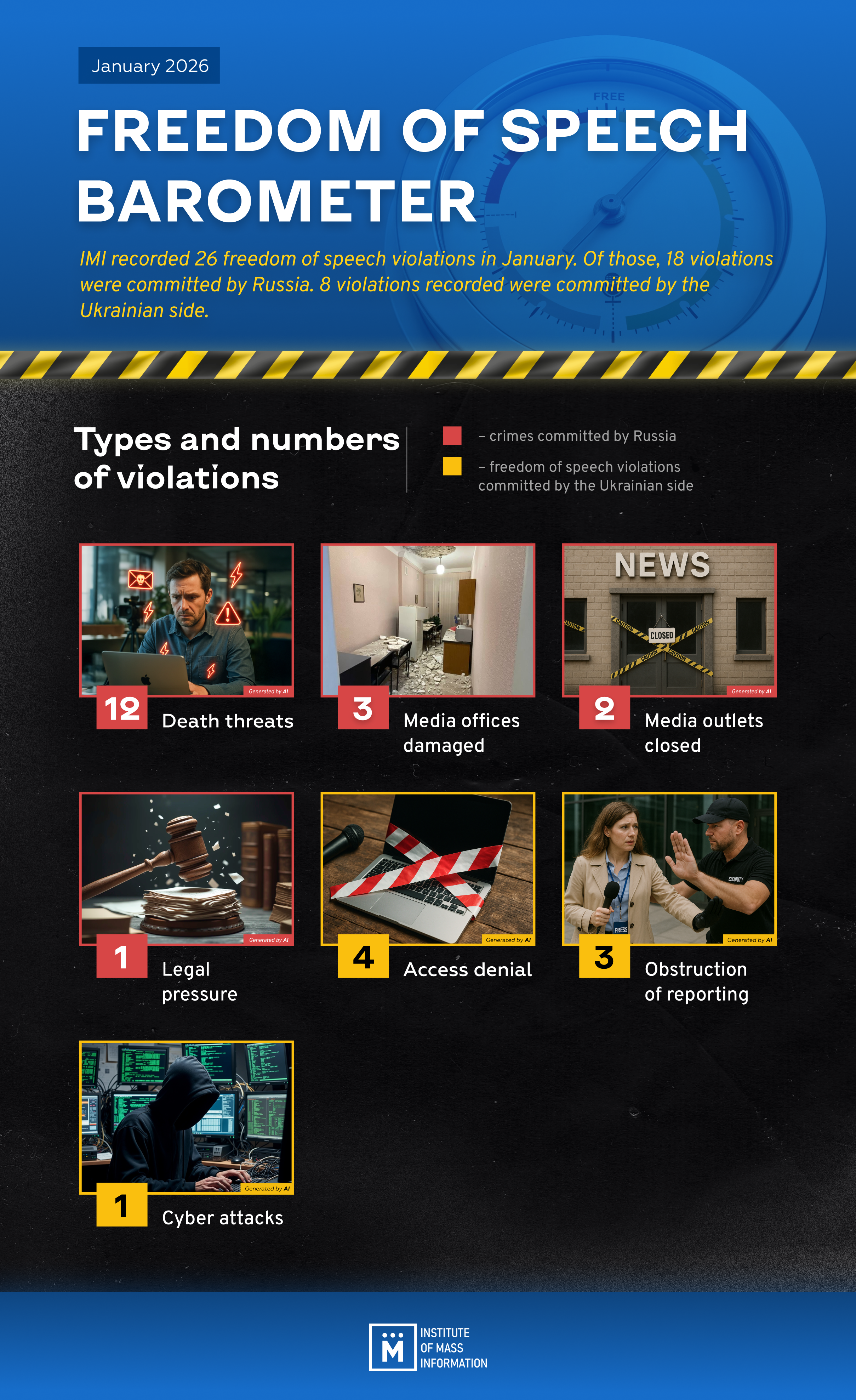
The Institute of Mass Information experts recorded 26 freedom of speech violations in Ukraine in January 2025. 18 were committed by Russia, according to the IMI’s monthly monitoring study Freedom of Speech Barometer.
Russia’s crimes against media and journalists in Ukraine included death threats and intimidation of journalists, damage to media offices, media outelts closing down, and legal pressure.
The death of three media workers turned UAF servicemembers was reported in January:
- Lana Chornohorska, journalist and UAF servicewoman (UAV pilot and navigator). Killed by a Russian drone in Ukraine’s South on 1 January 2026. She was a reporter with the Kharkiv-based news outlet Lyuk, activist, and artist before enlisting.
- Volodymyr Siniychuk, serviceman, photocorrespondent with the local newspaper Ridnyi Kray (Velyka Bahachka village, Poltava oblast). Killed in action in Donetsk oblast on 4 January 2026. He was drafted into the army on 20 December 2022, following the full-scale invasion.
- Yuriy Mihashko, serviceman, production designer at Novyi Kanal. Killed in action in Sumy oblast. Enlisted in the Defense Forces in March 2022.
Damaged media offices
Offices of three media organisations in Kyiv were damaged as a result of Russian strikes on Ukraine’s energy infrastructure:
- Realna Hazeta, relocated from Luhansk oblast;
- Institute of Mass Information;
- Television Toronto.
When heating was switched on after a long time of being disabled, the sudden temperature change burst the pipes, leading to flooding in the buildings. Technology and equipment was damaged; the offices are temporarily unusable.
Death threats to journalists (false bomb threats sent en masse)
Several Ukrainian news outlets received emails on 30 January claiming that bombs had been planted in their offices as well as buildings of some state bodies. The senders called themselves “soldiers” or “ex-sappers”, claiming to have installed hundreds of explosive devices and threatening to set them off over the course of several days. The letters were similar, each listing random addresses in Ukraine and abroad and baring the hallmarks of an attack campaign. IMI representatives Kateryna Sereda, Iryna Nebesna, and Valentyna Troyan received such messages, as well as the following news outlets: Vilne Radio (Anastasia Shybiko, Olena Rusinova), Farvater.Skhid (Anna Nikolayenko), MediaDokaz, Detector Media, 18000, Pershyi Kryvorizkyi, Kremenchutskyi Telegraf, Poltavska Khvylia and Poltavska Dumka.
Media outlets closing down
Print media outlets across Ukraine continue to close down due to the financial crisis and the impact of the full-scale war:
- Nashe Prydnistrovya, one of the oldest print newspapers in Vinnytsia oblast that had been in print for 95 years;
- he newspaper Nash Kray, based in Rozhyshche (Volyn oblast).
The reasons include the print run drop, growing delivery costs, loss of ad revenues, staffing shortages, and blackout-induced work complications. The news outlets say they may resume operations in the future.
Legal pressure
Russia has put Odesa-based investigative journalist and environmentalist Vladyslav Balinskyi on the international wanted list for his work tracking Russia’s war crimes and the environmental impact of its aggression. Balinskyi is charged with “spreading fake information about the Russian Armed Forces” and “damaging war memorials”; the case has been submitted to a court in Moscow.
IMI also recorded press freedom violations unrelated to Russia’s war on Ukraine. These included obstruction of reporting, denial of access to information, and cyber attacks.
Obstruction of reporting
- Journalists with the news outlets Nakypilo and Dumka were barred from entering a Nova Post terminal to film the aftermath of a Russian air strike. They were only granted access after the security company’s management intervened. The issue was the security letting journalists in selectively despite the situation being the same.
- Journalist Oksana Pidnebesna was was removed from an Odesa courtroom during an open hearing in the case of a pro-Russian group. The defense falsely claimed that the journalist was a witness in the case. She appealed against the decision and contacted the police, viewing this as obstruction of reporting.
- Dnipro City Council deputy Artem Khmelnykov kicked down the camera of freelance reporter Oleksandr Slavnyi, who wanted to get a comment from the official. An investigation has been opened under Article 171 Part 1 of the Criminal Code. The journalist filed a statement with the police, who entered the data into the URPI and are looking into the incident.
Access to public information
- The Odesa Oblast Military Administration refused to disclose the sums spent on the top officials’ and staff’s business trips to journalists, claiming the information was not public and could not be shared under martial law.
- Only reporters with local TV channels were invited to the introduction of the new Chernivtsi Oblast Military Administration chair.
- Poltava journalists have been unable to get a response from the city’s acting mayor Kateryna Yamshchykova and the Cirty Council’s first deputy chair Valeriy Parkhomenko regarding a proposed meeting with the latter. The journalists have questions regarding Parkhomenko’s work.
- 061.ua journalist Elmira Shahabudtdynova has been unable to get comments on war crime trials from the oblast prosecutor’s office since the release of her news story reporting on the financial declarations filed by a Zaporizhzhia oblast prosecutor. The prosecutor’s office said that disclosing the requested information would be “inappropriate” at the respective stages of the investigations, which affects coverage of the trials.
Cyber attacks
- The news website ZHAR.INFO was targeted in a three-day DDoS attack following several social media posts by the media outlet reporting on high-profile construction projects in Khmelnytskyi city. The attack aimed to access the website’s admin panel; the team believes the attack had to do with their reporting criticising the local authorities.
See the full list of freedom of speech violations here.
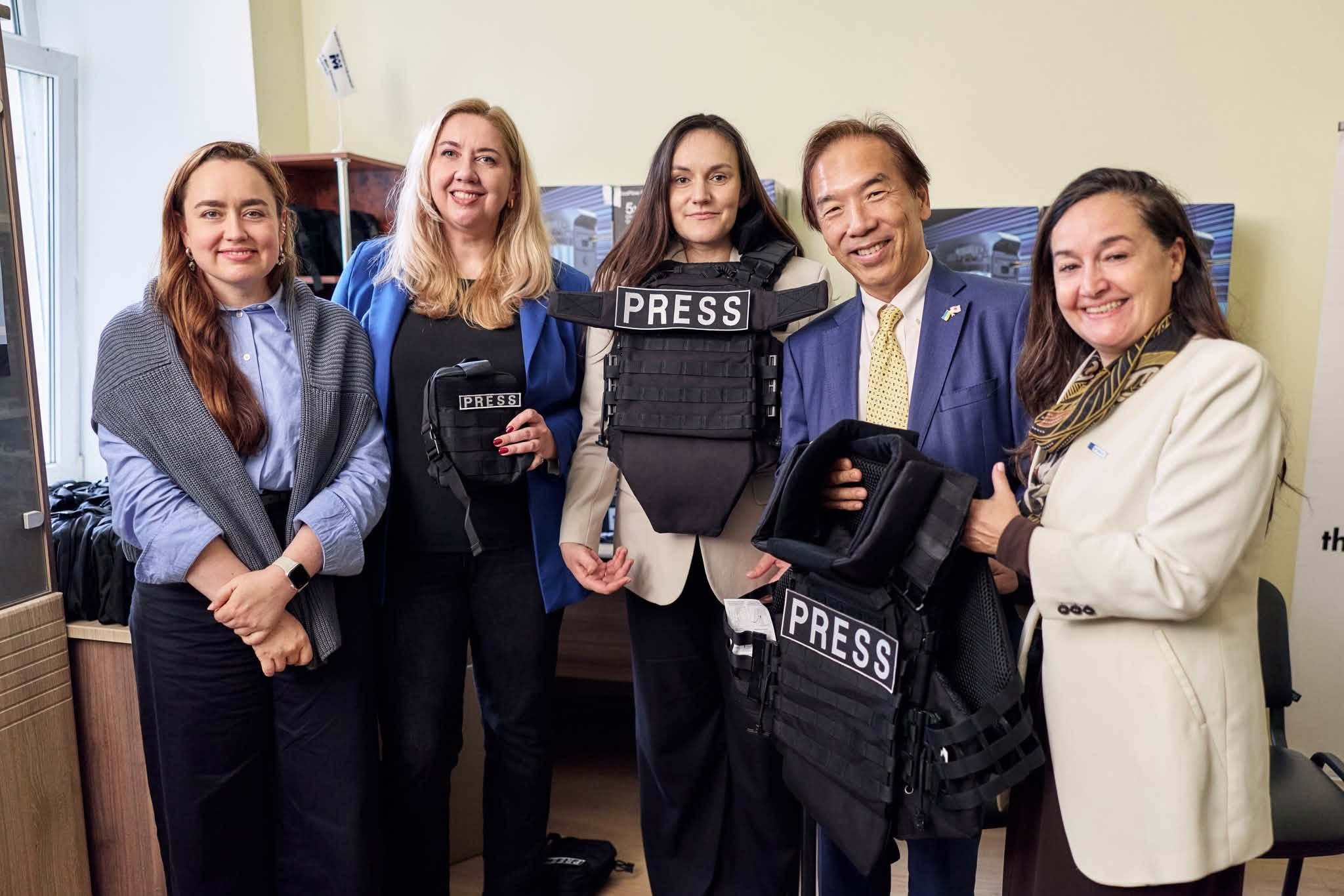
The Institute of Mass Information (IMI) is a civil society organization specializing in the media, operating since 1996. IMI defends the rights of journalists, studies the media landscape and reports on media-related events, fights propaganda and disinformation, and provides media workers with safety equipment for trips to combat areas (since the start of the Russo–Ukrainian war in 2014).
IMI carries out the only monitoring study of freedom of speech in Ukraine, keeps a list of transparent and responsible online media outlets, and tracks Russia’s media crimes in the war on Ukraine. IMI has representatives in 20 oblasts of Ukraine and runs a network of Media Hubs that provide journalists with unfailing support. IMI’s partners include Reporters Without Borders (RSF); the organization is also a member of the International Freedom of Expression Exchange (IFEX).