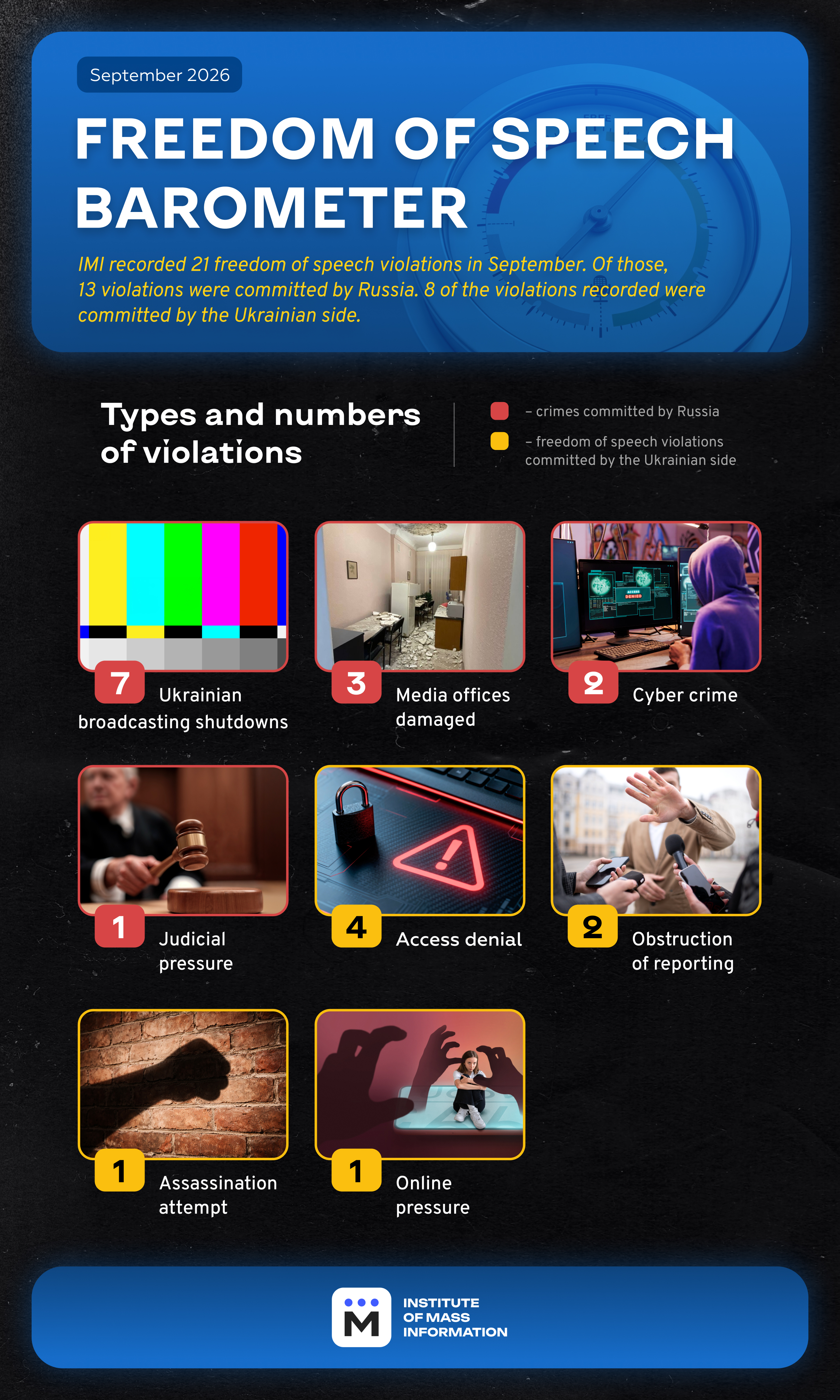
Experts at the Institute of Mass Information recorded 21 press freedom violations in Ukraine in September 2026. 13 were related to Russia’s aggression while eight were committed by Ukrainian nationals and institutions, as evidenced by IMI’s monthly monitoring study, the Freedom of Speech Barometer.
The deaths of three media workers were reported in September. Two of them, Ruslan Rudukan and Oleksiy Nurulin, were killed in action defending Ukraine. Maria Yivzhenko, formerly a journalist with NV Business, died in a Russian strike on a business centre in Kyiv.
RUSSIA’S CRIMES
Damage to media offices
- The offices of at least three Ukrainian news outlets were damaged in Russian attacks: We Ukraine TV and We Ukraine+ in Kyiv (the strike damaged the newsroom and staff’s offices and injured several people); Suspilne Dnipro (the shock wave damaged the broadcaster’s Kryvyi Rih bureau, blasting out the windows, damaging the doors, the ceiling, and furniture; the staff were unharmed); Obriyi Iziumshchyny in Izium (the shock wave burst the windows and doors, making the building unfit for use; the two employees who were inside during the strike were unharmed).
Judicial pressure
- The Russia-installed “Zaporizhzhia Oblast Court” sentenced Iryna Levchenko, a journalist from Melitopol unlawfully detained in 2023, to 15 years in prison, having found her guilty of “espionage”.
Cyber crimes
- IMI recorded two cyber crimes against Ukrainian media: Russian hackers targeted the website of Freedom TV in a prolonged combined DDoS attack, disrupting its operations and making it inaccessible for 10 minutes; NV also reported unknown individuals creating a fake “mirror” of their website to promote an AI-generated video containing disinformation about NABU searching the Defence Procurement Agency ex-chief. NABU has called the footage fake, stressing that content like this suggested that Russia was using cutting edge technology in the information war.
Disabling Ukrainian broadcasting
- At least seven Ukrainian news organisations reported disruption or halting of their operations following Russian strikes on data centres, telecom and other infrastructure in Kyiv on 26 September: Novyny.LIVE, Priamyi, Suspilne, Channel 5, Armiya TV, Kolo, and Konkurent Ukraina. These media outlets experienced TV signal and T2 broadcasting disruption and website functioning issues.
Violations unrelated to Russia’s war against Ukraine
IMI recorded eight press freedom violations committed by Ukrainian nationals and institutions and unrelated to Russo–Ukrainian war in September. Most of these cases (four) concerned denial of access to information, the rest included obstruction of reporting (two), an assassination attempt, and one instance of online pressure.
The infringements were recorded in Kyiv city, Chernihiv, Rivne, Vinnytsia, and Chernivtsi oblasts and committed by officials of local or national authorities, law enforcement bodies, private individuals, or business representatives.
Assassination attempt
- The Security Service of Ukraine (SBU) has issued a suspicion notice to a man for commissioning a physical attack on a Pryluky-based blogger Oleksandr Lesyk: the perpetrators were supposed to shoot him in the limbs and douse him with sulfuric acid. The attempt was prevented at the preparation stage. The blogger criticised the local authorities, reported on corruption and criminal law probes into persons with ties to officials.
Obstruction of reporting
- Two instances of obstruction were recorded: local officials in Rivne covered up the camera used by Chetverta Vlada journalists, demanded they show their IDs and prevented them from asking questions during a public report by acting mayor Viktor Shakyrzian; and staff of the State Emergency Service (SES) HQ in Vinnytsia prevented 20 Khvylyn journalist Vitaliy Pavlovskyi from leaving the premises after he finished carrying out his task there. The police have opened an obstruction investigation into the incident, assigning victim status to Pavlovskyi.
Access to information for journalists
- IMI recorded four cases of journalists facing denial of access to information: The Kyiv Independent’s Danylo Mokryk filed a complaint with the Verkhovna Rada Commissioner for Human Rights against Ukraine’s President’s Office (PO) over their refusal to publish his online petition calling for a press conference with Volodymyr Zelenskyi; Chernivtsi prosecutors and police refused to provide IMI representative Alyona Chorna with information about an investigation into potential embezzlement of budget funds allocated for the renovation of bomb shelters in the city, citing investigation secrecy; Molodyi Bukovynets journalist Liudmyla Osadchuk tried to get information about the renovation progress at the Chernivtsi Oblast Hospital’s infectious diseases ward twice, but was turned down despite officials’ promises to share the data; ZHAR.INFO’s Maria Turchyna contacted the Verkhovna Rada Commissioner for Human Rights over a state-owned company refusing to disclose documents concerning a tender consultant involved in procurement for a bomb shelter construction project.
Online pressure
- Texty journalist Lyubov Velychko was targeted in a smear campaign while investigating a network of social media accounts and bloggers opposing the mobilisation effort and discrediting the UAF.
See the full monitoring report here.
The Institute of Mass Information (IMI) is a civil society organization specializing in the media, operating since 1996. IMI defends the rights of journalists, studies the media landscape and reports on media-related events, fights propaganda and disinformation, and provides media workers with safety equipment for trips to combat areas (since the start of the Russo–Ukrainian war in 2014).
IMI carries out the only monitoring study of freedom of speech in Ukraine, keeps a list of transparent and responsible online media outlets, and tracks Russia’s media crimes in the war on Ukraine. IMI has representatives in 20 oblasts of Ukraine and runs a network of Media Hubs that provide journalists with unfailing support. IMI’s partners include Reporters Without Borders (RSF); the organization is also a member of the International Freedom of Expression Exchange (IFEX).