
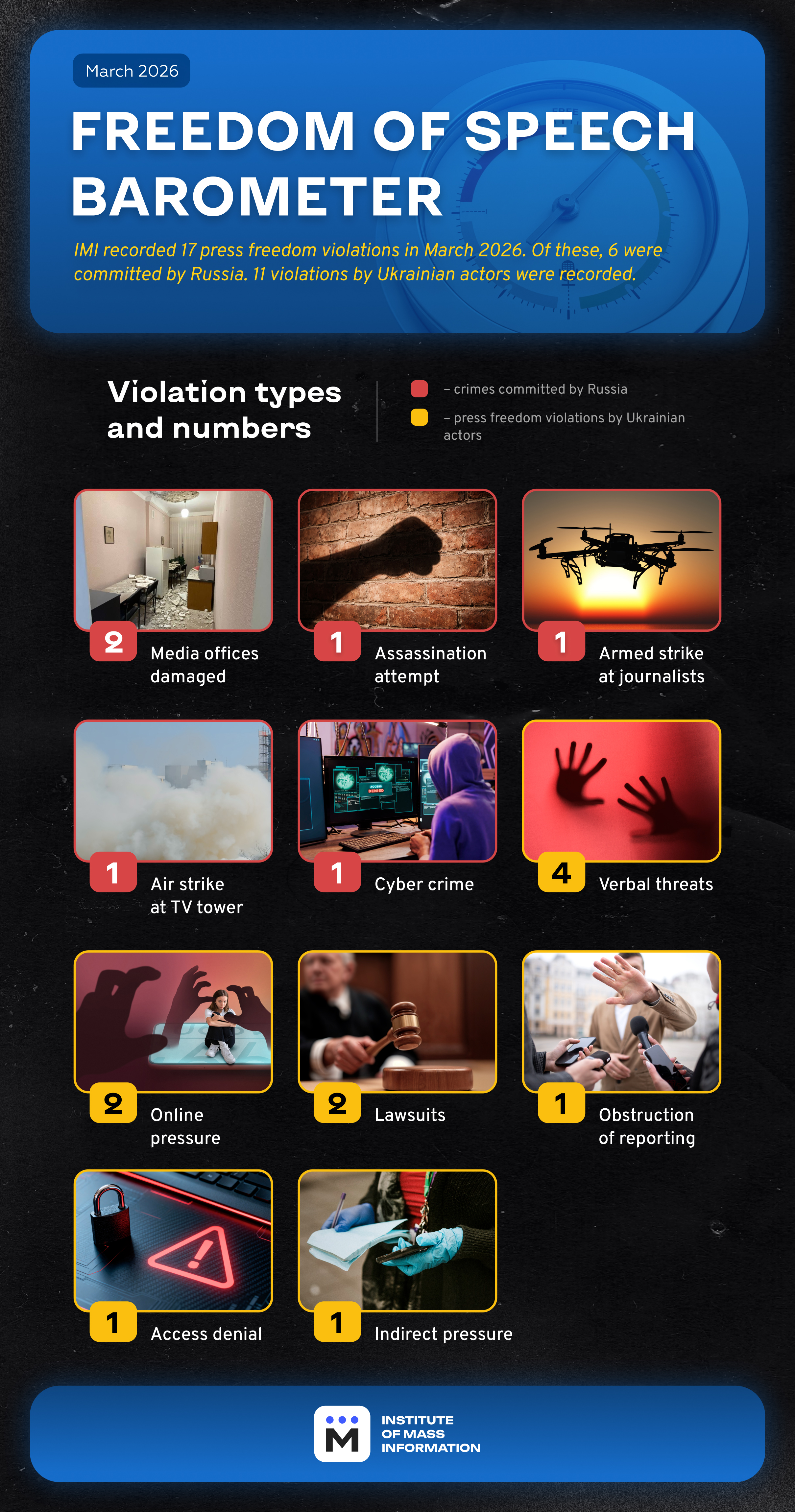
The Institute of Mass Information experts recorded 17 freedom of speech violations in Ukraine in March 2026. Six were committed by Russia, as evidenced by IMI’s monthly monitoring study Freedom of Speech Barometer.
Russia’s crimes against media and journalists in Ukraine included assassination attempts, destruction and damage of media offices, and cyber crimes.
The deaths of three media workers turned UAF servicemembers were reported in March:
- Volodymyr Fomichenko-Zakutskyi, formerly the marketing director at Zaborona Media. His death was officially announced on 10 March. It is reported that he was killed in action on 26 February 2026 near Pokrovsk (Donetsk oblast).
- Arthur Petrov, media professional and soldier, killed while helping evacuate the wounded in Kupyansk-Vuzlovyi (Kharkiv oblast) on 18 March 2026.
- Yevheniy Solovey, serviceman and TSN cameraman. Joined 1+1 Media in 2011. Killed in action on 27 March 2026.
Assassination attempt
- A Suspilne Dnipro filming crew was able to escape a Russian FPV drone following them thanks to being equipped with a drone detector. The crew was working in Demuryne village (Dnipropetrovsk oblast). The journalists reported that the FPV drone had been circling right above them and are convinced that they had been targeted deliberately.
Armed strikes at journalists
- A Suspilne Dnipro filming crew came under Russian mortar fire in Kapulivka (Dnipropetrovsk oblast). The reporters were filming a news story accompanied by police when Russian troops opened fire: the shells dropped 50–100 meters away from them. The crew managed to escape, no one was injured.
Destruction or damage to media offices
- The buildings housing the Suspilne Odesa office were damaged in a Russian air strike. One of the buildings was hit by a Shahed drone and is beyond repair. There were no casualties, but the windows in most rooms shattered and the rooms themselves are damaged.
- The office of the newspaper Mezhivskyi Merydian was destroyed in a Russian guided bomb strike in Mezhova village (Dnipropetrovsk oblast), which is located 12 km away from the front line. The team continues to work and make new issues of the newspaper despite losing the office.
Air strikes at TV towers
- Russian drones hit the TV tower and a Concern for Radio Broadcasting, Radio Communications, and Television (CRRT) facility during a strike in Kryvyi Rih (Dnipropetrovsk oblast). The digital broadcasting signal in the city went down as a result of the strike.
Cyber crimes
- The news website Novyny Donbasu was targeted in an intense cyber-attack by Russian hackers, resulting in data being compromised and the website temporarily going down. Some archive material was restorred, but the website’s operations have been complicated.
IMI also recorded press freedom violations unrelated to Russia’s war on Ukraine. These included verbal threats to journalists and obstruction of reporting, denial of access to public information, online and indirect pressure, and lawsuits against news outlets. Violations were recorded in Kyiv city, Khmelnytskyi, Mykolaiv, Odesa, Lviv, and Volyn oblast and were committed by local government bodies, private individuals, servicemembers, etc.
Obstruction of legal reporting
- Zhar.Info journalist Alyona Bereza was barred from attending the a hearing at the State Inspectorate for Architecture and Urban Planning. Officials cited regulations and the defendant’s request as reasons for the refusal, but the procedure says such hearings should be open to the media.
Verbal threats, intimidation of journalists
- Journalist Olha Khudetska received violent threats after reporting on the non-transparent spending of donation money by the Hospitallers Medical Battalion.
- War correspondent Anna Kaliuzhna received over 150 abusive messages after a post criticising the command of the Ukrainian Armed Forces, including messages questioning her professionalism and misogynistic comments, which she views as pressure and attempted intimidation.
- Suspilne Mykolaiv journalists were threatened over their reporting about the suspect in a murder trial. The threats referred to possible attacks on the journalists and damaged to their proterty during an upcoming hearing.
- The commander of the Advanced Company within HUR’s International Legion threatened The Kyiv Independent reporter Jared Goyette and Brazilian SBT correspondent Sergio Utsch, who investigated the death of the Brazilian volunteer Bruno Gabriel Leal da Silva.
Access to information
- The Mykolaiv Alumina Plant refused to provide MykVisti with information about the salary of the company’s director, claiming their query was “unclear.”
Indirect pressure
- The Odesa-based news website Antykoruptsiynyi Vymir reported systemic pressure by businessman Heorhiy Sedykh after the release of their news story about public procurement in the Usatove community. The businessman continued to demand the takedown of their news story even after the media outlet shared his perspective in a separate material. The team views this as an attempt to curtail the reporting of publically important information.
Online pressure
- Mykolaiv-based news website MykVisti recorded uncommon technical activity, which slowed the website down. The content was saved, internal systems were not affected, and the attacks were likely carried out via distributed bot networks.
- Hromadske journalist Denys Bulavin faced online harassment following the release of his article about attacks on servicemembers working in territorial enlistment centers.
Legal pressure
- Lawyer Oleksiy Shevchuk sued NGL.media, demanding 100 thousand hryvnias in moral damages. The lawsuit was triggered by the news outlet’s Facebook post saying that NGL.media was joining a statement by civil society organisations demanding Shevchuk’s withdrawal from the competition commission that is to select candidates for the Specialised Anti-Corruption Prosecutor’s Office.
- Mykhailo Bukharov, CEO of the Lutsk-based company Vennagro (Spetskomuntekh), sued the Investigative Journalistm Center “Syla Pravdy”. He demanded that information reported the news story “Why a Lutsk company that sold over 160 million worth of equipment to state institutions is going bankrupt” be declared false and certain passages quoting the company’s co-founder Vadym Venislavskyi be retracted.
See the full list of press freedom violations in Ukraine in March 2026 here.
The Institute of Mass Information (IMI) is a civil society organization specializing in the media, operating since 1996. IMI defends the rights of journalists, studies the media landscape and reports on media-related events, fights propaganda and disinformation, and provides media workers with safety equipment for trips to combat areas (since the start of the Russo–Ukrainian war in 2014).
IMI carries out the only monitoring study of freedom of speech in Ukraine, keeps a list of transparent and responsible online media outlets, and tracks Russia’s media crimes in the war on Ukraine. IMI has representatives in 20 oblasts of Ukraine and runs a network of Media Hubs that provide journalists with unfailing support. IMI’s partners include Reporters Without Borders (RSF); the organization is also a member of the International Freedom of Expression Exchange (IFEX).