
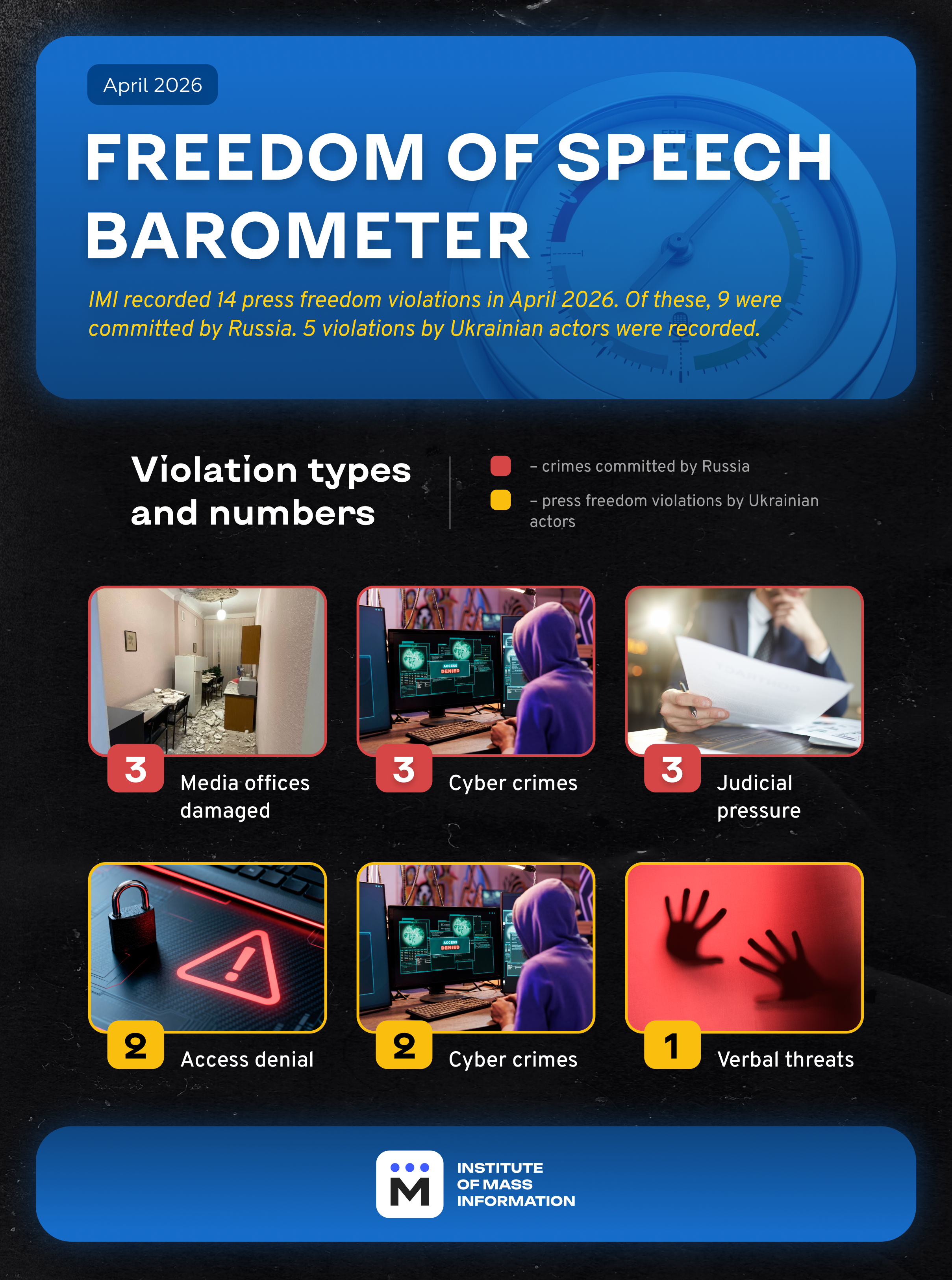
The Institute of Mass Information experts recorded 14 freedom of speech violations in Ukraine in April 2026. Nine were committed by Russia, as evidenced by IMI’s monthly monitoring study, the Freedom of Speech Barometer.
Russia’s crimes against the media and journalists in Ukraine included destruction of and damage to media offices, cyber crimes, and judicial pressure.
The deaths of two media workers turned UAF servicemembers* were reported in April:
- Ihor Malakhov, filmmaker and servicemember who had been considered missing since 2023. Killed in combat near Stepove village (Donetsk oblast, close to Avdiivka) on 29 December 2023. His body was identified by DNA in 2026.
- Viktoria Bobrova, UAF servicewoman and 2+2 TV casting director; press officer with the Mountain Assault Brigade No. 10 “Edelweiss”.
Destruction of and damage to media offices
- A Russian strike in Pryluky (Chernihiv oblast) on 7 April damaged the city council building. Reporters with Pryluky TV, who were in the building at the time of the attack, evacuated to a bomb shelter in time and were unharmed. However, the team lost two full sets of video equipment in the strike.
- The Dnipro-based radio station Europe Plus Dnipro temporarily went off air after a Russian strike in the city on 15 April. A Shahed drone hit the building where the radio station’s office is located, causing them to stop broadcasting for half a day.
Cyber crimes
- The website of the Kharkiv-based news outlet Nakypilo was targeted by hackers based in Russia. The perpetrators tried to overload the website with requests. The page stayed online and no data was compromised.
- The Kropyvnytskyi-based regional newspaper Kirovohradska Pravda lost access to their Instagram account, which had over 25,000 followers. The profile is now unavailable and empty. The team does not rule out Russian involvement.
- Russian hackers attacked the Freedom TV internal communication system, briefly accessing the channel’s corporate chat. Logins of some staff members were posted online along with screenshots of some official correspondence. A Russian hacker group has claimed responsibility for the attack.
Judicial pressure
- A Russian court sentenced the Institute of Mass Information (IMI) expert Iryna Zemlyana in absentia to 13 years in prison for allegedly attacking Sergei Andreev, the Russian Ambassador to Poland, in Warsaw in 2022. Iryna Zemlyana says that the ruling is politically motivated and is part of a pressure campaign against her; according to her, the charges are entirely fabricated. She was also charged with promoting “fakes” about the Russian army.
- A court in Russia sentenced Ukrainian journalist Oleksiy Homon in absentia to 9 years in prison on terrorism charges.
- A Russian court sentenced Oleksandr Malyshev, an administrator of the Telegram channel Melitopol is Ukraine, to 26 years in a high-security prison. He was found guilty of involvement in a terrorist group, espionage, and terrorism.
IMI also recorded press freedom violations unrelated to Russia’s war on Ukraine. These included verbal threats to journalists, restriction of access to public information, and cyber attacks. Violations were recorded in Kyiv city, Poltava and Mykolaiv oblasts and were committed by local government bodies and private individuals.
Verbal threats
- TSN reported violent threats to their journalist Olha Myronchuk following the release of her investigation about religious organisations operating in Ukraine on the news outlet’s YouTube channel. The journalist received a series of intimidating anonymous calls and messages, some of which involved violent threats. TSN viewed this as pressure and contacted the police.
Access to information for journalists
- The Poltava Oblast Council charged Nadia Kucher, the regional IMI representative, 6,500 hryvnias for copies of documents she had requested in her query about the budget money spent on media coverage of the government’s work. IMI believes such demands to be unlawful, as the requested information was a public interest and concerned budget expenditures.
- The Mykolaiv City Council issued an invoice for UAH 2,980 to regional IMI representative Kateryna Sereda for making copies of documents she had requested. According to the City Council’s calculations, providing a full response to her query would involve making copies of nearly 900 pages. IMI considers this, too, to be denial of access to public information, as this concerns budget expenditures.
Cyber attacks
- The news website ZN.ua was targeted in a DDoS attack. This resulted in disruptions in the website’s operations as the media outlet’s tech support team worked on restoring access.
- Bihus.Info journalist Svitlana Stetsenko was targeted in an online harassment campaign following the release of her investigation into the U420 network. She contacted the police over the dangerous psychotropic substances her investigation revealed, but did not report the harassment or verbal threats.
See the full list of freedom of speech violations committed in Ukraine in April here.
The Institute of Mass Information (IMI) is a civil society organization specializing in the media, operating since 1996. IMI defends the rights of journalists, studies the media landscape and reports on media-related events, fights propaganda and disinformation, and provides media workers with safety equipment for trips to combat areas (since the start of the Russo–Ukrainian war in 2014).IMI carries out the only monitoring study of freedom of speech in Ukraine, keeps a list of transparent and responsible online media outlets, and tracks Russia’s media crimes in the war on Ukraine. IMI has representatives in 20 oblasts of Ukraine and runs a network of Media Hubs that provide journalists with unfailing support. IMI’s partners include Reporters Without Borders (RSF); the organization is also a member of the International Freedom of Expression Exchange (IFEX).