
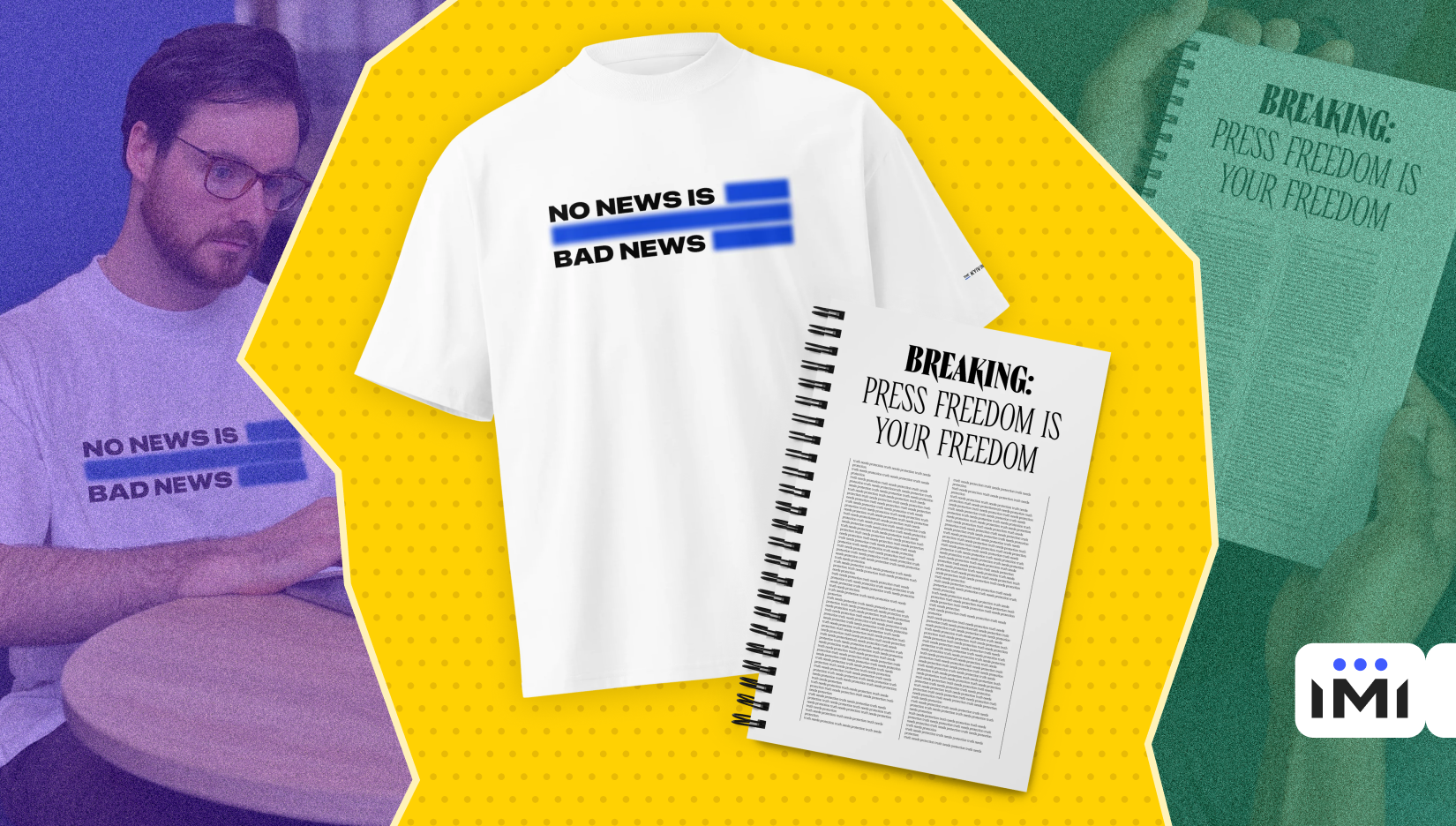
The Kyiv Independent has partnered with the Institute of Mass Information to launch a new merchandise collection, “No News is Bad News,” dedicated to protecting journalists covering Russia’s war against Ukraine.
The collection was launched on 21 April and features a graphic t-shirt and a softcover notebook, available on the Kyiv Independent store.
From 21 April through 5 May, 100% of the profits of this collection will support the purchase of drone detectors for front-line reporters through IMI. Drone detectors are designed to identify incoming threats in advance, giving journalists critical seconds to take cover. These devices will be added to IMI’s Safety Library, where reporters can borrow them free of charge from IMI’s Kyiv office and its regional Mediabaza hubs across 15 cities. IMI has delivered protective equipment to journalists more than 12,000 times since 2014.
The selected device, WHOOVER 3.3, is a portable system designed to detect and intercept analog video signals from FPV drones and fixed-wing unmanned aerial vehicles across key combat frequencies. It costs Hr 24,000 (around $540) per unit.
The campaign is timed to coincide with World Press Freedom Day, established by the United Nations in 1993 to highlight the importance of a free press and the safety of journalists worldwide.
The collection’s name reflects a wartime reality in Ukraine: as Russia increasingly targets journalists, civilians, and volunteers, particularly with first-person view drones, reporting from the front lines is becoming more dangerous. When journalists cannot safely access and document events, the world risks losing visibility into the truth of the war.
“Using the occasion of the World Press Freedom Day, we would like to focus the public’s attention on the fact that no news is, in fact, bad news — the quiet is not a sign of ease and calm, but rather a signal of a catastrophe unfolding while nobody is there to document it,” the media outlet writes.
The Kyiv Independent added that traditional PRESS markings no longer provide protection and may instead attract attention from drone operators. Drone detectors have become one of the only effective tools for early warning.
The news outlet invited their audience to join the initiative and support the safety of journalists, which directly impacts the world’s ability to receive reliable information about the events in Ukraine.
IMI director Oksana Romaniuk thanked the Kyiv Independent for a timely initiative to support reporters working in Ukraine.
“Working close to the front line now requires not just professionalism and bravery, but also basic means of survival and protection. This is not just a fundraiser for equipment – it is a response to a new reality where a journalist’s safety directly impacts society’s ability to see the truth of the war. Media outlets supporting one another is especially important, and the Kyiv Independent has been consistent in doing so. This speaks to a deep maturity and an understanding that today, protecting independent journalism is part of protecting democracy, remembrance, and truth,” Oksana Romaniuk said.
According to IMI, Russia has committed 901 crimes against journalists and the media in Ukraine since the start of the full-scale invasion. IMI has also pointed out that while artillery posed the biggest threat to journalists in 2022, in 2025–2026 UAVs (FPV drones, Lancet and Molniya type drones, etc.) have become the dominant risk factor. In the fourth year of the full-scale invasion, IMI recorded the deaths of three media professionals while reporting, all three being killed in drone strikes.
IMI has also insisted that wearing PRESS labels in areas with ongoing FPV drone warfare does not protect journalists but may increase the likelihood of them being targeted.
The Institute of Mass Information (IMI) is a civil society organization specializing in the media, operating since 1996. IMI defends the rights of journalists, studies the media landscape and reports on media-related events, fights propaganda and disinformation, and provides media workers with safety equipment for trips to combat areas (since the start of the Russo–Ukrainian war in 2014).
IMI carries out the only monitoring study of freedom of speech in Ukraine, keeps a list of transparent and responsible online media outlets, and tracks Russia’s media crimes in the war on Ukraine. IMI has representatives in 20 oblasts of Ukraine and runs a network of Media Hubs that provide journalists with unfailing support. IMI’s partners include Reporters Without Borders (RSF); the organization is also a member of the International Freedom of Expression Exchange (IFEX).