
When considering whom to invite to the Hague to speak about Russia’s crimes against the media, the Institute of Mass Information team immediately thought of photographer Heorhiy (Georges) Ivanchenko. Picture it: the OSCE Parliamentary Assembly session, attended by international organisations, diplomats, and parliamentarians (including Russian ones, of course) who have gathered to discuss global security challenges – and Georges, with a prosthetic left leg showing that the current safety rules do not work.
Georges was wounded in a Russian FPV drone strike while working with his French colleague Antoni Lallican near Druzhkivka, Donetsk oblast, on 3 October 2025. Both were wearing “Press” badges. Antoni died on the spot. Georges survived, but lost his leg. And he came to the Hague with us to share his firsthand perspective.
The session was attended by Aida Belloulid, Antoni’s partner; Maxime Brandstaetter, a friend of Frederic Leclerc-Imhoff and a witness to his murder in 2022; and Suspilne Kharkiv producer Oleksandra Novosel — a media professional who has been feeling the war’s impact not just on her work, but her entire life. She brought with her a fragment of a Russian Shahed drone that flew over her head.
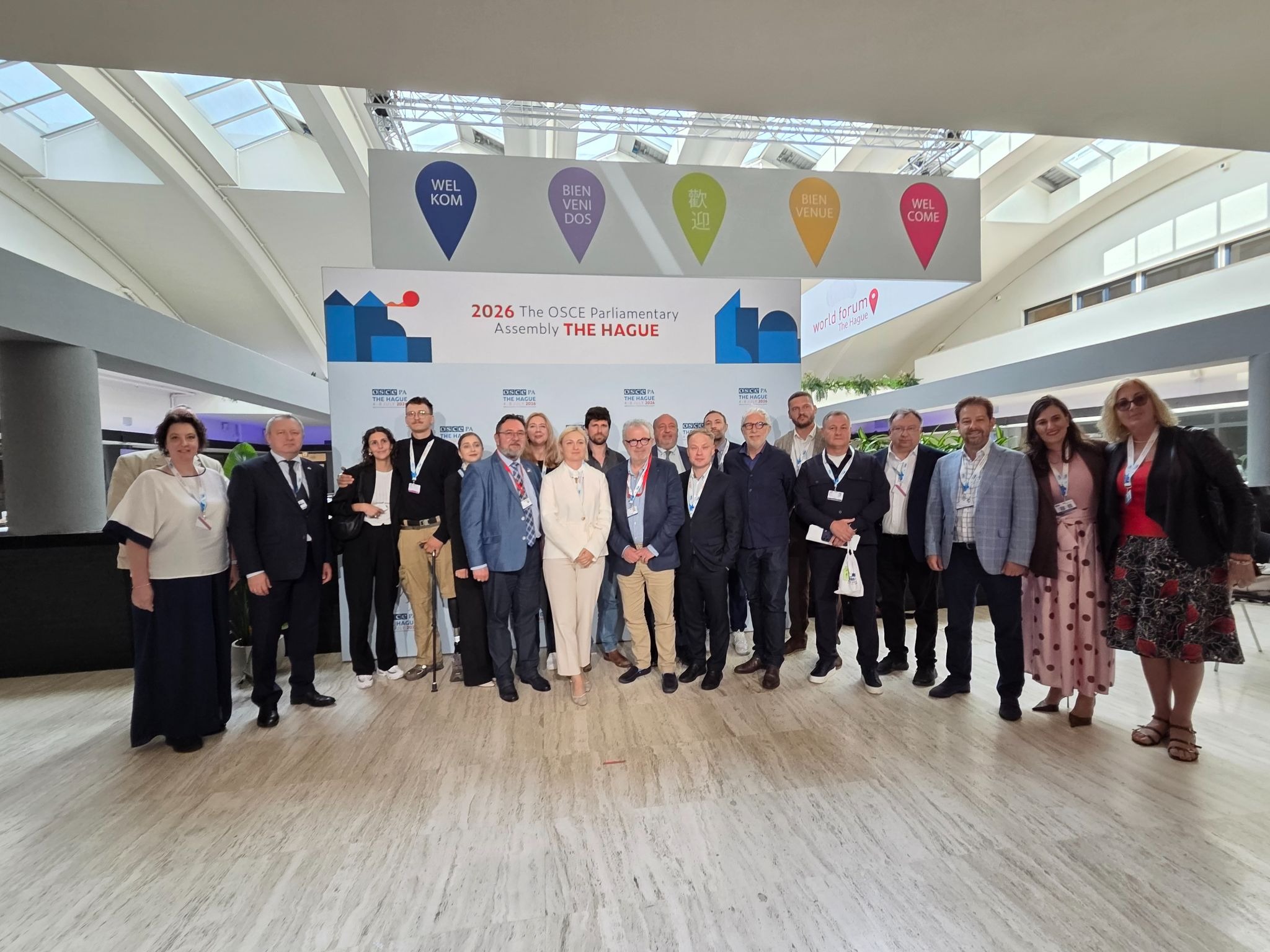
The special side event “Investigating Russia’s Crimes Against Media in Ukraine: Call for Justice” took place on 6 July as part of the 33rd annual OSCE Parliamentary Assembly session. It was initiated by Ukraine’s Temporarily Parliamentary Commission for Investigating Russia’s Crimes against Journalists and co-organised by: the Ukrainian and French Delegations to OSCE PA, the international organisation Reporters Without Borders (RSF), and the Ukrainian civil society organisation Institute of Mass Information (IMI).
“The Russian drone operator knew they were journalists”
When Aida, who lives in France, heard news that Antoni and Georges might have been attacked near the front line, she frantically contacted everyone she knew in Ukraine, but was unable to find out what had really happened. Two hours later, a friend told Aida that Antoni had been killed on the spot in a Russian drone strike.
“Antoni and Georges were working on a news report about fortification construction works. The soldiers accompanying them had been warned several times about drone activity in the area, and the group had taken cover before continuing their work. Both Antoni and Georges were experienced war reporters, and both were wearing body armour. Everything suggests that the drone operator identified them and decided to follow and kill them. It should be noted that hitting a target with a drone is not easy: it requires some determination. The operator knew that they were journalists, and decided to pursue them anyway,” Aida said.
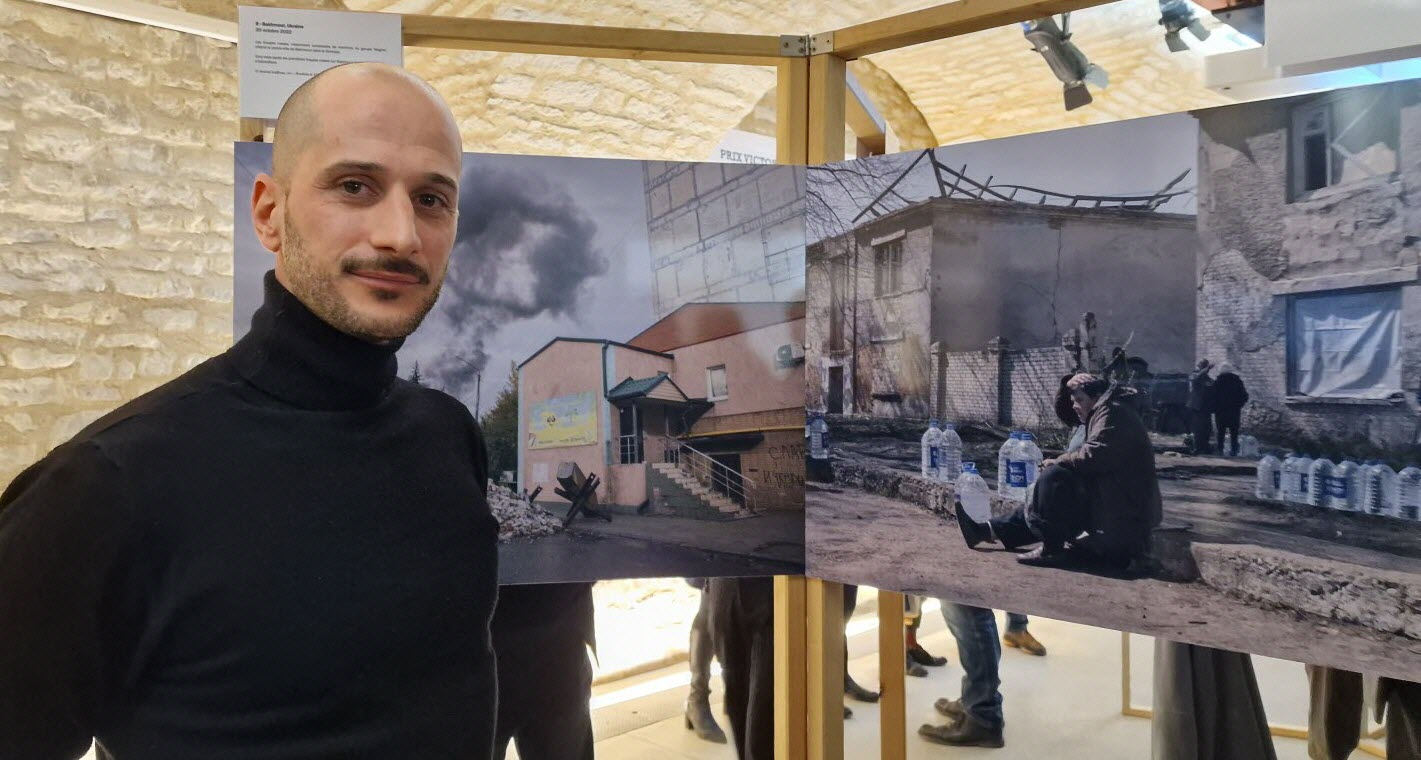
She travelled to Ukraine at once and spent over 10 days dealing with the bureaucracy and taking Antoni’s body home. She then had to sort out the French paperwork, too: a prosecutor’s office has opened an investigation into Antoni’s murder, but it is not certain that it will be able to complete it.
“Unfortunately, in recent months we have realised that the resources allocated to this task are extremely insufficient: the investigators are unfamiliar with drone technology and have neither the resources nor the experience to work with open sources online, monitor Telegram channels, or make frequent trips to Ukraine for interviews and inspections,” Aida said.
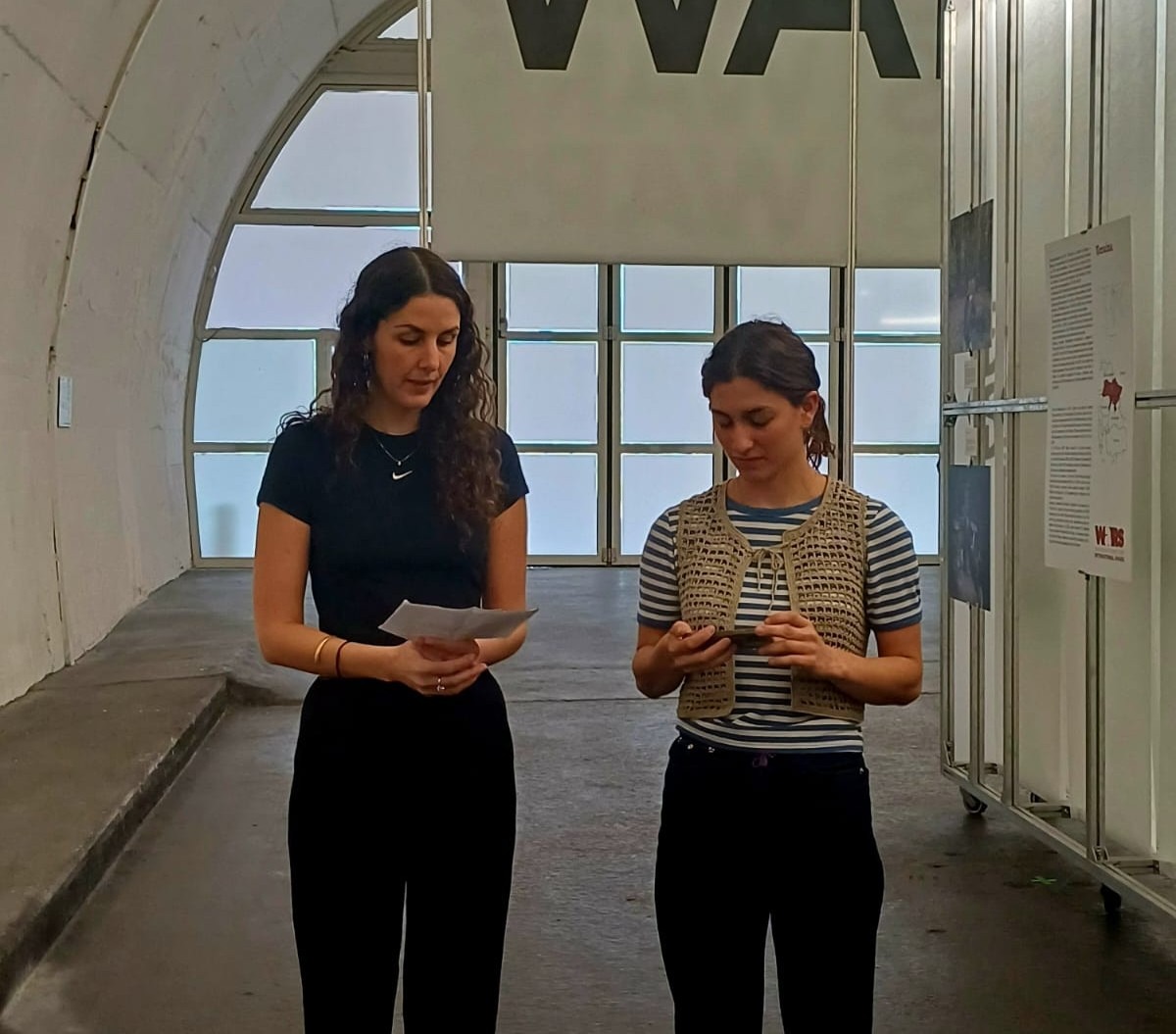
She urged France to give the victims a legal opportunity to hold Russia and the Russian army accountable for the war crimes they commit.
“Antoni witnessed the impunity with which Russia kills civilians, humanitarian workers, and journalists before becoming a victim himself. Russia must be held accountable for its crimes,” she added.
“We had to adapt”
“Warfare in the East and South of Ukraine has changed. Early in my time working there, we were mostly afraid of artillery fire. Now we constantly glance up at the sky. We listen for any odd noise. After all, it could be a drone with an FPV camera. If that’s the case, you only have a few seconds,” Georges Ivanchenko said.
He arrived in the Hague to speak about how drones have changed the war: the Russian forces use them to target not just reporters, but also humanitarian workers, evacuation crews, ordinary civilians on bicycles trying to survive.
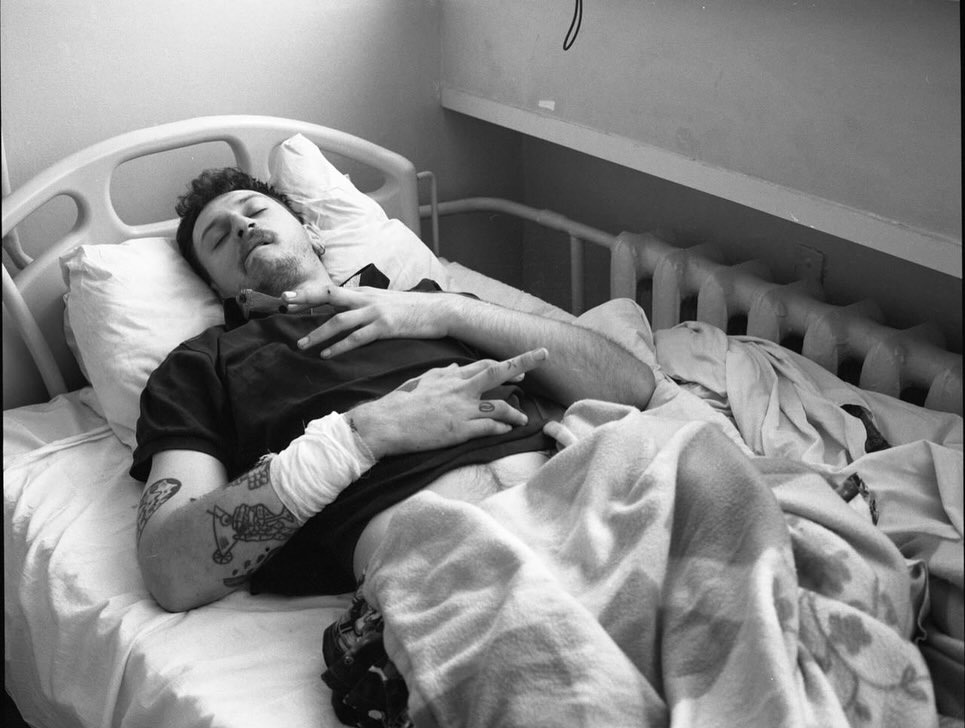
“We had to adapt. But many of the safety rules that were in place a few years ago no longer work. I believe that not only journalists, but also international organisations, humanitarian crews, and everyone working in war zones need to rethink modern warfare,” Georges said.
“The necessity of ‘Press’ badges has been debated since 2022”
On 30 May 2022, journalists with France’s BFM TV were driving towards the front line in a humanitarian truck delivering aid to civilians and picking up evacuees on the way back. They were heading to Lysychansk that day: the city bordering the very battlefield, surrounded by Russian troops. An explosion went off on the city’s outskirts and the debris pierced the vehicle. Maxime Brandstaetter and Oksana Leut were lucky enough to only get scrapped. Frederic Leclerc-Imhoff died almost instantly.
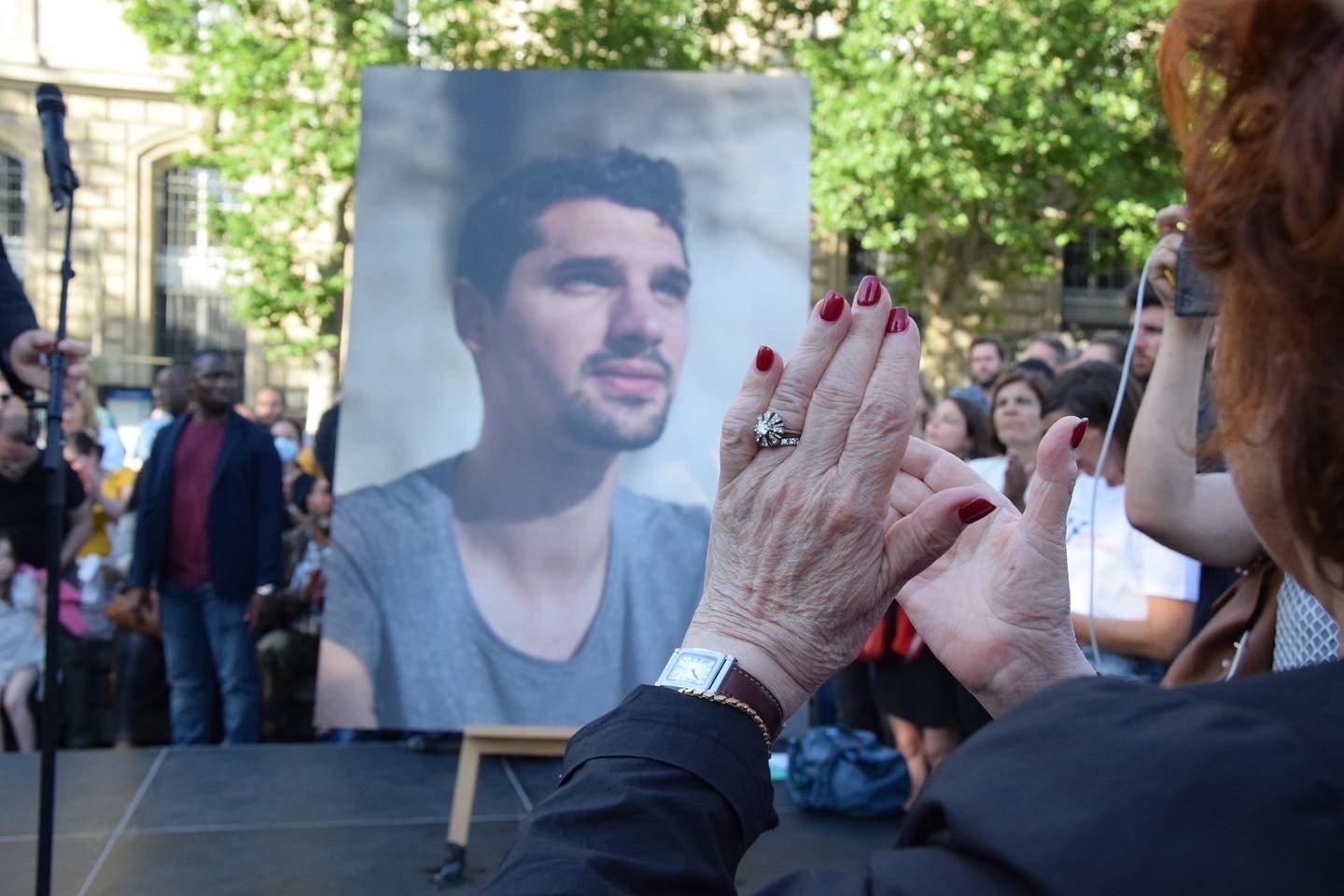
“Could the Russian troops have known that they were firing at journalists? We were in a vehicle, wearing safety gear—body armour and helmets—that clearly said, ‘Press.’ Even though the necessity of the labels was being debated back in 2022, too, with many arguing that they were making us a target. You could see Frederic and his camera through the truck’s windshield, that’s all. But the Russian army could not have been unaware that it was a humanitarian truck. Moreover, numerous international news stories about evacuations—filmed from inside trucks—showed that they regularly carried journalists,” Maxime said.
Later that day, the Russian news agency TASS claimed that Frederic and Maxime were French agents delivering ammunition to the front line.
“I‘ve lost count of how many times I could’ve died”
Oleksandra Novosel shows a small black piece of metal. It is a fragment of a Russian drone that hit the Kharkiv National Art Museum, which is located next to Suspilne’s local branch, just as her crew was working there.
“We are targets because we tell the world the truth about Russian war crimes. This is why they attack Ukrainian journalists. This is why they decided to attack our office. Russia is killing for the truth. And this is a challenge to the European security system and international order,” Oleksandra said.
Like many media professionals living in the regions adjacent to the front line, she does need to go on a reporting trip to see war: she lives it. Russian missiles and bombs reach Kharkiv city in a matter of minutes. So she has to fit her daily routine, work, and her entire life into the breaks between strikes.
Journalists from all over the world come to Ukraine for a week or two, then go back home to their families to rest and recover, says Oleksandra. Ukrainian media workers do not have this opportunity.
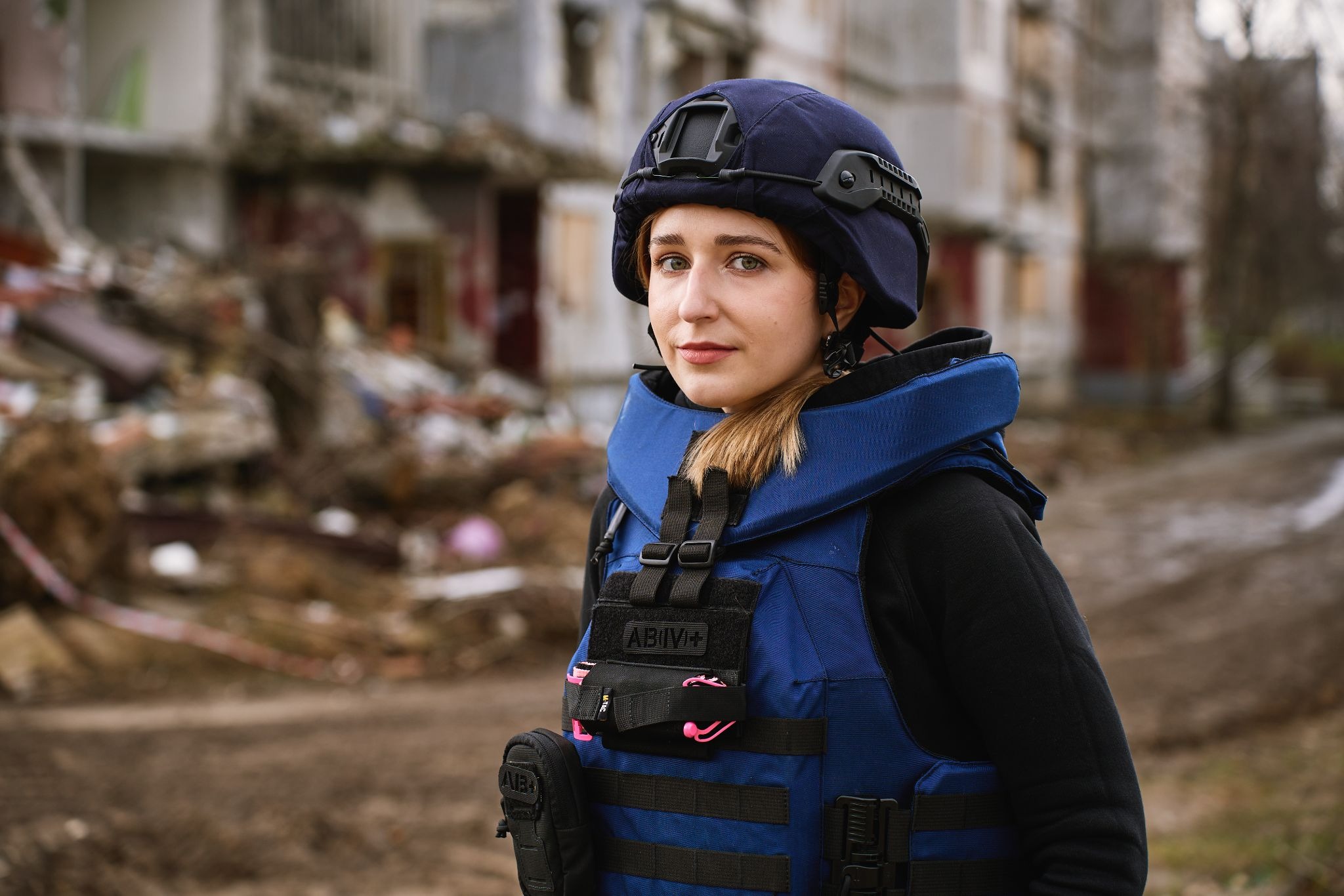
“You know, I’ve lost count of how many times I could’ve died. We’ve been working in this environment for years. And so many of my colleagues couldn’t stand the strain. They switched professions not only due to the physical danger, but also because they couldn’t take the emotional pain anymore,” she said.
Nearly a thousand crimes against journalists
The above are the stories behind the statistics, police investigations, and public statements.
“937 crimes against journalists and media have been recorded since February 2022. About 131 media workers from Ukraine and other countries have been killed. At least 26 Ukrainian journalists remain illegally detained by Russia today. I think this is where we should say that we need accountability. And those who committed these crimes must answer and pay for it,” said Pere Joan Pons Sampietro, the President of the OSCE Parliamentary Assembly.
He cited data by the Institute of Mass Information, included in the draft resolution on Russia’s war crimes against journalists, media workers, and freedom of speech in Ukraine, which was attached to the Hague Declaration following the 33rd OSCE PA session. It should be noted that the data have been updated since the resolution was released. IMI’s latest statistics recorded since the beginning of Russia’s full-scale invasion are as follows:
- 958 crimes against journalists and the media in Ukraine comitted;
- 134 media profrssionals killed, with 15 dying while reporting.
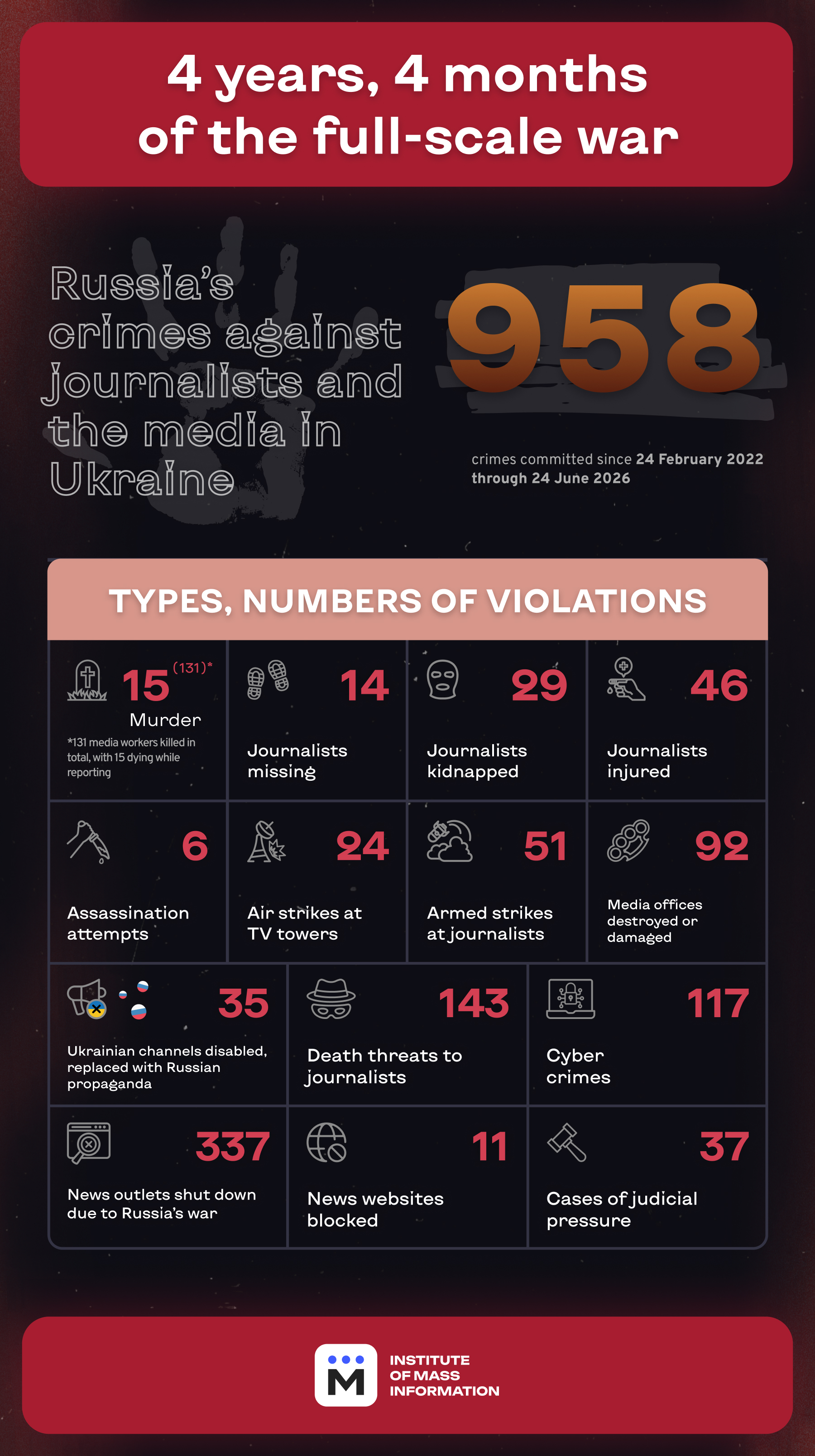
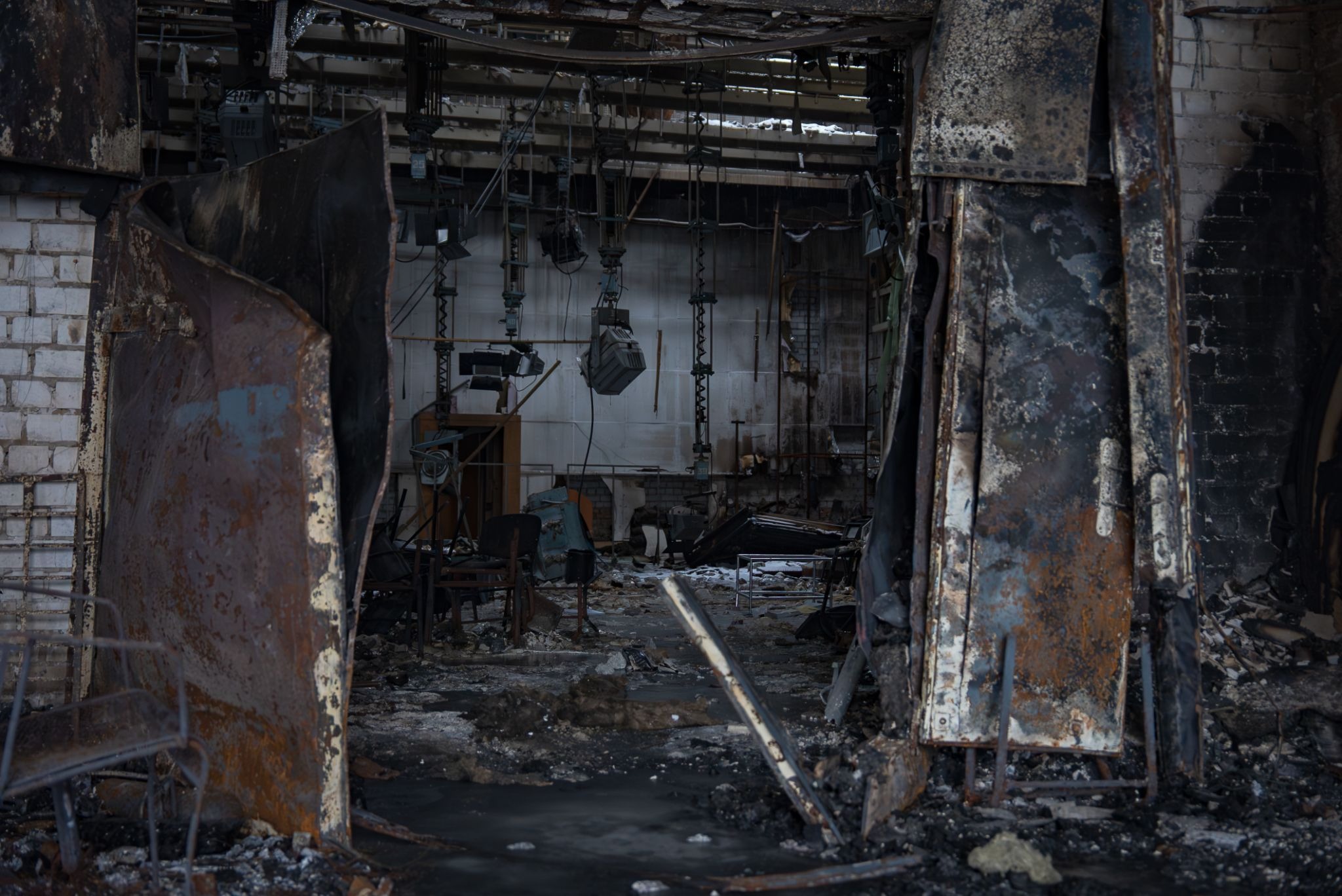
Moreover, Russia has carried out at least 85 targeted attacks on media offices and 40 strikes on TV towers in Ukraine since 2022. At least 337 media outlets have ceased operations due to the Russian invasion and its consequences, added Institute of Mass Information director Oksana Romaniuk.
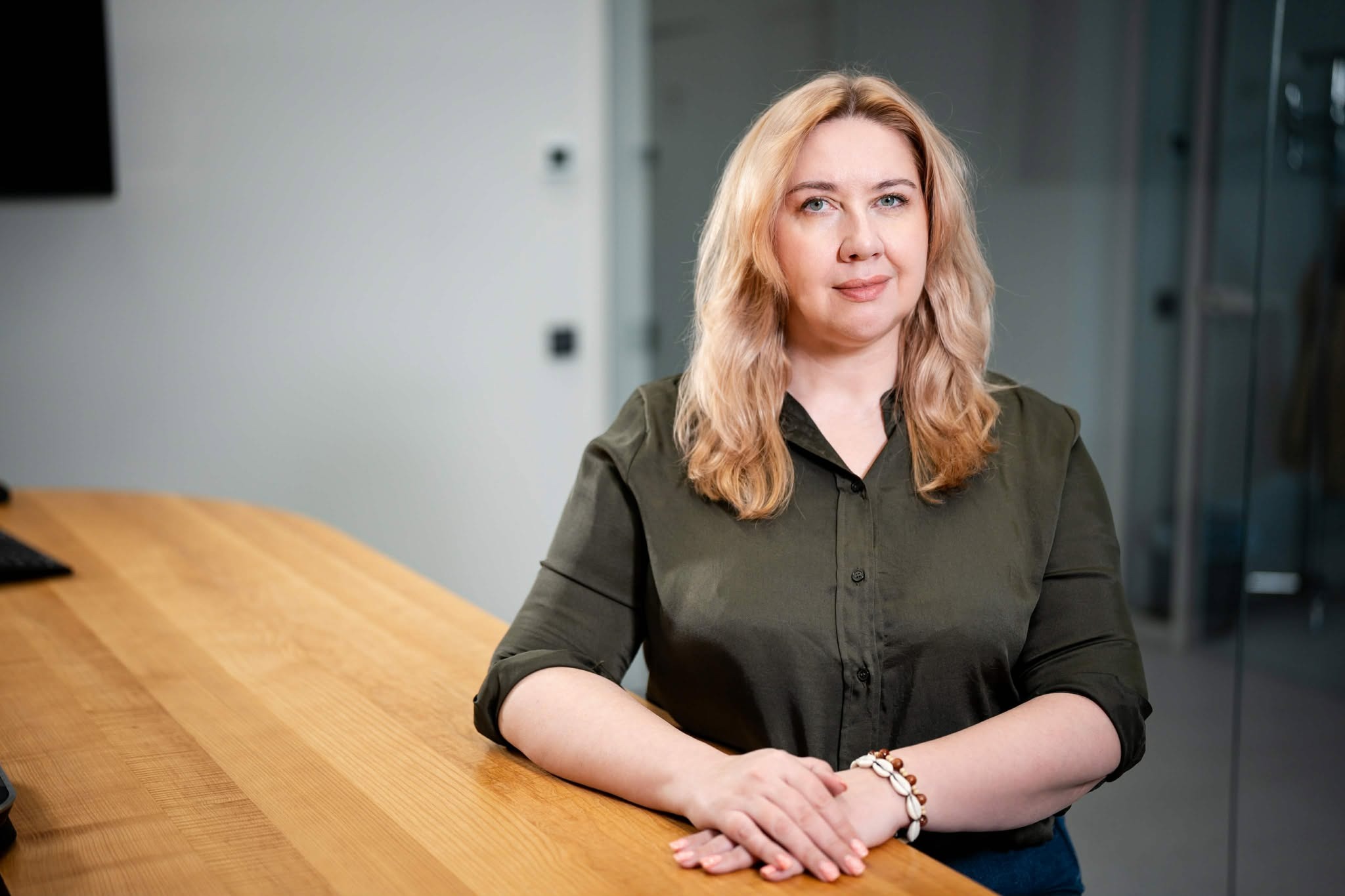
“I believe that Russia is purposefully creating an information blackout to simply hide the truth and spread propaganda everywhere,” she said.
She called on parliamentarians and international organisations start viewing the media as civilian infrastructure that warrants special protection.
“The accountability mechanisms that we have now focus mainly on crimes against people, and there is no equivalent legal category or compensation mechanism for destroyed media infrastructure… I believe that there should be an analogy here with the cultural site or medical facility protections. Media infrastructure, which ensures public access to information, deserves its own status as an object subject to protection,” Oksana Romaniuk said.
As foreign digital interference becomes increasingly frequent and dangerous, the work of journalists is often the last line of defense against the destruction of truth, said Pascal Allizard, Head of the French Delegation to the OSCE PA.
“Reporting from a conflict zone is not just a professional duty. It is a direct contribution to the defense of democratic principles and international law. We therefore have a collective responsibility to protect journalists in view of the war in Ukraine. We must do everything in our power to continue to demand the immediate release of journalists detained in violation of international law, to support mechanisms for tracking crimes against the media, and to fight impunity for those who committed and ordered these terrible crimes. In a broader sense, everywhere, in times of war as well as peace, protecting journalists means protecting the right to information, and protecting the right to information means protecting democracy itself,” he said.
“A ‘Press’ badge does not protect anyone even if international law says otherwise”
The TIC dealing with Russia’s crimes against journalists is collecting testimonies by media professionals and evidence of targeted attacks on the media by Russian forces. The TIC Chair Yevhenia Kravchuk quoted the following testimony by a journalist from Dnipro city: press officers in the combat zone have been asking reporters to remove their “Press” badges because it makes the press officers accompanying them a target.
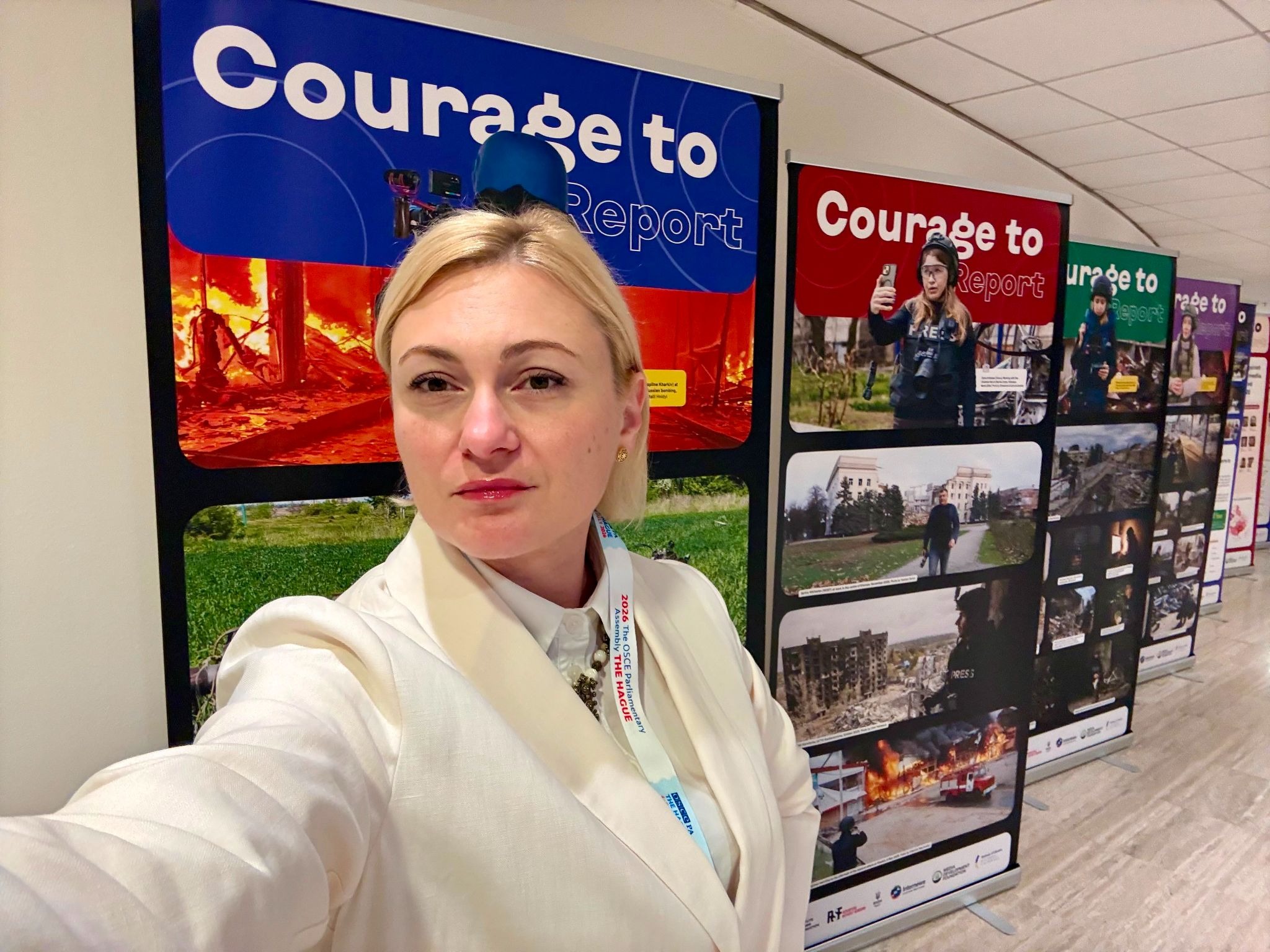
“Both international and Ukrainian journalists are becoming targets for Russian missiles and other attacks. And these are not just one-off cases: this is a method of warfare. Russia is sending a clear signal: reporting the truth about the war in Ukraine is a deadly thing. The ‘Press’ label does not protect anyone, even if international law says otherwise,” said Andriy Kostin, Ukraine’s Ambassador to the Kingdom of the Netherlands and Prosecutor General in 2022–2024.
He added that stepping up the pressure, such as introducing sanctions for such crimes, could be a vital additional tool for influencing Russia.
The international watchdog Reporters Without Borders also believes that attacks on journalists are a state policy by Russia.
“After filing ten criminal law motions with Ukraine’s Prosecutor General and the International Criminal Court (ICC) qualifying these acts as war crimes, since February last year we have moved to classifying them as crimes against humanity… We are analysing these events as a generalised and systematic offensive on the civilian population: as a state policy, in fact, namely a policy of persecuting people for their reporting,” explained Antoine Bernard, RSF’s Director of Advocacy and Assistance.
An international discussion of a possible overhaul of humanitarian law to protect media workers is long overdue, said Yaroslav Yurchyshyn, the Verkhovna Rada’s Freedom of Speech Committee Chair.
“Yes, we view these crimes as systemic. We realise that Russia is waging a war on truth, because it considers any journalist to be a propagandist. There are no independent media in Russia. Only some diaspora news outlets are still able to express a position, while the Russian government fully controls the domestic media and uses them as a soft power tool to cover up the crimes they commit… We need to start a discussion at the international level on changing humanitarian law. Because the guarantees that were established after World War II do not protect journalists at all now,” Yurchyshyn said.
He supported the position previously expressed by the Institute of Mass Information, among others, that journalists should be allowed to carry means of protection against drones without losing their civilian status.
Russia is abusing international law
Kravchuk added that journalists are becoming targets of transnational persecution as Russia puts them on wanted lists and tries to abuse international mechanisms to get them detained.
This case was not mentioned in the Hague, but this is exactly what happened to Iryna Zemlyana, a media expert at the Institute of Mass Information. Russia sentenced her in absentia to 13 years in prison, accusing her of attacking the Russian ambassador in Warsaw and promoting fake news about the Russian army. Iryna, who is hiding in Europe, could end up on Interpol’s wanted list at any moment. Ukrainian media organisations and the Media Movement have called on the Ukrainian authorities and international partners to intervene in her persecution by Russia.
How many more discussions do we need?
“How many more round table discussions until we stop Russia?” was the question on my mind on the way home from a trip that included two events: a discussion of the media’s role in the recovery process at the Ukraine Recovery Conference 2026 in Gdansk and the Hague event.
After 12 years of war and four years of the full-scale invasion, every Ukrainian has the indisputable right to be angry at slow international institutions, cautious partners, and long diplomacy as people here die every day. But some choose to be angry while making efforts to patiently persuade. International instituions also consist of people, and people are moved by human stories. One can read a report, listen to an official’s speech, or even watch a movie about battlefield reporters and missiles whooshing over them, and make another statement condemning this. Or one can meet a journalist who has been there, has dropped to the ground and to dodge the debris flying — here is the yellow and purple bruise on her elbow from hitting the asphalt. She will probably tell them that she was not worrying for herself at that moment but for the dog whom she left home alone. And she will be asking not for money for the media sector, but for Patriot missiles and sanctions against Russia that count, that finally make it disintegrate — the best prerequisite for the growth of Ukraine’s media market in Ukraine.
And the official will go home in the evening and think about a lonely dog, the colour of the bruise, about whether those dropping prone to the ground as a missile whistles over them are scared of scraping their face.
That is why I want to see Ukrainian journalists at all international panel discussions and informal meetings related to the media. On-the-ground reporters who can tell in half a second by the sound what type of missile is incoming and where it is going to hit, who understand different drone detector models. Media managers who juggle budgets, write scrolls of grant applications, come up with new formats for advertisers and merch for donors so that journalists get their salaries and the community gets news and stories. Editors who can tell by their team’s working pace and quality who is overdue for a vacation.
If we can’t bring journalists there, we will bring photos. IMI has accumulated a sizeable collection of photos of reporters work since 2022. With Ukraine’s destroyed cities, collapsed buildings, fires, trenches, unexploded missiles in the background… Most of them were not war correspondents until 2022, but had to become ones. They are always happy to share their photos with us unconditionally. And we find opportunities to make as many exhibitions of them as possible, including those displayed abroad.
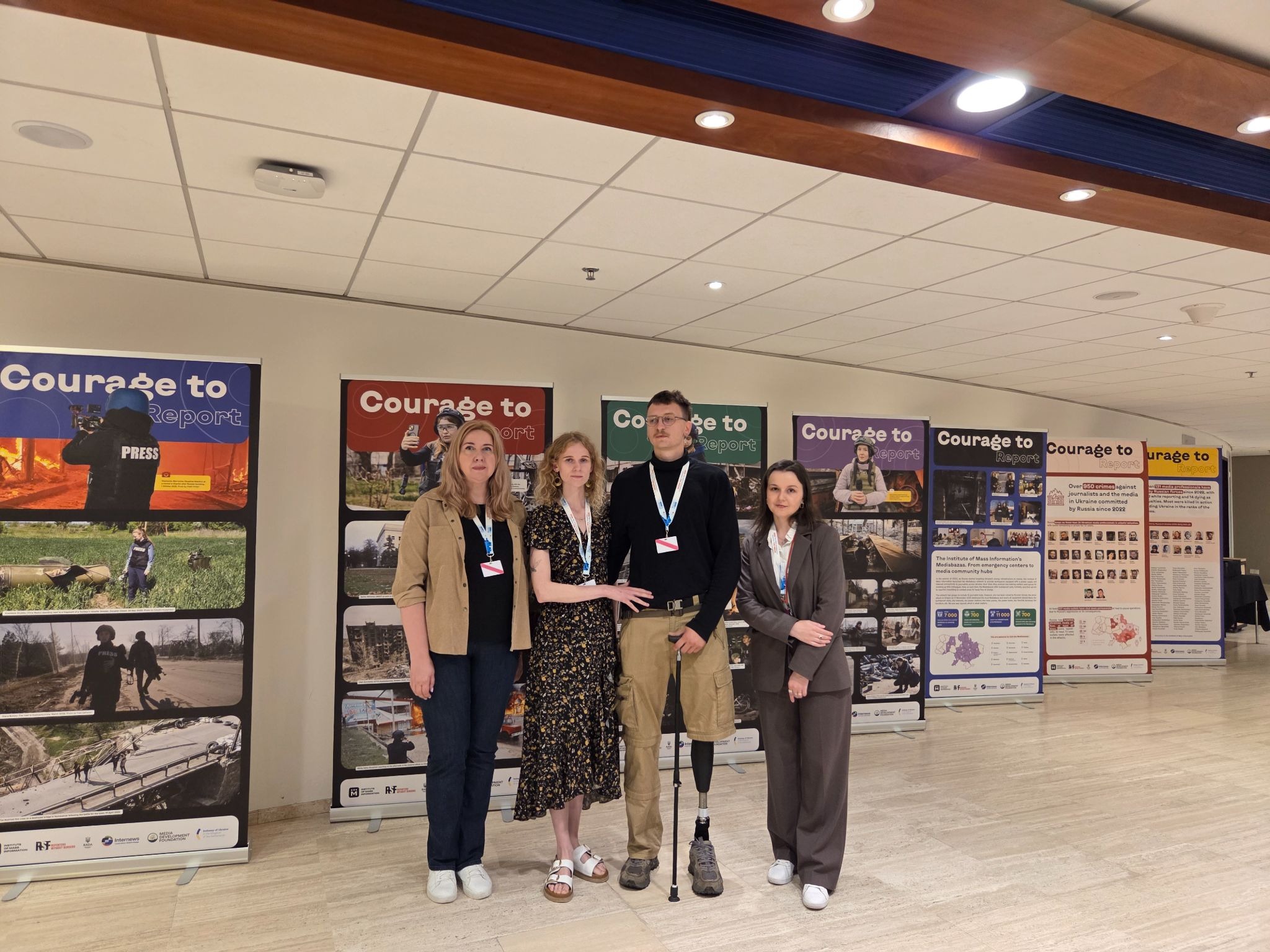
Courage to Report is one of such exhibitions organised by us together with our partners, first opened in Kyiv on Press Freedom Day 2026 with financial support from the European Union. Yevhenia Kravchuk saw it and offered to display it in the Hague during the OSCE PA session. The boards with photos of reporters covering the war in Ukraine remained across from the plenary meeting hall through the entire session. We hope that they struck a chord with some of the parliamentarians as they were walking to their seats to address global security challenges.