
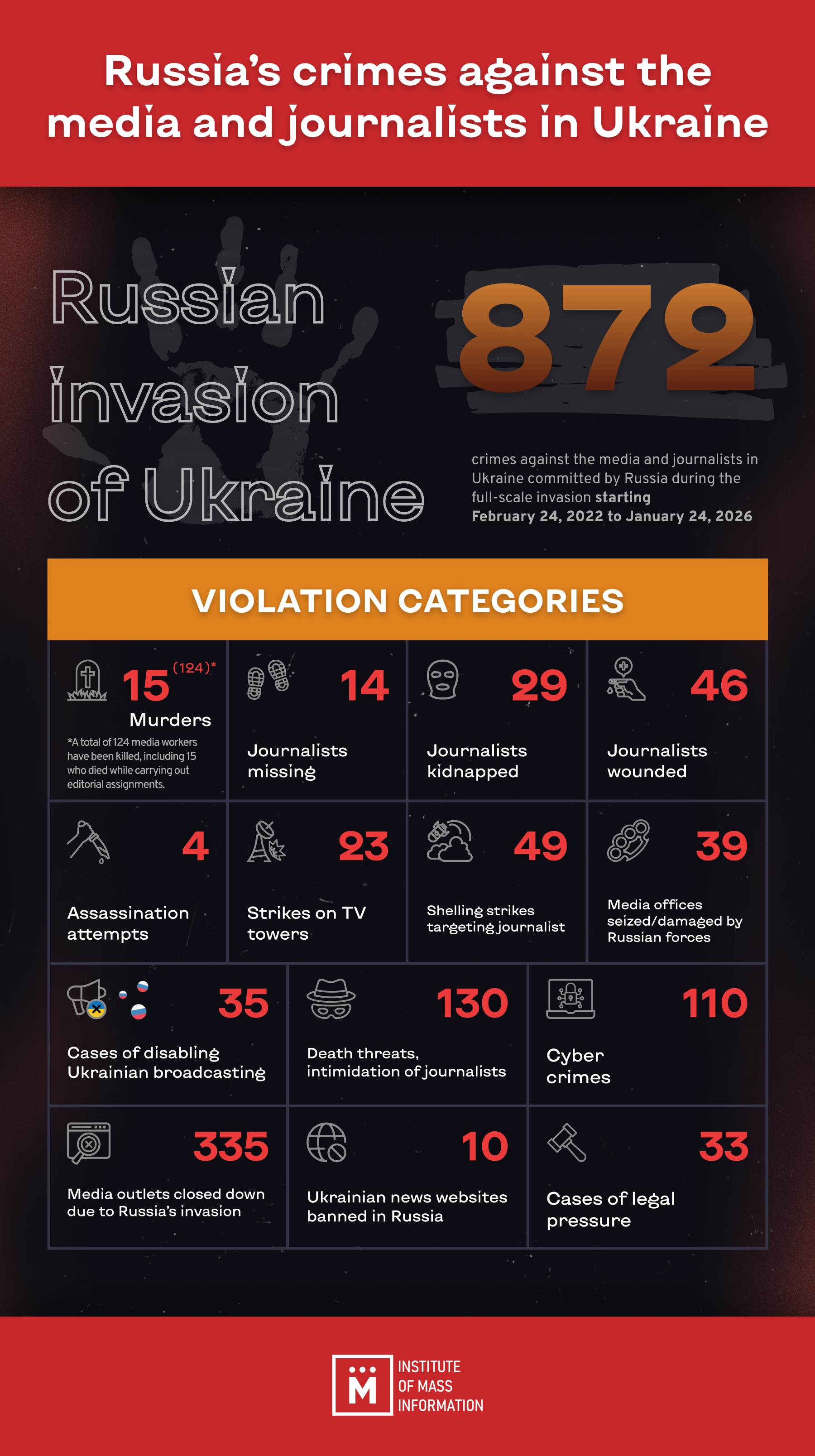
In the three years and 11 months since the start of the full-scale invasion, Russia committed 872 crimes against journalists and the media in Ukraine, as evidenced by the Monitoring Study of Russia’s Crimes Against Journalists and the Media, which the Institute of Mass Information has been carrying out since the first day of Russia’s invasion of Ukraine.
IMI recorded 2 crimes against media and journalists committed by Russia since 24 December 2025 through 24 January 2026. Both were news outlets shutting down due to Russia’s war on Ukraine.
Three media workers turned UAF servicemembers were reported dead in January:
- Lana Chornohorska, journalist and UAF servicewoman (UAV pilot and navigator). Killed by a Russian drone in Ukraine’s South on 1 January 2026. She was a reporter with the Kharkiv-based news outlet Lyuk, activist, and artist before enlisting.
- Volodymyr Siniychuk, serviceman, photocorrespondent with the local newspaper Ridnyi Kray (Velyka Bahachka village, Poltava oblast). Killed in action in Donetsk oblast on 4 January 2026. He was drafted into the army on 20 December 2022, following the full-scale invasion.
- Yuriy Mihashko, serviceman, production designer at Novyi Kanal. Killed in action in Sumy oblast. Enlisted in the Defense Forces in March 2022.
A total of 124 media workers have been killed in Ukraine since the start of Russia’s full-scale invasion, with 15 dying while reporting.
News outlets closing down
- Nashe Prydnestrovya, one of the oldest print newspapers in Vinnytsia oblast, closed down after 95 years in print due to financial struggles and the impact of the war. The team hopes to resume operations in the future.
- The newspaper Nash Kray, based in Rozhyshche (Volyn oblast), went out of print. The decision was fuelled by a sharp drop in circulation numbers, Ukrposhta delivery costs rising, the loss of ad revenue after the start of the full-scale war, staffing shortage, and blackouts. The team is deciding whether to resume publication or to close down permanently.
“This was when long blackouts began, and the media had to survive and continue working in an extremely difficult situation not just in the industry, but in daily life as well. Newsrooms worked with no stable power supply, connectivity, or heating, and yet continued to inform their audience,” said Kateryna Dyachuk, IMI’s chief freedom of speech monitor.
See the full list of Russia’s crimes against freedom of speech in Ukraine here.
The Institute of Mass Information (IMI) is a civil society organization specializing in the media, operating since 1996. IMI defends the rights of journalists, studies the media landscape and reports on media-related events, fights propaganda and disinformation, and provides media workers with safety equipment for trips to combat areas (since the start of the Russo–Ukrainian war in 2014).
IMI carries out the only monitoring study of freedom of speech in Ukraine, keeps a list of transparent and responsible online media outlets, and tracks Russia’s media crimes in the war on Ukraine. IMI has representatives in 20 oblasts of Ukraine and runs a network of Media Hubs that provide journalists with unfailing support. IMI’s partners include Reporters Without Borders (RSF); the organization is also a member of the International Freedom of Expression Exchange (IFEX).