Experts at the Institute of Mass Information recorded 14 press freedom violations in Ukraine in October 2026. Four of these were related to Russia’s aggression while 10 were committed by Ukrainian nationals and institutions, as evidenced by IMI’s monthly monitoring study, the Freedom of Speech Barometer.
RUSSIA’S CRIMES
Media professionals killed
Five media professionals turned UAF servicemembers were reported dead in October. Two of them had long been considered missing in action. One is Samuil Proskuriakov, who contributed to UNN, Zaborona, Hromadske, and Babel, went missing in 2022; the second is Dmytro Khyzhniak, host at Hit FM and TV-5, had been considered missing since 2024. They were only officially declared dead in 2026.
UAF serviceman and YouTube blogger Kyrylo Soloshenko was killed in action on 15 October 2026. He rose to popularity on YouTube in 2014–2016, producing his own videos and collaborating with other bloggers who were popular at the time. Vasyl Velychko, a cameraman with the Poltava-based TV channels IRT Poltava and Misto Plus turned UAF servicemember, was killed on 16 October.
Serviceman, photographer, and cameraman Volodymyr Obertas was killed in Kherson on 27 October while accompanying a group of war correspondents and filming city streets. He died in an explosion caused by a landmine likely planted in central Kherson by Russian troops on the first day of the ceasefire. Obertas had filmed the drone video that first showed the world the scale of humanitarian disaster in occupied Oleshky.
144 media professionals have been killed by Russian forces since the start of Russia’s full-scale invasion of Ukraine, with 15 dying while reporting.
READ MORE
- Freedom of Speech Barometer for September 2026
- 989 crimes against Ukrainian journalists, media committed by Russia since 24 Feb 2022
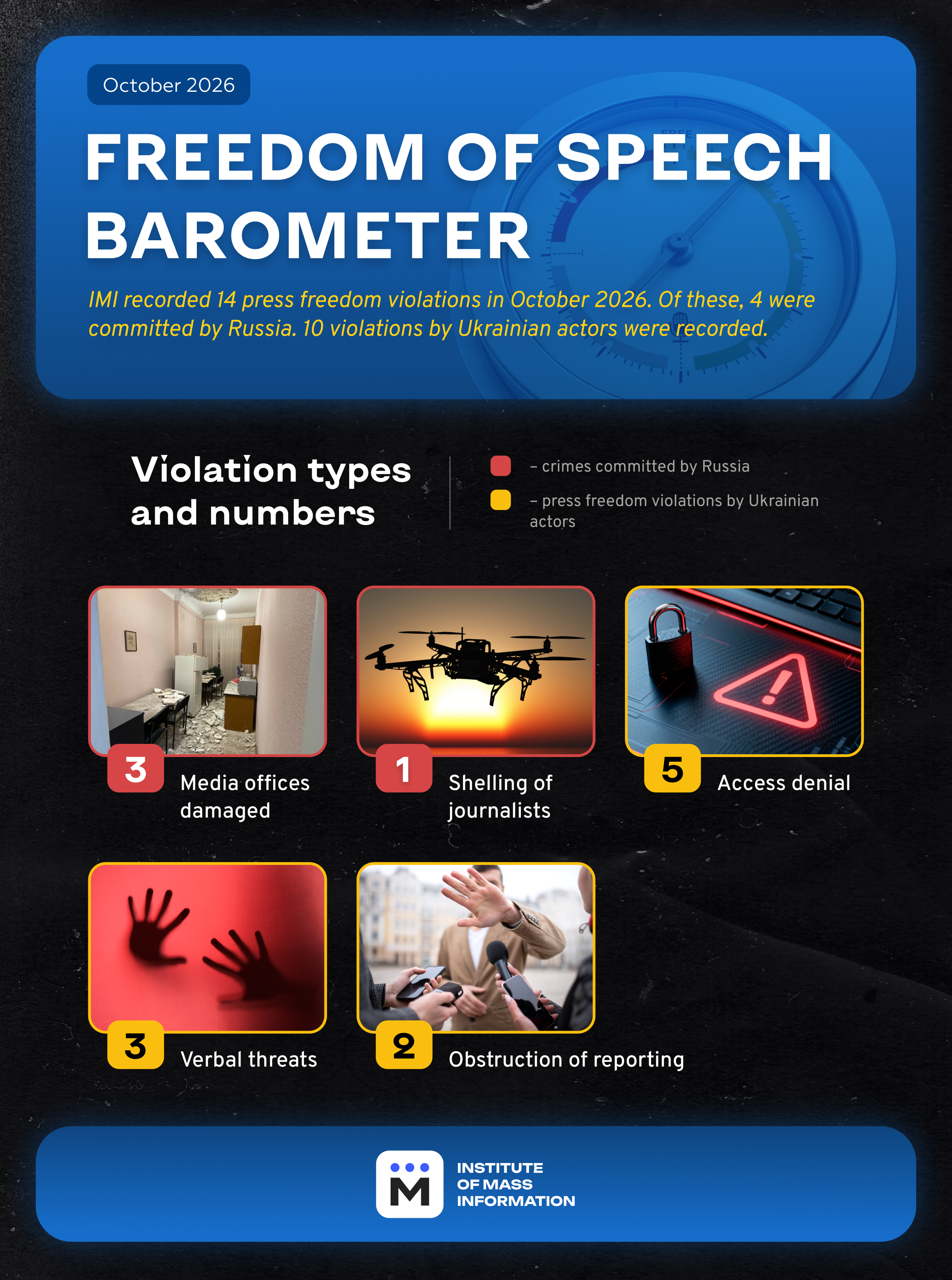
Air strikes on journalists
- A Suspilne Zaporizhzhia filming crew came under attack by Russian FPV drones in Kushuhum village (seven kilometres south of Zaporizhzhia city) while documenting the aftermath of earlier strikes. The journalists were unable to leave the village for over three hours, and a drone hit next to their car.
Damage to media offices
- The Suspilne Zaporizhzhia office was damaged in a Russian ballistic missile strike in Zaporizhzhia city: the shock wave blasted out windows and doors in the building. The team were unharmed, as there was no one inside at the time of the attack.
- A Russian strike on Kyiv overnight on 19 October inflicted significant damage on the office of the newspaper Zakon i Biznes. The shock wave blasted out all the windows, destroyed the interior walls, and damaged the equipment and furniture in the office. None of the newsroom’s staff were in the office at the time.
- A Russian drone targeted the office of the private broadcaster Vizyt TV in Kremenchuk, Poltava oblast, causing significant damage to the building and starting a fire. The damage to equipment and infrastructure forced the channel to temporarily stop producing news, though they remained on air. The seven employees were in shelter during the attack. No one was injured.
Violations unrelated to Russia’s war against Ukraine
IMI recorded 10 press freedom violations committed by Ukrainian nationals and institutions and unrelated to Russo–Ukrainian war in September. Half of these cases concerned denial of access to public information, making it the largest infringement category of the month. Most violations took the form of selective accreditation, denial of admission to public events, and refusals to share documents.
Three instances of violent threats and two cases of obstruction using physical force or restriction of reporters’ movement were recorded.
The infringements were recorded in eight regions across Ukraine: Rivne, Volyn, Kyiv, Kharkiv, Sumy, Khmelnytskyi, Ternopil, and Kirovohrad oblasts, with Khmelnytskyi oblast leading in terms of the number of violations committed (two instances of denial of access to information). The violations were committed by private individuals, officials, law enforcers, and state bodies, namely oblast military administrations, the SBI, police, a state agency, and a state university.
Death threats, intimidation
- The Rivne-based outlet Chetverta Vlada reported that their chief editor Volodymyr Torbich had received death threats over his reporting from a local official’s ex-husband, who demanded Torbich not mention his children in his investigations.
- Yuriy Rychuk, owner of the media group Vechirniy Lutsk, received a text message containing death threats to him and his family over his “paid-for scribbles.”
- A woman attacked an Espreso TV film crew near Darnytsia metro station in Kyiv city, verbally threatening them and grabbing at their hands and camera. The journalists had to call the police to put an end to the conflict.
Obstruction of legal reporting
- Kharkiv police and a man claiming to be a security guard from a nearby factory forcibly dragged three photojournalists out of the grounds of a polyclinic that had been affected in a Russian air strike earlier. The security guard tried to take away their camera and the journalists were accused of helping Russian troops.
- Vladyslava Kritska, a journalist with the local online outlet Cukr, was detained for about 20 minutes by the staff of a Sumy shopping mall, where she had come to film the aftermath of a Russian strike. The staff threatened to take away her phone and blocked the exit. The journalist was only able to leave the building with the help of a police officer.
Access to information for journalists
- The Khmelnytskyi Oblast Military Administration (OMA) was selective in inviting reporters to a meeting with Verkhovna Rada Chair Ruslan Stefanchuk, which four local TV channels got to attend but no news websites did.
- Iryna Beliakova, a reporter with 20 Khvylyn, was denied accreditation to cover the meeting with Verkhovna Rada Chairman Ruslan Stefanchuk, allegedly due to missing the application deadline.
- The State Bureau of Investigation (SBI) refused to report whether persons involved in arranging, commissioning, or carrying out the stalking of Bihus.Info journalists in 2024 had been identified or when the case files would be sent to court.
- Staff of Volodymyr Vynnychenko State University of Central Ukraine (Kropyvnytskyi) barred journalists with local news outlets to cover the university’s rector election.
- A Khmelnytskyi oblast state agency declined to share documents concerning a tender consultant involved in procurement for a bomb shelter construction project with ZHAR.INFO journalist Maria Turchyna a second time after a letter by the Verkhovna Rada Commissioner for Human Rights asking them to review the journalist’s query.
See the full monitoring study below.
Russia’s crimes
Armed strikes on journalists – 1
1. Suspilne Zaporizhzhia crew comes under Russian drone attack
15.10.2026 A Suspilne Zaporizhzhia film crew came under attack by Russian FPV drones in Kushuhum village (seven kilometres south of Zaporizhzhia city) where the media workers were documenting the aftermath 6 October shelling, Suspilne reports.
The reporters were targeted by Russian FPV drones within minutes of starting work. The crew was unable to leave the village for more than three hours.
The media workers managed to film several damaged houses and then had to take cover under trees and in bushes. One of the drones struck right next to their car.
“Now I recall us putting on our body armour before driving into Kushuhum with an ironic smile; us cracking a few dark jokes, and myself telling the team, ‘Let’s not get worked up, everything will be fine. We’ll get it done quickly and head back.’ But in the end, neither ‘quickly’ nor ‘getting it done’ went down as planned,” said Anastasia Potapenko, a Suspilne Zaporizhzhia correspondent.
She remarked that being completely prepared for this is impossible.
“Because it’s one thing when you hear a drone somewhere out there, in the distance. But when you hear them non-stop, when they circle and hover right over you and your colleagues, it’s a totally different level of fear. Nothing compares to it,” the media professional explained.
Suspilne Zaporizhzhia chief editor Alyona Natalukha said that the situation in the village had been much calmer just six months earlier. This time, the crew was simply unable to move, because people in body armour carrying a camera had become targets for the Russian forces.
However, she added, correspondent Anastasia Potapenko, cameraman Maksym Savchuk, driver Oleksandr Denysenko, and safety staff Daniil Levchenko acted professionally.
“Situations like this are happening increasingly often. Working in the oblast under shelling means constant risk and an enormous psychological burden. In the midst of all this madness, my colleagues kept working. The boys shielded Nastia and supported one another. Anastasia and Maksym filmed comments and spoke to the camera about the situation. When the crew came back, we could see how emotionally difficult and frightening that shoot had been. I’m extremely grateful to the team that, despite everything, they choose to come to work every day and to head out into the countryside again and again, to show what the Russians are doing to our villages, and how people have been living in these conditions for four years now,” Alyona Natalukha remarked.
The company stressed that Suspilne’s film crews are equipped with body armour and first aid kits. The teams follow the rules and constantly monitor the situation to keep themselves safe. The company also organises safety training, allowing their staff to hone their first aid skills.
Media offices damaged — 3
1. Suspilne Zaporizhzhia office damaged in Russian strike
17.10.2026 The Suspilne Zaporizhzhia office was damaged in a Russian ballistic missile strike in Zaporizhzhia on 17 October, the broadcaster reported.
The shock wave blasted out windows and doors in the building. The team were unharmed, as there was no one inside at the time of the attack.
The broadcasting company is assessing the extent of the damage together with the police.
Russian forces targeted Zaporizhzhia city in a massive missile strike on the morning of 17 October. The attack damaged apartment blocks and cars across the city and caused a fire. Five people have been reported wounded, including a child. The prosecutor is investigating the attack as a war crime (Part 1, Article 438 of the Criminal Code of Ukraine).
2. Newspaper’s office damaged in Russian strike on Kyiv
22.10.2026 A Russian strike on Kyiv overnight on 19 October inflicted significant damage on the office of the newspaper Zakon i Biznes, the outlet reported.
As the newspaper writes, a Russian missile hit next to the building housing their office.
The shock wave blasted out all the windows, destroyed the interior walls, damaged the equipment and furniture in the office, and caused suspended ceilings to collapse.
Criminal law proceedings have been opened over the damage to the building.
None of the newsroom’s staff were in the office at the time. The team is operating as usual. The site’s servers are safe, the newsroom remarked.
Zakon i Biznes is a weekly analytical newspaper founded on 15 June 1991 by Zakon i Biznes Editorial Team LLC. The outlet’s chief editor is Roman Vasylovych Bobov.
3. Vizyt TV office targeted in Russian drone strike on Kremenchuk
22.10.2026 A Russian drone targeted the office of the private broadcaster Vizyt TV in Kremenchuk, Poltava oblast, overnight on 22 October. The strike caused significant damage to the building and started a fire. Because of the damage, the TV channel has temporarily stopped producing news.
Vizyt reported that they would remain on air, but would temporarily halt the release of news bulletins.
“Due to technical circumstances, Vizyt TV is forced to temporarily halt the production and release of news bulletins. For now, the channel continues to broadcast, but news bulletins will temporarily be absent from the air. We are doing everything we can to restore the newsroom’s work as soon as possible and return to the usual format of informing the people of Kremenchuk,” the channel’s statement reads.
Poltava Oblast Military Administration Chair Vitaliy Diakivnych reported on his Telegram channel that the strike had caused a fire.
As journalist and Kremenchutska Hazeta chief editor Oleh Bulashev told IMI’s regional representative Nadia Kucher, the broadcaster’s office is located in central Kremenchuk, amid many residential buildings.
As reported by Kremenchutska Hazeta, the worst damage was sustained by the office of the channel’s editor Iryna Skrypachova and by the newsroom, where the editorial team worked.
Vizyt said that the seven employees were in shelter during the attack. No one was injured.
Because of the extensive destruction and damage to equipment and infrastructure, the complex had to halt operations. Full operation can not be resumed at present.
The press freedom situation in Ukraine unrelated to Russia’s war
Physical aggression
Death threats, intimidation, persecution – 3
1. Chetverta Vlada chief editor receives death threats
05.10.2026 The Rivne-based outlet Chetverta Vlada reported that their chief editor Volodymyr Torbich had received death threats following the release of a news piece on criminal law proceedings involving the children of Liana Dynovska, director of the Rivne Social Services Centre.
According to the organisation, two voice messages from Oleksandr Dynovskyi, the official’s ex-husband and the father of her children, were sent to Chetverta Vlada‘s Facebook page on 29 September. In the messages, the man demanded that his children not be mentioned in the outlet’s reporting and threatened to murder Volodymyr Torbich.
In the first voice message, as quoted by Chetverta Vlada, Oleksandr Dynovskyi addressed Volodymyr Torbich and said:
“Hey, Volodya?! It’s Dynovskyi. What the f***, you’ve got nothing better to do? If you touch my f***ing kids one more time, I’ll come to Rivne and cut your f***ing head off. You have my f***ing word. What, are you a scumbag or something?!”
In the second message, he again demanded that his children not be mentioned in the news:
“Torbich, you’re a sick man. See that you don’t touch my kids. Don’t touch my kids, because… well, it’s not decent. Have you got no one to write about, f***ing nothing to write about? Write about the office, you… f***ing dumb***. Don’t touch my kids!”
The newsroom regards these messages as threats to Volodymyr Torbich in connection with his reporting.
Chetverta Vlada has also reported on criminal law proceedings involving Oleksandr Dynovskyi. According to Rivne City Court data, the man fired ten shots in the direction of police officers in 2025. 34 more live rounds, which he had been storing illegally after finding them in Sumy oblast, were found in his possession. He pleaded guilty. The court sentenced him to three years in prison, but released him from serving the sentence with a two-year probation period and stripped him of the rank of senior soldier.
Moreover, the outlet writes, the court register contains a ruling by the Derazhnia District Court of Khmelnytskyi oblast, dated 17 March 2026, concerning Oleksandr Dynovskyi being absent from his army unit without leave under martial law.
Volodymyr Torbich said he took the threats seriously and believed they were linked to his reporting.
“Since Dynovskyi has threatened other people’s lives before and has even fired shots in their direction, and the court case was put on hold because of his military service, I regard his threats as a crime against me in connection with my professional work. Since he has access to weapons and has already gone AWOL, I view these threats as real. A lawyer has already prepared a report of the crime,” Torbich said.
He added that this was not the first time the team had faced pressure for their work, but it was the first instance of overt death threats that they have faced.
2. Vechirniy Lutsk owner reports threats
19.10.2026 Lutsk-based media professional Yuriy Rychuk, owner of the media group Vechirniy Lutsk, has shared a text message containing threats to him and his family in a Facebook post and discussed it with Maia Holub, the Institute of Mass Information’s regional representative in Volyn oblast.
The text from an unknown person, sent via a messaging app, asked whether the journalist’s conscience allowed him to sleep at night. The message also included the phrase “the scribbles you wrote for money will come back to bite you or your family.”
In comments to IMI’s representative, Yuriy Rychuk remarked that the message had arrived via Viber on Saturday, 17 October, signed “Slava”. The sender’s phone number comes up in GetContact as “Stanislav Pozniakevych”, but when the journalist dialled it, he discovered that the number was not in service.
Yuriy Rychuk remarked that he had not yet contacted the police and did not think it was necessary at present. He had no assumptions about who sent the message or why.
“Honestly, I don’t even have any theories. My only emotion here is surprise. In my reporting work over recent years, I can’t recall a single critical piece that could have caused its ‘subject’ enough discomfort to prompt such threats. Nor can I recall any subjects of my reporting who would have stooped to such primitive ‘threats.’ Or perhaps I think too highly of people…” Yuriy Rychuk commented.
He did, however, add ironically:
“Full moon is soon, which folk belief says prompts mentally unstable people to behave inappropriately. But the full moon is still a week away. And I have no other assumptions,” he added.
Volodymyr Zelenchuk, a lawyer with the Institute of Mass Information, remarked in comments that threats, as a criminally punishable act, must, among other things, be real and specific.
“A threat being real means that it may, with a significant degree of probability, be carried out. ‘Specific’ means that the person is threatened with real, objective harm. A message like this, unfortunately, does not meet these criteria and cannot, on its own, be classified under Article 345-1 (threats or violence against a journalist),” he commented.
At the same time, the IMI lawyer remarked, if such messages are part of a campaign aminig to pressure or intimidate a journalist and may be linked to specific piece of reporting and the people opposing it, one can speak of signs of unlawful influence on a journalist with the purpose of obstructing the performance of their professional duties, or of persecution of a journalist over his lawful reporting, which is a punishable offence under Part 2 of Article 171 of the Criminal Code of Ukraine.
Volodymyr Zelenchuk remarked that it is right to report such incidents, and that, if this happened consistently and was prompted by some material, one could try to gather evidence of specific individuals’ involvement independently and contact law enforcement with that information.
3. Woman attacks Espreso TV reporters in Kyiv
19.10.2026 A woman attacked an Espreso TV film crew near Darnytsia metro station in Kyiv city, verbally threatening them and grabbing at their hands and camera. The incident occurred shortly after the crew finished filming a news story about the transport situation around the station, correspondent Natalia Starepravo reported in a Facebook post. She elaborated in comments to Institute of Mass Information (IMI) journalist Valentyna Troyan.
Starepravo said that filming had already been completed and the journalists had been waiting for their driver. The camera was not running at the time.
A woman approached the reporters, accompanied by another person. She began shouting at them in Russian, demanding that they stop filming and explain why they were filming passers-by, in particular elderly people, and used obscene language.
“She didn’t want to listen, hurling abusive words at us. She walked up to us and started grabbing at the camera, at the cameraman, at the tripod, and started grabbing my hands,” Natalia Starepravo said.
In posted footage from the scene, the woman is insulting and threatening the journalist.
“What ‘job’? You know where you’re going to be doing your ‘job’, my dear? Shut your mouth! Do you think I’m going to like you? I’ll smash your glasses, you c***, if you even look at me, damn it,” the woman shouted, addressing the journalist.
The unknown woman also threatened to damage their equipment: “Why the f*** are you filming? Let me take a rock and f***ing smash all of this.”
The journalists tried to explain that they had the right to work in a public space and encouraged the woman to call the police. Passers-by began to stand up for the crew, but the woman reacted aggressively to them as well.
Since the woman did not stop her threats and continued to pursue the cameraman carrying the equipment, the journalists called the police themselves.
Starepravo said that the officers who had responded to the call identified the woman and said they have encountered her before. She had a document confirming she has mental disabilities.
The correspondent said that the woman had continued to behave aggressively even in the presence of the police, threatening to “punch the faces” of both the journalists and the officers.
The film crew did not file an official report with the police. After speaking with the police, the journalists left the scene.
None of the media workers suffered serious injuries, and the equipment was not damaged.
Obstruction of lawful reporting — 2
1. AFP staff says police, security forcibly removed 3 reporters from Kharkiv strike site
13.10.2026 Kharkiv police and a man claiming to be a security guard from a nearby factory forcibly dragged photojournalists Serhiy Bobok, Andriy Mariyenko, and Sofia Hatilova out of the grounds of a polyclinic that had been affected in a Russian air strike earlier, AFP stringer Serhiy Bobok reported in a Facebook post.
The journalist said that he and his colleagues, all stringers with international news agencies, had arrived at the site following a Russian strike on civilian infrastructure and entered the polyclinic’s courtyard freely, cameras in hand.
Then, several police officers and a civilian man ran up to the journalists shouting that the polyclinic was a “strategic facility.” The man tried to wrench the camera out of Bobok’s hands in the police’s presence.
“Then he and a police officer grabbed me by the arms, and they dragged me out through the polyclinic’s entrance by force. As they did so, they told me that people like me were the ones helping the Russian army aim their strikes on Kharkiv and that we just came here to make money,” Serhiy Bobok recounted.
The assailants treated Andriy Mariyenko in the same way, while photojournalist Sofia Hatilova was led out of the grounds after being knocked down onto the asphalt.
Serhiy Bobok remarked that the patrol officers only showed interest in checking the journalists’ documents when they were taking their crime report. After the journalists had been removed from the premises, other media workers were let in unhindered. Photos and footage from the location were later published by the official channels of the State Emergency Service (DSNS), the police, and the oblast military administration.
Serhiy Bobok added that he and his colleagues had filed an official police report over the use of physical force and the accusations of espionage.
In comments to IMI journalist Valentyna Troyan, he said that he and Sofia Hatilova had not been wearing PRESS insignia, while Andriy Mariienko had been wearing a badge with a printed copy of his credentials.
“Nobody asked us for documents, even though we said we were journalists and had accreditation,” the photojournalist remarked.
He said that neither Sofia Hatilova being pushed by an officer nor the accusations of “helping the Russian army” were captured on record. The incident occurred after he and Andriy Mariyenko had been removed from the site.
Serhiy Bobok aded that he had not seen whether the police officers were wearing body cameras and that the officers had ignored the media workers’ requests to state their surnames and ranks.
The media workers filed a report with the patrol police.
“I called the police immediately after the incident,” Serhiy Bobok remarked.
However, he said he did not know whether the data has been entered into the Unified Register of Pre-Trial Investigations under Article 171 of the Criminal Code of Ukraine (obstruction of lawful reporting).
“We don’t know that. The police press service has confirmed that the reports had been registered, and that’s all. We’ve had air strikes every day, we’ve been working to cover each one, and there was the weekend on top of that, so we simply haven’t had the chance to send a query,” Bobok explained.
The photojournalist stressed that this was the first time since the start of Russia’s full-scale invasion of Ukraine that he had encountered such a situation.
“Thank you for your attention to this situation. We are all stringers for news agencies (I’m with AFP, Sofia with Reuters, Andriy with AP), and we’ve been at strike sites constantly since the first day of the full-scale invasion (Sofia since May 2022). Conflicts occur regularly, but we’ve never seen such brazen behaviour by the police in all this time,” Serhiy Bobok said.
2. Sumy reporter detained on Russian strike site during filming
16.10.2026 Vladyslava Kritska, a journalist with the local online outlet Cukr, was detained for about 20 minutes by the staff of a Sumy shopping mall, where she had come to film the aftermath of a Russian strike, on 16 October. The staff claimed that she needed permission from the owner to film, threatened to take away her phone, and blocked the exit. The journalist was only able to leave the building with the help of a police officer, Cukr editor Vladyslava Kudielnik reported to Olha Panfilova, the Institute of Mass Information’s representative in Sumy oblast.
Kudielnik said that Vladyslava Kritska had arrived at the mall along with a colleague after the attack to assess the impact of the strike. The journalist holds accreditation from the Ukrainian Armed Forces.
Part of the territory around the shopping centre had been cordoned off, with rescuers and police working there. Kritska introduced herself to the police officers and the State Emergency Service and asked them about the details of the incident. She then went to another entrance to the building, which was not taped off.
A security guard opened the door for her and let her inside. The journalist filmed a short interview with him about the details of the strike and documented the destruction inside the premises. When she was about to leave, she found the door locked.
Kudielnik says that several people who did not introduce themselves, probably employed by the mall’s owner, met the journalist at the exit.
They said it was private property and that the journalist had no right to film there. They told Kritska they would “not let her out,” threatened to take away her phone, and said they would call their lawyer, Kudielnik says. The security guard was then ordered not to let the journalist through. He locked the door and stood in front of it, blocking the exit, the editor says.
Soon a woman who claimed to be a lawyer arrived. She insisted that the journalist needed permission from the shopping mall’s owner to film. The reporter explained that the security guard had let her in, and refused to talk without the police present.
The lawyer called the police but, the editor says, only mentioned the Russian strike during the call, not the situation with the journalist. Meanwhile, Kritska was able to get a colleague to ask a police officer working on site to come over.
Vladyslava Kritska says that even after the police officer arrived, they refused to let her out. A mall manager objected to her leaving, saying they needed to “sort things out,” while the security guard continued to block the door. The journalist recorded this episode on a voice recorder.
In the end, the police officer personally escorted the journalist out of the building, together with the other parties to the conflict. She was detaimed for about 20 minutes in total.
Throughout this time, there was an air raid alert in Sumy, and the threat of repeat strikes remained, the editor remarked. Soon after the journalist stepped outside, air defence started going off, so she had to seek shelter together with the police officer.
The police documented the incident and took the journalist’s statement. The Cukr team plans to file an official report over obstruction of lawful reporting.
Censorship, access to information
Access to information for journalists — 5
1. Khmelnytskyi OMA was selective in inviting reporters to VRU Chair meeting
06.10.2026 The Khmelnytskyi Oblast Military Administration (OMA) was selective in inviting reporters to a meeting with Verkhovna Rada Chair Ruslan Stefanchuk, which four local TV channels got to attend but no news websites did, the OMA press office reported to Alyona Bereza, the Institute of Mass Information’s representative in Khmelnytskyi oblast.
The meeting, titled “Parliament Dialogue”, took place at Leonid Yuzkov Khmelnytskyi University of Management and Law on 6 October. It primarily focused on the Civil Code of Ukraine overhaul. Khmelnytskyi OMA Chair Serhiy Tiurin called the event an “open dialogue” in a Telegram post and remarked that the participants could put questions to the Parliament Chair.
Alyona Bereza contacted Khmelnytskyi OMA’s press office to find out on what grounds reporters had been invited. A press office representative confirmed in a conversation that invitations had been extended selectively, by phone. The press office also cited limits on attendance, saying that 11 media representatives had been present, making up 10% of the people in the room, in line with the recommendations set out for the event.
Four TV channels were invited: Suspilne Khmelnytskyi, Channel 33, Misto, and TV7+. Press office staff from the OVA and the Oblast Council were also present. Not a single news website was invited.
“We usually invite everyone to events. You know there’s a group chat where we post invitations. Since few people respond, we called those who attend events most often,” the press office representative explained.
IMI’s representative pointed out that news websites had received no invitations and therefore had not been able to decide whether to attend the meeting. Asked why, given the limited number of seats, staff with government press services had been counted among the media representatives while news websites had not been invited, the OMA press service replied: “They provide coverage of officials.”
Alyona Bereza said that all media outlets should have been given the opportunity to ask questions about changes to legislation affecting their work, namely the new version of the Civil Code, authored by Verkhovna Rada Chair Ruslan Stefanchuk.
The Ternopil-based newsroom 20 Khvylyn also reported difficulties accessing the “Parliament Dialogue” event. The outlet’s journalist Iryna Beliakova wrote that she had submitted an accreditation application on 5 October. However, the following day the team was told that the application had been submitted too late.
IMI lawyer Volodymyr Zelenchuk explained that limiting the number of attendees because of a venue’s capacity under martial law is not a breach of law in and of itself. Still, he added, the way these seats were allocated was entirely unlawful.
“The method of ‘calling around at random’ or inviting reporters selectively is discriminatory, because a state body’s press office has no right to decide which media outlet is ‘more important’ or ‘more fitting’ for an event,” Volodymyr Zelenchuk explained.
He said that the third clause of Part 1, Article 26 of the Law of Ukraine “On Media” provides that accreditation must be based on openness, equality, and fairness so as to safeguard the public’s right to receive information through the media.
“The selective principle of ‘inviting those who attend events most often’ goes against the principles of equality and fairness, and the absence of advance notice of the event goes against the openness principle,” Volodymyr Zelenchuk remarked.
The lawyer pointed out that the OMA had not publicly announced the event in advance. In his view, this may indicate a violation of the law on access to public information.
He recalled that, under Article 15 of the Law “On Access to Public Information”, public authorities are obliged to publish information about their open events, work plans, and the procedure for attending meetings in advance.
2. 20 Khvylyn journalist denied accreditation for Ruslan Stefanchuk meeting in Ternopil
06.10.2026 Iryna Beliakova, a reporter with the Ternopil-based outlet 20 Khvylyn, was denied accreditation to cover the meeting with Verkhovna Rada Chairman Ruslan Stefanchuk that took place in Ternopil on 6 October. Ternopil Oblast Military Administration explained that the journalist had missed the deadline and submitted her application when the lists of media had already been passed to the organisers.
In comments to Iryna Nebesna, the Institute of Mass Information’s regional representative, Iryna Beliakova said she had submitted her application to take part in the “Parliamentary Dialogue” event on 5 October. The next day, the journalist posted a question in the group chat with the Ternopil OMA, asking for details regarding press access, and learned that she had not been granted accreditation.
“I asked a question in the chat regarding their approach to the press, and that was when I found out there I had not been accredited. When I asked whether I could apply again, they said Stefanchuk’s press service had declined,” the journalist said.
Nadia Yashchyshak, acting head of the oblast administration’s PR department, explained in comments to IMI’s representative that the invitation for media was posted in the group chat on 5 October along with an accreditation form (the former was posted at 11:02, the latter, with follow-up comments and a request to re-register, at 1:46pm).
“The post said that accreditation had to be completed by 2pm. At 3:30pm we had already submitted the lists of media to the organising department, which handled further communication with Stefanchuk’s team. Iryna applied at 4pm, and we didn’t see that. The next morning she wrote something about the event in the group chat. I replied to her personally, saying that the lists had been submitted earlier, but that I would ask whether they could still add her. Management told me it was too late, because the lists had already been submitted,” Yashchyshak remarked.
She said that Iryna Beliakova was not the only one denied accreditation due to late application; one other outlet faced this problem as well.
3. SBI declines to say whether Bihus.Info stalkers have been identified
07.10.2026 The State Bureau of Investigation (SBI) refused to say whether persons involved in arranging, commissioning, or carrying out the stalking of Bihus.Info journalists in 2024 had been identified or when the case files would be sent to court, citing secrecy of investigation in their response to an information query by Detector Media.
On 25 September, the outlet sent the SBI a series of questions about the progress of the pre-trial investigation. The journalists asked whether suspicion notices had been issued to those who commissioned and carried out the surveillance, how many forensic examinations had been ordered and completed, why they were being delayed, and the approximate timeframe for sending the indictment to court.
The SBI’s Investigation Office responded by merely confirming that the pre-trial investigation in proceedings No. 22024000000000042 of 17 January 2024 was still underway.
The case is being investigated under three articles of the Criminal Code of Ukraine:
- obstruction of lawful reporting by an official or a group of persons (Part 3, Article 171);
- violation of personal privacy (Part 2, Article 182);
- unlawful use of special technology to covertly obtain information (Part 1, Article 359).
At the same time, the outlet remarked, the SBI did not provide substantial answers to the questions posed. Citing the Law of Ukraine “On Access to Public Information” and Article 222 of the Criminal Procedure Code of Ukraine, the agency stated that information on the pre-trial investigation was confidential and could only be released with written approval by the investigator or a prosecutor.
4. Reporters barred from covering Kropyvnytskyi university rector election
16.10.2026 Staff of Volodymyr Vynnychenko State University of Central Ukraine (Kropyvnytskyi) barred journalists with local news outlets to cover the university’s rector election, reports Pavlo Lisnychenko, the Institute of Mass Information’s regional representative, citing a Facebook post by independent journalist Anatoliy Voinyi and comments by Olena Sidorova, director of the newspaper Kirovohradska Pravda.
Anatoliy Voinyi, who also chairs the public council at Kirovohrad Oblast Military Administration, wrote a Facebook post on 15 October, saying that he had been denied access to cover the rector election. The staff claimed he did not have the necessary credentials.
Journalists with Kirovohradska Pravda ran into the same problem. Olena Sidorova said that the newsroom regarded the rector election as an event of public importance and open to media coverage.
“We have covered the university’s events many times before, and faced no such restrictions on reporting. However, at the entrance we were told that only accredited media representatives could attend the election, so the newsroom’s journalists would not be let in. We had our press IDs with us, confirming our professional status. We also offered to pass the accreditation procedure on the spot, but were refused,” Olena Sidorova told IMI’s representative.
She said that the staff at the election venue had explained that the accreditation procedure was available on the institution’s official website.
However, IMI lawyer Volodymyr Zelenchuk stresses that no internal regulation of an institution can disregard Ukrainian law.
He said that Article 25 of the Law “On Information” guarantees journalists the right to freely enter the premises of public bodies and attend the open events they hold.
“Since, in general, it is public authorities that are vested with the right to grant accreditation, a state university must also be subject to the other provisions of the information law concerning the rights and obligations of public bodies. Thus, refusing journalists entry to the university’s premises is an overt breach of the law and, in general, may be classified as obstruction of lawful reporting,” Zelenchuk remarked.
IMI’s representative tried to contact the State University of Central Ukraine at the phone numbers listed on the institution’s website, but no one was immediately available.
IMI is ready to publish the university’s position if one is provided.
5. State agency declines to share information with ZHAR.INFO journalist again
30.10.2026 The Khmelnytskyi Oblast Procurement Service has declined to share documents concerning a tender consultant involved in procurement for a bomb shelter construction project with ZHAR.INFO journalist Maria Turchyna again. Her request was reviewed after a letter from the office of the Verkhovna Rada Commissioner for Human Rights.
Alyona Bereza, the Institute of Mass Information’s regional representative in Khmelnytskyi oblast, learned of this from responses by the agency and by the Commissioner’s Khmelnytskyi oblast office, which ZHAR.INFO shared with her.
Maria Turchyna submitted a query for information to the company on 21 July 2026, asking for contracts or other documents relating to tender consultations in two procurements for the construction of a bomb shelter for Horodok Lyceum No. 2. In her query, the journalist pointed out that the tender documentation stipulated that the consultant’s services would be paid for by the procurement winner, in the amount of 130,000 hryvnias excluding VAT.
After the first refusal, the journalist filed a complaint with the Commissioner. The Commissioner’s office approached the agency, asking it to review the query again, stressing that any restriction of access needed to be justifyed through applying the “three-part test.”
In its 9 October response, signed by commission chair Andriy Kolesnik, the agency refused to provide the documents again, claiming that they were not the information administrator in this case and that the agreement was confidential:
“Information about it can not be disclosed without the consent of the other party. Moreover, the terms of the contract and the current law provide for liability for disclosing confidential information,” the agency’s response states.
The agency said that disclosing the information could lead to a breach of contractual obligations and to property losses and reputational damage, and assessed that the public interest did not outweigh that harm, since it was the tender winner shouldering the expenses for the consultant’s services. At the same time, an audit of the procurement found that the inclusion of this condition in the tender documentation had been unlawful, since consultant services were not covered by the procurement deal.
Oksana Kizaieva, the Commissioner’s representative in Khmelnytskyi oblast, reported that proceedings on the complaint had been concluded:
“In view of the above, and of the response provided by the Commissioner, we see no grounds for taking additional action within these proceedings. Accordingly, the proceedings on your complaint have been concluded,” the response from the Commissioner’s office states.
Lawyer Yuriy Melnyk considers the repeat refusal legally unfounded and stressed that a term in a contract could not override the requirements of the law:
“A contractual term can not override the requirements of the law. Moreover, it is specific information that can be classified, not the entire document: the rest of the contract must be provided,” the lawyer stressed.
The lawyer added that the mention of the “three-part test” alone did not show that it had been applied properly, and that the Commissioner’s office had handled the complaint as a formality:
“So there are grounds to go to an administrative court and demand that the contract be provided, if necessary with the fragments proven to be confidential edited out,” Yuriy Melnyk concluded.
Defending freedom of speech
Authorities’ responses to press freedom violations — 1
1. Police opens probe into death threats to Chetverta Vlada editor
06.10.2026 Rivne police have opened an investigation into the death threats to Chetverta Vlada chief editor Volodymyr Torbich, the Rivne oblast police communications department announced on 2 October.
According to the police, their officers came across a news story about a likely criminal offence against a journalist while monitoring open sources. The piece described two voice messages containing violent threats, which had been sent to Chetverta Vlada‘s official Facebook page on 29 September.
“According to the reports, following the release of a news story about a drug trafficking trial, a man warned that he would use physical force, since members of his family were implicated in that case,” the police said.
They have launched a pre-trial investigation under Part 1, Article 345-1 of the Criminal Code of Ukraine (threats or violence against a journalist). The penalty under this article includes up to two years of community labour, up to three years of probation, or restriction or deprivation of liberty.
On 1 October 2026, Chetverta Vlada reported that their chief editor Volodymyr Torbich had received death threats following the release of a news piece about a drug trafficking case. Oleksandr Dynovskyi, ex-husband of Liana Dynovska, director of the Rivne Social Services Centre, and the father of her children, who are implicated in the case, sent two voice messages threatening to kill Torbich and demanding that the outlet not mention his children in their news.
The team regards these messages as threats to their chief editor in connection with his reporting.
Responses by the media community — 3
1. Ukraine’s media community demands Austria investigate police’s conduct while detaining UP reporters
09.10.2026 Ukrainian news organisations and civil society organisations, including the Institute of Mass Information (IMI) and the Media Movement (Mediarukh), are demanding that the Austrian authorities urgently, transparently, and independently investigate the detention of Ukrainska Pravda journalist Mykhailo Tkach and cameraman Yaroslav Bondarenko in Vienna on 8 October.
The media community released the corresponding statement on 9 October in response to the events that occurred as the journalists were carrying out an editorial assignment. As was reported, Mykhailo Tkach was held in custody for more than 12 hours, while cameraman Yaroslav Bondarenko was injured during the detention and ended up in hospital. Media professionals stress that following up on a police report does not justify excessive use of force, intimidation, or the confiscation of communication devices without due process.
27.10.2026 Media NGOs, civil society organisations, and the Media Movement called on Verkhovna Rada MPs not to support draft bill No. 10242 in the version proposed for repeat second reading, as stated in the joint address endorsed by the Institute of Mass Information.
The organisations believe that the document creates risks of journalists getting prosecuted for reporting socially important information and does not ensure proper protection of journalists’ sources.
They called on the Verkhovna Rada to amend the draft bill, enshrine clear guarantees against frivolous prosecution for lawful reporting of socially necessary information, provide procedural safeguards against the use of investigations to identify journalistic sources and to pressure newsrooms, review the proportionality of the proposed penalties, and to hold an open discussion involving media and human rights experts.
3. Ukraine’s NGOs, media orgs call on Verkhovna Rada not to adopt new Civil Code
28.10.2026 Ukraine’s civil society organisations and media organisations are calling on the Verkhovna Rada not to adopt new Civil Code (draft bill No. 15150) in second reading or as a whole, as per a joint statement by NGOs and the media, which the Institute of Mass Information has endorsed.
In their view, the proposed changes could create risks for freedom of expression, human rights, and the protection of property, while a complete replacement of the Code could lead to years of legal uncertainty and contradictions in case law.
In the joint statement, the signatories stressed that the draft bill needed an independent legal review and broad public discussion.
The reservations include possible restrictions on journalistic investigations, risks to the rights of women, children, and LGBTIQ+ people, as well as weaker protection for state-owned and communal property, including nature reserves and cultural heritage sites.
“Media and human rights organisations warned of threats to freedom of expression in the new Civil Code as early as June 2026. These included potential court bans on releasing pieces of reporting, an excessive expansion of the right to respond, the risks of the “right to obscurity” being exploited to hide information of public interest, and increased judicial pressure on journalists. These provisions risk chilling journalistic investigations and obstructing access to socially important information. European experts have also pointed out the need for additional freedom of expression safeguards,” the statement reads.
The authors of the statement also pointed out the potential impact of completely replacing the current Code, which has been in effect for over 22 years. According to them, changing the legal regulation could call into question part of the established case law and mean longer and more expensive proceedings for citizens and business. The statement also cites the Supreme Court’s warnings regarding the time it takes to build settled practice in applying new clauses.
The signatories acknowledged the need to modernise Ukraine’s civil law, but proposed making the changes gradually, through separate draft bills or coordinated packages of amendments to the current code. They called for an independent legal review of the potential impact of the changes on human rights, the judicial system, and Ukraine’s EU integration obligations.