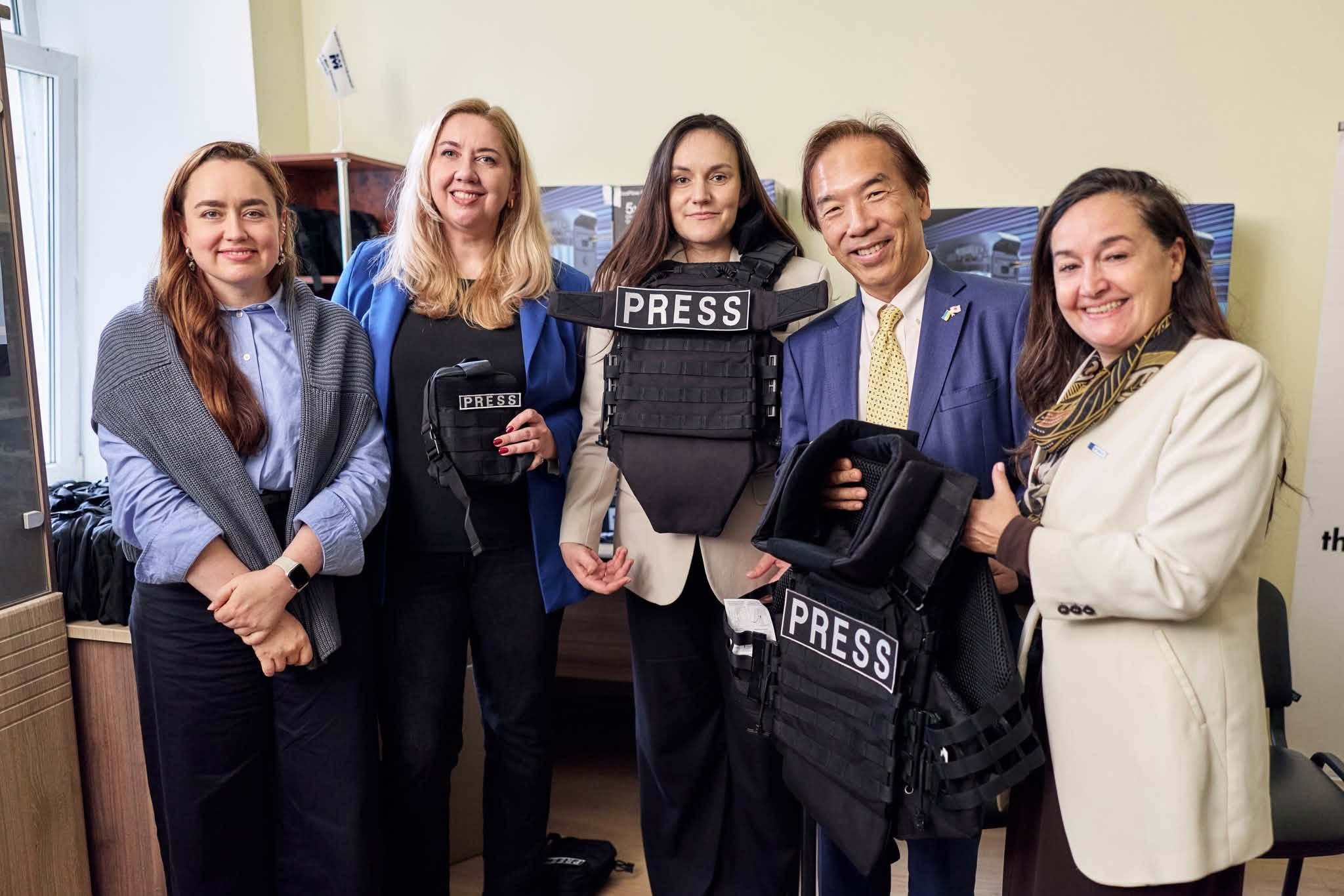
UNESCO delivered equipment to protect Ukrainian media professionals and support their work in wartime to the Institute of Mass Information (IMI) on 9 October, with the support of the Government of Japan and in partnership with Ukraine’s Ministry of Culture.
IMI received:
- 20 portable power stations;
- 30 high-capacity power banks;
- 50 individual first aid kits (IFAK) including tourniquets, occlusive dressings, and haemostatic agents;
- 150 CAT tourniquets;
- 10 armour vests (plate carriers) anatomically adapted to women’s bodies;
- 10 ballistic helmets;
- 5 portable radios.
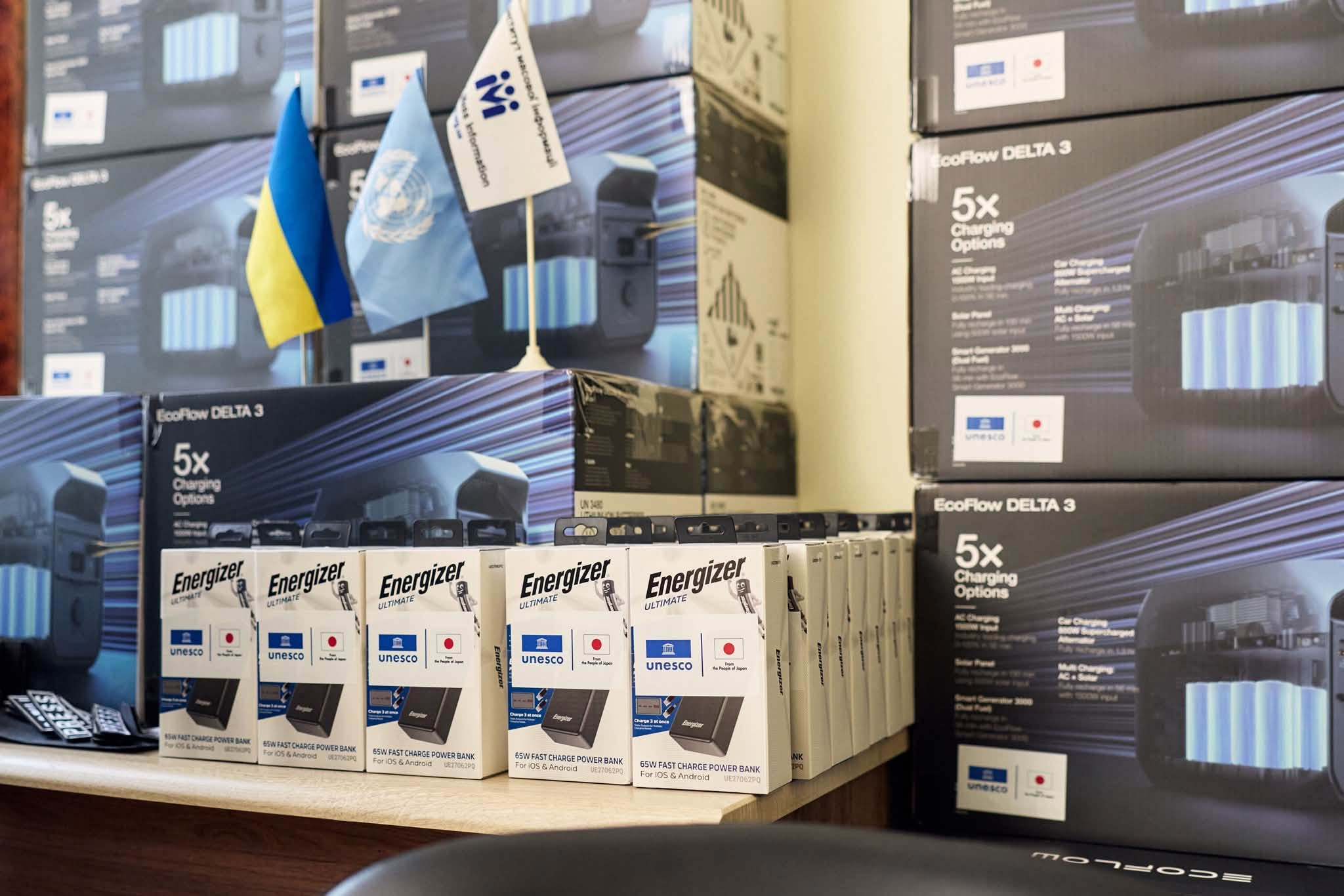
The equipment will be added to IMI’s Safety Library and Mediabaza stocks and will be lent to media workers free of charge. Reporters and newsrooms that need safety gear or equipment for their work can fill out the online form on IMI’s website or contact their regional Mediabaza.
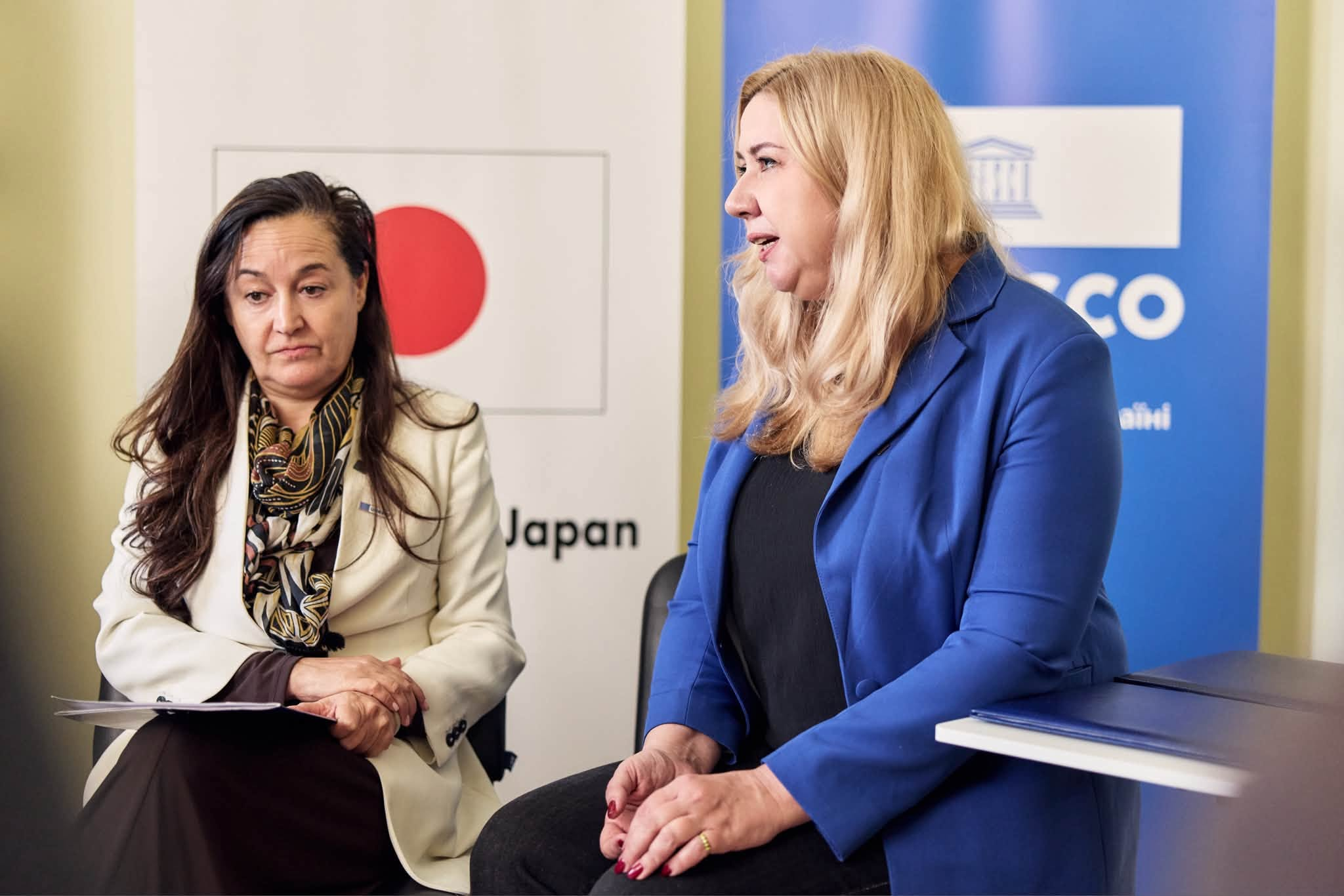
“Body armour, first aid kits, and drone detectors save lives, while power stations and other equipment allow newsrooms to stay connected even during prolonged power outages. It is especially important that this aid responds to the real needs of women journalists, war correspondents in particular, by including specially adapted body armour. We are grateful to the Government of Japan, UNESCO, and Ukraine’s Ministry of Culture for their support. IMI will pass the equipment on to the journalists and newsrooms that need it most. Supporting the safety and resilience of the media today is both an investment in Ukrainians’ right to information and in preserving independent journalism,” said Oksana Romaniuk, director of the Institute of Mass Information.
Tetiana Berezhna, Ukraine’s Deputy Prime Minister for Humanitarian Policy and Minister of Culture, described supplying safety equipment to media workers as an investment in trust.
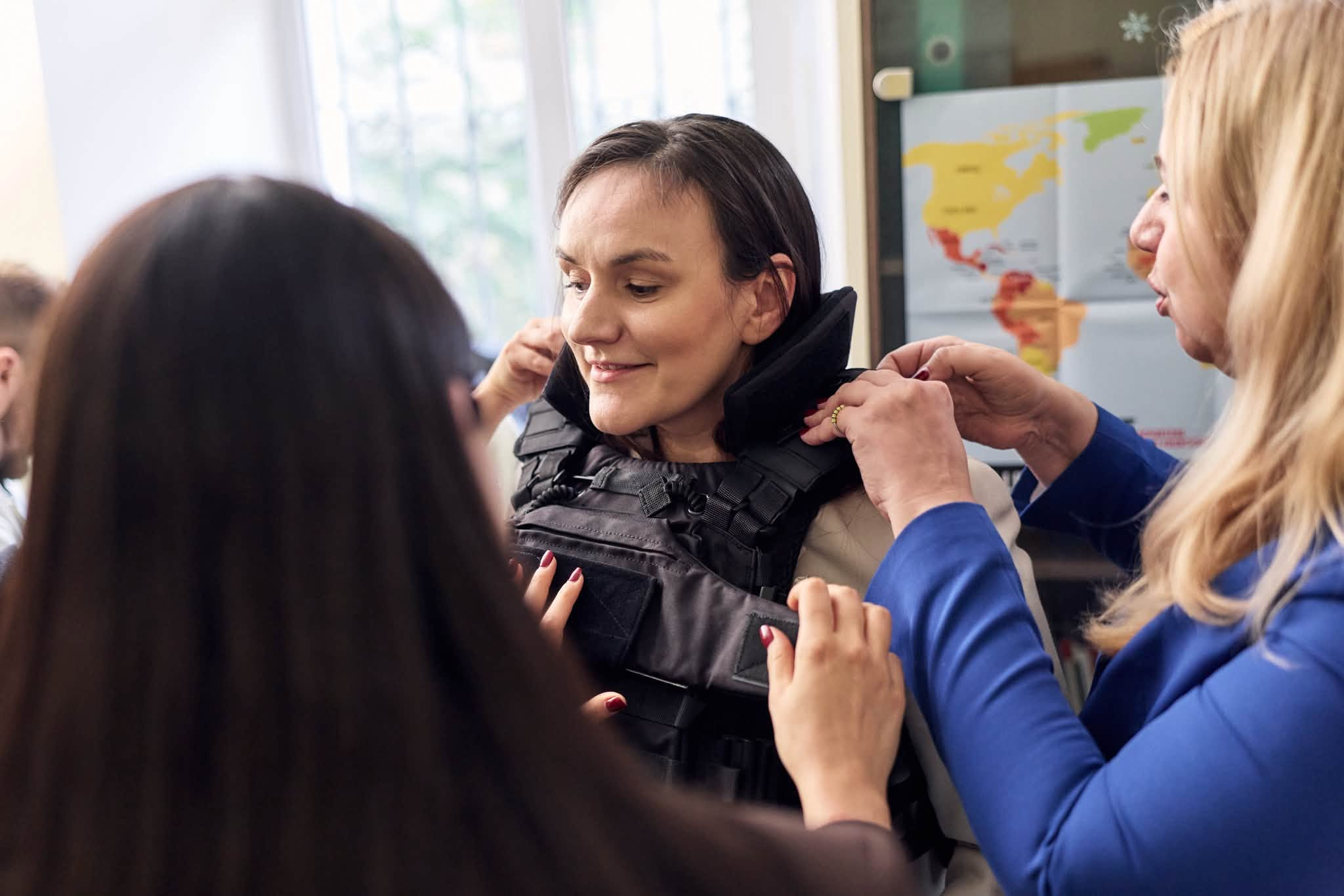
“I really like the saying that trust is a type of critical infrastructure. And trust is built by journalists, people who share the truth about Ukraine with the whole world. We understand that being a reporter in Ukraine is very hard. It’s not just the challenges that come with the job, but also the war and the danger surrounding you on all sides. That’s why the equipment delivered today is a huge investment in this critical infrastructure, in trust, enabling you to cover the events taking place in Ukraine now, cover the war and Russia’s aggression, and help us call things and processes by their real names. And we realise that 80% of battlefield reporters are women, so it’s extremely important that they work comfortably and do everything they can,” the Minister remarked.
Japan’s Ambassador Extraordinary and Plenipotentiary to Ukraine, Yo Osumi, added that supporting efforts to improve journalists’ safety and resilience mattered to his country.
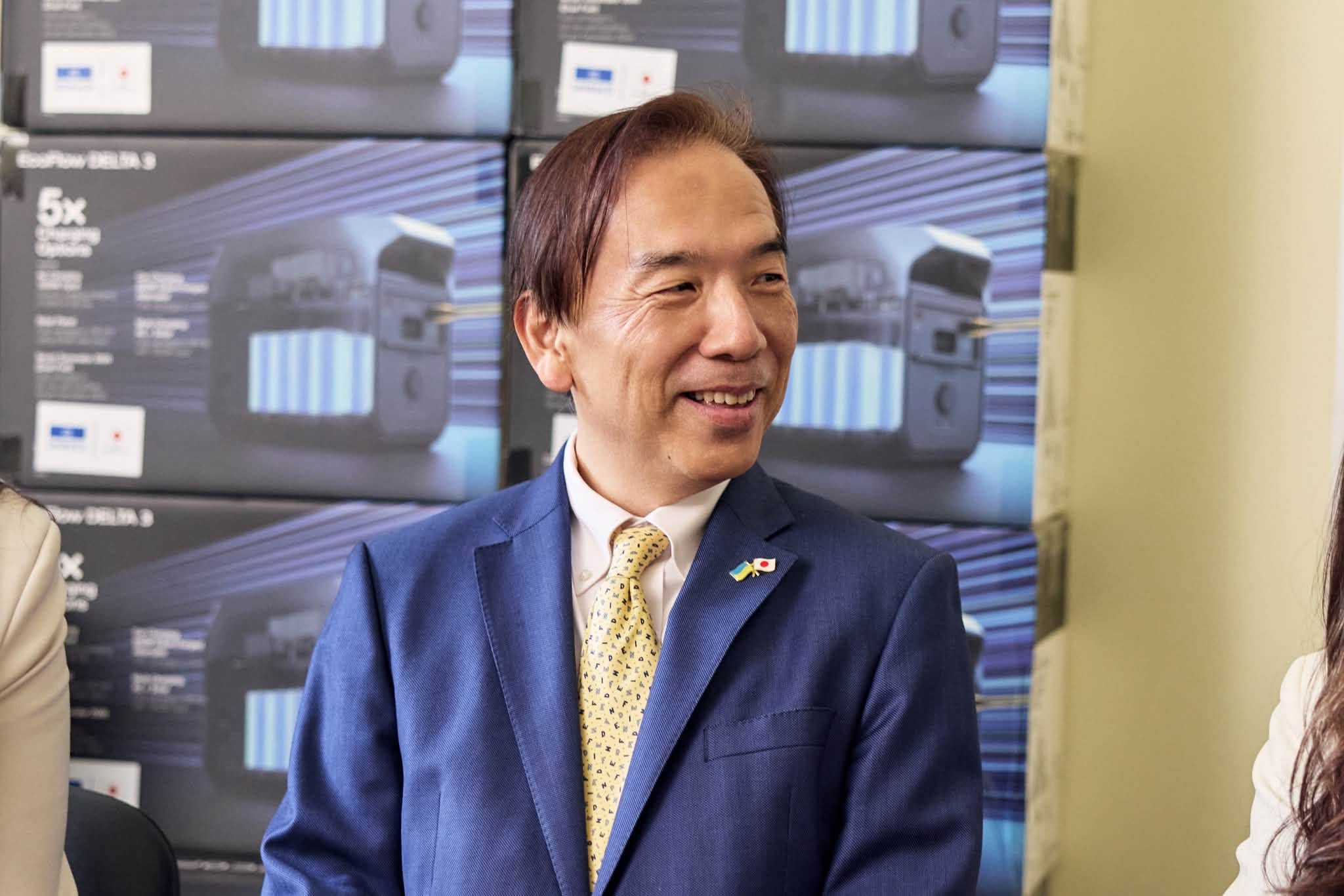
“After all, independent media and courageous journalists play a key role in an open and resilient society. And this is even more relevant in the digital age. That is why we deeply value your courage and dedication. We hope this aid will help you carry out your important work in safer conditions,” the Ambassador said.
The meeting took place at the Institute of Mass Information office in Kyiv, which was flooded last winter, along with all the equipment stored in it, after heating pipes in the building burst as a result of Russian strikes on the energy system. Chiara Dezzi Bardeschi, head of UNESCO’s Representation in Ukraine, highlighted the symbolism of the venue.
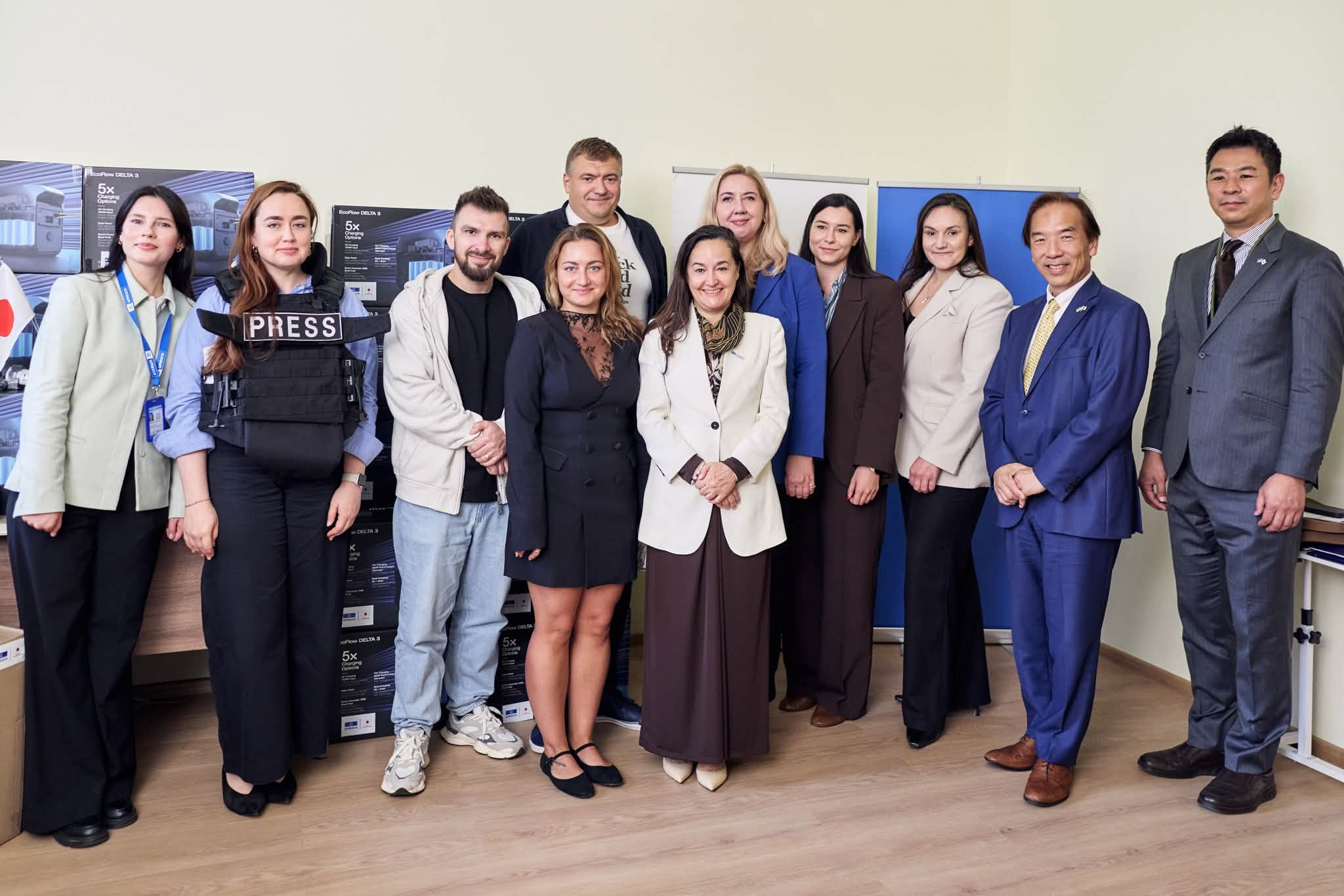
“It is a great honour for us that this partnership grew stronger essentially with the very start of the full-scale invasion, and we are also grateful to our media partners, because without you, your active participation, and your daily work, it would be impossible to keep delivering reliable information and to provide not only Ukrainians but all of us with access to information about the situation in Ukraine… It is also very symbolic for us to do this here, since the Institute of Mass Information suffered flooding as a result of damage caused by one of the strikes. The issue of journalists’ safety remains extremely urgent, and we at UNESCO are deeply concerned with it and ready to continue cooperating with all partners,” the UNESCO Representative said.
As per IMI’s monitoring study, Russia has committed 977 crimes against journalists and the media in Ukraine since the start of the full-scale invasion:
- 139 media professionals have died in the course of Russia’s aggression, with 15 killed while reporting;
- media outlets’ offices have been destroyed or damaged in Russian strikes 109 times;
- 338 newsrooms halted operations or shut down permanently due to the impact of the war;
- at least 27 media professionals remain imprisoned by Russian forces.
The Institute of Mass Information (IMI) is a civil society organization specializing in the media, operating since 1996. IMI defends the rights of journalists, studies the media landscape and reports on media-related events, fights propaganda and disinformation, and provides media workers with safety equipment for trips to combat areas (since the start of the Russo–Ukrainian war in 2014).
IMI carries out the only monitoring study of freedom of speech in Ukraine, keeps a list of transparent and responsible online media outlets, and tracks Russia’s media crimes in the war on Ukraine. IMI has representatives in 20 oblasts of Ukraine and runs a network of Media Hubs that provide journalists with unfailing support. IMI’s partners include Reporters Without Borders (RSF); the organization is also a member of the International Freedom of Expression Exchange (IFEX).