

The Institute of Mass Information experts recorded 8 freedom of speech violations in Ukraine in December 2025, all unrelated to Russia’s war on Ukraine, according to the IMI’s monthly monitoring study Freedom of Speech Barometer.
The death of two media workers turned UAF servicemen was reported in December:
- Vasyl Khomko, serviceman, ex-director for the travel show “Heads and Tails”. Killed in action while giving cover to his retreating group on 2 October 2025. Volunteered to join the army in March 2022. He first served in the Mountain Assault Brigade No. 128 for 2.5 years and then in the Special Operations Forces for almost a year.
- Kostyantyn Shtyfurak, serviceman, filmmaker, journalist. Enlisted the Ukrainian Armed Forces in the summer of 2022 and served as a commander of a UAV unit. Served in the “Hornets of Hell” unit of the Hetman Ivan Mazepa mechanized brigade No. 54. His death was reported on 16 December 2025.
A total of 123 media workers have been killed in Ukraine since the start of Russia’s full-scale invasion, with 15 dying while reporting.
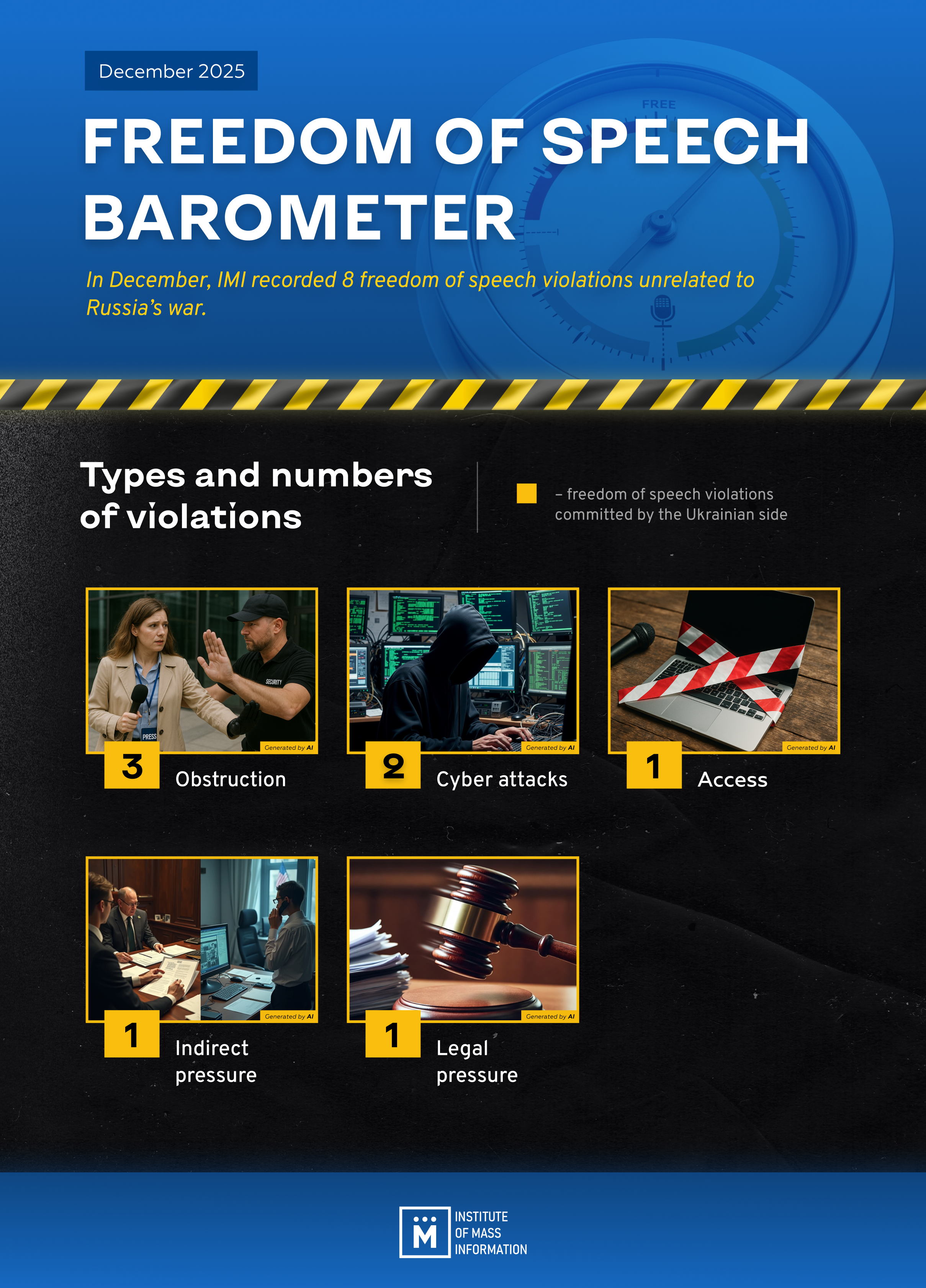
Of the eight recorded instances of freedom of speech violations three were categorised as obstruction of reporting, two as cyber attacks, and one each as other types: access to information, indirect pressure, and legal pressure.
Obstruction of reporting
- Sudovyi Reporter chief editor Iryna Saliy received a WhatsApp message with a request to take down a news story about Kyiv judges for a monetary reward. The journalist views this as pressure and an attempt to influence the news outlet’s editorial policy.
- Dnipro.media reporters were not allowed to attend a plenary session in the Dnipro City Council’s session hall. They were seated on a glazed balcony instead of the session hall while journalsts with the municipal news outlet worked downstairs unhindered. Dnipro.media says the restriction of access has been systematic.
- MykVisti journalist Yulia Boychenko faced harrassment on social media following the release of her news story about Mykolaiv’s new water supply system, with users accusing her of “helping the enemy aim air strikes,” leaking her photo and contact data. The news outlet views this as intimidation and a smear attempt.
Access to information
- Four district administrations in Kyiv city did not respond to Slidstvo.Info’s queries regarding the state and accessibility of bomb shelters, claiming the information is “classified”. Lawyers stress that this data is public and vital for citizens’ safety.
Indirect pressure
- Kremenchuk mayor Vitaliy Maletskyi blamed journalists with the local channel Vizyt TV for the delays in the construction of a bomb shelter in a daycare. He accused the reporters of visiting the construction site to film a news story, saying that the construction crew refused to work because of this.
Cyber attacks
- Nashi Groshi website sustained a DDoS attack shortly after the release of an investigation that could harm the interests of the Heart Institute director Borys Todurov.
- Suspilne Kherson lost access to their Telegram channel, with someone taking over and posting content to the channel instead of the team.
Legal pressure
- A Poltavaoblenergo representative threatened to sue Darya Hustilina, chief editor with the news website Chutivskyi Kray, over her reporting and demanded a takedown of her post. The journalist refused.
Furthermore, IMI recorded one case in occupied Crimea, where Russian pressure on media workers continues. Russian security forces searched the home of journalist and political scientist Lenora Dyulber on 4 December 2025. She was taken to Simferopol and released after an interview. Durning the search, Russian operatives thoroughly inspected every room, looked through all the documents, study notes, and the journalist’s PhD thesis; they took photos of her notes and books, checked her phone, and confiscated her computer.
Lenora Dyulber hosts the popular talk show Merkez, co-authored a sociological study “Crimean Tatars amid the Political Environment Transformation”, and is a Crimean Tatar activist.
See the full list of freedom of speech violations recorded in Ukraine in December 2025 below.
Crimea — 1
1. Russian forces search journalist Lenora Dyulber’s home in Crimea, take her to Simferopol
04.12.2025 Russian security forces in occupied Crimea searched the home of journalist and political scientist Lenora Dyulber and confiscated her computer. She was taken to Simferopol and released after a questioning, the journalist’s mother Elmira Dyulberova reported to Crimean Solidarity.
According to Elmira Dyulberova, there was a knock on their door soon after 6 a.m. Several cars and two minibuses were parked on the street. About 20 armed people first scattered around the yard, then around “all the rooms there were,” Dulberova added. The operatives were acoompanied by two witnesses, and the law enforcers identified themselves.
“[They told us] to open everything ourselves, tell everything ourselves without hiding anything,” Elmira Dyulberova recounted the operatives’ words.
The search was warranted by the “Kyiv District Court of Simferopol.”
“Lenora read [the documents] – they told her to sign them. […] They started to examine everything, they didn’t take anything, they examined it very carefully,” the journalist’s mother added.
Lenora Dyulber. Photo via Lenora Dyulber on Facebook
The security forces paid special attention to Lenora Dyulber’s academic papers; they questioned her in detail about her education.
“They looked through her entire thesis from cover to cover – where she studied, what she studied. She said she [graduated] a PhD program. They specified if it was a program in Simferopol, what was the topic of her thesis. They looked through every page – all the notes, all the books were photographed, all the dressers, all the documents were perused,” Elmira Dyulberova said.
They later examined the bathroom, the toilet, looked through the journalist’s phone, and took her computer. They drew up a report and took Lenora Dyulber to Simferopol.
“I asked where they were taking her. They said to Simferopol, ‘don’t worry, don’t be nervous, it’s an hour and a half to Simferopol, an hour and a half to talk to your daughter, and then she’ll come home,’” the journalist’s mother said.
Lenora Dyulber is a political scientist, sociologist, journalist, and Crimean Tatar activist. She hosts the popular talk show Merkez and co-authored a sociological study “Crimean Tatars amid the Political Environment Transformation”.
Freedom of speech situation in Ukraine unrelated to Russia’s war
Physical aggression
Obstruction of legal reporting — 3
1. Sudovyi Reporter editor offered bribe for article takedown
09.12.2025 Iryna Saliy, founder and chief editor of Sudovyi Reporter, received a WhatsApp message with a request to take certain information down from the news website for a monetary reward. Iryna reported this in a Facebook post and shared screenshots of the conversation.
In a comment to Institute of Mass Information journalist Valentyna Troyan, Iryna Saliy said that the exchange concerned the 21 September article “Case on 7 million confiscation from a Kyiv judge couple to be tried in camera”.
Saliy later learned that she had been contacted by the Communication Solutions LLC founder, Lesya Butsenko.
“Her phone number, which she used to text me, is easily found in Interfax announcements: Lesya Butsenko is the contact for reporter accreditation. And a person with this name was once an assistant to multiple MPs of the 5th and 6th convocations – from the Socialist Party and the Party of Regions. So I was being contacted by a PR specialist,” Iryna said.
The journalist added that she did not continue the conversation beyond what is pictured in the screenshots.
“As I understand it, she is a PR person and was hired to remove an article from my website for money. Obviously, I cannot tell who the customer is. I can only assume. It is quite likely that it’s the judges featured in the article. Especially since they have already filed a motion with the High Council of Justice over my article ‘Case on 7 million confiscation from a Kyiv judge couple to be tried in camera’, claiming that I was interfering in their work,” Saliy told IMI.
Saliy believes that the removal of the article could have been ordered by the judges’ friends or their adversaries who want to discredit them.
“For example, MP Dubinskyi, who is being tried for high treason. Judge Anokhin, who is featured in the article, is a judge in that case. Dubinskyi has repeatedly challenged Judge Anokhin over the apartment story. And he has filed complaints with the Supreme Court of Justice against Judges Anokhin and Budzan. I highlighted this very aspect in my article: how Dubinskyi is trying to exploit the judges’ apartment case in his own interests,” the journalist explained.
She added that this was the second attempt to take down the article.
“The previous one was in September: the next morning after the article was released. Back then, they were reluctant to tell me which article they meant. Well, I explained that I don’t delete articles, and that was the end of it,” Iryna Saliy added.
2. Dnipro.media journalists not allowed into Dnipro City Council hall
10.12.2025 Anastasia Taran and Maria Onyshchenko, journalists with the news website Dnipro.media, were not allowed to attend the 10 December plenary session in the Dnipro City Council’s session hall. The reporters have filed a complaint with the police, the media outlet reports.
They were seated on the glazed balcony intended for the public, with the City Council employee (who did not introduce herself) citing “the regulations”. The woman with the communal company Munitsypalna Varta (“municipal guard”) who did not allow the journalists to enter another, un-glazed balcony did not say her name either and did not explain the reasons for the refusal.
A security guard present confirmed that “journalists go to the balcony on the right,” to which the Munitsypalna Varta representative replied, “It’s the left one now, that’s what it says.” The journalists were not given a document or provided with any details as to the grounds of the City Council employees’ actions.
On 8 December, the journalists submitted a request for admission to plenary sessions and received an approval to attend the City Council sessions on 10 and 17 December 2025.
The media outlet pointed out that journalists likely representing the city’s municipal Dnipro Television Studio, owned by the Dnipro City Council, were present unhindered in the session hall and on the unglazed balcony.
Journalist Maria Onyshchenko called the police to file a complaint on obstruction of reporting. As soon as 10 minutes later, as the journalist was on her way to the police, she was approached by the director of the Dnipro City Council’s support department, Oleksandr Lytvyn, who escorted journalist Maria Onyshchenko to the unglazed balcony. Still, she did file an obstruction complaint.
Anastasia Taran stayed on the glazed balcony. Maria commented that the glass, which makes the image mirrored, spoils the sound quality, makes deputies’ speeches impossible to record and prevents journalists from taking comments from accountable officials, is an arbitrary barrier that contradicts the principles of openness and transparency enshrined in the Charter.
Dnipro.media chief editor Nika Yehorova said in a comment to the Institute of Mass Information’s regional representative Kateryna Lysiuk that this is not the first time that their journalists have faced such a situation in the City Council.
“The 10 December situation is not our first time — a similar incident already occurred on 25 February. Then, as now, Dnipro.media journalists were effectively barred from working in the session hall, with no clear legal grounds or written decrees provided. In both cases, we highlighted the fact that the City Council’s regulations, the territorial community Charter, and the current law say that the sessions should be open and that journalists should be given free access to cover them. Still, we observe that access conditions differ for independent media and municipal media, which warrants a separate explanation from the City Council,” said Nika Yehorova.
The news outlet’s journalists shared footage with the IMI representative showing that other media outlets were working inside the session hall and on the open balcony.
In a comment to the IMI representative, Yulia Vitvytska, Dnipro City Council’s chief of information policy and local self-government, internal and information policy, claimed that the Dnipro.media reporters had been seated on the open balcony while the glazed balcony had been reserved for activists with the Money for the Armed Forces movement. The official does not know the reasons why the journalists ended up on the other balcony.
When asked why this media outlet was barred from working in the session hall, the answer was “deputies work there,” and when asked why reporters with the municipal channel were allowed to work there, she replied, “This is our municipal news outlet, it covers the City Council’s work. There were only cameras in the session hall.”
When asked about the “regulations” cited by the City Council employee and the Munitsypalna Varta representative, Vitvytska said that an answer would require consulting many documents and advised IMI to submit an information query: then the lawyers would provide an answer.
The Institute of Mass Information has contacted the Dnipro City Council with an information query regarding the situation.
3. MykVisti journalist faces online harrassment over reporting on new water pipeline
18.12.2025 Yulia Boychenko, journalist with the news website MykVisti, faced harrassment on social media following the release of her news story about Mykolaiv’s new water supply system, which she wrote after a tour organised by the Mykolaiv Oblast Military Administration (OMA), reports Kateryna Sereda, the Institute of Mass Information representative in Mykolaiv obalst.
Local activist Valeriy Prud made a Facebook post featuring the journalist’s photo and making allegations against her. The news outlet views this as public pressure and a smear attempt in retaliation for Boychenko’s professional reporting.
The news story in question was released on 17 December 2025, following a tour organised by the Mykolaiv OMA: the journalists were shown around water intake facilities and given an overivew of the water purification process. The news outlet’s story featured a description of what they had seen during the tour and an explanation of how the water is processed, when the people of Mykolaiv will get access to “drinkable” water, and how this will affect its price.
However, following the release of the article, activist Valeriy Prud made a post using the journalist’s photo and effectively singling her out as the one to blame for possible risks to the city.
“This madam decided that it was time to bring enemy strikes on the new Mykolaiv water pipeline. Chasing after hype can cost the people of Mykolaiv dearly. We’ve been through this before. Can counterintelligence calm such hypemongers? The article includes photos of the water pipeline and a lot of specifics to make its destruction easy. I don’t want to help the occupiers. And the newspaper’s website is not hard to find,” Mykolaiv’s local Valeriy Prud wrote on Facebook.
He attached a screenshot of Yulia Boychenko’s profile page on the MykVisti website, which lists her contact information and the office’s address.
Yulia Boychenko commented the post, saying that those present during the press tour included not just media workers but also representatives of central government and local authorities, and that journalists had been briefed on security.
“It was an official tour, organised by the Mykolaiv OMA, to the water supply and processing facilities being built for Mykolaiv. Besides our team, there were representatives of other media outlets who have also released news stories on their respective resources. There were representatives of central, regional, and city authorities. Do you think journalists would have been allowed there if this was classified information? Media representatives were briefed on what we could film and publish and what we could not. So the article only features the photos and information that meet the security requirements. There was no hypemongering. The article aims to show people what the state was spending considerable money on, the scale of these works. And lastly. The war has been going on for several years. An Orlan can see a lot even without this article,” Yulia Boychenko wrote in the comments to the post.
The news outlet says that the article was of public interest because water supply has been a key issue for Mykolaiv in wartime. At the same time, the editorial board views the public allegations against the journalist personally and the use of her photo in a negative context as an attempt to exert pressure on Boychenko and discredit the media outlet, MykVisti head Oleh Derenyuha told IMI in a comment.
“We plan to file a statement with the police to that effect and to sue for defamation,” Oleh Derenyuha said.
He added that such targeted social media posts, including a journalist’s photo and personal allegations, are unacceptable and potentially constitute intimidation. In his opinion, a journalist being singled out, cast as a villain and implicated in potential threats or “provoking air strikes” is a form or pressure.
“Such posts create a dangerous precedent: instead of discussing the content of the article, focus is shifted to the journalist’s person and prompts the audience to join a hate campaign. This can have a chilling effect, causing journalists to avoid socially important topics, in particular critical infrastructure, due to the risk of public harrassment and smear campaigns,” Oleh Derenyuha explained.
It should be noted that the Mykolaiv Oblast Military Administration, the State Agency for Infrastructure Restoration and Development, the Mykolaiv City Council, as well as other local media outlets that attended the press tour have also released material with photos and information about the operation of water intake facilities and the construction of water processing facilities for the Mykolaiv water supply system.
According to public registers, Valeriy Prud is the founder of the NGO Ukrainian Association of ATO Combatants and Volunteers in Mykolaiv Oblast, calls himself a volunteer. In 2014, after the beginning of the ATO (Anti-Terrorist Operation), he was the deputy commander of the so-called People’s Militia of Mykolaiv Oblast – a volunteer-based group that emerged in Mykolaiv in response to the Russian sabotage threat. In 2020, Valeriy Prud ran for the Mykolaiv City Council from the Palchevskyi’s Victory party.
Earlier, Mykolaiv police opened a probe following MykVisti’s reporting on meals in the city’s schools.
Censorship, curated agendas, access to information
Access to information — 1
1. Four district administrations in Kyiv withhold bomb shelter data from Slidstvo.Info
25.12.2025 Four district administrations in Kyiv city did not respond to Slidstvo.Info‘s queries regarding the state and accessibility of bomb shelters, claiming the information is “classified”, the news outlet reports.
Journalists wrote to all 10 district administrations in the capital as part of a special project on bomb shelters, asking for information on the shelters’ design, namely whether they are equipped with ramps and toilets, as well as their sizes, capacities, and accessibility.
The administrations of the Desnyanskyi, Svyatoshynskyi, Obolonskyi, and Darnytskyi districts did not answer the queries. Neither did the officials respond to the key question: whether the shelters listed by the journalists are accessible for the public.
Meanwhile, Leonid Yemets, chair of the Kyiv City Council’s temporary investigative commission for bomb shelter inspection, says that this information is public and that district administrations have to disclose it.
Oksana Maksymeniuk, a lawyer at the Institute for Regional Press Development, emphasised that official information can only be consdered classfied after it passes the so-called “threefold test”, as required by law. Maksymeniuk said that the district administrations did not sufficiently explain what harm the disclosure of the requested data could cause, which is against the law.
“The state of bomb shelters, whether people can get to them, whether they are equipped with everything necessary for people to stay there for a long time (and the shelling strikes targeting Kyiv are constantly intensifying and last hours) – this information is a matter of the lives and safety of Kyiv residents. Sharing such information cannot be restricted or prohibited,” Maksymeniuk said, adding that withholding such data did more harm than good.
Indirect pressure
Other instances of indirect pressure — 1
1. Kremenchuk mayor blames journalists for delays in bomb shelter construction
05.12.2025 Vitaliy Maletskyi, the mayor of Kremenchuk (Poltava oblast), blamed local journalists for the delays in the construction of a bomb shelter in a daycare during the 4 December Kremenchuk City Council executive committee meeting. His words were caught on the meeting’s livestream, reports Nadia Kucher, the Institute of Mass Information representatve in Poltava oblast.
During the meeting, reporters with Vizyt TV asked Vitaliy Maletskyi to comment on the fact that the bomb shelter in a Kremenchuk daycare has not been opened despite the promises. The mayor responded by criticising the journalists.
“Thanks to the work of your TV channel, ‘Transparency and Accountability’ (i.e. the procurement oversight group. – Ed.), and the work of some Kremenchuk City Council deputies affiliated with your channel’s owner, who are very chaste about deadlines, the regulatory paperwork, and everything else. Because of this, we have to work exclusively above board. And this drags out the construction in wartime,” said Vitaliy Maletskyi.
The mayor accused the Vizyt TV reporters of visiting the construction site to film a news story, saying that the construction crew refused to work because of this.
“You made it so the builders are afraid to work. They do not want to be frequenting the prosecutor’s office for the next three or four years, as some of our builders are now doing, because they worked faster than the standards require,” said Maletskyi.
In November, Taras Panasenko, chair of the Poltava City Council’s housing and communal services department, accused Poltavshchyna journalists of making an error when comparing the types of salt that the city planned to purchase.
Online pressure
Cyber attacks — 2
1. Nashi Groshi reports DDoS attack following investigation into Heart Institute contracts
02.12.2025 The website of the online news outlet Nashi Groshi sustained a DDoS attack on 2 December, shortly after the release of an investigation that could harm the interests of the Heart Institute director Borys Todurov, Nashi Groshi reported in a Facebook post.
“After the dust had settled on the DDoS battlefield, we saw that the attack had targeted the article about Todurov. Who knows what this means,” the team wrote.
“The Heart Institute arranged a kaleidoscope of caveats to award the contract to a company from the ‘Mindich tapes’ that constructed the Energoatom protection buildings,” the journalists said.
In their 1 December 2025 investigation “Energoatom protection contractor wants 1 billion for the Heart Institute at inflated prices”, Nashi Groshi reported that the Ministry of Health’s Heart Institute had announced a UAH 1.32 billion tender competition for the reconstruction of a building; Construction Industry Countryinvestbud was chosen as the winner and received a proposal of more than UAH 1 billion. The company’s estimate revealed significantly inflated prices for construction materials: 20-40% higher than market prices, which could result in an overpayment of at least UAH 6.5 million. The media outlet reported that the tender involved complex and cumbersome requirements that could give an advantage to an certain bidder, in particular regarding the volume of documents and certifications that the competitors would have to submit. The company bidding for the contract previously received almost UAH 1 billion in contracts from Energoatom without bidding and was involved in investigations into dubious schemes mentioned in the “Mindich tapes.” Despite these risks and the identified inconsistencies, the tender is moving along and the choice of the contractor may be approved in the near future, writes Nashi Groshi.
Earlier, National Anti-Corruption Bureau of Ukraine (NABU) representatives said at a VRU Committee on Anti-Corruption Policy meeting that the suspects in the Midas case had been gathering intelligence on dozens of people including journalists, ministers and their deputies, and Security Service of Ukraine (SBU) employees.
NABU chief detective Oleksandr Abakumov specified that 10 journalists were targeted, including Yuriy Nikolov, the late [Oleksa] Shalaiskyi, and the rest of the journalists covering corruption in the energy sector (e.g. by Ukrenergo ex-CEO) and elsewhere.
2. Suspilne Kherson loses access to Telegram channel
22.12.2025 The Suspilne Kherson team lost access to their Telegram channel on 20 December and has been unable to restore it, the public broadcaster’s Kherson branch chief editor Tetyana Yaremenko told Institute of Mass Information journalist Valentyna Troyan.
She says that the media outlet’s digital team worked their shift as usual until 14:00 on 20 December.
“Then we noticed that we could no longer make posts in Telegram and the channel started posting content that was not ours,” said Tetyana Yaremenko.
She added that Suspilne had contacted the cyber police.
“In the meantime, we are working on other platforms: WhatsApp, Viber, Facebook, Instagram. You can also read full news stories about what is happening in Kherson city and Kherson oblast on our website,” said Tetyana Yaremenko.
She added that the editorial team has no idea who could have accessed their Telegram channel.
It is worth noting that during the period when the team was unable to access their Telegram channel, the channel mostly made post about battlefield developments and the energy sector situation.
Earlier, in September 2025, Vadym Khomenko, chief engineer at Suspilne Kherson, was injured in a Russian “petal mine” explosion in downtown Kherson.
Legal pressure
Other types of legal pressure — 1
1. Poltavaoblenergo official threatens to sue Chutivskyi Kray editor over her reporting
08.12.2025 Yuriy Velychko, Chutove district director at the JSC Poltavaoblenergo, threatens to sue Darya Hustilina, chief editor with the news website Chutivskyi Kray over her reporting and demands a takedown of her post. Darya Hustilina reported this to Nadia Kucher, the Institute of Mass Information representative in Poltava oblast.
Hustilina says that she posted a news story about a local entrepreneur who had installed solar panels on his house and had issues with Poltavaoblenergo over his use of electricity for business purposes to the Chutivskyi Kray Facebook page on 5 December.
Later, a representative of Poltavaoblenergo’s Chutove branch contacted her with a demand to take down the post and threats to sue her if the demand was not met.
“I refused to delete the post, but I did reply to the Poltavaoblenergo representative that if I had reported inaccurate or incomplete information, I would be happy to post an explanation by Poltavaoblenergo. Moreover, the man whom the story was about shared all the supporting documents regarding the situation in question,” said Hustilina.
The journalist added that the article did mention that according to Article 43 of the Law of Ukraine “On Media”, individuals and organisations have the right to a response and that Chutivsky Krai would publish one.
“To this, the branch director asked if I was refusing to delete the post. I replied that I refused to delete the story, but I would post his comment on the situation. We also agreed on a meeting to discuss the issue,” says the journalist.
Darya Hustilina added that when they met in person, Poltavaoblenergo’s Chutove branch director told her that he would be “speaking differently.”
“He did not explain what he meant. He said that he would go to the police and the court,” the journalist said.
IMI lawyer Volodymyr Zelenchuk said that Poltavaoblenergo is a commercial, private legal entity and the purpose of a company’s work is to meet the market’s needs for products, works and services.
“That is, the relationship between the consumer and the company is essentially contractual. The same as, say, when a person goes to a cafe, receives inadequate service there, and writes a negative comment or review,” the lawyer says. He adds that usually responsible owners of commercial businesses do not demand that the website where the comment or review was written take it down as misleading.
“Instead the they respond, explain, and try to convince other potential consumers that they know how to respond to negativity no matter how justified it may be,” says Volodymyr Zelenchuk. He adds that in reality the situation showcases not only the problem of market monopolisation or Poltavaoblenergo’s history as a state-owned company, but also that the legal mechanism for retracting unreliable reporting quite often harms freedom of speech in the country.
“In this case, the media outlet only acted as a relay of the views of a person who saw an issue in his contractual relations with the other party. The demand to take down this post is an attempt not to resolve the conflict but to remove it from the public eye,” the IMI lawyer is convinced. He notes that access to information that points to a human rights violation cannot be restricted.
“There was a reason why the author of the news story mentioned the media outlet’s willingness to publish the other party’s opinion, because they are equal participants in the contractual relations. Poltavaoblenergo does not want to use this opportunity and it is actually pretty clear why,” explains Volodymyr Zelenchuk.
Defending freedom of speech
The authorites’ response to freedom of speech violations — 1
1. Police closes probe into obstruction faced by Suspilne Zhytomyr journalists
26.12.2025 The police have closed the probe into obstruction of legal reporting faced by Suspilne Zhytomyr journalists, which was initiated following the incident in the Korolyovskyi District Court of Zhytomyr in December 2024, as per the police’s response to a query by Oksana Trokoz, the Institute of Mass Information’s regional representative.
The IMI representative was interested in the progress of the investigation a year after the offense was committed. On 18 December 2024, Suspilne’s reporter and a camerawoman faced obstruction while attempting to attend a hearing in the Korolyovskyi District Court of Zhytomyr. According to Suspilne Zhytomyr chief editor Dmytro Klymenko, relatives of the defendants aggressively blocked the courtroom door, abused them physically and verbally, while the court security did not intervene. The conflict was recorded on video.
Following the incident, the police initiated proceedings under Part 1 of Article 171 (“Obstruction of legal reporting”) of the Criminal Code of Ukraine. However, as noted in the response to IMI’s query, on 16 May 2025, the inquiry unit of the Zhytomyr Police Department No. 1 decided to close the proceedings in view of the pre-trial investigation findings and on the grounds of Part 2 of Article 1 of Article 284 of the Criminal Procedure Code of Ukraine (no corpus delicti found).
The police’s reply also stated that the investigation had identified a person who had entered into an argument with the reporter in the court building, but no suspicion notices had been issed and no one was prosecuted. Moreover, the polce said that ensuring journalists’ unhindered access to open court hearings was not within the competence of the pre-trial investigation body.
Suspilne Zhytomyr chief editor Dmytro Klymenko said that he learned about the case’s closure from IMI and not from the police. The news outlet plans to appeal the decision to close the probe.
“We will appeal the closure of the case. And it is strange, because the victim should have been notified of the proceedings being closed. And this was not the case. That is why the appeal. We want none such situations. We want to do our work safely and know that the rights of journalists are protected,” Dmytro Klymenko added.
Response by the journalist community — 2
1. Media NGOs speak out against amnesty for war criminals in US peace plan
04.12.2025 Multiple international and Ukrainian media NGOs have spoken out against the amnesty for the war crimes committed in the course of Russia’s full-scale invasion (especially crimes against journalists) proposed by the US peace plan, as per the statement released by the Media Freedom Rapid Response (MFRR) on the International Press Institute’s website on 4 December. The Institute of Mass Information is a signatory to the statement.
The organisations demand that those responsible for the killing of at least 16 journalists, the serious injury of dozens more, as well as for other attacks on media infrastructure, are identified and held accountable.
Investigations should rely, among other sources, on the expertise of Ukrainian journalists and media, the statement says.
“Any attempt to introduce blanket amnesty that covers potential war crimes committed against journalists, or civilians, would represent a severe breach of international law including international humanitarian law and relevant human rights obligations,” the statement reads.
The NGOs say that the deliberate targeting of journalists, as civilians, as well as media infrastructure, constitutes a war crime, and must be investigated as such under the Rome Statute of the International Criminal Court (ICC) and relevant domestic law.
“Any form of amnesty for such violations would lack legal grounds,” the statement says.
The statement mentions deceased media workers such as Ukrainian journalist Viktoria Roshchyna, who was tortured to death in a Russian prison in 2024, French photojournalst Antoni Lallican, and the Ukrainian reporters Alyona Hramova and Yevhen Karmazin, who were killed in Russian drone strikes in October 2025.
As of November 2025, the MFRR has also documented 53 cases in which Russian armed forces destroyed Ukrainian media infrastructure. We further note that peace discussions this month follow one of the deadliest periods for journalists in Ukraine since the start of Russia’s full-scale invasion in February 2022. As reported by monitoring bodies in Ukraine, this increase in targeted attacks on journalists wearing PRESS vests has created an increasingly dangerous security situation for journalists and media workers reporting from the front lines.
“We therefore strongly urge all parties involved in peace deal discussions – including the U.S. and the E.U – not to agree to any measures granting amnesty for war crimes committed against journalists, as civilians. Any such concessions would dramatically undermine international treaties and international humanitarian law, set a dangerous legal precedent, and send a signal to the world that attacks against journalists and civilians can go unpunished,” the statement says.
As reported earlier, the Institute of Mass Information recorded considerable losses for the media community in October 2025: three journalists died while reporting and two more were injured. A new trend has emerged: Russian troops targeting journalists with drones such as Lancet or FPV away from the front line.
2. CJE demands investigation into unlawful profiling of journalists by Midas case suspects
16.12.2025 The Commission on Journalism Ethics (CJE) demands an immediate and transparent investigation into the violation of the privacy of journalists profiled by the Midas case suspects.
The Commission released a statement to this effect on 16 December, after the list of journalists targeted in the unlawful personal data gathering campaign was released.
On 15 December 2025, Yaroslav Yurchyshyn, chair of the parliamentary Freedom of Speech Committee, posted a list of media workers whose dossiers were maintained by the suspects in the corruption case “Operation Midas”. The list featured the Commission on Journalism Ethics chair, Andriy Kulykov.
The CJE stressed that unlawful surveillance, gathering intelligence about the private lives of journalists, or any forms of pressure on the media were unacceptable, contradict Ukraine’s Constitution as well as the state’s international obligations, and pose a threat to freedom of speech and national security amid a full-scale war.
The statement also mentions other risks posed by the illegal collecting of journalists’ personal data. Such information can potentially be used by Russian intelligence to discredit Ukrainian institutions, as well as to blackmail, recruit, or physically endanger journalists working on investigations related to the defense industry, security, and corruption.
The Commission on Journalim Ethics addressed the state’s top officials with a demand to “publicly confirm they have zero tolerance for unlawful operations against journalists.” The Commission demanded that the Verkhovna Rada boost the parliamentary oversight over the work of law enforcement bodies in terms of interference in the work of the media, in particular by holding parliamentary hearings on the issue.
The CJE emphasised that freedom of speech and the safety of journalists are fundamental prerequisites for the stability of Ukrainian democracy in wartime.
As IMI reported, the suspects in the Midas graft case had compiled hundreds of “dossiers” on journalists, officialsm and NABU detectives. Oleksandr Abakumov, chief detective at the National Anti-Corruption Bureau, said these included 10 journalists investigating corruption, such as Yuriy Nikolov and Oleksa Shalayskyi.
NABU announced a special operation to expose corruption in the energy sector on 10 November 2025. The investigation revealed that the persons involved in a criminal organisation had built a large-scale scheme to influence strategic state-sector enterprises such as Energoatom.
Law enforcement operatives detained five of the seven suspects. These included a businessman whom the investigation considers the head of the criminal organisation, a former advisor to the Minister of Energy, and Energoatom’s executive director for physical protection and security.
Suspicion notices were issued to businessman, Kvartal-95 studio co-founder Timur Mindich (code name “Carlson” on NABU tapes), former advisor to the Minister of Energy, Ihor Myroniuk (“Rocket”), Energoatom’s executive director for security, Dmytro Basov (“Tenor”), and four “employees” of the so-called “money laundering back office”, including Oleksandr Zukerman (“Sugarman”), Ihor Fursenko (“Ryoshik”), Lesya Ustymenko, and Lyudmyla Zorina. Five people from the list of suspects have been detained. Two, Timur Mindich and Oleksandr Zukerman, have left Ukraine.