

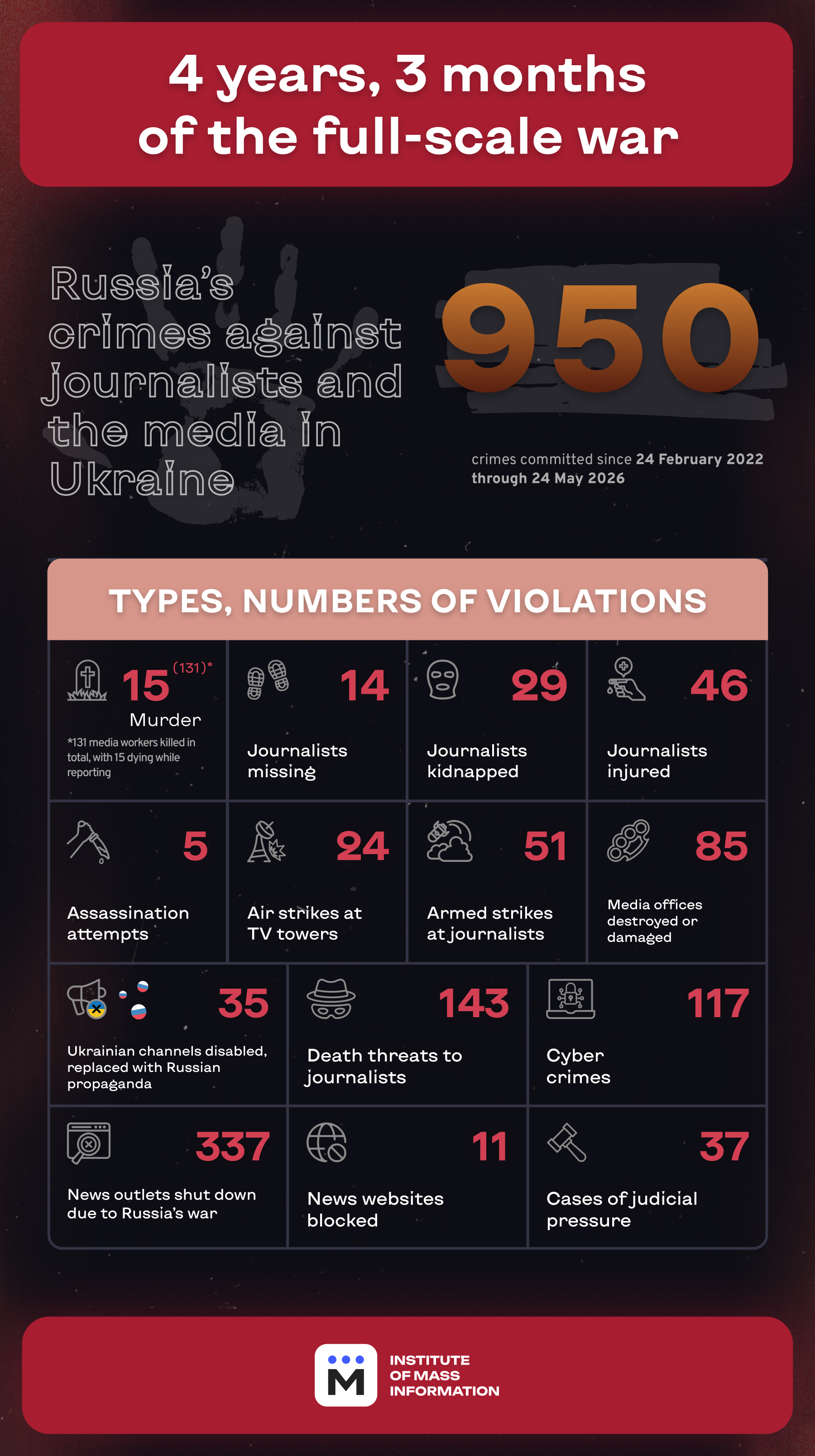
Report updated to include one more case of a media office being damaged in the Russian strike in Kyiv on 24 May. The updated total number of recorded crimes against the media and journalists is thus 950, with damage recorded in 85 media offices.
Russia committed 950 crimes against journalists and the media in Ukraine in the four years and three months since the start of the full-scale war, as evidenced by the Monitoring Study of Russia’s Crimes Against Journalists and the Media, which the Institute of Mass Information has been carrying out since the first day of Russia’s invasion of Ukraine.
The latest findings suggest that Russia committed 13 new crimes in the period from 24 April to 24 May 2026 alone, including damage to and destruction of media offices, cyber crimes, and judicial pressure.
The deaths of two media professionals who had been defending Ukraine in the ranks of the UAF were reported in April–May:
- Viktoria Bobrova, UAF servicewoman and 2+2 TV casting director; press officer with the Mountain Assault Brigade No. 10 “Edelweiss”.
- Oleksandr Klymenko, a serviceman, videographer, and director from Poltava. He had worked as a video editor with the Poltava-based TV channels Misto and Tsentralnyi (before 2020). Klymenko had been considered missing in action since 2024. His death was confirmed on 30 April 2026 by the DNA examination of the soldiers’ bodies released by Russia.
Damage to and destruction of media offices
- The office of Obriyi Iziumshchyny, located in Izium (Kharkiv oblast), is still in disrepair after the March 2022 Russian strike. The attack broke the windows, doors, and the roof in the building, and the office was looted while the city was under occupation. Russian troops had lived in the building at the time. The team has done some repairs at their own expense, but it remains damaged.
- The office of the Ternopil-based newspaper 20 Khvylyn was damaged in Russia’s mass drone attack on the city: fragments of a shot-down Shahed drone hit the office building and broke the windows. There were no casualties, since all staff were in a bomb shelter.
- The Suspilne Zaporizhzhia office was damaged in a Russian drone strike along with the TV tower infrastructure. There were no casualties among the team, as everyone had taken cover in the bomb shelter. The attack damaged the windows in the buildings and television broadcasting was temporarily off due to damage to the television tower.
- Russian strikes at Sumy blasted out the windows in Kordon.Media office eight times in late 2025. Most damage was inflicted by various types of drones. The team continued to work despite the repeated attacks, doing some repairs at their own expense or with support from charity organisations. The team is allowed to work remotely for their own safety.
- The DW office in Kyiv was damaged in a Russian strike. The team was unharmed.
- The office of the news website Shelter was damaged in a Russian strike in Kyiv. The team was unharmed.
- The Kyiv office of Realna Hazeta, formerly based in Luhansk, was damaged by Russian shelling. The windows in the building were broken, some of the plaster flaked off the walls, and furniture and equipment were damaged.
- The office of the independent news website Graty was damaged in the Russian strike in Kyiv. The blast wave damaged the office room and podcast studio. The team was unharmed.
- The Kyiv studio of Germany’s ARD was severely damaged in a Russian strike. The windows were broken and some walls collapsed. The staff were unharmed.
- The external glazing in the UNIAN office in Kyiv was damaged in a Russian strike.
Cyber crimes
- Russian hackers attacked the Freedom TV internal communication system on 14 April, briefly accessing the channel’s corporate chat. Logins of some journalists, editors, and other staff were posted online along with screenshots of some official correspondence. A Russian hacker group has claimed responsibility for the attack.
- Hackers targeted the blog section on the Ukrainska Pravda website and posted Russian propaganda there. The hackers accessed the passwords of some prominent columnists and made fake posts impersonating them.
Judicial pressure
- A court in Russia sentenced Oleksandr Malyshev, an administrator of the Telegram channel Melitopol is Ukraine, to 26 years in a high-security prison. He was convicted of “espionage” and “terrorism” for allegedly gathering intelligence about Russian military objects in the occupied parts of Zaporizhzhia oblast.
The Institute of Mass Information (IMI) is a civil society organization specializing in the media, operating since 1996. IMI defends the rights of journalists, studies the media landscape and reports on media-related events, fights propaganda and disinformation, and provides media workers with safety equipment for trips to combat areas (since the start of the Russo–Ukrainian war in 2014).
IMI carries out the only monitoring study of freedom of speech in Ukraine, keeps a list of transparent and responsible online media outlets, and tracks Russia’s media crimes in the war on Ukraine. IMI has representatives in 20 oblasts of Ukraine and runs a network of Media Hubs that provide journalists with unfailing support. IMI’s partners include Reporters Without Borders (RSF); the organization is also a member of the International Freedom of Expression Exchange (IFEX).