
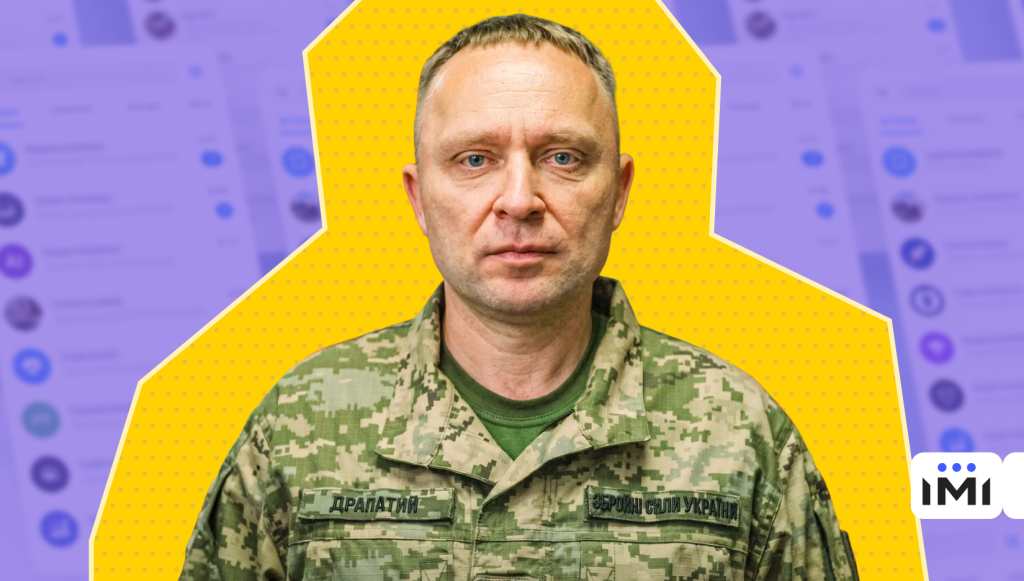
The appointment of Mykhailo Drapatyi as Commander-in-Chief of the Ukrainian Armed Forces has triggered a disproportionately intense reaction from Russian state-affiliated media — and that intensity speaks volumes in itself. Having examined six Kremlin-affiliated news outlets and ten pro-war Telegram channels from 20 through 25 July 2026, IMI analysts discovered a coordinated campaign built around three interlinked yet mutually contradictory lines of attack:
- Degradation through mockery and dehumanisation, ranging from puns playing up his surname (“drapaty” being a Ukrainian slang term for “to flee”) to Dmitri Medvedev’s overtly vulgar rhetoric designed to substitute hate speech for real arguments.
- Conspiracy theories about Drapatyi being a “British spy”, framing his appointment as part of the “Ukraine is being ruled from outside” narrative, with the only “evidence” being a military award Drapatyi received back in 2021.
- Insisting that “this will change nothing”, a ubiquitous talking point echoed in sync by Russian state-affiliated media, pro-war Telegram channels, and the Kremlin’s spokespeople, tailored to target the domestic audience as well as Ukrainian and international ones.
The contradiction at the core of this campaign is that Russia’s propaganda machine inssted that Drapatyi’s appointment didn’t matter while pouring state-level effort into discrediting him. This discrepancy between the professed indifference and the attention actually paid to the matter is in itself a clear indicator that Moscow perceived the event as a threat to be addressed urgently.
From mockery to dehumanisation
The campaign was spearheaded by pro-war channels on Telegram. Rather than focusing on the new Commander-in-Chief’s professional experience, they zeroed in on his last name, linking it to the Ukrainian word “драпати” (“drapaty”), meaning “to flee”. The purpose of this crude wordplay was to paint a caricature of the Ukrainian commander before any discussion of his actual qualities even begins.
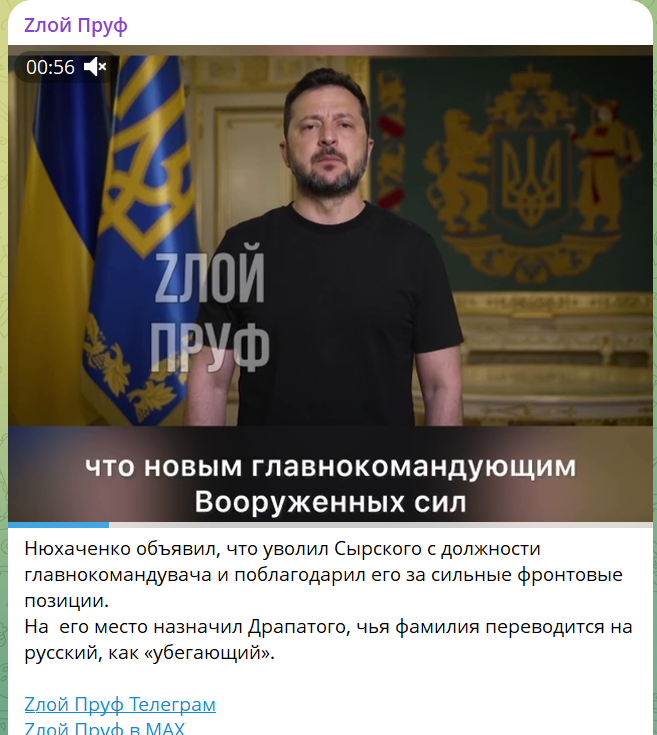
Screenshot from Zloy Pruf on Telegram
Traditional media soon followed suit: for instance, Gazeta.ru circulated remarks to the same effect by Dmitri Rogozin, presenting him as a senator and a defense sector actor. Here, mockery served as a tool of symbolic degradation: a military leader who is potentially dangerous to Russia is instead cast as an unserious, comical figure.
That said, this line of attack soon backfired within the propaganda effort itself. Oleg Tsarev and Yuriy Podoliaka, by contrast, emphasised Drapatyi’s relatively young age, his combat experience, and his rapid rise through the ranks: from battalion commander to occupying the highest post in Ukraine’s Armed Forces. These assessments overtly contradicted the attempts to portray him as weak or incompetent, and inadvertently betrayed genuine concern.
Dmitri Medvedev, deputy chair of Russia’s Security Council, was the most aggressive in his rhetoric, calling Drapatyi “scum” in his Telegram posts, resorting to obscene language and sexualised insults, and characterising the Ukrainian commander as a “Russophobe” bent on “destroying Russian civilisation.”
Here, personal insults spill over into outright dehumanisation: rather than assessing the commander’s actions or professional qualities, Medvedev strips him of human traits altogether and casts him as absolute evil incarnate. The obscene language here serves to mobilise the Russian audience emotionally, substituting hatred, contempt, and a thirst for revenge for rational argument. Tellingly, the fact that an official of Medvedev’s rank joined the smear campaign dispels any illusion that it might have been an organic reaction by a handful of bloggers.
“London’s agent”: fitting Drapatyi’s appointment into the “external rule” narrative
One of the core narratives of Russian propaganda is the idea that Ukraine is entirely dependent on the West. Drapatyi’s appointment was framed as part of this narrative as well.
Pro-Kremlin outlets circulated unsubstantiated claims that the new Commander-in-Chief is a British intelligence agent acting on London’s instructions. Citing a Russian “war expert”, Gazeta.ru claimed that British special services control the staffing decisions in the Ukrainian army.
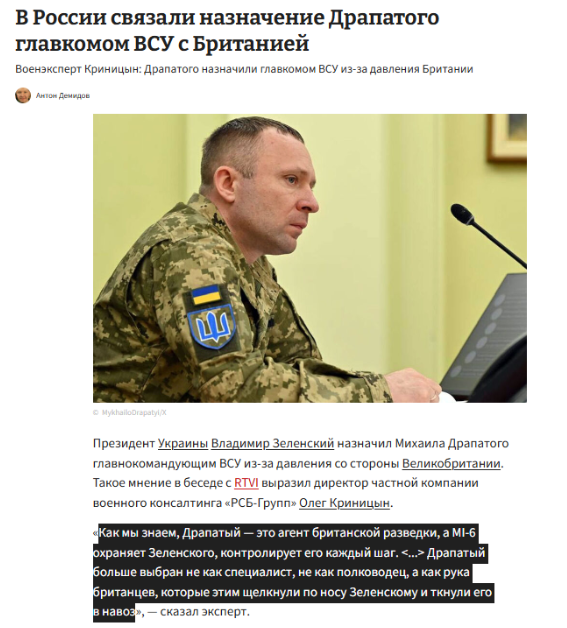
“As we know, Drapatyi is a British intelligence agent, and MI-6 protects Zelenskyi, controls his every move . . . Drapatyi was chosen less as an expert or commander and rather as a hand of the Brits, who slapped Zelenskyi on the wrist and rubbed his nose in the dirt.”
Screenshot from Gazeta.ru
The Kremlin’s royal propagandist Vladimir Soloviev amplified the narrative by posting a photo of Drapatyi receiving a ceremonial sword — a British military honor presented to him personally by Melinda Simmons, then UK Ambassador to Ukraine, in June 2021.
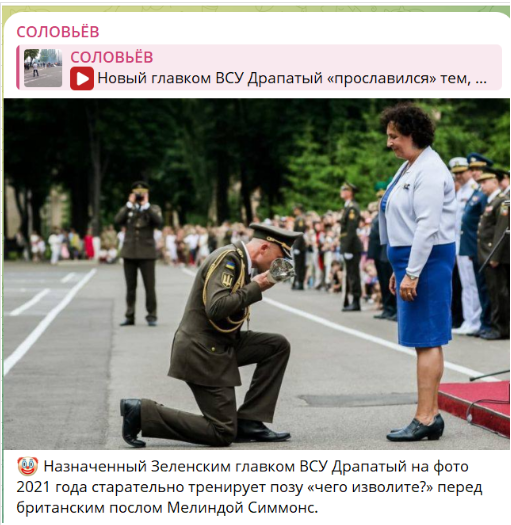
Screenshot from Soloviev on Telegram
The mechanism at work here is a classic manipulation: a real fact is deliberately taken out of context and presented as “proof of allegiance.” An official international award is framed as evidence of political dependency.
IMI analyst Olena Holub points to a characteristic move: “Russian propaganda has not cited a single fact linking Drapatyi to British intelligence services aside from the sword award. Instead, they have been using a standard technique: presenting unfounded claims as common knowledge. The posts feature phrases like ‘as everyone knows’ or ‘as we all know,’ which creates an impression that the claims are obvious and need no proof.”
Drapatyi’s biography doesn’t support this theory: he has served in the Ukrainian Armed Forces since 2004, rising from tank platoon commander to Commander-in-Chief; he took part in the battles for Mariupol and has commanded units in the most difficult sectors of the combat zone. His career unfolded entirely within the system of Ukraine’s military training and command. The talking point is targeted primarily at the domestic audience, as it feeds the narrative that Russia is not at war with Ukraine but with the “collective West,” which supposedly puppeteers the Ukrainian state.
“This changes nothing”: underplaying the importance of the reshuffle
The third line of attack was to claim that the new appointment would have no effect on the battlefield situation, where, as per Russia’s propaganda outlets, Russia holds an indisputable advantage.
KP.ru, citing the Ukrainian President’s former spokeswoman Yulia Mendel, wrote that Drapatyi “won’t be able to solve all the army’s problems” and that the reshuffle “is unlikely to change much,” thus repeating the ubiquitous claim that the Ukrainian Armed Forces have been suffering “enormous losses.” Gazeta.ru drew on a comment from retired colonel Viktor Baranets, who argued that Syrskyi had left his successor a “difficult inheritance” — an army in retreat, plagued by desertion and mobilisation problems.
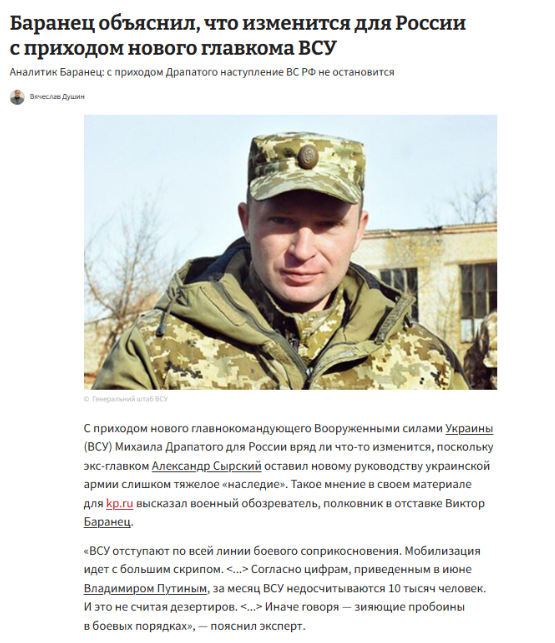
“The appointment of the new Commander-in-Chief of the Ukrainian Armed Forces, Mykhailo Drapatyi, is unlikely to change anything for Russia, since the previous Commander, Oleksasndr Syrskyi, left the new command of the Ukrainian army with a rather difficult ‘inheritance’, war commentator, retired colonel Viktor Baranets believes.”
Screenshot from Gazeta.ru
This claim was not a one-off assessment by an individual commentator but part of a coordinated rhetoric, as confirmed by the reaction of Russia’s presidential spokesman Dmitri Peskov, who he stated at a briefing that the change in Ukraine’s military leadership would have no effect on the battlefield situation, where the Russian army is supposedly advancing “along the entire front line.” Kremlin spokespeople, propaganda outlets, and pro-war channels were all pushing the same message in sync, which signals centralised campaign management.
One message for three audiences
The point that “this will change nothing” is ubiquitous, since it can easily be adapted for different target groups:
- With Russian society, it reinforces the belief that Russia’s victory is inevitable. Ukraine’s army is portrayed as exhausted and disorganised and the reshuffle is framed as an attempt to cover up a systemic crisis.
- For audiences in Ukraine, the same message works to erode the morale: the change in leadership is presented as a mere formality. For a stronger effect, Drapatyi is cast as a “butcher” and compared to Syrskyi in order to facilitate society’s distrust of the UAF command, stoke tensions between the military and civilians, and undermine support for the mobilisation effort.
- For the international audience, the claim that the reshuffle will achieve nothing becomes an argument against continued aid to Ukraine, the reasoning being that Ukraine’s army has no prospects, so military and financial support would be a waste of resources.
Thus one message serves three functions: convincing the Russians that the war effort is succeeding, demoralising the Ukrainians, and sowing doubt among the Western audiences as to whether supporting Ukraine is wise.
Conclusions
The Russian propaganda machine’s response to Drapatyi’s appointment showcases how one occasion can be used to push several narratives at once: first degradation through mockery, then dehumanisation, “British spy” conspiracy theories, and the claim that the reshuffle will achieve nothing.
What stands out most is how contradictory these messages are. On one hand, the propaganda has been insisting that Drapatyi’s appointment meant nothing. On the other, it paid a disproportionate amount of attention to him, involving state officials, leading pro-Kremlin media outlets, and popular pro-war channels. This dissonance between the professed indifference and the actual effort invested is key to understanding the situation: if the event were truly insignificant, it wouldn’t require a crisis management response of this scale.
Despite the claims that the change in leadership “will change nothing,” the Kremlin has poured considerable resources to address it. The intensity of the campaign shows that Russia’s propaganda machine perceived the new Commander-in-Chief’s appointment as an event whose significance needed to be downplayed urgently, and therefore as a factor that may have real impact on Ukraine’s defense capabilities.
*The sample included six Russian news outlets (Radio Sputnik, Lenta.ru, Gazeta.ru, Rossiyskaya Gazeta, Moskovskiy Komsomolets, Komsomolskaya Pravda), as well as 10 Russian pro-Kremlin Telegram channels: Voenkor Kotenok, Zakhar Prilepin, Zloy Pruf, Oleg Tsarev, Voenny Osvedomitel, Sladkov+, Dva Mayora, Mir Segodnya s Yuri Podolyaka, Soloviev, Dmitri Medvedev. The analysis was carried out from 20 through 25 July 2026.