

An article falsely attributed to Chernihiv journalist Iryna Synelnyk, who works with the news agency UNIAN, has been circulated on Facebook. The article was posted by a clone of the news outlet’s page. It is being spread on the social media platform through advertising.
The journalist told the IMI representative in Chernihiv oblast about this.
According to Iryna, the article is signed with her name and talks about the heavy losses of the Ukrainian army and the need to negotiate with Russian President Vladimir Putin.
“Recently we have seen a rise of fake websites of our national media outlets, which post articles that parrot Russian narratives, signed with the names of these outlets’ journalists. The journalists, of course, do not know that their name has been exploited in this way. Such a thing happened to me. On Facebook, these articles are being circulated through advertising. The links to UNIAN publications end with ‘.html’, but the fake link ends with ‘.php’. This is the distinction; the layout of the page is visually identical to the original,” said Iryna Synelnyk.
Fact-checkers from the project “The Other Side of News” have pointed out that this Russian practice of spreading fakes through Facebook ads is becoming increasingly common.
“The news feed is literally drowning in paid-for posts labeled as ‘advertising’. All of them sow conspiracy theories and outright lies. A brief recap: the Ukrainian government is mired in corruption, Western aid is ‘going down the drain’; the military cannot resist the Russian missile barrage, therefore urgent negociations are needed; the new recruits are being sent to slaughter with no training,” the project notes.
Besides UNIAN, fake pages of “Obozrevatel” and “RBC-Ukraine” have been encountered, report the fact-checkers.
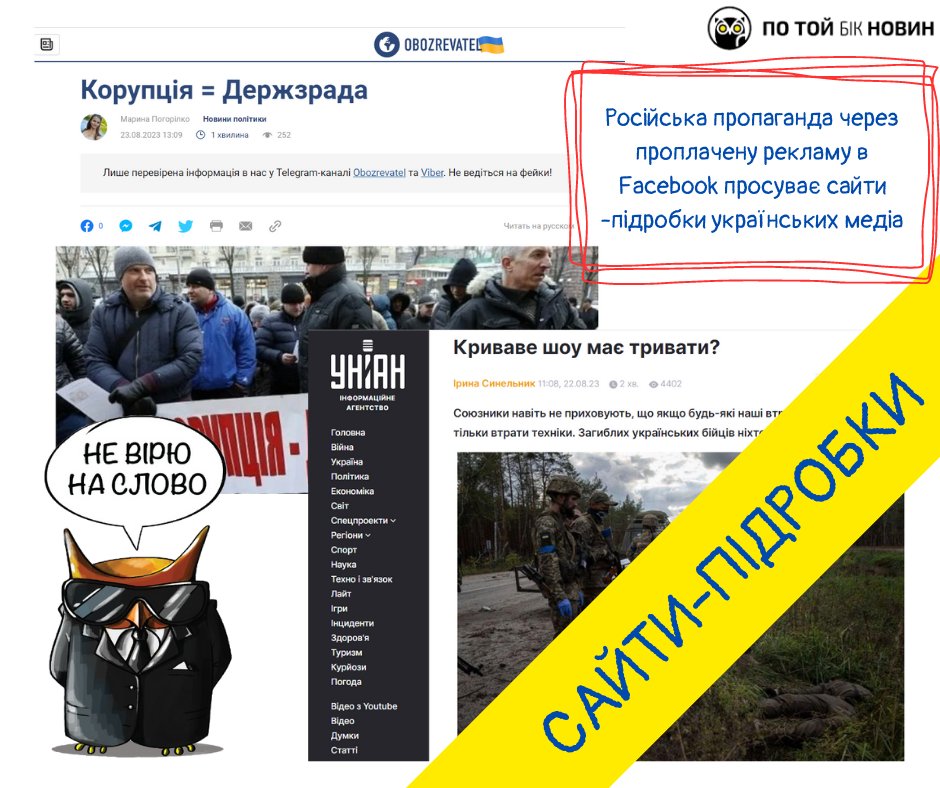
Screenshot by The Other Side of News
The algorithm for creating fakes is as follows: take a well-known website and make a carbon copy of its layout and title, but with a different domain name.
For example, the fake website that pretends to be “Obozrevatel” has the domain “.ltd”, while the real one has “.com”. After posting fake content with signatures of real employees, they actively distribute the articles in the Ukrainian segment of Facebook through the advertising algorithm.
Chernihiv journalist Iryna Synelnyk, whose name was used to promote Russian narratives in this way, told IMI that she had already contacted the Security Service of Ukraine about this.
As IMI reported, a fake website imitating the media outlet “Ukrainian Pravda” appeared on the Internet in April. “Ukrainian Pravda” contacted the SBU with a request to address the spread of a fake column by the journalist, military officer Pavlo Kazarin, done by unknown persons through a fake website.
In April, a fake website mimicking that of the news outlet Ukrainska Pravda appeared online. Journalist Pavlo Kazarin pointed out that the UP clone website posted a column impersonating him. Ukrainska Pravda contacted the SBU about this fact.
In March, 2023, the editors of RBC Ukraine filed a statement with the cyberpolice over website forgery and a fake article criticizing the UAF Commander-in-Chief, Valery Zaluzhny. In June 2022, the RBC-Ukraine reported that some criminals were posing as their editorial office to advertise a survey with which RBC-Ukraine had nothing to do on social media. Back then, the RBC-Ukraine contacted the National Police, the Security Service of Ukraine, and the Ministry of Digital Transformation regarding this issue.
Obozrevatel and Ukrinform have also reported having their websites cloned.