

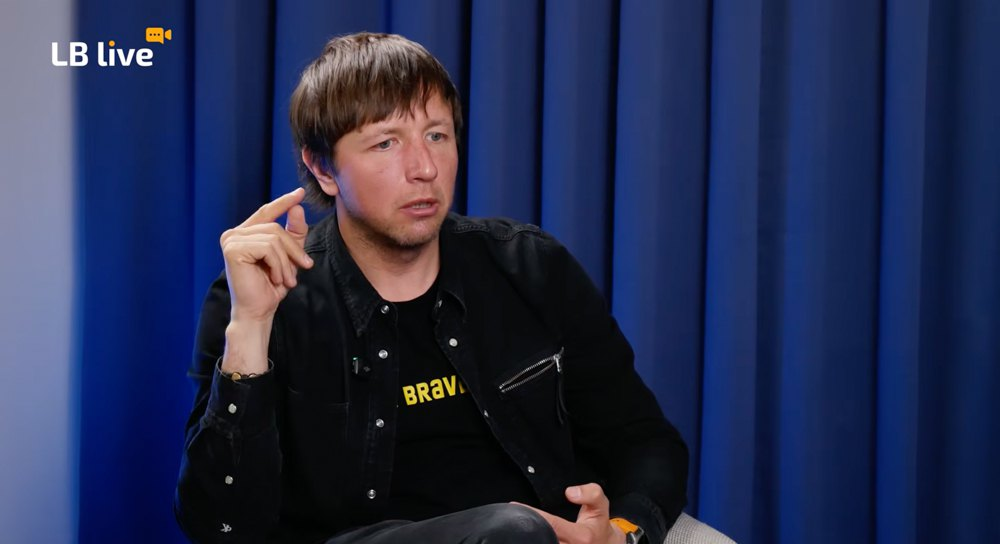
As the Associated Press crew, which included photographer and documentarist Yevhen Maloletka, stayed in besieged Mariupol (Donetsk region) in 2022, they very quickly found themselves in an information vacuum. The media workers could only navigate the situation by relying on what they saw first-hand. Yevhen Maloletka told LB.ua.
“We were essentially in a trap, in an information vacuum: there was no communication, no access to news or battlefield maps. We could only see what was happening before our eyes. For example, we would see the wounded while working in a hospital, the destroyed houses — but that was only part of the picture. We saw several neighborhoods, but Mariupol is a big city. We couldn’t go beyond its borders: to Sartana, Talakivka or other villages that had been under shelling since the first days [if the invasion]. People were trapped, and we filmed what we could in those circumstances, with no understanding of the full situation,” the photographer said.
Maloletka said that the city was “dying” slowly. At first there was still electricity, water, and gas. But the situation deteriorated day by day. Eventually, the blackout was total. By 11–12 March, there was only one spot in the city with a signal — near a mobile operator’s tower. It was powered by generators and provided minimal connectivity. “We would come there and try to send out our material. I remember one time when we had to send a video. We would split it into 12–20 short clips so that they weighed less, upload them to several phones, and send them separately. And then the team at the editorial office would put it together. Such a chain for one news story.
“But it was important: to show what was happening in Mariupol, what doctors were seeing every day,” said Yevhen Maloletka.
He added that sending photos to the office was easier, but the connection would constantly go down and the files would not go through.
“In the final stages, when that spot was no longer working, Mykhailo Vershinin [chief of Mariupol patrol police] helped us: he had satellite Internet in the patrol police office. We would come to him and send our material from there. The police also helped us with transport and logistics, because we had already lost our car. We would drive out, film something on the way, then edit it, send it — and so on for several days in a row, until the moment we left,” said Yevhen Maloletka.
Ukrainian photojournalist Yevhen Maloletka has released a book called “The Siege of Mariupol”. The book features the series of photos he took during the first 20 days of the full-scale invasion.
In the book, Maloletka reflects on the photographer’s responsibility, the importance of each shot, and the challenges a photographer faces while working. He talks about people and for people, about strength and weakness, about birth and death.
Yevhen Maloletka is a Ukrainian photojournalist who has been covering the war in Ukraine since 2014.
The article “20 Days in Mariupol: The Crew That Documented the City’s Agony” by Associated Press correspondent Mstyslav Chernov was released on 22 March 2022. Chernov, along with Yevhen Maloletka and Vasylysa Stepanenko, spent 20 days in besieged Mariupol before evacuating. They covered the developments in Mariupol, which was blockaded by Russian troops, filmed the destruction caused by the air strikes in the city, doctors working in local hospitals, and numerous civilian casualties.
The team won the Pulitzer Prize, the Directors Guild of America Award, and the BAFTA Award for their work in besieged Mariupol.
On 10 March 2024, Mstyslav Chernov’s “20 Days in Mariupol” won an Oscar as the best feature-length documentary, becoming the first Ukrainian film to win an Oscar.