
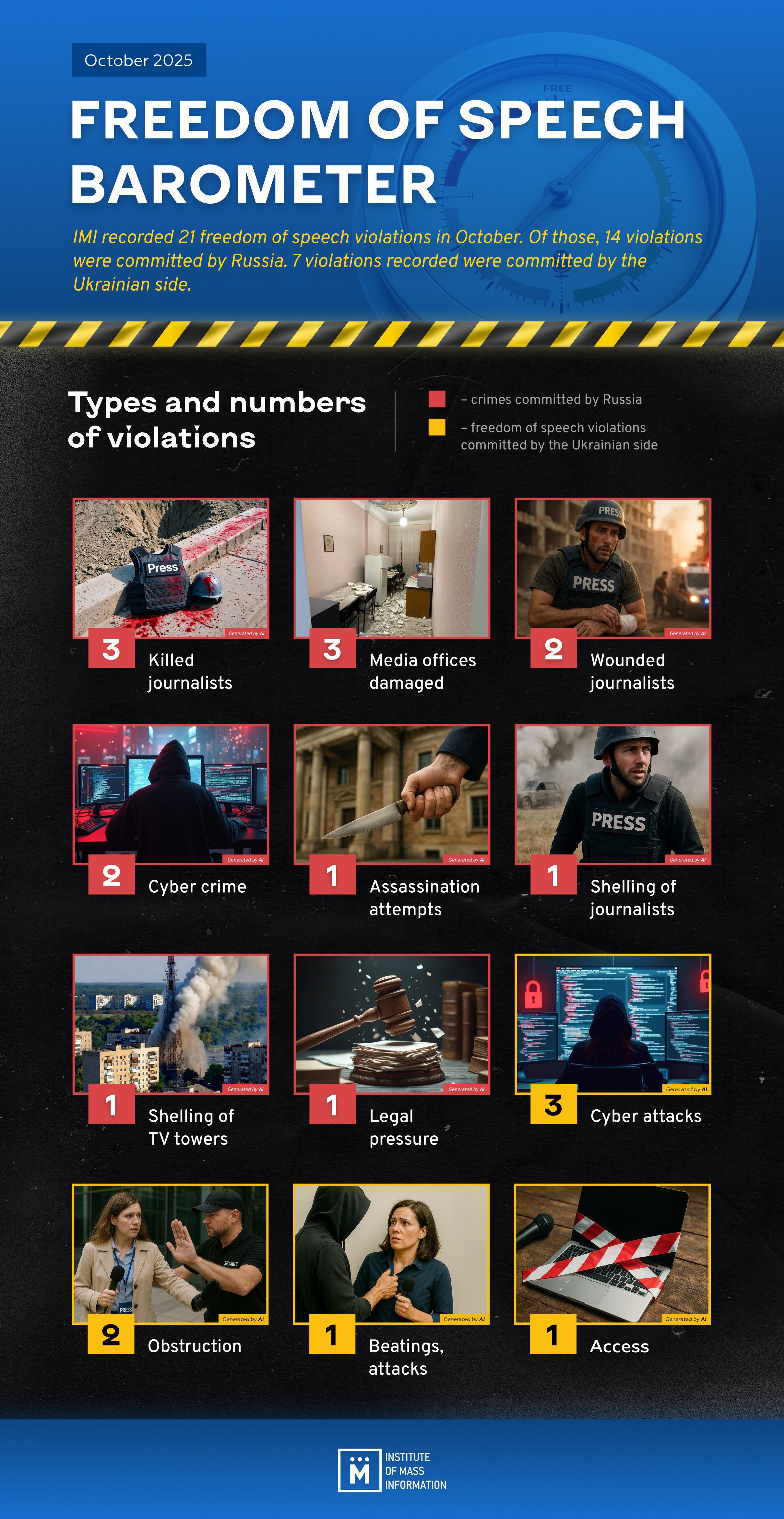
The Institute of Mass Information experts recorded 21 freedom of speech violations in Ukraine in September 2025, with 14 committed by Russia, according to the IMI’s monthly monitoring study Freedom of Speech Barometer.
Russia’s crimes against media and journalists included murder of media workers and an assassination attempt, armed strikes at and wounding of journalists, damage to media offices, strikes at TV towers, cyber crimes, and legal pressure.
The Institute of Mass Information recorded significant losses for the media community in October: three media workers died while reporting and two more were injured. A new trend has emerged: Russian troops targeting journalists with drones such as Lancet or FPV away from the front line.
“This tactic suggests deliberate use of UAVs to target media personnel, which makes reporting even more risky and highlights the strategic threat to mass media representatives not just on the battlefield, but in areas adjacent to the front line as well. This creates a need for extra steps to protect journalists, such as anti-drone technology, special training and the arrangement of safe routes for reporters on the front line,” says Kateryna Dyachuk.
Russian forces killed five media workers in October, with three dying while reporting:
- Antoni Lallican, a French photo journalist, killed in a Russian drone strike near Druzhkivka (Dontesk oblast) on 3 October 2025. Antoni Lallican covered social issues in conflict zones around the world. His pictures have been featured in Le Monde, Le Figaro, Libération, Der Spiegel, Zeit, FAZ, etc. He had been documenting the impact of Russia’s invasion of Ukraine since March 2022.
- Alyona Hramova (Hubanova), war reporter with Ukraine’s international broadcasting channel Freedom TV. Killed in a Lancet drone strike by Russian troops in Kramatorsk (Donetsk oblast) on 23 October 2025. She and her crew were in a car at a gas station at the moment of the strike.
- Yevhen Karmazin, cameraman with Ukraine’s international broadcasting channel Freedom TV. Killed in a Lancet drone strike by Russian troops in Kramatorsk (Donetsk oblast) on 23 October 2025. He and his crew were in a car at a gas station at the moment of the strike.
- Oleksandr Urvantsev, killed in action in Kharkiv oblast on 7 October 2025. Cameraman with the Chernihiv-based Dytynets TV turned UAV operator.
- Vadym Pidlypenskyi, serviceman, Ligamedia sales manager. Killed in combat near Lyman (Donetsk oblast) on 25 October 2025. Enlisted in the Ukrainian Armed Forces in 2024.
117 media workers have died in the course of Russia’s full-scale invasion of Ukraine, with 15 dying while reporting.
Assassination attempt: a Russian FPV drone attempted to target Daphne Wesdorp, journalist with the Dutch news outlet Het Nederlands Dagblad, as she was filming the aftermath of a strike at the Holy Assumption Church in Kostyantynivka (Donetsk oblast). Oleh Petrasiuk, the liaison officer with the UAF Mechanized Brigade No. 24 who accompanied the reporter, spotted the drone and shot it down with a machine gun, averting the tragedy.
Journalists injured:
- Ukrainian photo journalist Heorhiy Ivanchenko was wounded in the Russian FPV drone strike that killed his colleague Antoni Lallican. Ivanchenko’s leg was amputated after the injury, and he needs a long rehabilitation. Heorhiy Ivanchenko says the drone strike was deliberate.
- Freedom TV special correspondent Oleksandr Kolychev was injured in a Russian Lancet drone strike in Kramatorsk (Donetsk oblast) on 23 October 2025. He and his crew were in a car at a gas station at the moment of the strike. Kolychev is now in a serious condition in the hospital. The strike killed his colleagues Alyona Hramova and Yevhen Karmazin.
Armed strikes at journalists:
- Die Welt camera crew came under fire by a Russian Lancet drone while filming a news story about a Ukrainian air defense unit: the three journalists suffered injuries of various severity. The journalists were a few meters away from the army crew and clearly marked as press representatives.
Media offices damaged:
- The buildings of the Suspilne Kherson were damaged in a Russian artillery strike on 7 October: a roof, windows, and a facade were damaged. There were no casualties, the team continued working as usual.
- The Kyiv office of the newspaper Gordon was damaged in the Russian strike on 23 October. There was no one in the office, so no one was injured. However, the office is unfit for use now because there are no windows and the weather is cold.
Strikes at TV towers:
- A TV tower in central Chernihiv was damaged in a Russian strike on 29 October. The Chernihiv City Council press office reported that works to stabilise the structure would begin shortly.
Russia’s cyber crimes:
- Yulia Boychenko, journalist with the Mykolaiv-based online media outlet MykVisti, received a message that appeared to be an invitation to a non-existent NATO–UAF event and contained a phishing link disguised as a registration form. The link led to a page mimicking a Google form but created through a Russian registrar to steal data. The incident has been reported to the police.
- The website of the Kharkiv-based media outlet Nakypilo was down for about an hour due to an intense DDoS attack early on 22 October. Chief editor Olena Leptuha said that the attack occurred as the team was releasing a news story about a Russian strike on a kindergarten. The team believes that Russian hackers were behind the attack.
Ukrainian media workers sentenced by Russian courts:
- Yana Suvorova, an administrator of the Telegram channel Melitopol Is Ukraine, has been sentenced to 14 years in a low security prison. She was convicted of “terrorism” and “espionage” for pro-Ukrainian posts. Suvorova has been in Russian detention since August 2023.
See the full list of Russia’s crimes against media and journalists in Ukraine here.
IMI also recorded seven freedom of speech violations unrelated to Russia’s war on Ukraine. These included cases of physical attacks, obstruction of reporting, pressure, restricting access to information, and cyber attacks.
Physical attacks:
- Ivano-Frankivsk photojournalist Yuriy Rylchuk was beaten by a young man on a scooter whom he had caught on camera; the journalist was injured, called the police and an ambulance.
Obstruction of reporting:
- Serhiy Volovyk, a former employee of a Kharkiv territorial enlistment office, knocked the phone out of the hands of Suspilne Kharkiv correspondent Dmytro Hrebinnyk following a court hearing. The incident happened when the journalist asked Volovyk to comment on the court ruling.
- Journalist Lyubov Velychko said she had faced pressure from Ibox Bank lawyers after taking photos, audio and video recordings during a hearing in the case concerning the bank. She took photos, audio and video recordings of the hearing, but the lawyers demanded she delete the footage and not publish it. Velychko considers these actions as psychological pressure and unlawful.
- The editorial staff of Comments.ua say they have faced an orchestrated smear campaign following their reporting on Ibok Bank and LeoGaming. Anonymous Telegram channels and web resources shared false information about the news outlet’s owner Viktor Holdskyi, which the team viewed as an attempt at pressure and interference in independent journalism.
Online pressure:
- Channel 24 host Daryna Trunova faced online attacks following her Facebook posts about the death of a conscript. She was insulted and called a propagandist in social media comments and private messages despite only reporting on facts and developments in the case on Facebook.
- LIGA.net recorded a series of attempts to hack the website administration system targeting politics-related content, but the malicious actors failed to access the content and the team stepped up their defenses.
See the full list of freedom of speech violations in Ukraine in October 2025 here.
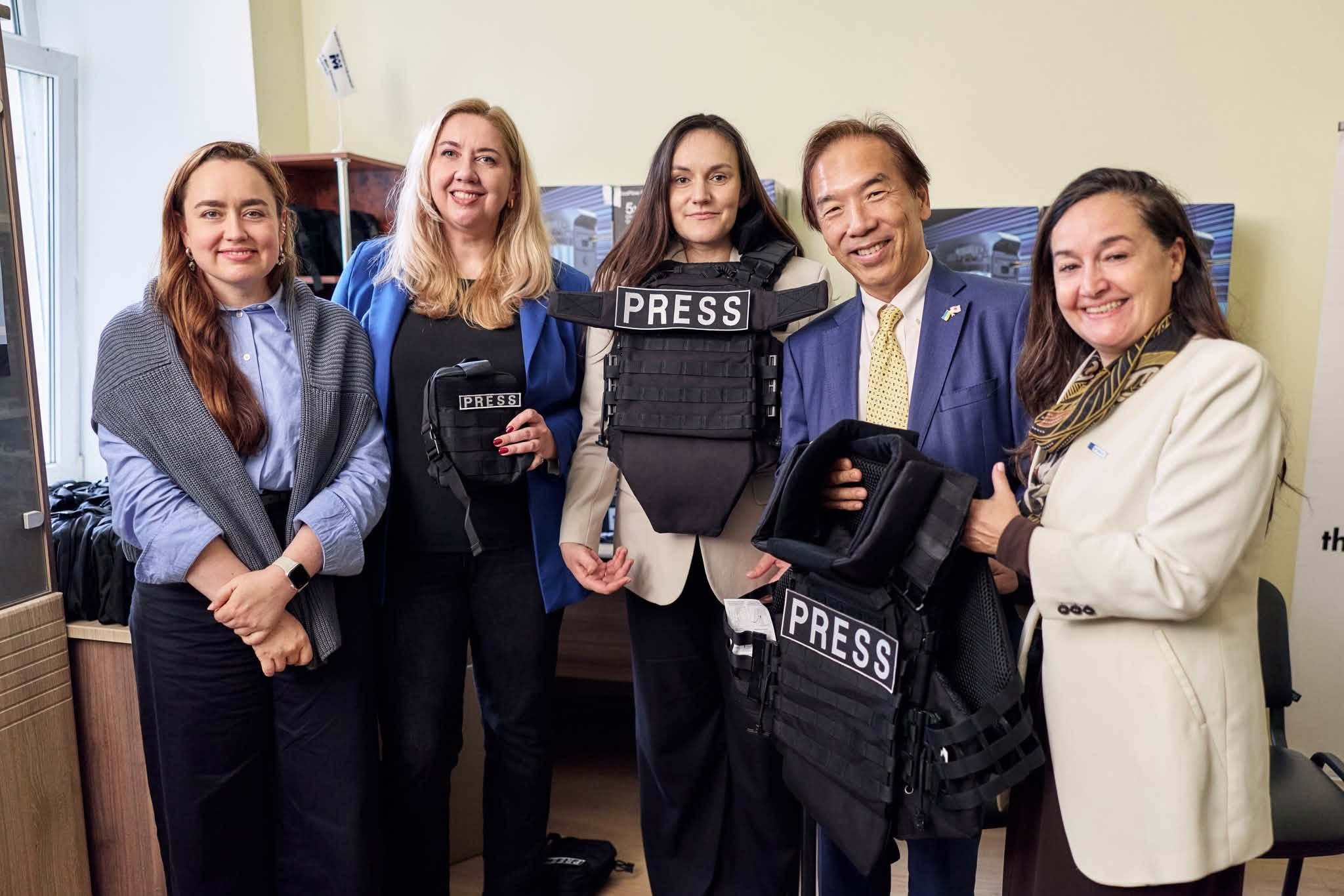
The Institute of Mass Information (IMI) is a civil society organization specializing in the media, operating since 1996. IMI defends the rights of journalists, studies the media landscape and reports on media-related events, fights propaganda and disinformation, and provides media workers with safety equipment for trips to combat areas (since the start of the Russo–Ukrainian war in 2014).
IMI carries out the only monitoring study of freedom of speech in Ukraine, keeps a list of transparent and responsible online media outlets, and tracks Russia’s media crimes in the war on Ukraine. IMI has representatives in 20 oblasts of Ukraine and runs a network of Media Hubs that provide journalists with unfailing support. IMI’s partners include Reporters Without Borders (RSF); the organization is also a member of the International Freedom of Expression Exchange (IFEX).