
Report and diagram corrected: one legal pressure case removed as it did not occur in February. This did not affect the total sum of violations for the month.
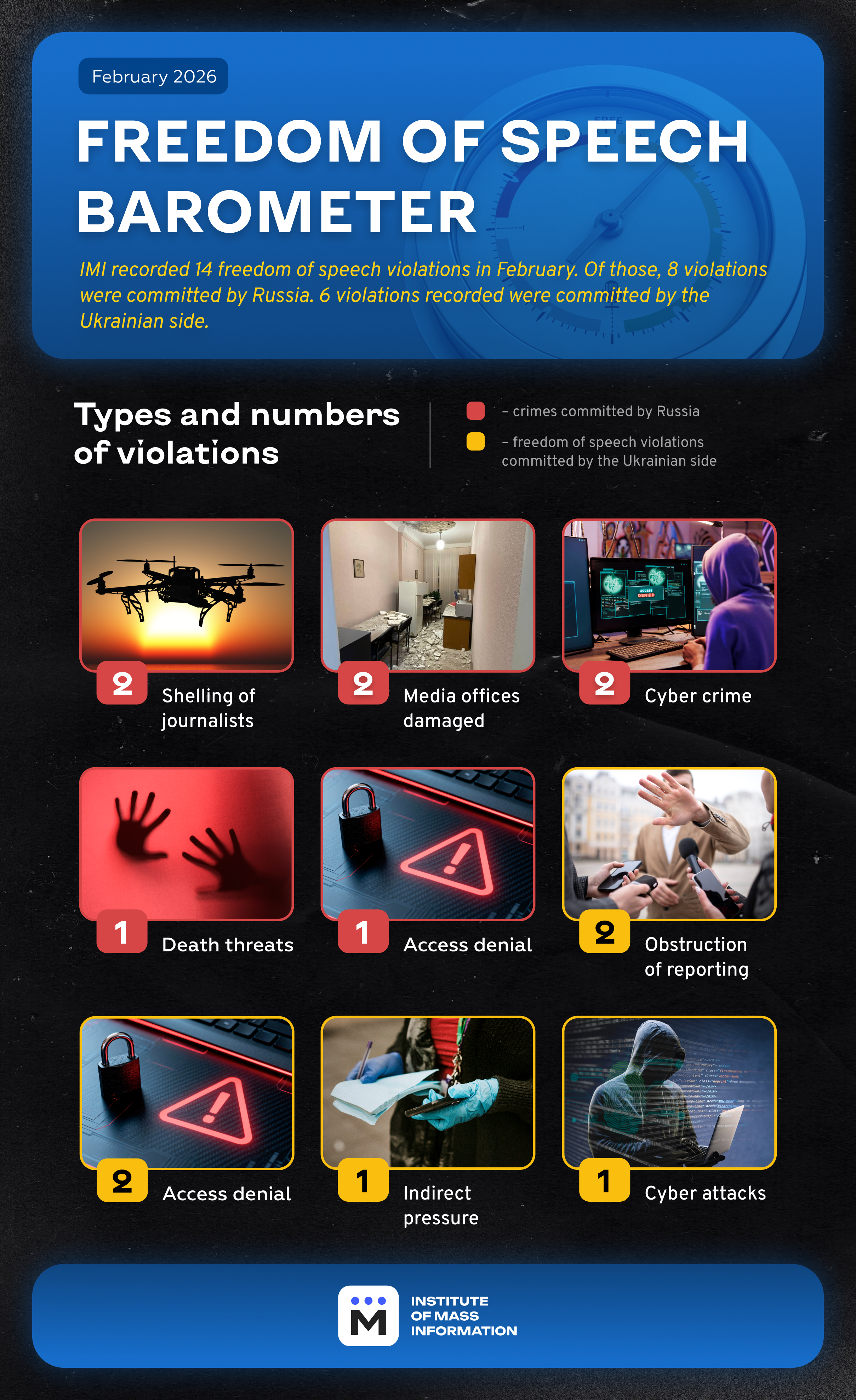
The Institute of Mass Information experts recorded 14 freedom of speech violations in Ukraine in February 2025. Eight were committed by Russia, as evidenced by IMI’s monthly monitoring study Freedom of Speech Barometer.
Russia’s crimes against media and journalists in Ukraine included armed strikes at journalists and death threats to them, destruction and damage of media offices, and cyber crimes.
The death of one media worker turned UAF servicemember was reported in February:
- Serhiy Fisun, UAF Airborne Assault Forces officer and journalist born in Kharkiv. He was killed in a Russian Lancet drone strike on 5 February 2026.
Filming crews coming under Russian drone fire
- Suspilne Dnipro came under attack in Ternivka (Dnipropetrovsk oblast) while filming the aftermath of an earlier Russian strike at a bus carrying miners. The drone fell down about 700 meters away from the journalists. They were wearing bulletproof vests and helmets with PRESS markings and were unharmed.
- Journalists with the Latvian Public Media (LSM) were attacked while working near the front line in Ukraine. The drone exploded near their car, damaging it, but the journalists were not injured. The crew was working on a news storya bout a Latvian national fighting in the ranks of the UAF in Donetsk oblast.
Destroying or damaging media offices
- The office of the Snovsk-based newspaper Promin (Chernihiv oblast) was severely damaged in a Russian drone strike. The team was unharmed and the equipment was intact, the team is looking for benefactors to help shoulder the repairs.
- Nashe Zhyittia office in Novomykolaivka (Zaporizhzhia oblast) has been effectively destroyed and is now unusable as a result of the guided bomb strike by Russian forces. The windows and doors are broken, the walls and furniture battered. The team is unharmed and is considering relocating.
Death threats to journalists
- The news website Kremenchutskyi Telegraf (Poltava oblast) received an email claiming that bombs had been planted in two dozen facilities in the oblast. The email listed the supposedly sabotaged buildings, which included malls, railway stations, and local government bodies.
Cyber-crimes
- A cyber-attack on an Internet provider’s servers resulted in two Chernivtsi-based TV channels, Chernivetskyi Promin and C4, briefly broadcasting content promoting Russian propaganda narraitves.
- The Astra 4A satellite, which retransmits TV channels of Ukraine’s public broadcaster Suspilne, experienced brief signal interference. The incident occurred on 26 February at 11:00. The disturbance was eliminated by 13:55.
Blocking access to media
- Roskomnadzor included the website of the Syla Pravdy Center for Investigative Journalism in the list of resources banned in Russia. The team learned of the ban from an email they received in their inbox. The register lists no reasons for the ban.
IMI also recorded press freedom violations unrelated to Russia’s war on Ukraine. These included obstruction of reporting, denial of access to information, indirect pressure, and cyber attacks.
Obstruction of legal reporting
- Odesa-based journalist Ksenya Sitinska faced obstruction of reporting while carrying out an editorial assignment for Freedom TV: the security guards at an apartment complex barred her from filming the aftermath of a recent Russian air strike. Despite the journalist being accredited by the Ministry of Defense, the guards demanded a permit from the complex administration and tried to cover her camera lens with their hands.
- Chetverta Vlada reported pressure on their journalist Myroslava Prymak by Rivne-based lawyer Oleksandr Lutsiuk, who was featured in her investigation. He asked her personal questions during a phone call and made unfounded allegations about her family. The team views this as an attempt to discredit the journalist and interfere with the upcoming article.
Access to information for journalists
- The Odesa Oblast Military Administration refused to disclose the sums spent on the top officials’ and staff’s business trips abroad taken during the martial law period to Nikcenter journalists, saying that preparing a response to their query would “require significant intellectual effort” and claiming that the requested data was not public information.
- The news website Poltavshchyna reported that the Poltava City Council had left three of their information queries regarding permits for the ongoing repair work in the local Corps Park without response. One of the queries had to be submitted twice because the City Council missed the response deadline the first time.
Indirect pressure
- Ukrainska Pravda chief editor Sevgil Musaieva reported a campaign aiming to discredit the agreement between the news outlet and the Netherlands-based fund Pluralis B.V. She said Telegram channels had made manipulative claims about the investor’s alleged ties to Russian oligarchs. Musaieva stressed that their ownership structure was transparent and that no Russian or Belarusian money was involved.
Cyber attacks
- Syla Pravdy received a series of dubious copyright infringement notices from Google. The team considers the notices to be frivolous and views them as an attempt to damage their search engine indexation and their visibility. The contested articles have not been taken down, but the team is wary of possible future consequences.
Legal pressure
- Lawyer Oleksiy Shevchuk has sued the news outlet NGL.media and is demanding 100 thousand hryvnias in moral damages. He accuses the journalists of defamation over a Facebook post saying that NGL.media was joining a statement by civil society organisations demanding Shevchuk’s withdrawal from the competition commission that is to select candidates for the Specialised Anti-Corruption Prosecutor’s Office.
See the full list of press freedom violations in Ukraine in February 2026 here.
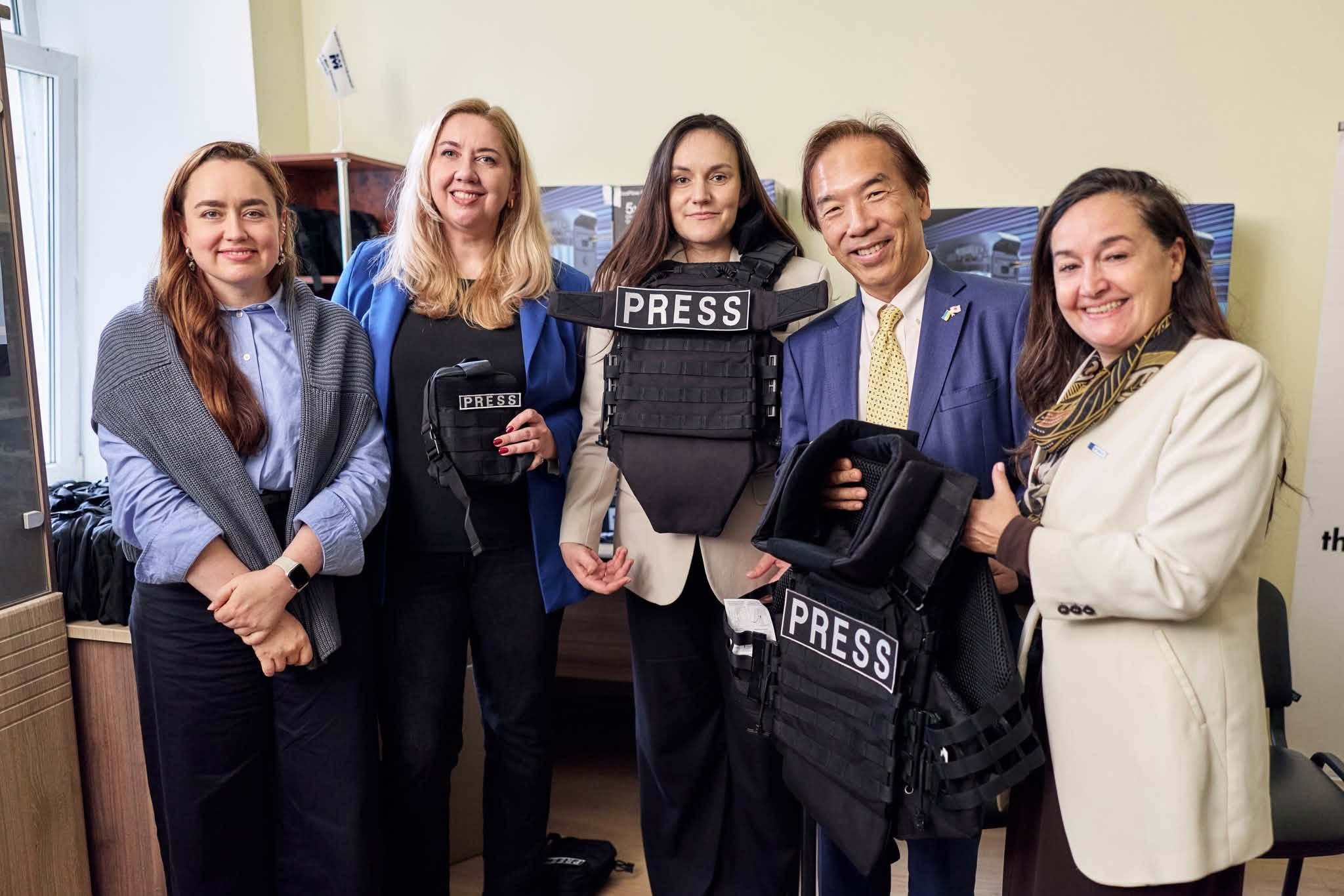
The Institute of Mass Information (IMI) is a civil society organization specializing in the media, operating since 1996. IMI defends the rights of journalists, studies the media landscape and reports on media-related events, fights propaganda and disinformation, and provides media workers with safety equipment for trips to combat areas (since the start of the Russo–Ukrainian war in 2014).
IMI carries out the only monitoring study of freedom of speech in Ukraine, keeps a list of transparent and responsible online media outlets, and tracks Russia’s media crimes in the war on Ukraine. IMI has representatives in 20 oblasts of Ukraine and runs a network of Media Hubs that provide journalists with unfailing support. IMI’s partners include Reporters Without Borders (RSF); the organization is also a member of the International Freedom of Expression Exchange (IFEX).