
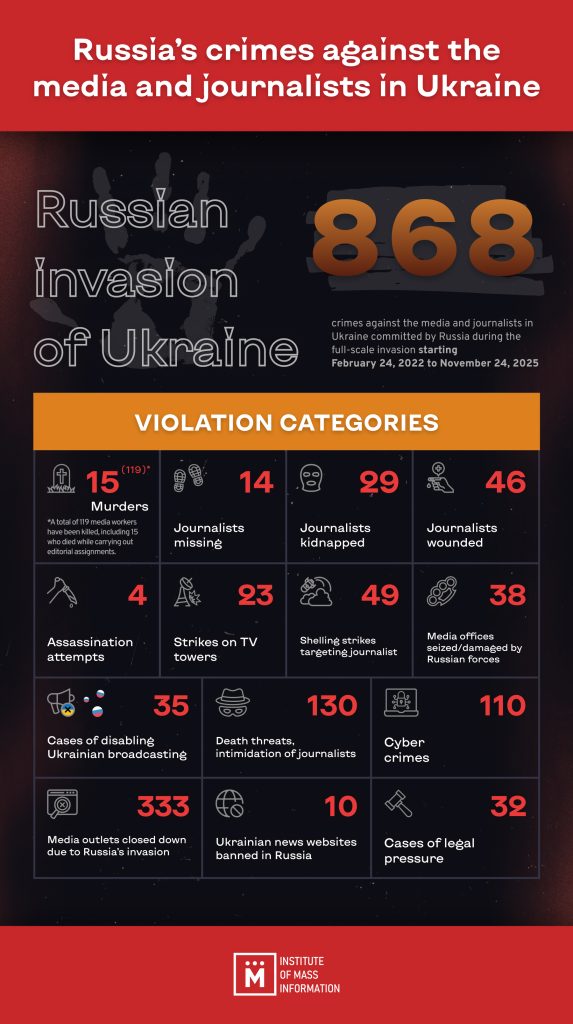
In the three years and nine months since the start of the full-scale invasion, Russia has committed 868 crimes against journalists and the media in Ukraine, as evidenced by the Monitoring Study of Russia’s Crimes Against Journalists and the Media, which the Institute of Mass Information has been carrying out since the first day of Russia’s invasion of Ukraine.
IMI recorded 10 crimes against media and journalists committed by Russia in October – November 2025. These included an assassination attempt, armed strikes at journalists, TV towers, and media offices, as well as legal pressure.
In October – November, the Russian forces killed 3 media workers who were defending Ukraine from the Russian invasion:
- Vadym Pidlypenskyi, serviceman, Ligamedia sales manager. Killed in combat near Lyman (Donetsk oblast) on 25 October 2025. Enlisted in the Ukrainian Armed Forces in 2024.
- Kostyantyn Huzenko, photographer, media producer, Ukraïner team member, liaison officer at the Rear Admiral Mykhailo Ostrohradskyi Marine Brigade No. 35. Killed on 2 November 2025.
- Anton Bondarenko, UAF serviceman, Ukrainian fixer for the French TV channels TF1 and LCI. Went missing in action in Kharkiv oblast on 15 September 2025. His death was confirmed by a DNA test.
A total of 119 media workers have been killed in Ukraine since the start of Russia’s full-scale invasion, with 15 dying while reporting.
Assassination attempt
- A Russian FPV drone attempted to target Daphne Wesdorp, journalist with the Dutch news outlet Het Nederlands Dagblad, as she was filming the aftermath of a strike at the Holy Assumption Church in Kostyantynivka (Donetsk oblast). Oleh Petrasiuk, the liaison officer with the UAF Mechanized Brigade No. 24 who accompanied the reporter, spotted the drone and shot it down with a machine gun, averting the tragedy.
Armed strikes at journalists
- Die Welt camera crew came under fire by a Russian Lancet drone while filming a news story about a Ukrainian air defense unit: the three journalists suffered injuries of various severity. The journalists were a few meters away from the army crew and clearly marked as press representatives.
- Russian troops deployed a drone to hit a Proliska Humanitarian Mission car as it was approaching Kostyantynivka (Donetsk oblast) on 8 November. There were four people in the car: two volunteers and two journalists from Spain and Austria. All four survived.
- A Russian FPV drone struck at an evacuation vehicle carrying volunteers and Radio Liberty correspondent Serhiy Horbatenko near Lyman (Donetsk oblast) on 20 November.
Strikes at TV towers
- A TV tower in central Chernihiv was damaged in a Russian strike on 29 October. The Chernihiv City Council press office reported that works to stabilise the structure would begin shortly.
- A TV tower in Dnipro city was damaged in a Russian strike. Local TV channels and radio were off air.
Damage to media offices
- A Russian FPV drone strike on Nikopol (Dnipropetrovsk oblast) on 28 October damaged the editorial office of the local newspaper Pivdenna Zorya. None of the media workers were injured.
- The Russian drone strike in Dnipro overnight on 15 November damaged the building where the offices of the newspaper Visti Prydniprovya and the news website Novyny Pidhorodne (founded by Visti Prydniprovya) are located. The blast wave broke the windows, damaged the frames, furniture, and some office equipment.
- The Russian mass drone strike on Dnipro city late on 17 November damaged the building where the office of the regional Suspilne branch was located.
Ukrainian media workers sentenced by Russian courts:
- Yana Suvorova, an administrator of the Telegram channel Melitopol Is Ukraine, has been sentenced to 14 years in a low security prison. She was convicted of “terrorism” and “espionage” for pro-Ukrainian posts. Suvorova has been in Russian detention since August 2023.
See the full list of Russia’s crimes against freedom of speech in Ukraine here.
The Institute of Mass Information (IMI) is a civil society organization specializing in the media, operating since 1996. IMI defends the rights of journalists, studies the media landscape and reports on media-related events, fights propaganda and disinformation, and provides media workers with safety equipment for trips to combat areas (since the start of the Russo–Ukrainian war in 2014).
IMI carries out the only monitoring study of freedom of speech in Ukraine, keeps a list of transparent and responsible online media outlets, and tracks Russia’s media crimes in the war on Ukraine. IMI has representatives in 20 oblasts of Ukraine and runs a network of Media Hubs that provide journalists with unfailing support. IMI’s partners include Reporters Without Borders (RSF); the organization is also a member of the International Freedom of Expression Exchange (IFEX).