
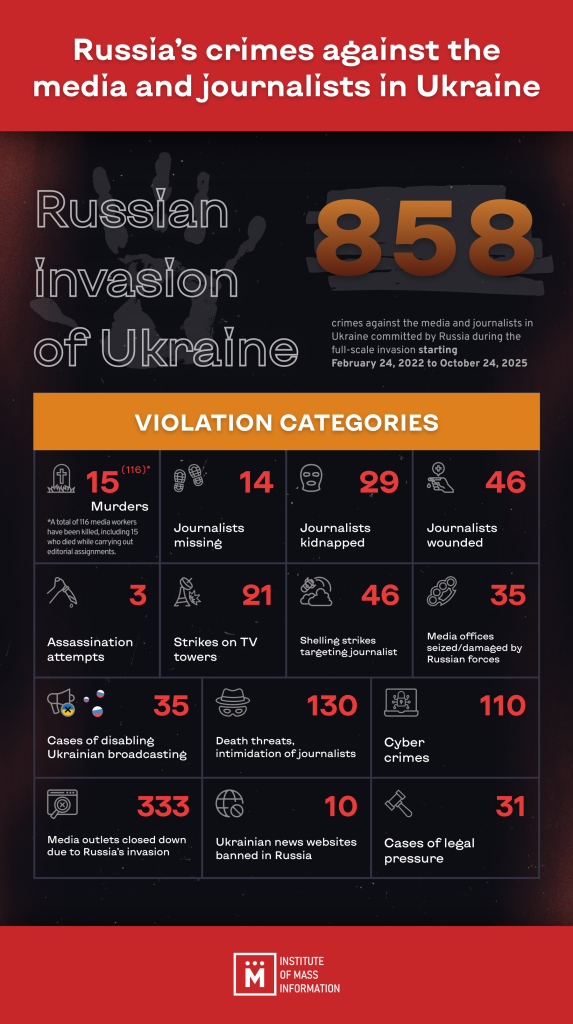
In the three years and eight months since the start of the full-scale invasion, Russia has committed 858 crimes against journalists and the media in Ukraine, as evidenced by the Monitoring Study of Russia’s Crimes Against Journalists and the Media, which the Institute of Mass Information has been carrying out since the first day of Russia’s invasion of Ukraine.
IMI recorded 10 crimes against media and journalists committed by Russia in September – October 2025. These included murder and wounding of journalists, damage to media offices, and cyber crimes.
Five media workers were reported dead in September – October, with three dying while reporting:
- Antoni Lallican, a French photo journalist, killed in a Russian drone strike near Druzhkivka (Dontesk oblast) on 3 October 2025. Antoni Lallican covered social issues in conflict zones around the world. His pictures have been featured in Le Monde, Le Figaro, Libération, Der Spiegel, Zeit, FAZ, etc. He had been documenting the impact of Russia’s invasion of Ukraine since March 2022.
- Alyona Hramova (Hubanova), war reporter with Ukraine’s international broadcasting channel Freedom TV. Killed in a Lancet drone strike by Russian troops in Kramatorsk (Donetsk oblast) on 23 October 2025. She and her crew were in a car at a gas station at the moment of the strike.
- Yevhen Karmazin, cameraman with Ukraine’s international broadcasting channel Freedom TV. Killed in a Lancet drone strike by Russian troops in Kramatorsk (Donetsk oblast) on 23 October 2025. He and his crew were in a car at a gas station at the moment of the strike.
This month saw the deaths of two media workers turned servicemen:
- Bohdan Buday, Journalist with Vinnytsia-based online news outlet Vezha, Ukrainian Armed Forces officer. Died on 26 September 2025 in the area where he was performing his duties.
- Oleksandr Urvantsev, killed in action in Kharkiv oblast on 7 October 2025. Cameraman with the Chernihiv-based Dytynets TV turned UAV operator.
A total of 116 media workers have been killed in Ukraine since the start of Russia’s full-scale invasion, with 15 dying while reporting.
Journalists injured. Ukrainian photo journalist Heorhiy Ivanchenko was wounded in the Russian FPV drone strike that killed his colleague Antoni Lallican. Ivanchenko’s leg was amputated after the injury, and he needs a long rehabilitation. Heorhiy Ivanchenko says the drone strike was deliberate.
Freedom TV special correspondent Oleksandr Kolychev was injured in a Russian Lancet drone strike in Kramatorsk (Donetsk oblast) on 23 October 2025. He and his crew were in a car at a gas station at the moment of the strike.
Media offices damaged. The buildings of the Suspilne Kherson were damaged in a Russian artillery strike on 7 October: a roof, windows, and a facade were damaged. There were no casualties, the team continued working as usual.
The Kyiv office of the newspaper Gordon was damaged in the Russian strike on 23 October. There was no one in the office, so no one was injured. However, the office is unfit for use now because there are no windows and the weather is cold.
Russia’s cyber crimes. Russia’s special services hacked the blog of Ukrainska Pravda contributor Yana Matviychuk and made a fake post impersonating her. The post intended to discredit the UAF by alleging that they had targeted civilian objects in Foros (occupied Crimea). The post was promptly deleted but had already been picked up by key Russian propaganda outlets.
Yulia Boychenko, journalist with the Mykolaiv-based online media outlet MykVisti, received a message that appeared to be an invitation to a non-existent NATO–UAF event and contained a phishing link disguised as a registration form. The link led to a page mimicking a Google form but created through a Russian registrar to steal data. The incident has been reported to the police.
The website of the Kharkiv-based media outlet Nakypilo was down for about an hour due to an intense DDoS attack early on 22 October. Chief editor Olena Leptuha said that the attack occurred as the team was releasing a news story about a Russian strike on a kindergarten. The team believes that Russian hackers were behind the attack.
See the full list of Russia’s crimes against freedom of speech in Ukraine here.
The Institute of Mass Information (IMI) is a civil society organization specializing in the media, operating since 1996. IMI defends the rights of journalists, studies the media landscape and reports on media-related events, fights propaganda and disinformation, and provides media workers with safety equipment for trips to combat areas (since the start of the Russo–Ukrainian war in 2014).
IMI carries out the only monitoring study of freedom of speech in Ukraine, keeps a list of transparent and responsible online media outlets, and tracks Russia’s media crimes in the war on Ukraine. IMI has representatives in 20 oblasts of Ukraine and runs a network of Media Hubs that provide journalists with unfailing support. IMI’s partners include Reporters Without Borders (RSF); the organization is also a member of the International Freedom of Expression Exchange (IFEX).