
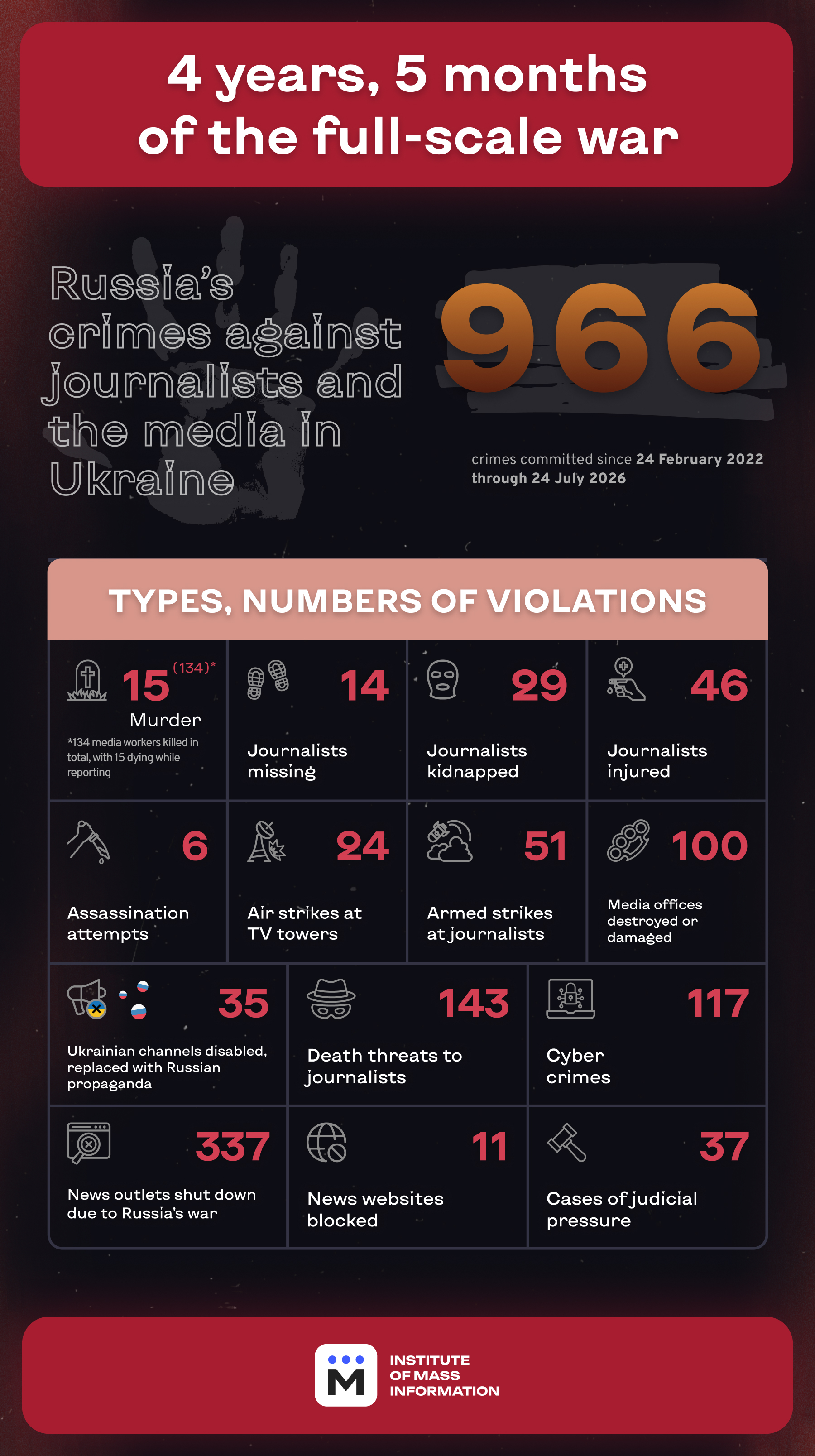
Russia committed 966 crimes against journalists and the media in Ukraine in the four years and five months since the start of the full-scale war, as evidenced by the Monitoring Study of Russia’s Crimes Against Journalists and the Media, which the Institute of Mass Information has been carrying out since the first day of Russia’s invasion of Ukraine.
IMI recorded eight new cases in the period from 24 June to 24 July 2026, including media offices and journalists’ property being damaged.
The death of three media professionals turned servicemembers were reported in June–July:
- Maksym Oseredchuk, former producer for ABC News turned UAF servicemember. Killed in a Russian drone strike on 24 June 2026.
- Oleksandr Vernihorov, cameraman with several Dnipro-based TV channels, UAF serviceman. Killed in action in Kharkiv oblast on 28 June.
- Ivan Trembovetskyi, UAF serviceman, managing editor with TET TV, 2+2 TV. Killed in action in Sumy oblast.
A total of 134 media professionals have been killed in the course of the full-scale invasion, with 15 dying while reporting, 105 killed in action, and 14 dying as civilian casualties.
Media offices & property damaged
- A Russian drone hit the courtyard of the Suspilne Zaporizhzhia branch. The staff were in a bomb shelter and were not harmed; their cars were damaged. A journalist whose crew was away working on the ground was stunned by the blast wave.
- The editorial office of Novyny Kramatorskoho Rayonu suffered significant damage as a result of a Russian airstrike in Kramatorsk on July 5.
- The office of the newspaper Novyny Kramatorska was also severely damaged in the 5 July air strike in Kramatorsk, Donetsk oblast.
- The Channel 5 office in Kyiv was damaged in a Russian overnight strike on 6 July. The channel went off air.
- The Islandiya TV studio was damaged in the Russian air strike of 2 July. A security guard was killed.
- The Russian attack on Sumy overnight on 17 July damaged the office and studio of the local news website Kordon.Media. The blast wave tore out the entrance door and studio door fasteners. Some plaster flaked off the walls and some things fell down.
- The office of the Zaporizhzhia-based news outlet inform.zp.ua was damaged in a Russian strike. The shock wave broke the window grilles in the building and caused ceiling collapse in some rooms.
- The 23 July Russian air strike in Bilopillya, Sumy oblast, affected the office of the local newspaper Bilopilshchyna, damaging the roof, the ceiling, furniture, and computer equipment.
See the full list of Russia’s crimes against media and journalists in Ukraine here.
The Institute of Mass Information (IMI) is a civil society organization specializing in the media, operating since 1996. IMI defends the rights of journalists, studies the media landscape and reports on media-related events, fights propaganda and disinformation, and provides media workers with safety equipment for trips to combat areas (since the start of the Russo–Ukrainian war in 2014).
IMI carries out the only monitoring study of freedom of speech in Ukraine, keeps a list of transparent and responsible online media outlets, and tracks Russia’s media crimes in the war on Ukraine. IMI has representatives in 20 oblasts of Ukraine and runs a network of Media Hubs that provide journalists with unfailing support. IMI’s partners include Reporters Without Borders (RSF); the organization is also a member of the International Freedom of Expression Exchange (IFEX).