
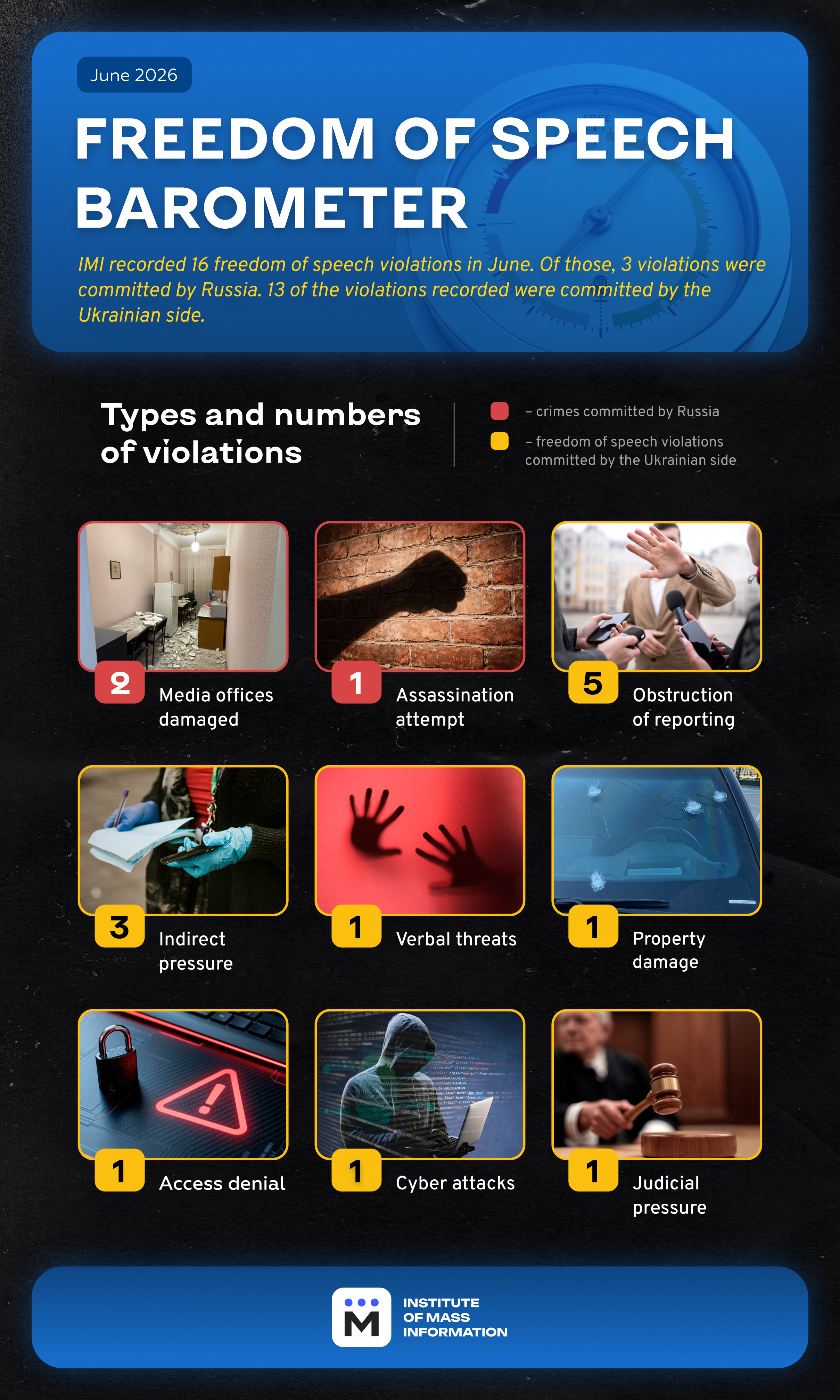
The Institute of Mass Information experts recorded 16 press freedom violations in Ukraine in June 2026. 3 were committed by Russia, as evidenced by IMI’s monthly monitoring study, the Freedom of Speech Barometer.
Russia’s crimes against the media and journalists included an assassination attempt, destruction of and damage to media offices.
The death of one media worker turned UAF servicemember was reported in June:
- Maksym Oseredchuk, former producer for the US TV channel ABC News, servicemember. Died in a Russian drone strike on 24 June 2026.
Assassination attempts
- A Russian FPV drone tried to attack a Suspilne Dnipro filming crew twice as they were interviewing a servicemember in Zaporizhzhia oblast on 23 June. No one was injured in the incident. As soon as the second drone left, the journalists got to their car and left the dangerous area.
Destruction of and damage to media outlets’ property
- The Promin office in Snovsk (Chernihiv oblast) was damaged again during a Russian strike on 3 June. The blast damaged the windows and shattered the glass in the building. No one was injured.
- A Russian drone hit the courtyard of the Suspilne Zaporizhzhia branch on 26 June. The staff were in a bomb shelter at the moment of the strike and were unharmed, though their cars were damaged. A journalist whose crew was away working on the ground was stunned by the blast wave.
IMI also recorded 13 press freedom violations unrelated to Russia’s war on Ukraine. These included violent threats, damage to journalists’ property, obstruction of reporting, denial of access to information, cyber attacks, judicial pressure, and indirect pressure.
Violations were recorded in Kyiv, Kharkiv, Rivne, and Sumy, as well as Donetsk, Mykolaiv, and Poltava oblasts. The perpetrators were officials of various ranks, servicemembers, and private individuals.
Violent threats
- On 26 June Babel reported violent threats by Mykola Kharkhan, a serviceman in the “Skelia” Assault Regiment No. 425, after the release of their news story about a series of non-combat deaths in the regiment. Kharkhan posted a video address insulting the journalists, accusing the news outlet of working “for Russian money” and saying that “everyone involved will have to puke the money up later”.
Damage to journalists’ property
- On 25 June Azad Safarov, producer with the UK TV channel Sky News, said that their crew’s armoured car had been targeted at close range by an unknown shooter as they were filming a news story about the “Skelia” Assault Regiment No. 425 in March 2025. The driver who was in the car at the moment of the attack was unharmed, but the journalists counted 12 bullet holes in the car.
Obstruction of legal reporting
- Chetverta Vlada journalist Anastasia Savliuk faced obstruction by employees of the Rivne housing and maintenance department, who took away her phone, tried to forcibly detain her in the building, and threatened her with police inspections.
- Nakypilo cameraman Ihor Leptuha was not allowed to enter the Kharkiv Art Museum to film on 14 June after the museum was damaged in a Russian strike.
- Nakypilo journalist Alisa Zhynkina reported on 15 June that security guards barred reporters from entering the Kharkiv Art Museum or filming during a press event.
- Nakypilo journalists reported facing obstruction while covering the aftermath of the Russian strike on the Kharkiv Zoo, saying that security did not allow reporters to enter the premises and the staff interfered with their work.
- Gwara Media journalist Yelyzaveta Dyachenko faced obstruction while covering the aftermath of the Kharkiv Zoo strike.
Denial of access to information
- The Mykolaiv Oblast Infrastructure Restoration and Development Service refused to share the costs of repairing the Pivdennobuzkyi (Varvarivskyi) Bridge, the scope of the repairs done, and the project’s 2026 funding with MykVisti. The agency advised the journalists to look for some of the information on the E-data portal instead.
Indirect pressure
- Babel co-founder and chief editor Kateryna Kobernyk reported pressure and smear attempts by MP Yaroslav Zhelezniak, who made a post on Telegram alleging the news outlet had “real owners” and saying he would “do some media hitmanship”.
- Vizyt journalist Daria Zgura reported facing pressure, harassment, and body shaming following the release of her news story about the treatment of stray animals in a private animal shelter in Kremenchuk.
- A man in Sumy filed police complaints against the local media outlet Cukr and its journalist Anna Shpurik, claiming that the journalist was preparing a misleading news story about him. The man has also sent a series of private messages to Shpurik, containing threats and accusations, the team said.
Cyber attacks
- The news website Babel reported that their editor Hlib Husev had been targeted in a hacker attack. He received a phishing letter containing a link to an archive with malware disguised as documents about alleged abuses in a UAF unit.
Judicial pressure
- Euromaidan Press received multiple legal claims after releasing an investigative series about the Russian oligarch Oleg Boyko and his business ties in Europe. The team received three legal letters demanding they take down their articles, publish an apology, and remove the mentions of some persons.
Russia’s crimes
Assassination attempts — 1
1. Russian FPV drone targets Suspilne Dnipro crew
23.06.2026 A Russian FPV drone tried to attack a Suspilne Dnipro filming crew as they were interviewing a servicemember in Zaporizhzhia oblast on 23 June, journalist Antonina Chuiko reported to Kateryna Lysiuk, the Institute of Mass Information representative in Dnipropetrovsk oblast.
Chuiko said she was wearing a PRESS vest at the moment of the attack.
The filming crew including correspondent Antonina Chuiko, cameraman Oleksandr Shaldybin, and driver Oleksandr Kim were working with a Ukrainian Armed Forces unit in a Zaporizhzhia village. They were taking down the soldiers’ accounts of going out on missions. Chuiko said this had been a regular frontline filming session.
“All three of us were wearing body armor, helmets, and carried first-aid kits. We were talking and filming the soldiers when we heard the sound of a drone. A soldier who was outdoors said that it was an FPV. We hid in a building, where we continued filming. The drone hovered above us for some time, then left, and we heard an explosion,” said Antonina Chuiko.
The journalists decided to finish the interview quickly and leave the area. However, another drone was spotted shortly after. The journalists’ civilian car was parked nearby, under the trees, but they didn’t dare to run to it and decided to wait.
“We waited a little longer. Cameraman Oleksandr Shaldybin decided to go out first, but turned back because the FPV drone was hovering nearby, above the thicket we would have to cross to reach our car. The drone hung around for a few minutes and was on its way, at which point we ran to the car and left right away,” said the Suspilne Dnipro correspondent.
Destruction or damage to media outlets’ property
1. Promin office damaged in Russian strike again
03.06.2026 The Promin office in Snovsk (Chernihiv oblast) was damaged in a Russian strike on 3 June, Suspilne Chernihiv reported, citing the newspaper’s editor Olena Kompanets.
Kompanets said that the blast damaged the windows and shattered the glass in the building. No one was injured.
“It was only yesterday [2 June] that we patched the seven windows that had been damaged in the 26 May strike in Snovsk with plastic film. That time, all employees who were on site were injured, diagnosed with acubarotrauma. And then the glass and window frames were blasted out again,” she said.
She added that this was the fourth time that the office has been damaged in Russian drone strikes: two times in 2025 and on 26 May and 3 June this year.
The newspaper’s office is located in central Snovsk, in the building of the former railway freight office.
2. Russian drone hits Suspilne Zaporizhzhia courtyard
26.06.2026 Russian troops attacked central Zaporizhzhia with missiles and drones at around 12:00 on 26 June. One of the drones hit the courtyard of the Suspilne Zaporizhzhia branch. The staff who were in the building were in a bomb shelter at the moment of the strike, so no one was injured, Suspilne reports.
However, a journalist whose crew was away working on the ground was stunned by the blast wave.
“A drone fell down in the office’s courtyard, we immediately contacted the special services and they arrived shortly to carry out the needed inspection. The buildings of the branch were intact, it was our staff’s cars in the parking lot that were damaged,” Suspilne Zaporizhzhia manager Marianna Hura said.
Suspilne Zaporizhzhia’s chief editor Alyona Natalukha said a Suspilne journalist was working on the ground at the moment of the strike and was affected by the blast wave.
“She suffered no severe injuries, but she did receive mild acubarotrauma (was stunned),” Natalukha said.
Crimea — 3
1. Lutfiye Zudiyeva issued another warning by occupation authorities
17.06.2026 The Russian police in Crimea issued another official warning to Crimean journalist and human rights activist Lutfiye Zudiyeva on 17 June, reminding her that actions that “create conditions for offenses to be committed” were unacceptable, Crimean Solidarity reports.
A Canköy department officer of the Russian police read the warning aloud to her near her home in Canköy. Zudiyeva herself believes it was issued in view of the upcoming Crimean Tatar Flag Day, which is celebrated annually on 26 June, as part of the traditional “preventive” measures the occupation authorities take ahead of remembrance dates and public rallies.
The document said that the police had received reports alleging Zudiyeva might take action that would facilitate a crime or administrative offense. The warning did not specify what was the action in question or what violations she was being accused of.
The warning cited the Russian laws “On the Fundamentals of the Crime Prevention System in the Russian Federation” and “On the Police”. It also said that if actions that the occupation authorities consider to be conducive to offenses are committed, the citizen may be held liable in accordance with Russian legislation.
Zudiyeva disagreed with the warning and left a written comment in the “document”.
“The Center for Combating Extremism calls such warnings a preventive measure, but in practice they have different uses. Over the years of working in human rights and journalism, I have seen many such documents, and most often they contain no specific description of the alleged violation. It seems that their purpose is to create a so-called chilling effect, when a person refrains even from legal actions — publishing, comments, or public activities — out of fear of future persecution,” Lutfiye Zudiyeva said.
This is not the first time that such action been taken against Zudiyeva. She has previously been handed similar warnings and faced administrative liability for her reporting. Human rights activists believe that the pressure on Zudiyeva is due to her coverage of topics related to the state of Crimean Tatars’ rights in occupied Crimea.
The Russian police have already visited Zudiyeva on 15 May 2026 to warn her of potential liability for holding “unauthorized rallies” on the Day of Remembrance for the Victims of the Crimean Tatar Genocide on 18 May.
2. Russia adds journalist to “foreign agent associates” list for working with Crimean Solidarity
30.06.2026 The Russian Ministry of Justice has added Zedin Acikeliamov, a Crimea-based citizen journalist covering political persecution for the human rights movement Crimean Solidarity, to the list of “foreign agent associates”, ZMINA reports, citing the Russian agency’s website.
Russia’s register of “foreign agent associates” includes individuals whom the Russian Ministry of Justice believes to be affiliated with the work of organisations or initiatives on the “foreign agents” list. Crimean Solidarity, which supports victims of political repression in the occupied Crimea, was recently assigned “foreign agent” status.
Zedin Acikeliamov has been a citizen journalist since 2017, working with Crimean Solidarity to cover police raids, detentions, and trials targeting Crimean Tatar political prisoners after the occupation of Crimea. He has repeatedly been persecuted for his work: his home has been searched, he has been detained, fined, and surveilled. The journalist stresses that the Russian media’s control over the information environment in Crimea makes independent coverage of events crucial.
30.06.2026 The Russian Ministry of Justice has added Ruslan Paralamov, a Crimea-based citizen journalist covering political persecution for the human rights movement Crimean Solidarity, to the list of “foreign agent associates”, ZMINA reports, citing the Russian agency’s website.
Russia’s register of “foreign agent associates” includes individuals whom the Russian Ministry of Justice believes to be affiliated with the work of organisations or initiatives on the “foreign agents” list. Crimean Solidarity, which supports victims of political repression in the occupied Crimea, was recently assigned “foreign agent” status.
Ruslan Paralamov joined Crimean Solidarity in 2017 and covers politically motivated trials and persecution of Crimean Tatars. In October 2021, he, Zedin Acikeliamov, and one more journalist were detained by Russian security forces while covering an appeal hearing in the case of several Crimean Tatar political prisoners. Despite having an editorial assignment, the journalists were taken to a police station and held in a temporary detention center overnight.
The press freedom situation in Ukraine unrelated to Russia’s war
Physical aggression
Violent threats — 1
1. Babel reports violent threats by UAF servicemember
26.06.2026 Babel reported violent threats by Mykola Kharkhan (call sign “Kyianyn”), a serviceman in the “Skelia” Assault Regiment No. 425 after the release of their news story about a series of deaths in the regiment.
In a video posted to Facebook on 25 June, Mykola Kharkhan called the Babel journalist who penned the news story a “whorenalist” and a “media hitman” on Russia’s payroll and referred to the news outlet itself as “Russian white collars”.
“Officially, what that whorenalist barfed out was 26 deaths from disease in Skelia. I’m reporting that out of the 26 people who died, 18 died in medical institutions. Not in Skelia,” Kharkhan said.
He added that the deaths should be investigated, but “no one is allowed to take Russian money and defame the most combat-ready units.”
He also referred to the police as “cyberpigs” and “cyberchekists” who have failed to defend the army’s honour.
“No, my kittens, I’m reporting: the money may be good today, but everyone involved will be puking it up later,” Kharkhan said.
The news outlet’s editor Hlib Husev told the Institute of Mass Information journalist Valentyna Troyan that the team viewed Kharkhan’s statements as threats.
He said they had not reported the threats to the police yet but planned to do so later that day. The team will also update their readers about any other negative reactions to the news story or threats.
During an online call with journalists, Oleksiy Bratushchak, the communications officer with the “Skelia” Assault Regiment No. 425, said that threats to journalists were unacceptable but servicemembers had the right to free speech.
Slidstvo.Info chief editor Anastasia Stanko asked Bratushchak how “Kyianyn’s” allegations that Babel worked for Russian money, should be held liable for it, and would have to “puke up” the money later should be perceived. She asked whether this was a threat, whether it could be considered his personal stance, and what the regiment’s position was.
Bratushchak replied that Harkhan was a blogger and could talk to his audience as he saw fit.
“Call sign ‘Kyianyn’, a blogger who joined us not so long ago, has his own audience he stays in contact with,” Bratushchak said.
He added that servicemembers were allowed to communicate with their audience to explain what was going on in the Ukrainian Armed Forces. He stressed that Kharkhan’s statements did not reflect the regiment’s official position.
“Are his words the official position? No. Moreover, the command, the representatives of our regiment present here, at this press conference, may disagree with what ‘Kyianyn’ or other bloggers in our regiment say. But this does not mean that a person has no right to express their opinions,” the spokesman said.
Bratushchak reiterated that threats to journalists were unacceptable: “When we discussed the response to Babel‘s news story, the commander and I clearly stated, and this was said at the meeting, that no action should be taken against the authors of this or any other investigation. Fighting journalists is not what we do.”
He added that he had not watched Kharkhan’s video as of the press conference happening. Anastasia Stanko asked whether ‘Kyianyn’ would be penalised for the threats. “Whether you like it or not, he is not just a servicemember, but a blogger as well, and freedom of speech has not been eradicated in our country. I will look into what exactly happened,” the spokesman replied.
On 23 June 2026, Babel released an investigation into the non-combat deaths of at least 26 recruits in the “Skelia” Assault Regiment No. 425 that occurred in late 2025 — spring 2026. The journalists discovered that most of the servicemembers died of pneumonia, cardiovascular and other diseases shortly after being drafted. Families of some of the deceased reported possible violence in the unit.
The Skelia Regiment said that the authors of the news story were making generalisations, reducing the unit’s history to one-off tragic instances. They claim that most of the deaths mentioned in the investigation occurred in hospitals or on the way to them and were related to the recruits’ health.
The regiment emphasised that they were not involved in the draft effort and said they were willing to work with law enforcement bodies and other authorities.
The Verkhovna Rada Commissioner for Human Rights Dmytro Lubinets reported that possible violations of servicemembers’ rights at Skelia were being verified.
The State Bureau of Investigation opened proceedings under Part 5 of Article 426-1 of the Criminal Code of Ukraine (“Excess of authority or official powers by a military official, committed under martial law, which caused grave consequences”) based on Babel’s report.
On 25 June 2026, Azad Safarov, producer with the UK channel Sky News, reported that an unknown man fired at the channel’s car at close range in March 2025 as the crew was filming a news story about the Skelia unit. The crew’s driver was in the car at the moment of the shooting.
Damage to journalists’ property, attacks on media offices — 1
1. Sky News says their car was attacked by shooter in 2025
25.06.2026 Azad Safarov, producer with the UK TV channel Sky News, said that their crew’s car had been targeted at close range by an unknown shooter as they were filming a news story about the “Skelia” Assault Regiment No. 425 in March 2025. Safarov reported on this in a Facebook post on 25 June.
He said that the incident had occurred near Dobropillya. The crew arrived at the location in two cars. In compliance with safety regulations, one car carrying the driver and the press officer stayed by the regiment’s command and observation post (COP). First, the parties agreed that the vehicles would be hidden and the drivers would be allowed to wait in the bomb shelter at the headquarters.
However, Safarov said, the press officer went to the shelter alone, leaving the driver to wait in the car outside. At 23:30, an unknown person approached the car and opened fire.
“Somewhere around 23:30, someone approached and shot the car from the driver’s side at close range. Fortunately, the reporters’ car was armored. The driver was unharmed,” the producer wrote.
After the shooting, Safarov said, another soldier came out of the building, picked up the shell casings, and told the driver to “scram, or the other cars would get shot too.”
When the driver tried to explain that she was acting in agreement with the press officer, they started threating her. Azad Safarov added that when the driver was able to get to a safe place and contact the filming crew, they immediately left the location.
“We counted 12 bullet holes in the car. Twelve. We were very lucky that the car was armored. Yes, it was a filming session with the ‘Skelia’ Regiment No. 425. That ‘Skelia’. This has never happened to us in all these years,” Safarov stressed.
The journalist emphasised that the incident had occurred more than a year ago and the team had been trying to resolve the issue through official channels since then, without making the situation public.
According to Safarov, the regiment commander promised to see it through, but they have received no answers yet. Instead, the producer added, the commander “promised to gift the driver some ‘Skelia’ patches.”
The filming crew also submitted official queries to the specialised UAF press center and the General Staff, but there was no response.
Azad Safarov explained that Sky News deliberately abstained from sparking an international scandal because the news outlet was rooting for Ukraine and considered the attack an one-off misdeed by an individual soldier.
“Now, reading about ‘Skelia’ [i.e. the Babel news story “‘Skelia’ assault regiment performs well in combat and is well-supplied. And, eyewitnesses say, people get tortured and beaten to death there’”], I realise that there is no point in remaining silent. This is horrible,” Azad Safarov concluded.
After the release of Babel’s story, the “Skelia” command officially confirmed the death of 26 servicemembers in the unit, adding that 18 of these died of disease in hospitals, and blamed the enlistment centers system for sending them unfit and unmotivated conscripts.
Still, the unit’s command acknowledged there were criminal proceedings ongoing in the unit, including the detention of Junior Sergeant Anatoliy Kucher and the investigation into an incident where a soldier was fatally wounded after an attempt to leave without permission in the “pine tree case”. The regiment also effectively admitted to systematic internal problems, reporting that they had to involve the Military Ombudsman’s Office to amend procedures and correct violations that had been ongoing for the past few months.
Azad Safarov told the Institute of Mass Information journalist Valentyna Troyan that he would not comment further on the events described in his post.
Oleksiy Bratushchak, the spokesman for the “Skelia” Assault Regiment No. 425, said in a comment to IMI that we would have to submit an official query to learn the regiment’s position. After that, the command would decide how to respond to the reported information.
Obstruction of legal reporting — 5
1. Chetverta Vlada journalist reports obstruction in Rivne state agency
11.06.2026 Chetverta Vlada journalist Anastasia Savliuk faced obstruction by employees of the Rivne housing and maintenance department, who took away her phone, tried to forcibly detain her in the building, and threatened her with police inspections, Savliuk reported in a comment to Hanna Kalaur, the Institute of Mass Information representative in Rivne oblast.
After the incident, the journalist contacted the police and filed a statement on obstruction of reporting.
Savliuk said that she had visited the Rivne housing and maintenance department, which oversees real estate owned by the army, on 10 June to personally submit a request for access to public information about the abandoned Officers’ House in Rivne, which is a historical building.
She had unsuccessfully searched for the right contacts to send a query by e-mail the day before, so she decided to go in person to submit the request and talk to the management.
The journalist said that she had entered the premises and the building without issues and learned from a staff member that the department head was absent. The staff member then offered her to leave her contact info so they could reach out to her later. Then a woman entered the office and urged the journalist to leave the building, claiming that it was a restricted access facility. Savliuk was holding her phone and filming the conversation in case she would need to report it in the future. The dispatcher noticed it and asked her to stop filming, and the woman, hearing this, approached the journalist, grabbed her phone and tried to run away with it, but Savliuk managed to get it back. The woman refused to identify herself.
Then other people arrived at the scene and threatened the journalist with inspections by the SBU, counterreconnaisance, and the police.
“One of the men forcibly held me by the arm, and the people around us told him to hold me down so that I wouldn’t run away. I called the chief editor and the police, still standing in the hallway,” Savliuk said.
After that another woman pushed the journalist out into the street, where she remained waiting for the police. When they arrived, they spoke with Savliuk and took her statement.
“I have filed a statement about obstruction of reporting, I will be waiting for the police’s response,” the journalist said.
The Institute of Mass Information lawyer Volodymyr Zelenchuk says that if the journalist could freely enter the building then it was not a restricted area and that filming in public places is not prohibited.
“It is quite doubtful that recording the process of filing a request to the housing and maintenance department could lead to the disclosure of secret information, classified information, or information that would harm the defense forces,” Volodymyr Zelenchuk commented on the situation.
IMI representative Hanna Kalaur tried to get a comment from the head of the Rivne housing and maintenance department, Dmytro Zakon, regarding the incident. However, the phone number that was at IMI’s disposal was invalid.
She also called the department number that the agency’s employee had shared with Anastasia Savliuk the day before. In response, the dispatcher said that IMI should file an official query and refused to share the department head’s current phone number.
The IMI representative has reached out to the police to learn whether criminal proceedings had been registered based on the journalist’s statement.
2. Kharkiv journalist faces obstruction while covering aftermath of Russian strike
14.06.2026 Nakypilo cameraman Ihor Leptuha was not allowed to enter the Kharkiv Art Museum to film on 14 June after the museum was damaged in a Russian strike, he reported to the Institute of Mass Information’s regional representative Yulia Napolska.
Leptuha said that upon arriving on site, they encountered a person in uniform who barred him and another journalist from entering the location or filming.
The journalists were verbally forbidden from filming again when the evacuation of paintings began, being told that they were interfering with the effort.
3. Kharkiv journalists denied access to museum damaged in Russian strike
15.06.2026 Security guards barred reporters from entering the Kharkiv Art Museum or filming during a press event on 15 June, Nakypilo journalist Alisa Zhynkina reported to the Institute of Mass Information’s regional representative Yulia Napolska.
Zhynkina said that a security guard had claimed that entering the museum without the director present was prohibited, as was filming. She added that the volunteers on site were very aggressive.
“Then the director came and said that she had not been notified that journalists would be there, so she could not let them in. The conversation lasted about 15 minutes. Then she told her own version of events and kept repeating that she would not let them upstairs. In the end, we managed to get her to allow journalists in in groups of three, accompanied by museum staff. The director constantly expressed her dissatisfaction with the journalists’ work, saying, ‘There were some journalists here yesterday, I hoped that they would be polite, but looking at you I see that you are not,’” Zhynkina said.
She added that the museum director insisted that each journalist should have made arrangements with her personally, then she would have taken them on a tour. At the same time, the journalist said, the meeting had been officially approved by the Kharkiv OMA, which was why the journalists were there.
4. Nakypilo journalists face obstruction while reporting on Kharkiv Zoo strike
15.06.2026 Nakypilo journalists faced obstruction while covering the aftermath of the Russian strike on the Kharkiv Zoo on 15 June, correspondent Pavlo Pakhomenko and cameraman Ihor Leptuha reported to the Institute of Mass Information’s regional representative Yulia Napolska, saying that security did not allow reporters to enter the premises and the staff interfered with their work.
“Yet again, people at a strike site did not let us in, animal caretakers, as I understand it. They did not touch me, but they grabbed Sofia Bobok (a Kharkiv-based journalist) and a Suspilne Kharkiv journalist by the hands. Every time it’s employees who aren’t authorised to make decisions who are shouting at journalists and telling them they should do something. Classic,” said Nakypilo correspondent Pavlo Pakhomenko.
Ihor Leptuha says even though the journalists were eventually allowed into the zoo, they were asked to leave again some time later.
He said that journalists have been facing access problems at the zoo since the coronavirus pandemic. According to him, there are usually no issues if you are filming on a phone, but the situation was different as they were working at the arrival site. The security guard at the main entrance did not allow the journalists through and said that he did not know whom they should contact to get permission.
The journalists attempted to enter the zoo through another gate, also to no avail: a security guard stopped him again. Leptuha remarked that it had seemed odd to him that reporters with other media outlets had already been working there.
“By the time Yuriy Sydorenko [chief of information and public relations at the Kharkiv City Council] arrived with his journalist pool, we were already inside, filming, but then something happened again and we were asked to leave the zoo,” Leptuha added.
5. Gwara Media journalist faces obstruction while covering Kharkiv Zoo strike
15.06.2026 Gwara Media journalist Yelyzaveta Dyachenko faced obstruction while covering the aftermath of the Kharkiv Zoo strike, she reported to the Institute of Mass Information’s regional representative Yulia Napolska.
She said that only some of the journalists were allowed into the zoo. Asking if she could enter, she was denied, and the door was closed in front of her.
After repeated calls to press offices and personal conversations with Yuriy Sydorenko, the journalists did manage to get to the strike site.
“Sydorenko said that we had five minutes to film and do our job. We started working. There were people nearby who were taking away the animals, they were in ordinary clothes, some were in uniform, but with no identification marks. I heard them being indignant at the presence of journalists and demanding we be taken away. One of them started shouting into a loudspeaker: ‘Everyone who is not working to address the damage, leave the zoo premises.’ They approached us later, pushing us out. Finally, all the journalists left,” Yelyzaveta said.
Censorship, access to information
Denial of access to information — 1
1. Reconstruction service withholds bridge repairs cost from MykVisti
10.06.2026 The Mykolaiv Oblast Infrastructure Restoration and Development Service refused to share the costs of repairing the Pivdennobuzkyi (Varvarivskyi) Bridge, the scope of the repairs done, and the project’s 2026 funding with MykVisti. Instead, the agency advised journalists to look for some of the information on E-data, MykVisti reports.
The news website’s journalist Yulia Boychenko reached out to the Restoration Service with an information query, asking how much money has been spent on repairing the Varvarivskyi Bridge since 2024, how much the repairs have progressed, and how much money is to be allocated to the project in 2026.
In response to the question about expenses, the service said that information on budget spending can be found on the Unified Web Portal for Public Budget Spending.
As for the repairs progress, the state body reported that the repairs are proceeding according to the schedule included in the contract. The response did not contain the percentage of work completed.
The service also did not specify how much money is allocated for the bridge repairs in 2026. The response only stated that “the amount of expenses is determined as per the requirements of budget law and the financial resources available.”
Volodymyr Zelenchuk, a lawyer at the Institute of Mass Information, believes that such a reply was unlawful, since the state body did not actually provide the requested information. The lawyer pointed out that the Law of Ukraine “On Access to Public Information” prohibits entities from withholding information and justifying the refusal by fact that it is available in open sources.
He added that such actions can be appealed to the Verkhovna Rada Commissioner for Human Rights or in court.
Indirect pressure
Political pressure — 1
1. Babel chief editor reports pressure by MP Zhelezniak
18.06.2026 Babel co-founder and chief editor Kateryna Kobernyk says her news outlet has faced pressure and smear attempts by MP Yaroslav Zhelezniak.
Kobernyk reported this in a Facebook post in response to the MP’s 16 June Telegram post where he asked after the real owner of the media outlet.
“By the way, I’m curious who is the real owner of the news outlet now. I heard that it’s someone from the defense industry, so I’d be grateful for detailed information. I’ll do some media hitmanship,” Zhelezniak wrote.
Kobernyk considers the MP’s words to be a “blatant lie” and a threat.
“This is such a blatant lie and a threat at the same time. A lie, because the names of Babel‘s real shareholders are well-known and there are no others. A threat, because, knowing for sure that this is the case, we are obviously supposed to start worrying and anticipating a fake investigation and mudslinging. We didn’t start worrying — we were just disgusted,” Kobernyk said.
She believes Zhelezniak’s post was a reaction to the critical material previously published by the media outlet, which analysed his investigations and statements. Two such articles were released, Kobernyk said.
Kobernyk added that the MP initially agreed with the criticism, but later started attacking the media outlet, alleging that “there is more than meets the eye” to the publication. She added that similar narratives about Babel’s alleged loyalty to the government have been peddled repeatedly by other pro-government bloggers.
In a comment to the Institute of Mass Information journalist Valentyna Troyan, Kobernyk reported that her team did not plan to contact the police regarding Yaroslav Zhelezniak’s statements for the time being.
“But if the official continues to spread disinformation, implying that Babel is hiding its real investors, which is obvious slander, we will do so. I believe that what Zhelezniak is doing is putting pressure on the editorial team and trying to intimidate them,” she said.
Kobernyk emphasised that the team did not plan to publish more information about the owners, since all the information is available in state registers and on the website.
“If you go to the ‘Investors’ section on the website, which not all media outlets have, the entire history of our investors will be written there. You can look, read, learn who bought what and when. There is a story there from 2020, when Babel was restarted, when Babel emerged in its current form, because we had closed down in 2019. And the names of previous investors from 2019 were also public. So we are as transparent as one can be. And what MP Zhelezniak is doing now follows the classic pro-Russian smear propaganda pattern, when someone wants to imply something and say, ‘Coincidence? I think not,’” she added.
Kobernyk also pointed out that the MP was blogging during working hours.
The Institute of Mass Information has reached out to Yaroslav Zhelezniak for comment.
The list of Babel shareholders changed in February 2026. On February 25, the Vyriy Industry owner and CEO Oleksiy Babenko bought out 75% of the news outlet from the Slovak company IG. 25% remained with the chief editor and founder Kateryna Kobernyk. Babenko joined the company as an individual.
Other instances of indirect pressure — 2
1. Kremenchuk journalist reports pressure, body shaming
19.06.2026 Daria Zgura, journalist with the Kremenchuk-based TV channel Vizyt, reported facing pressure, harassment, and body shaming following the release of her news story about the treatment of stray animals in a private animal shelter, Zgura reported to Nadia Kucher, the Institute of Mass Information representative in Poltava oblast.
The journalist said that the story about the organisation Mokri Nosyky and the treatment of animals in their private shelter was released on 16 june and was based on numerous letters by Kremenchuk residents who complained about the shelter causing inconveniences to the neighbours.
Daria Zgura said she had talked to these people while working on the story, and the people had not been opposed to the shelter existing, but pointed out issues that, in their opinion, needed to be resolved.
The journalist also reached out to the shelter for comment.
“To talk to the shelter staff, I arrived, introduced myself as a journalist with Vizyt TV, and told them the purpose of my visit. The person who was there and introduced herself as the owner’s assistant denied me access to the premises, but gave me the organisation owner’s phone number,” the journalist said.
During a phone conversation with the shelter’s owner, Zgura told her that a news story was in the works and offered her to comment on the complaints by neighbours and the shelter’s operations.
“The owner declined our request to enter the premises and gave no substantial comment. At the same time, she said that the farm, which she calls an animal shelter, is not officially registered as a shelter,” said Daria Zgura, adding that she used this information in the news story.
After the material was released, the shelter owner started publicly criticising her on social media, and some comments under the posts about the report attacked Zgura’s looks and personal qualities.
“After the story aired, the owner of the shelter took action against me that, in my opinion, was related to my reporting and aimed to discredit me as a journalist,” Zgura believes.
The journalist added that the shelter’s Instagram page also posted her photos with degrading captions and offensive comparisons.
“Later, on her personal Instagram page, the shelter owner started posting my photos and images with offensive or humiliating captions. She also made posts and stories featuring my photos where she offensively compared me to a pig,” said Daria Zgura.
The posts and comments also mentioned the rest of the Vizyt TV team, which the journalist views as pressure in response to her reporting.
“I think it matters that the aforementioned actions started immediately after the news story was released, targeted me specifically as the author of the story and the journalist who collected the information and prepared the material, and involved posting photos of me and statements aiming to shape a negative attitude towards me because of my reporting,” said the journalist.
The journalist said that she had filed a complaint with the police about pressure and harassment.
IMI representative Nadia Kucher asked the shelter for comment, which they promised to provide later, “after considering the proposal.” The shelter owner told the IMI representative on Instagram that she considered the story to be “one-sided” because it did not include the position of those who support the shelter’s operations.
Still, the owner of the shelter did not list any specific objections in her comment, citing her busy schedule.
“Sorry, but unfortunately I have no time to spend on this dirty story and yet another round of debate around it. I am very tired after a long trip. I just came back from taking my beloved dogs to new families abroad,” the shelter owner wrote, adding that all comments were available on the shelter’s page.
2. Man files police complaints against Cukr over news story about him
23.06.2026 A man in Sumy filed police complaints against the local media outlet Cukr and its journalist Anna Shpurik, claiming that the journalist was preparing a misleading news story about him, chied editor Vladyslava Kudelnik told Olha Panfilova, the Institute of Mass Information representative in Sumy oblast.
The news story in question was released on 11 June, titled, “’He asked me if I was a virgin and what kind of underwear I was wearing.’ A man accused of sexually harassing minors still sells cotton candy in Sumy.” The story says that its subject has been the suspect in a child sexual abuse case since 2022.
Kudelnik said that the man had filed two statements with the police, one of which preceded the release of the article.
She added that the man had talked openly and kindly to the journalist as she was taking comments for the story, willingly sharing information and not asking to read the text before publication.
Sumy Oblast Police spokesman Volodymyr Krupetskyi reported that the police had registered the statement and was vetting it.
The chief editor said that along with comments on the media outlet’s social media pages, the man has sent a series of private messages to Shpurik, containing threats (including religion-based ones) and accusations. Vladyslava Kudelnik considers such behavior to be an attempt to exert pressure on the journalist.
Cukr is yet to comment on the situation publicly; the team does not plan to do so until they decide to contact the police.
Kudelnik says that it took the team some time to work up the courage to cover this topic. It was important for the journalists that the news story does not slander the person still under trial.
“As we were working, we consulted with lawyers who helped us articulate things correctly. We also provided Oleksandr space in the article and a chance to speak, covering his position as fully as possible. What we did omit in the text were the insults and degrading remarks he made about the girls who had come forward with accusations,” said Vladyslav Kudelnik.
The team considers the news story to be of public interest because topic of child molestation is extremely sensitive. The subject of the article continues to work in proximity to children despite being under trial in a case related to four underage girls.
The journalists sought to raise awareness of violence against children and of the nuances in communication between adults and minors, the chief editor added.
Online pressure
Cyber attacks on news outlets, journalists — 1
1. Babel reports hacker attack on their editor
19.06.2026 The news website Babel reports that their editor Hlib Husev was targeted in a hacker attack.
According to the media outlet, Husev received a letter by one james***[email protected], signed “Ihor D****uk”, in his personal inbox on the afternoon of 18 June. The sender said they had gotten Husev’s contact from someone named Serhiy S***r and asked for help in reporting some information.
“It was hard not to suspect a phishing attempt based on the letter’s initial data, especially considering that Hlib Husev knew no one with these names,” the team stressed.
They added that the “information” they were asked to share was as follows:
“I am an infantryman in *** SAR’s Assault Battalion No. 2. The commander of our battalion demands that all infantrymen give up 30% of their combat wages every month…”
The sender then described the hardship faced by the unit and said that they had been “sent screenshots of correspondence, payments, and all this below-board accounting,” and said that he was ready to “share the evidence.”
The unit to which the sender referred is one of the most famous in the UAF assault troops. This unit was featured in a high-profile news story by Hleb Husev, which came out two months ago and has been viewed 130 thousand times.
The Babel team stressed that the attacker had clearly opted for the “social engineering” method, having studied their editor’s history and planned an attack specifically targeted at him. The letter closed with a link to an external resource: a folder on the fex.net service.
The team analysed the malicious software in an isolated environment. The link led to an archive containing two “office” documents with macro programs of 25 MB and 27 MB in size. They were “fresh” – created that morning.
“Using a cryptographic algorithm, we obtained the so-called hash sum of the files: that is, strings of letters and numbers unique for each file. We found no similar ‘hash sums’ in the open database of malicious software. This meant that the attacking script was probably personalised,” the team said.
The news outlet also studied the code of the macro programs (without running the macros themselves). It turned out that the files were of the “dropper” type. They were supposed to “unzip” into a separate program on the computer and run it in the background. The program was supposed to quietly observe and collect information.
The Babel team have reported the targeted hacker attack to CERT-UA, whose experts have confirmed that the files were malicious. The analysis continues.
Babel promised to add a detailed comment from CERT-UA to its news about the attack on Husev when they receive one.
The available data did not allow the Babel team to identify the attacker. However, they recalled that the day before, MP Yaroslav Zhelezniak alleged that Babel did not disclose its real owners. The news outlet’s co-founder and chief editor Kateryna Kobernyk responded by calling his statements pressure on the team and an attempt to smear it.
In a comment to an Institute of Mass Information journalist, Hlib Husev said that the attack had not bee incidental, because the team was working on several news reports on sensitive topics and a leak of information could pose a physical threat to the persons mentioned in them.
Judicial pressure
Other instances of judicial pressure — 1
1. Euromaidan Press reports pressure over Russian oligarch investigation
11.06.2026 The news website Euromaidan Press received multiple legal claims after releasing an investigative series about the Russian oligarch Oleg Boyko, chief editor Alya Shandra reported to the Institute of Mass Information.
Shandra said that the team had released the first two parts of the investigation about Oleg Boyko, his European business network and legal gaps in the Western sanctions, on 1 and 2 June 2026. The third episode of the series is now being prepared for release.
Shandra said that within five days after the release of the first two episodes, the team received three legal claims, which, according to her, came from a coordinated group of lawyers in different jurisdictions.
On 2 June in Poland, the law firm Lach Janas Biernat (attorney Dawid Biernat), acting on behalf of “Evapify Poland sp. z o.o.”, demanded that the 2 June article be taken down within two days and an apology be posted on the website’s main page in a specific format.
In the second claim, that arrived on the same day, Lach Janas Biernat demanded that all references to another defendant, Łukasz Notopulos, be deleted or the articles taken down within 24 hours.
On 8 June, the team received another claim, this time from Ukraine: by the law firm Burchills Ukraine, which represents Oleg Boyko’s interests. It contained a demand to delete both articles, post a pre-approved retraction, and refrain from releasing the third episode of the investigation.
Euromaidan Press said that some of the claims had come with warnings of potential complaints to hosting providers, Meta and Google platforms, and search engines in case the demands are not met. The team also views the demand to cancel the continuation of the series as censorship.
Shandra says that the team has already responded to some of these claims, saying that the article would remain online in its current version and that the news outlet did not plan to post apologies or remove mentions any persons from the article. Instead, the team offered to grant the persons in question the right to respond in accordance with journalism standards.
Defending freedom of speech
The authorities’ response to press freedom violations — 1
1. Rivne police opens obstruction probe in response to journalist’s statement
11.06.2026 The Rivne District Police Department has opened a case over obstruction faced by Chetverta Vlada journalist Anastasia Savliuk at the Rivne housing and maintenance department on 10 June, the police department reported on their website.
The case was filed under Part 1 of Article 171 (obstruction of legal reporting) of the Criminal Code of Ukraine. It covers illegal seizure of journalistic material or equipment, denial of access to information, and other willful actions impeding the work of a journalist.
According to the police, a journalist with a local news outlet contacted them at around 1:10 p.m. on 10 June. She reported that a state institution employee grabbed her mobile phone, demanded she delete video footage, refused to provide information, and forcibly made her leave the building.
The investigative team documented the details of the incident and took a statement from the journalist.
The article’s sanction provides for a fine, up to three years of probation, or restriction of liberty for the same term.
Earlier, Chetverta Vlada journalist Anastasia Savliuk reported facing obstruction by employees of the Rivne housing and maintenance department, who took away her phone, tried to forcibly detain her in the building, and threatened her with police inspections
Response by the media community — 1
1. Media community demands investigation into threats to Babel
01.07.2026 The Media Movement and the Ukrainian media community demand that law enforcement bodies investigate the threats to Babel journalists that were made after the release of an investigation into a series of non-combat deaths in the Skelia Assault Regiment No. 425. The demand was expressed in a joint address endorsed by the Institute of Mass Information.
The address urges the law enforcers to:
- immediately investigate the threats targeting journalist Kateryna Lykhohliad and the Babel team under the Criminal Code articles on threats to journalists and obstruction of legal reporting;
- ensure the safety of Kateryna Lykhohliad and chief editor Kateryna Kobernyk if the team requests this.
The media community also addressed to the command of the Skelia Assault Regiment No. 425 and the UAF Ground Forces with a call to publicly condemn the threats to the journalists, officially assess them, and not allow using servicemembers to discredit the media for their legal reporting in the future.
“We emphasise that the safety of journalists and the public’s right to information can not be compromised even in times of war. Pressure on journalists is a blow to the state’s defense capabilities, because accountability and trust are part of Ukraine’s resilience,” the address says.