
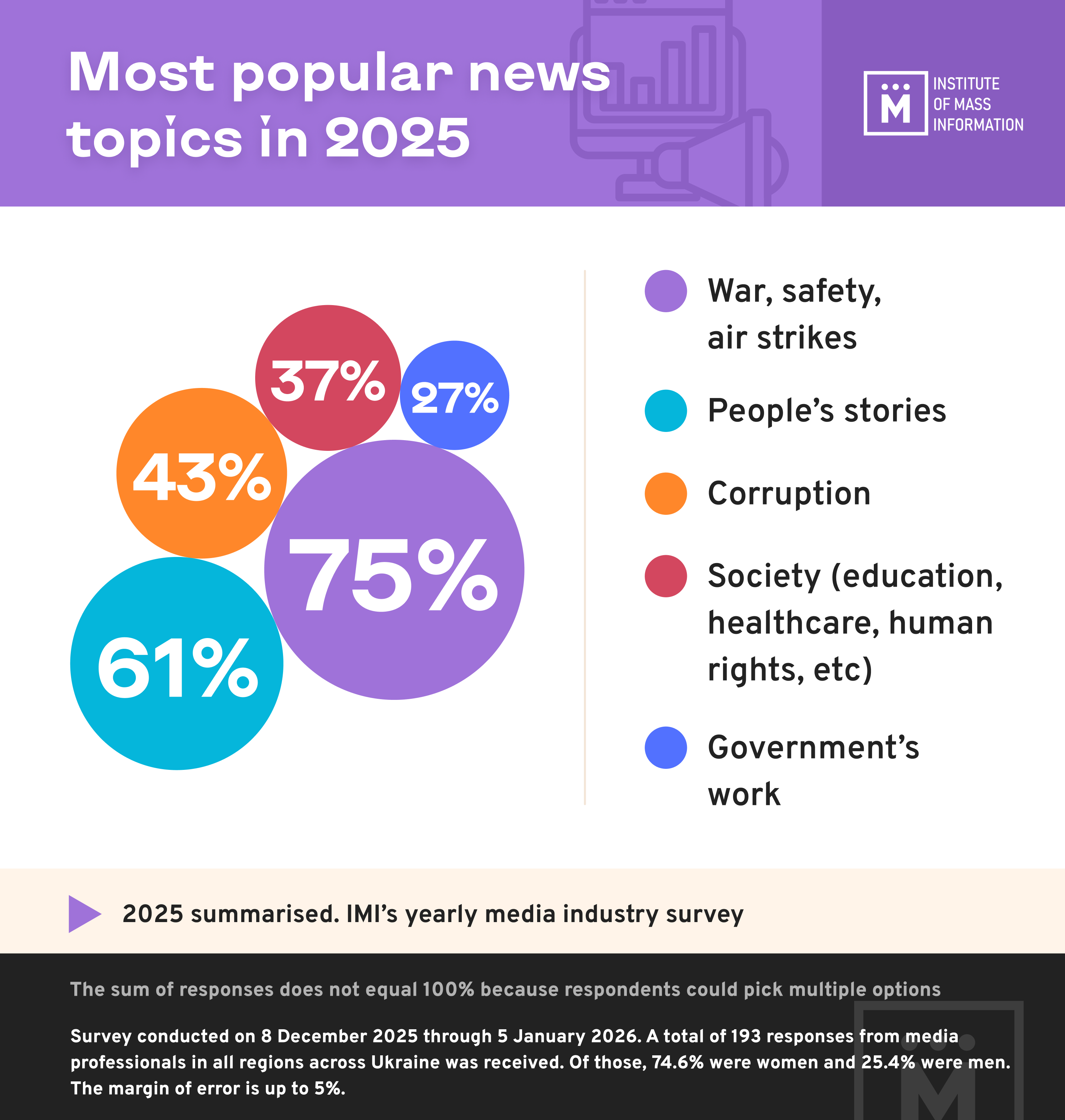
The audience of Ukrainian media was paying most attention to news about the war, safety, and air strikes in 2025, as reported by 75% of the journalists who took part in the quantitatve online survey by the Institute of Mass Information*.
People’s stories ranked second (61%), which confirms the steady demand for personalised content and the war’s humanitarian aspect. IMI experts observed this trend to have originated on social media, where personal stories have long been a key format for interacting with the audience.
Other priority topics in 2025 listed by the surveyed journalists included:
- Corruption (43%): accountability and resource spending oversight remain in high demand even in wartime.
- Social issues (37%), such as education, healthcare, and human rights.
- The work of the government and state bodies (27,5%), including decisions by local and national authorities.
- Culture (14%).
- Economics and income (12%).
- International politics (3%).
IMI’s survey coordinator Iryna Zemlyana believes that this structure of interests among the audience reflects not only the wartime reality, but also deeper changes in news consumption:
“The focus on shelling and safety is understandable: this is the basic human need for survival and navigating the reality of war. At the same time, the popularity of people’s stories suggests a fatigue from abstract summaries and figures and reveals a demand for understanding war through specific human experiences. This is a personalisation trend that has come to traditional media from social media and is increasingly influencing editorial policies,” says Iryna Zemlyana.
*The study was conducted using a quantitative anonymous online survey method with a simple random sample of potential respondents — journalists and news outlet editors. A total of 193 responses from media professionals in all regions across Ukraine was received. Of those, 74.6% were women and 25.4% were men. The margin of error is up to 5%. The survey was conducted on 8 December 2025 through 5 January 2026.
**The sum of responses does not equal 100% because respondents could pick multiple options.