
Based on a survey of media professionals, the Institute of Mass Information (IMI) has identified 10 key trends in content production and consumption that defined the way the Ukrainian media industry has evolved amid a full-scale war in 2025. These trends suggest that changes have been stemming not from creative concerns, but from the need to survive in the Ukrainian media market.*
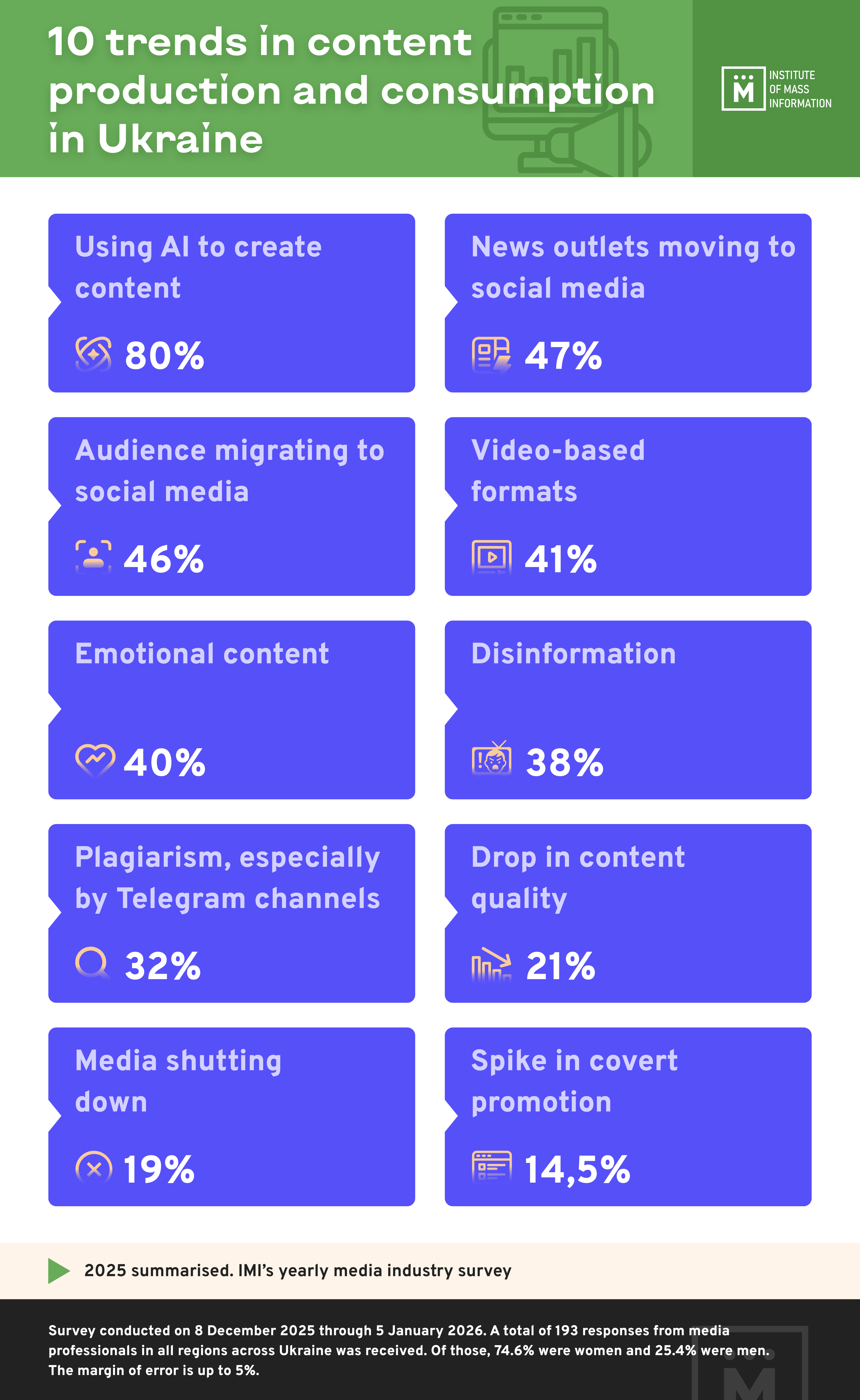
1. The use of generative artificial intelligence (AI) was the most commonly reported trend (by 80% of respondents). IMI analysts note that AI is being used increasingly often as a means to compensate for staff shortages, overload experienced by media teams, and limited financial resources, rather than as a strategic innovation-driven choice.
2. Traditional news outlets moving to social media, reported by 47%** of respondents. An increasing number of traditional news outlets are focusing on their social media as key resources for interaction with the audience and advertisers. Accordingly, the media are adapting their content’s format and logic to the requirements of social media platforms, which does not always impact the content’s quality positively.
3. The audience and advertisers migrating to social media (by 46% of respondents). This trend is connected to the previous one, as media notice their key partners and clients switch to social media and have to to follow them. More and more news outlets are launching projects on YouTube, TikTok, Instagram, developing their own Telegram channels, and exploring other opportunities.
4. Evolution of video-based formats (by 41% of respondents). Media professionals attribute the growing role of videos to the priorities of social media platforms, text-based content fatigue on the audience’s part, and growing competition for attention.
5. Content drawing on emotion and hype, reported as a trend by 40% of respondents. IMI analysts view this trend as alarming, as emotion is being used increasingly often to keep the audience hooked, sometimes to the detriment of the journalism standards of quality and balance.
6. Disinformation and psy-ops, reported as a trend by 38% of respondents. According to IMI experts, this trend being mentiond this often suggests that a new type of threat, directly related to the development of AI. While previously deepfakes used to be one-off cases and easily identifiable, now they are fast-upscaling, increasingly difficult to tell apart from reality and quite cheap to produce, all of which is exacerbated by the audience lacking the specialised skills to identify AI-generated content.
7. Plagiarism and content theft, reported as a trend by 32% of respondents. IMI analysts attribute this phenomenon to the growing competition for the audience’s attention and the ubiquity of Telegram, a platform where copyright mechanisms essentially do not work.
8. Drop in content quality, reported as a trend by 21% of respondents. IMI analysts believe this trend has to do with the financial crisis in the media sector, where news outlets are faced with resource and staffing shortages preventing them from producing exclusive material. In such an environment, news feeds are increasingly being flooded with reposts and second-hand content while the limited quantities of unique product are deliberately relegated to social media, where the requirements for fact-checking, quality, and responsibility to the audience are much more lax.
9. News outlets shutting down, reported as a key challenge by 19% of respondents. This is an extremely high figure that was one of the previous year’s unique features. IMI analysts attribute this dynamic primarily to the cessation or abrupt cuts of US funding, the long-term impact of the full-scale war, and the growing staffing crisis, which makes it impossible for some news outlets to operate stably even when the demand is there.
10. Spike in covert promotion, especially political, reported as a trend by 14.5% of respondents. Another unique indicator of the past year, correlating with the findings of another IMI monitoring study. Analysts note that some political forces have ramped up their efforts to “shower” news outlets in offers to publish political advertising structured as a news story, demanding that it not be labelled in any way. This creates additional pressure on the media in an environment of financial instability and increases the risks of violation of professional standards.
Nevertheless, media professionals also reported some positive trends, which, however, did not make the top ten. These included the evolution of niche and local news outlets (12%), increased transparency (12%), and improved content quality (8%).** These trends are not prevalent and need to be encouraged and developed in the future.
*The study was conducted using a quantitative anonymous online survey method with a simple random sample of potential respondents — journalists and news outlet editors. A total of 193 responses from media professionals in all regions across Ukraine was received. Of those, 74.6% were women and 25.4% were men. The margin of error is up to 5%. The survey was conducted on 8 December 2025 through 5 January 2026.
**The sum of responses does not equal 100% because respondents could pick multiple options.
Earlier, IMI released the first and second parts of this annual survey, focusing on the biggest challenges faced by Ukrainiain media in 2025 and the state of press freedom in Ukraine as reporterd by media professionals.