
Ukrainian journalists spent 2025 in a state of long-term functional exhaustion, but they had already adapted to the war and were more resilient than in previous years, as evidenced by the anonymous quantitative online survey of journalists conducted by the Institute of Mass Information on 8 December 2025 through 5 January 2026. The survey was formatted as a questionnaire and included 193 journalists in all regions across Ukraine.*
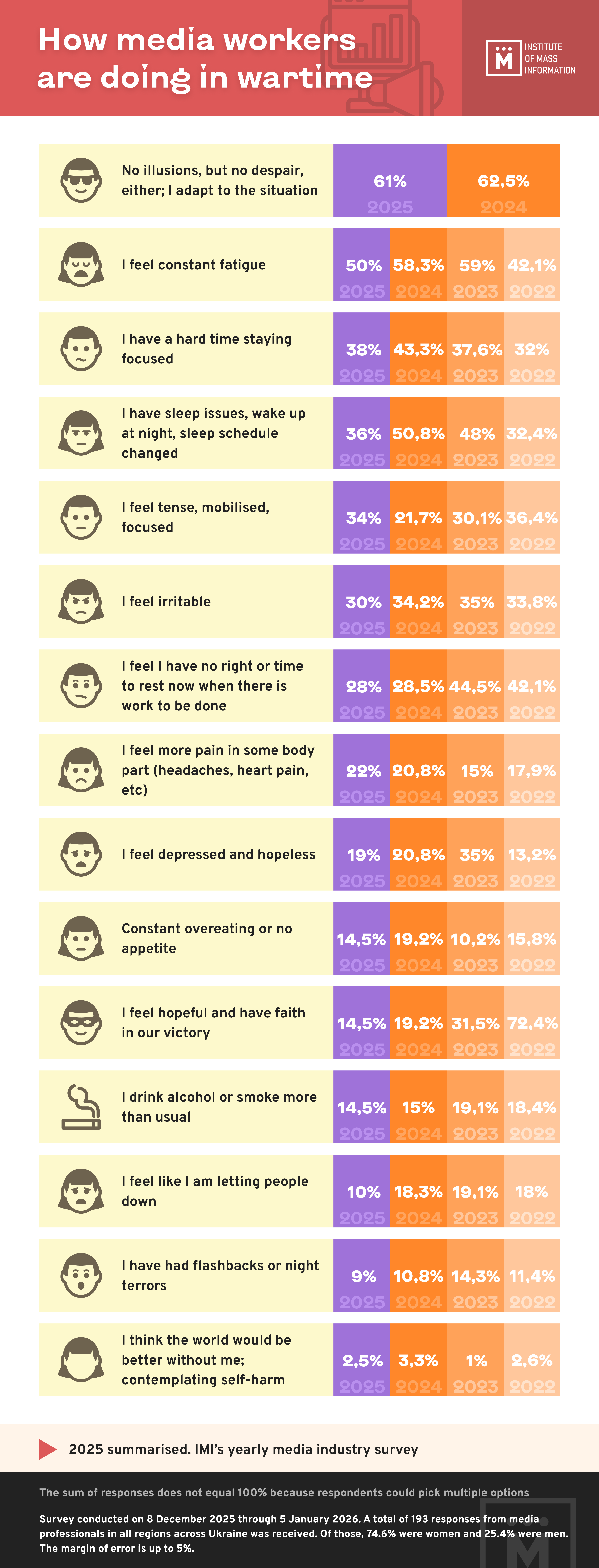
The Institute of Mass Information surveys for 2022 – 2025 showed a profound transformation in the mental and emotional state of Ukrainian journalists over the course of the full-scale war. The initial feelings of mobilisation and hopefulness gradually gave way to a prolonged exhaustion and the necessity to adapt to a long-term crisis. IMI recorded a gradual shift in mood among media professionals. The share of those who clung to hope and faith in Ukraine’s victory dropped from 72.4% in 2022 to 14.5% in 2025. By 2025, journalists have switched from the optimism that fuelled them in 2022 to adaptation mode, not clinging to illusions but not throwing in the towel, either, as was clearly visible from the majority’s response: 61% of respondents said they had “no illusions, but no despair, either; I adapt to the situation.” In fact, this seemed to the new norm: not telling oneself that “everything will be fine,” but to say, “I will make it through this day and do my job.” IMI experts found this to be an important element of resilience: relying not on emotions, but on responsibility and conscious choices for meaning.
Continuous fatigue was the dominant emotion in 2025, reported by half of the surveyed journalists (50%). This indicator has also dropped since 2024 (58.3%), but remained critically high and points to accumulated exhaustion.
At the same time, the share of respondents who described their state as tense, mobilised, and focused has grown in 2025: up to 34% compared to 21.7% in 2024. This suggests a shift from emotional reaction to the crisis to a more rational, operational state of survival and adaptation.
The IMI survey recorded a drop in acute stress symptoms. Namely, the share of journalists experiencing sleep problems decreased from 50.8% in 2024 to 36% in 2025. The number of those who reported feeling depressed and hopeless dropped from 35% in 2023 to 19% in 2025. Only 9% reported flashbacks and night terrors in 2025.
Still, a significant risk group remained. For instance, 38% of respondents reported attention span issues, 22% reported increased physical pain. The 2.5% of respondents who reported contemplating self-harm or feeling like the world would be better off withouth them call for special attention.
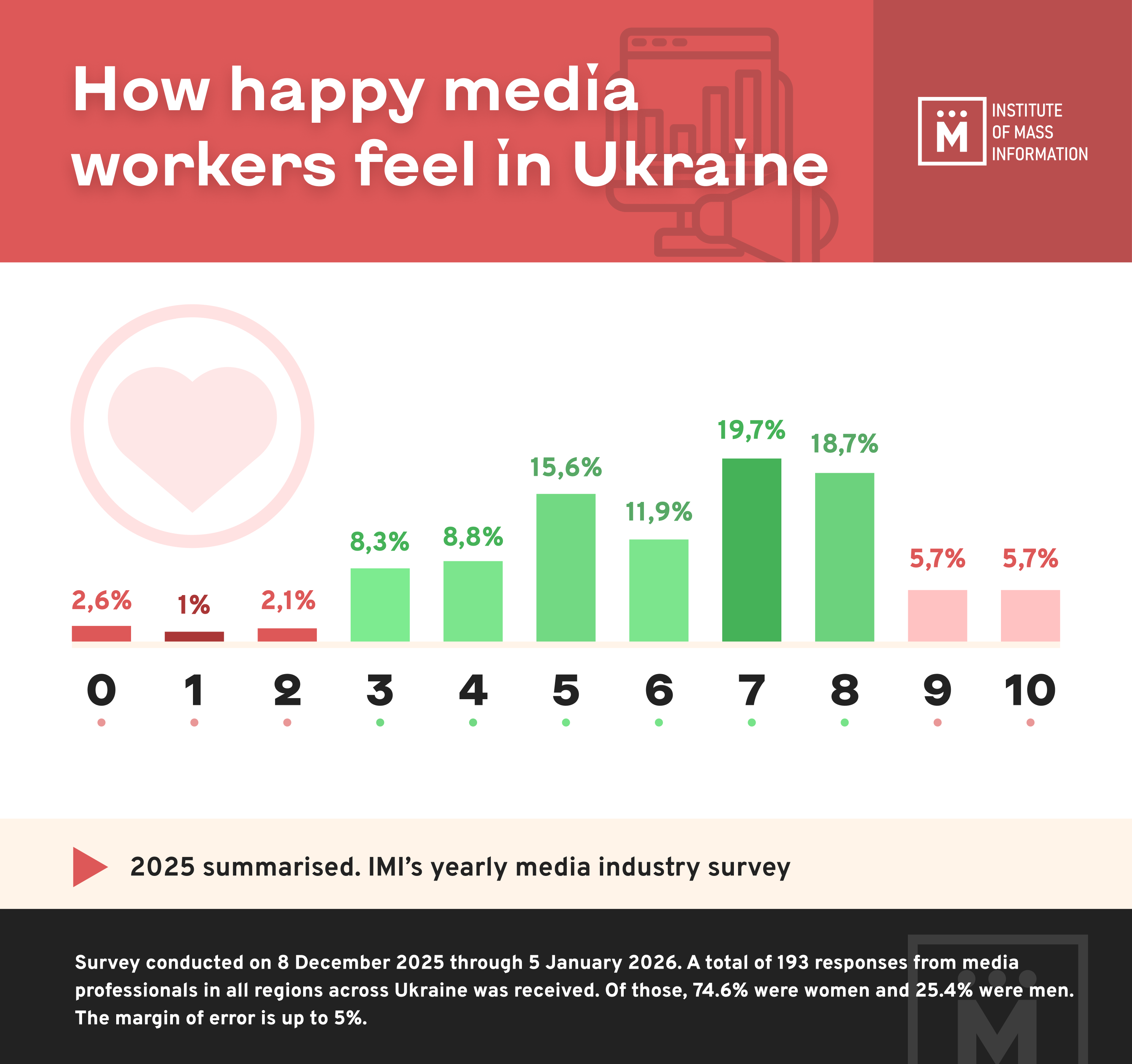
The survey also asked journalists to rate how happy they felt working in Ukraine’s media industry on a scale from 0 (totally unhappy) to 10 (very happy).
The dominant level of professional fulfillment was average. The largest share of responses ranged from 5 to 8 points. Namely, 19.7% of respondents rated their happiness at 7, 18.7% at 8, and another 15.6% at 5. This means that the majority of journalists feel neither extremely satisfied nor completely disappointed with their profession.
A low level of happiness (0–2 points) was reported by 5.7% of respondents. At the same time, only one in ten journalists felt truly satisfied with their work despite the war and the crisis in the industry (11.4% of media workers rated their happiness at 9–10 points).
Assessing their own energy level on a scale from 0 (complete exhaustion) to 10 (fully energised), most journalists chose values in the lower and middle sections of the scale. Most responses were at 3 points (21.8%), 5 points (20.7%), or 4 points (13%).
Overall, more than half of the respondents assessed their energy as below average or average. 16.6% of journalists (that is, one in six) reported a critically low energy level (0–2 points). Only 8.8% of respondents reported a high energy level (8–10 points), and only 0.5% rated their energy level at 10.
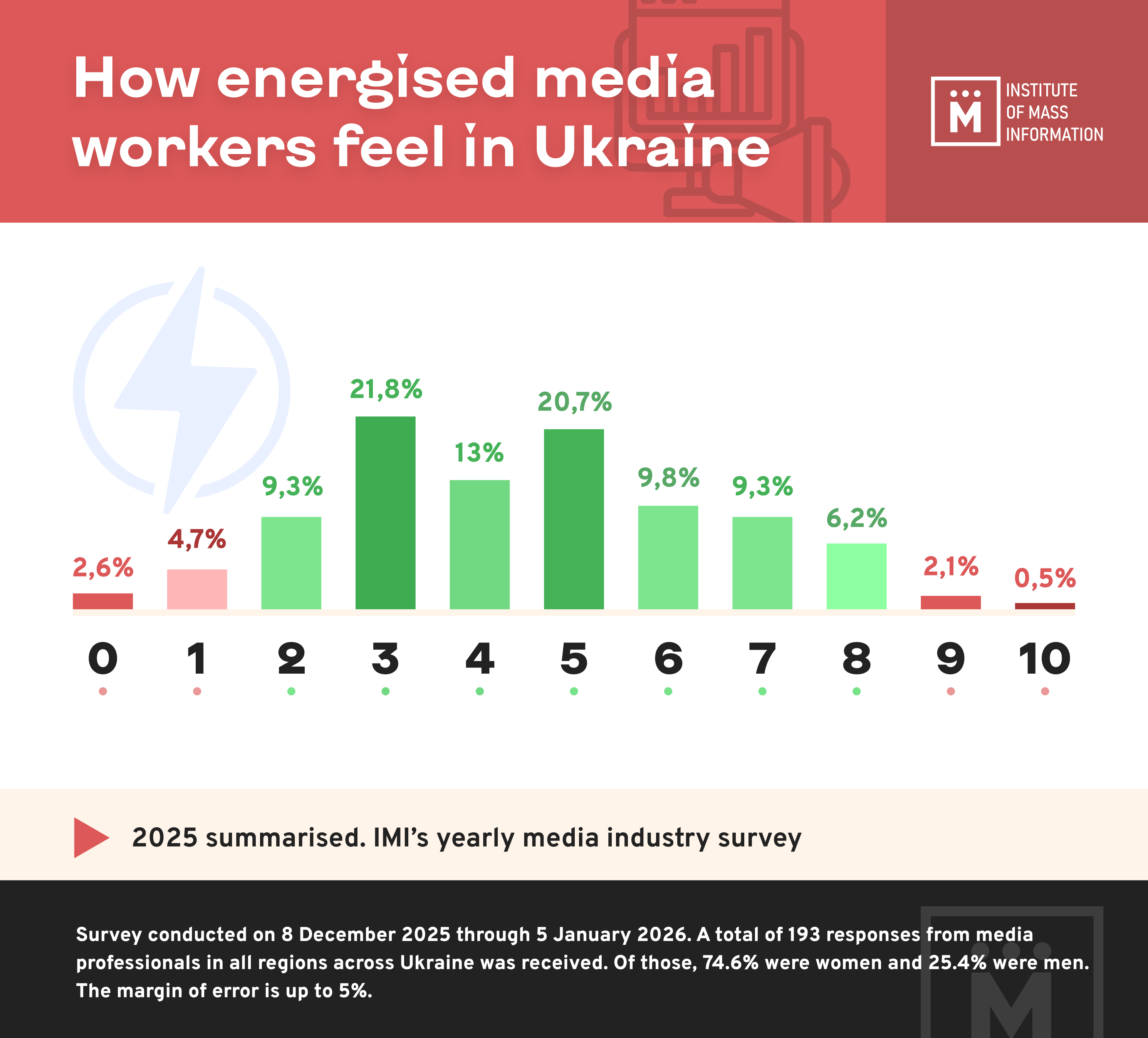
IMI experts say that these data point to a systematic exhaustion among media workers. Even when the level of professional fulfillment is relatively high, many journalists lack the internal resource, which points to accumulated fatigue, chronic overload, and high risks of burnout.
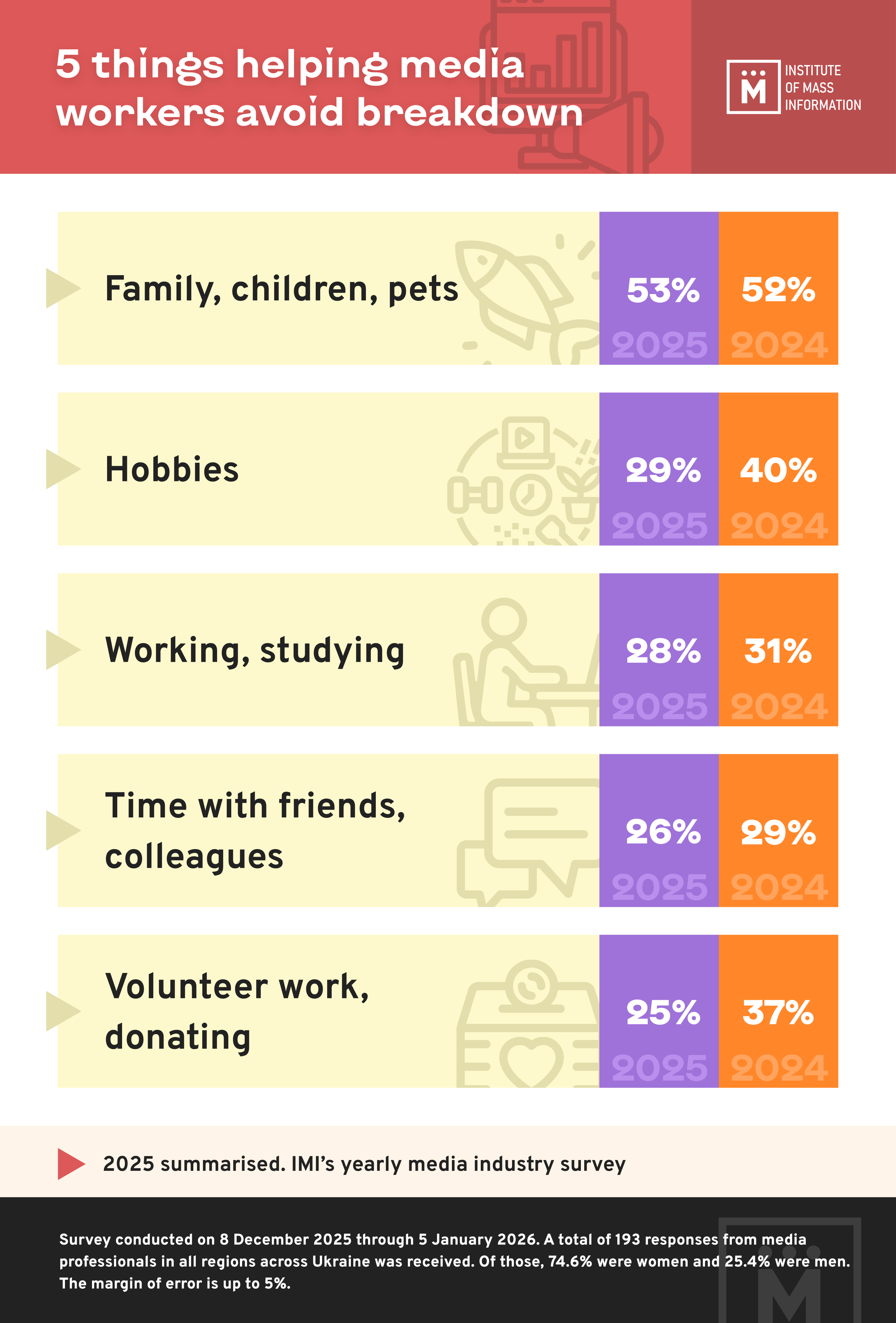
Most journalists relied on their close circle and everyday support as opposed to seeking professional mental health help or taking up recovery practices to avoid breakdown in 2025.
One’s relatives, children, and pets were reported as a source of support most often (53%), as in previous years. This indicator has been consistently high since 2022.
The share of those who practice hobbies for their mental health droppd to 29% in 2025, compared to 40% in 2024. The share of journalists who were trying to cope by working or studying more was 28%, lower than in 2023 (34.2%).
26% of respondents picked spending time with friends and colleagues — this figure is gradually dropping, as well. Only 23% of respondents reported trying to get more rest, which is significantly less than in 2024 (33%).
The survey revealed some worrying markers. For example, 6% of journalists said they did nothing to maintain their mental health, which is a bigger number than a year before. Drinking alcohol and smoking were reported as coping mechanisms by 13% of respondents, while in 2024 this figure was 11%.
The share of respondents seeking therapy has dropped to 12%, compared to 21% in 2024. This does not necessarily mean that journalists need it less, but rather points to financial or time constraints and may be a consequence of relevant grant programs shutting down. At the same time, 12% of journalists reported using antidepressants, which is a significant increase compared to 2022 (2.1%). 4% of respondents reported undergoing treatment with a psychiatrist.
*The study was conducted using a quantitative anonymous online survey method with a simple random sample of potential respondents — journalists and news outlet editors. A total of 193 responses from media professionals in all regions across Ukraine was received. Of those, 74.6% were women and 25.4% were men. The margin of error is up to 5%. The survey was conducted on 8 December 2025 through 5 January 2026.
**The sum of responses does not equal 100% because respondents could pick multiple options.