

The Khmelnytskyi Oblast Military Administration (OMA) was selective in inviting reporters to a meeting with Verkhovna Rada Chair Ruslan Stefanchuk, which four local TV channels got to attend but no news websites did, the OMA press office reported to Alyona Bereza, the Institute of Mass Information’s representative in Khmelnytskyi oblast.
The meeting, titled “Parliament Dialogue”, took place at Leonid Yuzkov Khmelnytskyi University of Management and Law on 6 October. It primarily focused on the Civil Code of Ukraine overhaul. Khmelnytskyi OMA Chair Serhiy Tiurin called the event an “open dialogue” in a Telegram post and remarked that the participants could put questions to the Parliament Chair.
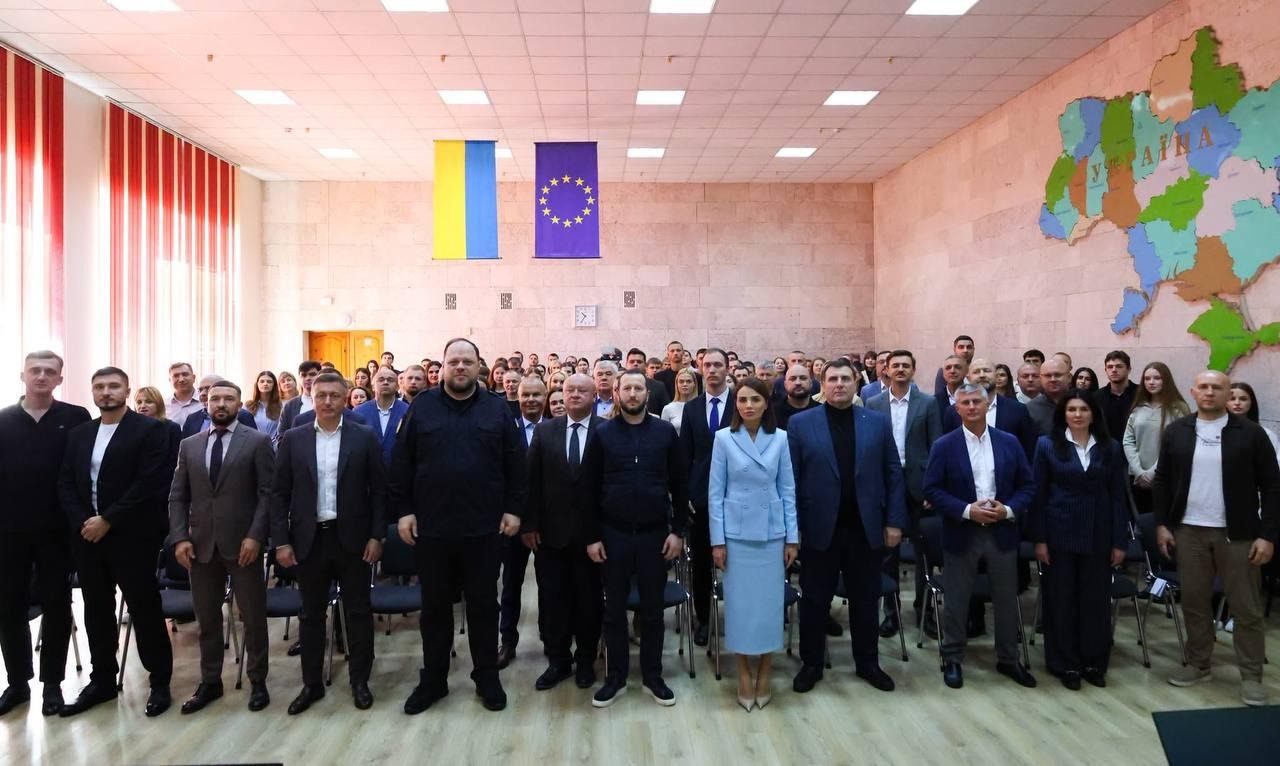
Alyona Bereza contacted Khmelnytskyi OMA’s press office to find out on what grounds reporters had been invited. A press office representative confirmed in a conversation that invitations had been extended selectively, by phone. The press office also cited limits on attendance, saying that 11 media representatives had been present, making up 10% of the people in the room, in line with the recommendations set out for the event.
Four TV channels were invited: Suspilne Khmelnytskyi, Channel 33, Misto, and TV7+. Press office staff from the OVA and the Oblast Council were also present. Not a single news website was invited.
READ MORE
“We usually invite everyone to events. You know there’s a group chat where we post invitations. Since few people respond, we called those who attend events most often,” the press office representative explained.
IMI’s representative pointed out that news websites had received no invitations and therefore had not been able to decide whether to attend the meeting. Asked why, given the limited number of seats, staff with government press services had been counted among the media representatives while news websites had not been invited, the OMA press service replied: “They provide coverage of officials.”
Alyona Bereza said that all media outlets should have been given the opportunity to ask questions about changes to legislation affecting their work, namely the new version of the Civil Code, authored by Verkhovna Rada Chair Ruslan Stefanchuk.
The Ternopil-based newsroom 20 Khvylyn also reported difficulties accessing the “Parliament Dialogue” event. The outlet’s journalist Iryna Beliakova wrote that she had submitted an accreditation application on 5 October. However, the following day the team was told that the application had been submitted too late.
IMI lawyer Volodymyr Zelenchuk explained that limiting the number of attendees because of a venue’s capacity under martial law is not a breach of law in and of itself. Still, he added, the way these seats were allocated was entirely unlawful.
“The method of ‘calling around at random’ or inviting reporters selectively is discriminatory, because a state body’s press office has no right to decide which media outlet is ‘more important’ or ‘more fitting’ for an event,” Volodymyr Zelenchuk explained.
He said that the third clause of Part 1, Article 26 of the Law of Ukraine “On Media” provides that accreditation must be based on openness, equality, and fairness so as to safeguard the public’s right to receive information through the media.
“The selective principle of ‘inviting those who attend events most often’ goes against the principles of equality and fairness, and the absence of advance notice of the event goes against the openness principle,” Volodymyr Zelenchuk remarked.
The lawyer pointed out that the OMA had not publicly announced the event in advance. In his view, this may indicate a violation of the law on access to public information.
He recalled that, under Article 15 of the Law “On Access to Public Information”, public authorities are obliged to publish information about their open events, work plans, and the procedure for attending meetings in advance.