
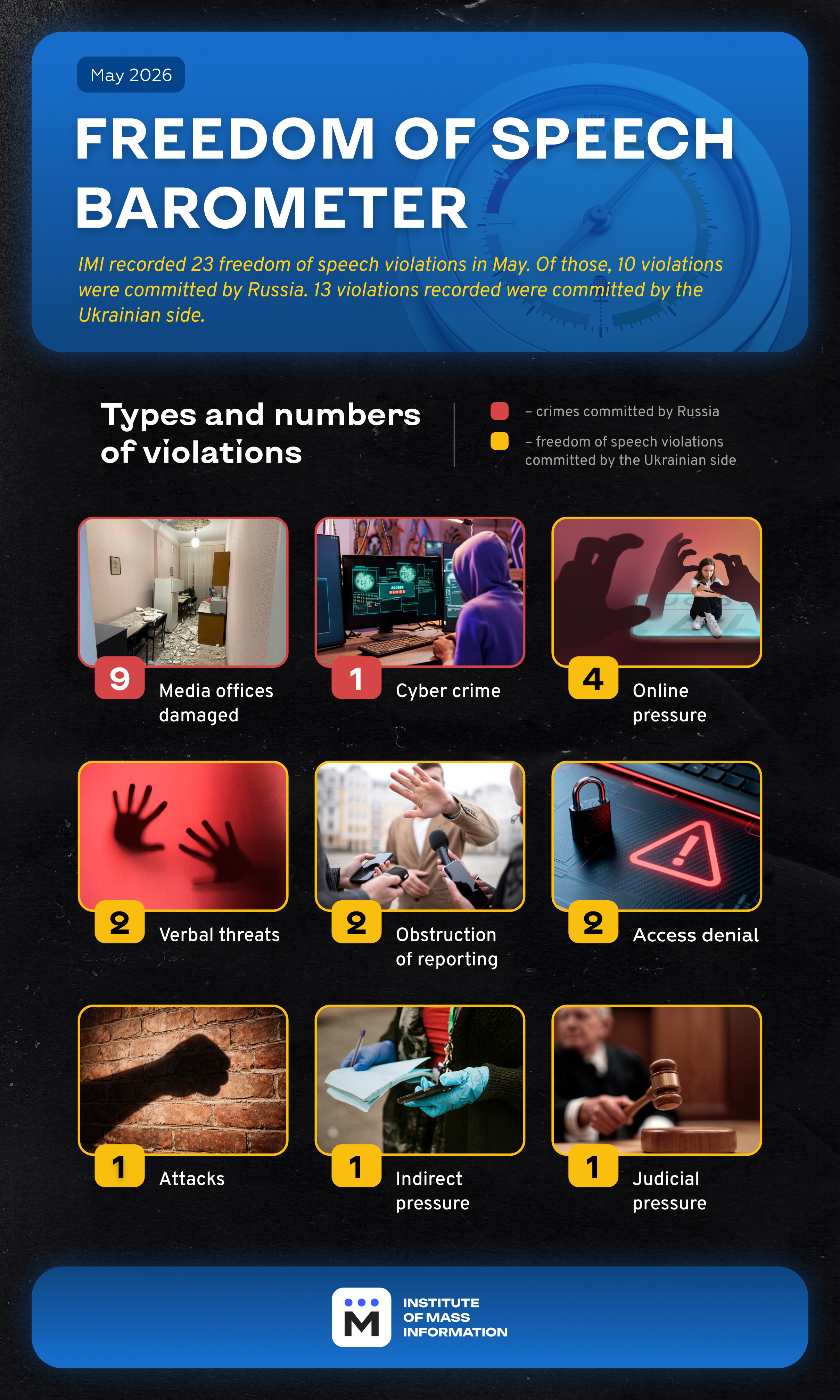
The Institute of Mass Information experts recorded 23 freedom of speech violations in Ukraine in May 2026. 10 were committed by Russia, as evidenced by IMI’s monthly monitoring study, the Freedom of Speech Barometer.
Russia’s crimes against the media and journalists included destruction of and damage to media offices, as well as cyber attacks.
The death of one media worker turned UAF servicemember* was reported in May:
- Oleksandr Klymenko, a serviceman, videographer, and director from Poltava. He had worked as a video editor with the Poltava-based TV channels Misto and Tsentralnyi (before 2020). Klymenko had been considered missing in action since 2024. His death was confirmed on 30 April 2026 by the DNA examination of the soldiers’ bodies released by Russia.
Destruction of and damage to media offices
- The office of the Ternopil-based newspaper 20 Khvylyn was damaged in Russia’s mass drone attack on the city: fragments of a shot-down Shahed drone hit the office building and broke the windows. There were no casualties, since all staff were in a bomb shelter.
- The Suspilne Zaporizhzhia office was damaged in a Russian drone strike along with the TV tower infrastructure. There were no casualties among the team, as everyone had taken cover in the bomb shelter. The attack damaged the windows in the buildings and television broadcasting was temporarily off due to damage to the television tower.
- Russian strikes at Sumy blasted out the windows in Kordon.Media office eight times in late 2025. Most damage was inflicted by various types of drones. The team continued to work despite the repeated attacks, doing some repairs at their own expense or with support from charity organisations. The team is allowed to work remotely for their own safety.
- The DW office in Kyiv was damaged in a Russian strike. The team was unharmed.
- The office of the news website Shelter was damaged in a Russian strike in Kyiv. The team was unharmed.
- The Kyiv office of Realna Hazeta, formerly based in Luhansk, was damaged by Russian shelling. The windows in the building were broken, some of the plaster flaked off the walls, and furniture and equipment were damaged.
- The office of the independent news website Graty was damaged in the Russian strike in Kyiv. The blast wave damaged the office room and podcast studio. The team was unharmed.
- The Kyiv studio of Germany’s ARD was severely damaged in a Russian strike. The windows were broken and some walls collapsed. The staff were unharmed.
- The external glazing in the UNIAN office in Kyiv was damaged in a Russian strike.
Cyber crimes
- Hackers targeted the blog section on the Ukrainska Pravda website and posted Russian propaganda there. The hackers accessed the passwords of some prominent columnists and made fake posts impersonating them.
IMI also recorded 13 press freedom violations unrelated to Russia’s war on Ukraine. These included cases of assault, death threats, obstruction of reporting, denial of access to information, online pressure, judicial pressure, and indirect pressure.
Violations were recorded in Kyiv city, Chernihiv, Dnipropetrovsk, Volyn, and Odesa oblasts. The perpetrators were officials of varying ranks and private persons.
Assault
- A Chernihiv village council staff attacked a Slidstvo.Info filming crew working on a news story about a deceased serviceman and knocked the camera out of the cameraman’s hands.
Death threats
- Texty.org.ua journalist Valeria Pavlenko faced veiled threats and hateful comments on social media following her reporting on the recent immigration panic. The comments hinted to a potential retaliation.
- Pershyi Kryvorizkyi journalist Yevhenia Bykova faced a wave of hateful social media comments and death threats, including warnings such as “some journalists don’t live long,” following a series of articles and registering a petition opposing the raise in water tariffs in the city.
Obstruction of legal reporting
- A Volyn city council official attacked a Syla Pravdy filming crew as they were working on a news story about a rent conflict, grabbing the correspondent’s phone out of her hands. The police are investigating the incident as obstruction of reporting.
- Larysa Kryvoruchko, the defense attorney of Vyacheslav Zinchenko, who stands accused of murdering the public figure Iryna Farion, warned journalists and public activists of potential legal liability for filming and sharing her private conversations in the courtroom.
Access to information
- The Odesa Oblast Military Administration (OMA) refused to share data about the salary of their chair Oleh Kiper with the Center for Public Investigations (CPI), citing martial law and security. The team believes the information to be of public interest and is drafting an appeal.
- The Chernihiv oblast enlistment office refused to disclose information about the burial of a deceased serviceman to Slidstvo.Info, claiming that the query was unfounded and the information could not be disclosed without the family’s consent. The journalists stress the public interest in the story.
Online pressure
- The donation section of the #SHOTAM website was targeted by hackers and bots shortly after the team discovered that a network of social media pages had been impersonating them.
- The Instagram page of Dnipro-based journalist Maria Tkachova was suspended following mass strikes by followers of the underage blogger Timofiy Poteriaylo. The blogger encouraged his subscribers to flag the journalist’s account after she posted a video about his activities.
- Suspilne Dnipro journalist Inna Lysak faced a wave of hateful comments and social media attacks after the release of her interview with Fedor Zinchenko, the father of Vyacheslav Zinchenko, who is accused of murdering Iryna Farion.
- Slidstvo.Info was targeted in an online smear campaign, with several websites posting identical news stories discrediting the news outlet within half an hour. This coincided with the release of Slidstvo’s investigation into a business affiliated with Viktor Medvedchuk’s milieu.
Indirect pressure
- The parliamentary Freedom of Speech Committee has tried the complaint by Danylo Mokryk, an investigative journalist with The Kyiv Independent, against MP Oleksiy Honcharenko. The journalist claimed that the official had posted screenshots from a private group chat that allowed to identify where Mokryk lives.
Judicial pressure
- Centrenergo PJSC is suing Bihus.Info journalist Svitlana Slipchenko, demanding that her investigation into the effort to overhaul the Trypillya TPP be taken down from their YouTube channel, the corresponding news story be removed from the website, and that the media outlet pay them ₴1 million as compensation for moral damage.
RUSSIA’S CRIMES
Destruction of and damage to media offices — 9
1. 20 Khvylyn office damaged in Russian strike in Ternopil
01.05.2026 The office of the Ternopil-based newspaper 20 Khvylyn was damaged in Russia’s mass drone attack on 1 May, editor Natalia Burlaku reported in a Facebook post and in a comment to the regional Institute of Mass Information representative Iryna Nebesna.
Burlaku said that fragments of a shot-down Shahed drone had hit the office building and damaged the windows.
“At the moment of the strike, all staff were in a bomb shelter, so there were no casualties. Some team members were working away from the office,” Burlaku added.
In a comment to the IMI representative, she said that the damage was not severe and they would shoulder the repairs on their own.
Ternopil OVA chair Taras Pastukh reported that 36 air targets were spotted over the city during the strike. 27 were shot down by air defense and nine more hit civilian infrastructure objects. According to Ternopil oblast police, 12 people were harmed in the strike as of 17:30 on 1 May.
2. Russian stikes blasted out Kordon.Media office windows 8 times in late 2025
08.05.2026 Russian strikes at civilian infrastructure in Sumy blasted out the windows in Kordon.Media office eight times in late 2025, the news website’s executive director Alyona Yatsyna reported to Olha Panfilova, the Institute of Mass Information representative in Sumy oblast.
Yatsyna says that the first strike was by a Molniya drone, which fell down outside in front of her office window. The explosion blasted out the glass. The attack occurred during the day, but there was no one in the office at the time: the journalists had gone to a nearby cafe.
The over 10 strikes that followed were by various types of drones (Lancet, Molniya, Cube); 8 of them resulted in damage to the office windows.
“Sometimes we had no time to replace the windows, sometimes the parts of the glass that had survived the previous blast would fall out. The panels that we used to board up the windows would also fly out. Now we have new windows with security film, so after some strikes they would just crack,” says Alyona Yatsyna.
The journalists worked for a while in an office with chipboard panels instead of glass, which made the work difficult.
Charity organisations and “Kordon’s friends” (the community supporting the news outlet) helped restore the office. For example, the humanitarian foundation Proliska delivered construction supplies, and the Baloo Foundation helped with the repairs.
The furniture in the office was also damaged: the team pulled out the fragments that had gotten stuck in some pieces and continue to use them. Kordon.Media has installed new windows at its own expense, but the team has applied for compensation, which is yet to arrive.
Alyona Yatsyna says that her team has a rule that says employees do not have to work in the office and can choose other places that they consider safer.
3. Suspilne office damaged in Russian strike in Zaporizhzhia
13.05.2026 The Russian forces attacked the premises of the Suspilne Zaporizhzhia office with a droneon 13 May, the broadcaster reported.
There were no casualties and no one was injured: all staff had left the premises and took cover by the time of the strike.
The attack damaged the windows in the buildings and television broadcasting was temporarily off due to damage to the television tower.
“What matters is that the people are alright. There is no severe damage to the office premises,” said Suspilne Zaporizhzhia manager Marianna Hura.
4. DW office in Kyiv damaged in Russian strike
24.05.026 The DW office in Kyiv was damaged in the Russian attack on Kyiv overnight on 24 May, the news outlet reported in a Facebook post.
DW Kyiv bureau chief Mykola Berdnyk said that the shock wave caused severe damage to the windows and ceiling in the office, adding that the team was unharmed and the journalists continued to work.
“Despite Kyiv being increasingly affected by Russian airstrike terror, the DW journalists working in Ukraine remain unwaveringly motivated,” Berdnyk said.
DW Quartermaster Barbara Massing stressed that the news of the office being damaged “came as a shock” and once again demonstrated the conditions under which Ukrainian journalists have to work while reporting on the war.
The Kyiv City Military Administration reported that the Russian strike in Kyiv killed two people and injured 86, including three children.
5. Russian strike at Kyiv damages news website’s office
24.05.2026 The office of the news website Shelter, located near Maidan Nezalezhnosti in Kyiv, was damaged in the Russian strike in the city overnight on 24 May, the media outlet reported in a Facebook post and on their website.
The strike affected the business center housing the office. The team reported that none of the employees were injured.
Shelter owner and chief editor Svitlana Sheremetyeva said that the team continued to work despite the serious damage to the premises.
“No matter how unpleasant the consequences of this night were for us, they are not even close to the experiences of those living in the high-rise buildings where the fire did not subside until morning. We will, of course, repair the office and the studio. And we will not stop working, because the Shelter team has countless plans, ideas and ambitions to fulfill,” she said.
6. Realna Hazeta office damaged in Russian strike in Kyiv
24.05.2026 The office of Realna Hazeta, formerly based in Luhansk, was damaged by Russian shelling overnight on 24 May, the news outlet reported in a Facebook post.
The windows in the building were broken, some of the plaster flaked off the walls, and furniture and equipment were damaged.
“There is not a single intact window left in the office. The furniture was either significantly damaged or destroyed. We have lost the equipment. However, no one was injured,” Realna Hazeta reported.
The team shared their bank details for donations.
In another post, chief editor Andriy Dykhtiarenko addressed his audience, saying that the environment in the office was “completely unfit for work” and that it was unlikely to be fully restored within months.
“We are grateful to everyone who supported us and continues to support us,” Andriy Dykhtiarenko added.
He said that the team had relocated from Luhansk and that they would continue to work despite Russian strikes following the team to Kyiv.
7. Graty office damaged in Russian strike in Kyiv
24.05.2026 The office of the independent Ukrainian news website Graty, focusing on social and political issues, was damaged in the Russian strike in Kyiv overnight on 24 May, chief editor Tetyana Kozak reported in a Facebook post.
Kozak said that the blast wave had damaged the interior rooms in the building, such as their office and podcast studio.
“The blast wave got the ceilings and windows in the building housing Graty‘s office and studio good. We were lucky: the equipment and windows are intact!” she said.
In a comment to the Institute of Mass Information, Tetyana Kozak said that the team continued to work.
“This is not even a question,” chief editor stressed.
Graty specializes in courtroom reporting and human rights coverage and has been actively tracking Russia’s war crimes in Ukraine since the start of the full-scale invasion.
8. Germany’s ARD studio damaged in Russian strike in Kyiv
24.05.2026 The ARD studio in central Kyiv was severely damaged in the Russian drone and missile strike on 24 May. It was likely partially destroyed by a shockwave that shattered the windows and caused wall collapse. No staff members were in the studio during the attack, ARD reports.
The building’s structural integrity needs to be assessed. Despite the extensive damage, the team continues to work: production and live reporting will be ensured using mobile technologies and alternative locations.
Studio head Vasyl Holod said that the team would not stop working despite the damage.
“Torn-out window frames, shards of glass everywhere, destroyed equipment – seeing your own workplace completely devastated is a shock. The Russian airstrikes have been massive and ruthless for years and are part of the brutal reality of life in Ukraine. I have enormous respect for our team, which refuses to be intimidated by this aggression and remains fully focused on our mission: to report what is happening,” he commented.
The ARD studio is subordinate to WDR. Director General Katrin Vernau expressed her “great relief” that no employees were injured.
9. UNIAN office damaged in Russia’s Kyiv strike
24.05.2026 The external glazing in the UNIAN office in Kyiv was damaged in the Russian strike overnight on 24 May, chief editor Mykhailo Hannytskyi reported in a comment to Institute of Mass Information journalist Valentyna Troyan.
He said that the windows in the office were intact and it was just the show-window that was broken. The incident will not affect the team’s work.
Hannytskyi added that the team had contacted to the police, asking them to record the impact of Russia’s war crimes. The police are yet to visit the office due to the large number of such requests. The glass shards will be cleaned out after this happens, chief editor said.
Mykhailo Hannytskyi shared a photo of the damaged glazing on Facebook. “It’s alright. We will fix it,” he wrote.
Cyber crimes — 1
1. Hackers target Ukrainska Pravda blogs, post Russian propaganda
07.05.2026 Hackers accessed the blog section of the Ukrainska Pravda website and posted Russian propaganda, UP’s deputy chief editor Yevhen Buderatskyi reported to Institute of Mass Information journalist Valentyna Troyan.
Buderatskyi said the hackers had accessed some columnists’ passwords.
“Then they used the accounts of those who write blogposts on our website to post this text. Its content was what led us to the logical conclusion that the Russians were behind it,” Yevhen said, sharing a screenshot.
The text claims that it is “the nationalists” or “the Nazis”, and not the Russians, who are Ukraine’s biggest enemy. The post was shared from the accounts belonging to Darya Kaleniuk (Anti-Corruption Action Centre executive director and board member), Oksana Zabuzhko (author, PEN Ukraine Vice President), and others. In Zabuzhko’s case, the propaganda text replaced her blogpost dating as far back as 2008.
“Our tech team is working to address the fallout [of the attack],” Yevhen Buderatskyi said.
CRIMEA — 1
1. Russian police visits Lutfiye Zudiyeva’s home to issue warning
18.05.2026 The Russian police visited Graty journalist and human rights activist Lutfiye Zudiyeva in her home in Canköy (Crimea) on 15 May, Zudiyeva told Crimean Solidarity.
The police warned her of potential liability for holding “unauthorized rallies” on the Day of Remembrance for the Victims of the Crimean Tatar Genocide on 18 May.
An officer with Russia’s Canköy Police Department had a “preventive conversation” with Zudiyeva, claiming to be acting on behalf of the Russian Interior Ministry and the Center for Countering Extremism “in order to prevent offenses and crimes of a terrorist or extremist nature.”
Lutfiye Zudiyeva, who was required to sign the document, left a note stating that she disagreed with the warning, had not endangered, and did not plan to endanger public security.
“Meetings with officers of various law enforcement agencies have become more consistent in recent years: now for one reason, now for another,” Zudiyeva said.
The Russian police also visited the human rights activist Mumine Saliyeva in Bağçasaray and Lilia Gemeci in Crimea’s Simferopol district, issuing similar warnings.
Crimean Solidarity reports that Russian police officers annualy hand out warnings to Crimean Tatar public figures, activists, and human rights defenders ahead of 18 May.
THE FREEDOM OF SPEECH SITUATION UNRELATED TO RUSSIA’S WAR IN UKRAINE
Physical aggression
Assault — 1
1. Village council staff knocks camera out of Slidstvo.Info cameraman’s hands
19.05.2026 A man claiming to be a “freelance worker” attacked Slidstvo.Info journalists at the Sribne Village Council (Chernihiv oblast) and knocked the camera out of the cameraman’s hands, the media outlet reports.
The incident occurred as the crew was working on a story about a Ukrainian serviceman who was tortured and died in Russian prison and whose body was repatriated a year ago. The journalists had arrived in the village to find out how and where the soldier was buried, since some of the villagers had opposed his burial in the community’s territory.
Not finding the soldier’s grave, the filming crew went to the village council to get a comment from council chair Olena Panchenko within her reception hours. Instead, a man they met in the council building said that the top officials were absent for a “Saturday clean-up event” and threatened to call the police.
The conflict escalated when the journalists tried to check the council chair’s office. In the building’s hall, the man started physically shoving the journalist out into the street. When the cameraman raised the camera to film his actions, the attacker knocked the device to the floor with a blow of his hand.
Later, the council’s deputy chief of humanitarian issues and social policy Nina Bondarenko heard the shouting and came out. She apologised for the “misunderstanding,” but confirmed that the council chair was away.
The journalists’ attempts to find Olena Panchenko at the clean-up event yilded no result: the utility workers said that they had not seen the official.
Death threats — 2
1. Texty.org.ua journalist faces veiled threats after reporting on immigration panic
26.05.2026 Texty.org.ua journalist Valeria Pavlenko faced veiled threats and hateful comments on social media following her reporting on the recent immigration panic, Pavlenko reported in a comment to the Institute of Mass Information journalist Valentyna Troyan and in a Facebook post.
Pavlenko said that the aggressive response was triggered by her analytical article “The Immigrants Invading Ukrainian TikTok”, which discussed artificially orchestrated media campaigns.
“There comes a day in the life of every journalist when they get threatened for their reporting. For me, this day came yesterday. And do you know why? Because we at Texty.org.ua released a study saying that the surge of hate towards immigrants bears all the hallmarks of a propaganda campaign,” Valeria Pavlenko said in her post.
She added that she initially expected such a reaction to come from her high-profile investigations or articles criticising officials, and not her analytical work.
The response was sparked by a comment to her video from a user named @michael01307, which read: “Madam host, will you feel safe walking outside after such videos? Aren’t you afraid that your work for the PO [President’s Office] will come back to bite you someday? Or simply, have you no shame?” The journalist replied, asking if the user was not afraid of being sued for threats; the user later deleted all their comments and the account.
In a comment to IMI, Valeria Pavlenko explained that she decided to make this situation public immediately to raise awareness of inappropriate comments and aggression online. She has not yet contacted her editorial office or the police for help.
She said that after she discussed the incident publicly, some anonymous users started arguing that the aggression had been justified.
“I didn’t receive any threats after that, but when I posted a thread about it, several anonymous accounts replied that ‘they were right, propagandists should hang’ or something like that (I didn’t read the comments, I blocked them immediately), and some argued that these were not threats. I don’t understand in what way the sentence ‘aren’t you scared to go out after such videos, aren’t you afraid that it will come back to bite you’ doesn’t sound like a veiled threat to someone,” Pavlenko stressed, adding that after the first comment was deleted, no one wrote to her personally.
2. “Some journalists don’t live long”: Pershyi Kryvorizkyi journalist reports death threats
27.05.2026 Pershyi Kryvorizkyi journalist Yevhenia Bykova faced a wave of hateful social media comments and death threats, including warnings such as “some journalists don’t live long,” following a series of articles and registering a petition opposing the raise in water tariffs in the city, Bykova and chief editor Olena Smolina told Kateryna Lysiuk, the Institute of Mass Information representative in Dnipropetrovsk oblast.
Yevheniya Bykova registered a petition calling for the resignation of the Kryvbasvodokanal director due to complaints about water quality, the lack of transparency in the company’s work, and the decision to raise the water tariffs.
The petition gained the required thousand votes in 10 hours and is to be reviewed at a Kryvyi Rih City Council session.
“And immediately many commentators under the post reporting that I was writing the petition rushed to defend the water utility. Which is not the first time this has happened to us. For at least a year now, there has been untypical activity under every news story about the water utility. The commentators included an account named ‘Anna Yuriivna’. She wrote, verbatim, ‘They say that not all journalists live long,’” said Yevhenia Bykova.
Pershyi Kryvorizkyi chief editor Olena Smolina said that the news outlet often reported on the water quality issue, relying on laboratory studies by state institutions.
Yevhenia Bykova said that she had decided to initiate a petition calling for the resignation of the director of Kryvbasvodokanal, since, in her opinion, there have been many issues in the company’s work.
“As a journalist, I see the general picture of the problem: the water utility does not respond to information queries, simply sending non-answers; the water quality is not up to code; the way the water utility repairs all these networks and responds to leak reports by Kryvyi Rih residents. A lot of problems have accumulated overall, which the company director should be monitoring,” said Yevhenia Bykova.
Using open sources, the journalists found that some of the commentators under the news outlet’s posts about Kryvbasvodokanal may be affiliated to the utility company.
Olena Smolina said that users actively defending the company regularly appear in the comments under the news outlet’s posts on Telegram. She added that some of the accounts were identified by names and surnames.
“These are real employees of the water utility, either those working in procurement those who oversee the water quality. That is, they are officially employed by the company. We have been seeing unusual activity on our channel, so we tracked them,” said Olena Smolina.
Yevhenia Bykova plans to report the threats and online harrassment she has faced in connection with her reporting to the police.
Obstruction of legal reporting — 2
1. Murder suspect’s lawyer warns journalists of liability for filming her conversations
06.05.2026 Larysa Kryvoruchko, the defense attorney of Vyacheslav Zinchenko, who stands accused of murdering the public figure Iryna Farion, wrote a Facebook post on 6 May warning journalists and public activists of potential legal liability for filming and sharing her private conversations in the courtroom.
The lawyer said that she considered it unacceptable to “eavesdrop on a lawyer’s phone conversations, share the content of their confidential talks with the client, publicly discuss defense tactics or private conversations.”
She added that such actions were in violation of the ethical standards of journalism, encroached on attorney—client privilege and a person’s right to defense, and potentially constituted several criminal offenses.
She also warned that in the future the defense would take legal action in response to such actions: “The right to defense presumes that communication between a lawyer and a client is confidential: without this, fair trial is impossible. The defense warns only once; in the future everything will be met with a legal response.”
The post was triggered by a video recording of her phone conversation taken during a hearing break on 5 May, Hromadske journalist Mariana Pietsukh, who is covering the trial, said in a comment to the Institute of Mass Information.
The journalist said that it was the first hearing in this high-profile case that involved Kryvoruchko, which is why the media were paying extra attention to her.
The defendant, Vyacheslav Zinchenko, refused the three previous lawyers assigned to him. The new lawyer, Larysa Kryvoruchko, failed to attend hearings twice, on 1 and 4 May, leading to them being postponed. On 5 May, the court dismissed the lawyer’s motion to disqualify the secretary and the panel of judges, but gave her two weeks to review the case files. The next hearing is scheduled for 20 May.
“After all, she appeared in court on 5 May, so the increased media attention to her was understandable, since this was her first hearing in such a high-profile case. Moreover, while changing lawyers, Zinchenko said that he was ‘changing his legal position,’ and it is important to understand what exactly will change with the new lawyer,” Pietsukh said.
According to the journalist, not only journalists but also representatives of support groups from both sides present in the courtroom were filming the hearings. The accused also sometimes talks with reporters during breaks, so journalists and those present are always ready to film.
She clarified that the media usually film clips of lawyers talking to their clients in the courtroom to use as B-rolls in their reports.
Pietsukh added that Kryvoruchko had talked with her client and spoke on the phone in the courtroom during breaks in the 5 May hearing without lowering her voice, so others present could hear her.
“She was not whispering, and everyone could hear her talking. She was also speaking loudly, sitting by the desk (while the judges were in the deliberation room), on the phone about some other work matters. Both the support groups on both sides and journalists recorded this on their phones,” Pietsukh said.
The journalist added that the lawyer’s conversations with the client and on the phone were both in Russian, which attracted extra attention given the prosecution’s belief that the crime could have been ideologically motivated.
“After all, the prosecution (prosecutors and the victim) is talking about an ideological motive for the crime. According to their version, the Iryna Farion was assassinated for her principled stance on the language issue, which the defendant allegedly believed to be divisive, according to the case files,” the journalist said.
Mariana Pietsukh noted that “the lawyer couldn’t not have realised that a public conversation in the courtroom, during a trial in a high-profile case, in Russian, in the presence of journalists as well as the victim’s support group, would attract special attention.”
At the same time, the journalist suggested that such statements by the lawyer may point to an intention to motion for in camera hearings in the future.
“But at the same time, she was not whispering as she spoke to her client, and she did not step out into the hallway to talk on the phone. She spoke in Ukrainian during the hearing, which means that she does speak it, and if she wanted, she could have carried out the other conversations in Ukrainian, too. It is quite possible that such warnings to journalists and other listeners are an attempt to demand that the later hearings be held in camera,” the journalist believes.
The Institute of Mass Information lawyer Volodymyr Zelenchuk notes that if a lawyer’s conversation with a client is confidential, it should not be deliberately carried out in a manner and place where filming is permitted by law and the court.
“The confidentiality of communication between a lawyer and a client is certainly protected by law, but this must have its logical or ethical limits. If a conversation occurs without respect for the rights of other persons present in the situation, then it is worth investigating whether such actions were intentionally compromising and whether they violate the ethical norms applicable to lawyers,” said Zelenchuk.
2. Syla Pravdy journalists attacked by Volyn official
29.05.2026 Mykola Yunak, a Volodymyr City Council official (Volyn oblast), “Servant of the People” member, attacked a filming crew with the Syla Pravdy Investigative Journalism Center, the media outlet reports.
According to Syla Pravdy, the official grabbed journalist Natalka Koval’s phone and stole it in the presence of police officers. The journalists filed a statement with the police for obstruction of reporting.
The incident occurred on 28 May at the Zakhidnyi Buh farm in Volodymyr, which the official owns.
The journalists had arrived in Volodymyr to get a comment from the official for a news story about the conflict between the Zakhidnyi Buh farm and the land share owners who did not their receive rent payments, according to media reports. The journalists arrived at the farm in voter reception hours.
The media outlet pointed out that the security guards had let the filming crew into the premises and an authorized person had come out of the building to comment on the situation and answer the journalists’ questions on video. Later, Mykola Yunak ran out of the office and started accusing the journalists of tresspassing and espionage.
After that, the official called the police.
“As officers from the Volodymyr police department were taking explanations from the journalists, the official grabbed the phone from correspondent Natalka Koval, which she was using to film the events, and broke it by tossing it inside the building. The elected official disregarded the police officers’ request to return the private property to its owner,” Syla Pravdy writes.
Then the journalist filed a police statement for obstruction of reporting.
Natalka Koval said that Mykola Yunak had grabbed her phone even though she had not been filming at the time:
“We were finishing our conversation with the police, and at that moment Mykola Yunak started insulting my colleague Anna Prysiazhna. He said some inappropriate things that I don’t even want to repeat. In order to somehow defend Anna, I took out my phone to let him know that I was ready to film his behaviour. Then he ran up to me, grabbed my phone, opened his office, ran inside, threw it against the floor, turned around and shut the door behind him. When the policeman told him to give me back the device, Yunak claimed that he hadn’t taken anything!”
On 29 May, Syla Pravdy videographer Anna Prysiazhna told Maya Holub, the Institute of Mass Information representative in Volyn oblast, that she and journalist Natalka Koval had been at the Volodymyr police station since early morning.
Volyn oblast police spokeswoman Olha Buzuluk said in a comment to the IMI representative that the police were investigating the incident as obstruction of reporting.
“The director [of the company] committed actions that may consitute obstruction of reporting. An investigative group was working on site. The police carried out their duties as prescribed by the law and within the scope of their mandate,” commented Olha Buzuluk.
Censorship, access to information
Access to information for journalists — 2
1. Odesa Military Administration withholds data on chair’s salary: journalists to file appeal
25.05.2026 The Odesa Oblast Military Administration (OMA) refused to share data about the salary of their chair Oleh Kiper with the Center for Public Investigations (CPI), citing martial law and security, the CPI reports.
Journalists sent the Odesa OMA a query regarding the salaries of the administration’s top officials, in particular chair Oleh Kiper and his deputies. The administration refused to share some of the requested information, saying that disclosing the data on Oleh Kiper’s salary during martial law could pose a threat to national security and “undermine the state body’s authority.”
CPI editor Olesya Lantsman said in a comment to the Institute of Mass Information representative in Odesa oblast that Oleh Kiper’s declaration should be publicly available because he oversees the use of a considerable amount of public resources (humanitarian aid, state procurement, property repairs) in wartime.
“The amassing of such power and colossal resources entails the highest corruption risks. The public interest is clear: the people of Odesa oblast have the right to know whether Oleh Kiper’s property status aligns with his official income. But there is also a state interest: Ukraine, as a EU candidate state, has undertaken obligations regarding transparency and anti-corruption reforms, and top officials’ declarations being inaccessible directly contradict them,” she said.
According to her, only four OMA chair declarations are missing from the NACP’s public access: those of Odesa, Kharkiv, Kherson, and Chernivtsi oblasts, while the OMA chairs of other frontline regions such as Sumy, Donetsk, Zaporizhzhia, and Mykolaiv, have submitted their declarations openly.
“So citing security risks as grounds for restricting access to the declaration is not a ubiquitous practice, but a selective one. It is telling that there have been repeated corruption allegations about Oleh Kiper. If these allegations are unfounded, an open declaration is the easiest way to refute them. If not, society and the police should have a way of verifying them,” Olesya Lantsman added.
The CPI remarked that the Law “On Access to Public Information” stipulates that data on the salaries of officials receiving funds from the state budget should be accessible. The organisation’s lawyers plan to appeal the Odesa OMA’s refusal in accordance with the procedure prescribed by law.
2. Chernihiv enlistment office declines Slidstvo.Info’s information query
29.05.2026 The Chernihiv oblast enlistment office refused to disclose information about the burial of the deceased serviceman Volodymyr Srebrodolskyi to Slidstvo.Info, claiming that the journalists had failed to cite sufficient grounds for the query and did not list the purpose of their probe or who commissioned the story, the news outlet reports.
The journalists requested information as part of the investigation “’We will burn you if you bury him here’: Village opposes burial of a soldier killed in Russian prison”.
The team said they had been trying to locate the soldier’s grave for several weeks, sending information queries to the enlistment office, local authorities, and coroner institutions, but were mostly faced with rejection or contradictory answers.
In its response, the Chernihiv oblast enlistment office claimed that the journalists failed to justify their effort to gather this data and inquired about the media professionals’ motives.
“The query by the NGO Slidstvo.Info cites no justification for the need to produce a news story about the deceased V. I. Srebrodolskyi, i.e. what made the reporting of this information necessary and who is the interested party or the commissioner of the production and publication of the information in question,” the enlistment office wrote in their response.
The enlistment office also said that the serviceman’s relatives had not consented to disclosure of information about him.
However, the journalists learned while working on the investigation that Volodymyr Srebrodolskyi had no close relatives at all. According to people from his village, the man lived alone in Karpylivka, Chernihiv oblast.
Slidstvo.Info said that after the late soldier’s body was repatriated, the burial proved problematic. Some residents of the village where he lived opposed the soldier’s burial at the local cemetery because of a video clip of him that the Russian forces filmed while holding him prisoner. Slidstvo.Info has reported earlier that in it, the prisoner criticised the Ukrainian authorities and said that he did not want to go back to Ukraine, claiming that he would be “handed a machine gun” and “thrown under mortar fire” again and that “was not going to fight and die for who knows what.”
Later, the Jaeger Brigade No. 152, where Srebrodolskyi served, confirmed to the journalists that the soldier had been eventually buried in Pryluky.
Indirect pressure
Other instances of indirect pressure — 1
1. Freedom of Speech Committee tries Mokryk’s complaint against MP Honcharenko
15.05.2026 The parliamentary Freedom of Speech Committee has tried the complaint by Danylo Mokryk, an investigative journalist with The Kyiv Independent, and ruled to hand the case files over to the Committee on Rules of Procedure and Parliamentary Ethics. The complaint regarded the actions by MP Oleksiy Honcharenko, who the journalist claimed, posted screenshots from a private group chat that allowed to identify where Mokryk lives on social media.
The Committee’s decision was passed on 15 May, ZMINA reports.
Danylo Mokryk said that Honcharenko started repeatedly mentioning him on social media after the journalist took his interview in January 2026. Mokryk ignored this for some time, but on 31 March, the MP posted screenshots from a private group chat for residents of the building where the journalist lives on Telegram and Facebook.
According to Mokryk, the MP posted a set of data that makes it quite easy to identify where he lives: “You don’t even need artificial intelligence to do this: you need half a day at most.”
The journalist stressed that this put him at risk, since he was involved in investigating Russian war crimes as part of The Kyiv Independent team and as such came in concact with suspects in such crimes.
He added that his team adhered to strict safety rules: journalists do not share photos that could point to the location of the office or their homes.
Mokryk said that he had contacted the police, who opened proceedings under Article 182 of the Criminal Code of Ukraine (“Violation of privacy”). He is legally recognised as the victim in the case and has already been questioned.
The journalist’s lawyer, Oksana Maksymeniuk, said that information about a person’s place of residence is confidential data.
“The right to free speech is the right to free speech, and Oleksiy Honcharenko is entitled to expressing himself. But in any case, there must be limits to exercising such a right,” she said.
Oleksiy Honcharenko objected to the journalist’s claims and said that Mokryk had made his home address public himself by writing texts in the house chat under his own name and photo. The MP added that he posted the screenshots without mentioning the exact address: “I published these screenshots without listing the address of the house.”
At the same time, Honcharenko accused the journalist of double standards, recalling earlier journalistic investigations which listed the home addresses of officials, their wives, and even children.
The MP added that public figures should be prepared for more attention: “If a person is so worried about their private life, then they probably choose some other profession.”
Regarding the police proceedings, Honcharenko said that this is the first time he has heard about it.
Yevhen Brahar, deputy chair of the Freedom of Speech Committee, said that the 608-person group chat is somewhat of a public space, even though he agreed that the information in the screenshots allows one to locate the building. In his opinion, the line between private and public “was not crossed” in this case.
After the discussion, the Freedom of Speech Committee voted to hand the case material over to the Committee on Rules of Procedure and Deputy Ethics to evaluate the MP’s actions.
The Committee’s chairman Yaroslav Yurchyshyn reported that the Committee may contact the police to request information about the progress of the pre-trial investigation without disclosing the secrets of the investigation.
Online pressure
Cyber attacks — 1
1. SHOTAM reports website attack, impersonation
04.05.2026 The donation section of the #SHOTAM website was targeted by hackers shortly after the team discovered that a network of social media pages called Insider had been renamed to #SHOTAM, the media outlet reported in an Instagram post.
“We do not believe in coincidences and regard this as a retaliation for our public stance and an attempt to disrupt our work. It is revealing that the very section of the website that allows us to receive support through donations was targeted,” the team wrote.
The team added that they had recorded a mass surge in automated fake account creation (over 100 in just 12 hours), which had clear signs of bot activity, such as:
- the phone numbers being sequentially generated from the same operator pool;
- the accounts being inactive after creation;
- new accounts being created in regular wave-like surges instead of being naturally distributed over time.
The team said that they had repelled the attack, the website had not been damaged and was operating as usual.
“And we are working on boosting our protection right now, because we assume that this could have been a test run before a more intense attack. We are also recording all the details and collecting technical evidence,” #SHOTAM said.
The team added that they did not consider the use of their website name to be an oversight or a coincidental match in creative decisions. There had been such assumptions before, but after the attack on the website disproved them.
Other instances of online pressure — 3
1. Journalist’s Instagram page suspended after strikes by Dnipro blogger’s subscribers
12.05.2026 The Instagram page of Dnipro-based journalist Maria Tkachova was suspended following mass strikes by followers of the underage blogger Timofiy “Kucher” Poteriaylo. The blogger encouraged his subscribers to flag the journalist’s account after she posted a video about his activities, Maria Tkachova reported to Kateryna Lysiuk, the Institute of Mass Information representative in Dnipropetrovsk oblast.
In her video, Maria Tkachova discussed Timofiy Poteriaylo, aged 16, who posts about the routes of Russian drones and missiles over Dnipro and the oblast on Telegram and posts videos from the strike sites within minutes after the shelling.
“In my video, I raised the issue of his activities, since he is a minor, pointing out that he drives a car without a license. I talked about him fundraising for a car for himself. About him posting videos filmed in cars such as BMW or Audi shortly after that. Timofiy Kucher has also been recorded asking his followers to ‘throw some gas money his way’ so that he can update people on where Russian drones or missiles are flying as quickly as possible,” Maria Tkachova said.
The journalist also brought up the issue of the underage blogger visiting Russian shelling sites in curfew hours.
“Where does he learn about these locations, why does he make them public by filming content under address signs? We, as journalists, are not allowed to go live from shelling sites, while the underage blogger does this regularly. I encourage people to read official sources such as the Ukrainian Air Forces during the air raids and to go down to bomb shelters immediately, while Kucher posts in real time about which building a Shahed is passing, without even thinking that they are controlled via the Internet. That is, the drone can monitor what exactly it is passing and where exactly it is flying at the moment,” the journalist said.
Tkachova also expressed concern in the video that the blogger posted a video of himself administering first aid to air strike victims while having no appropriate training.
“Tactical medicine instructors have said that he is completely illiterate about providing first aid. Who will be responsible if instead of helping he harms a person, he is underage. Who will be liable for this?” adds the journalist.
Maria Tkachova filed an appeal against the page suspension. While the appeal is being reviewed, the journalist created a new profile on Instagram.
2. Suspilne journalist reports online harrassment after interviewing murder suspect’s father
27.05.2026 Suspilne Dnipro journalist, Unpacking project host Inna Lysak faced a wave of hateful comments and social media attacks after the release of her interview with Fedor Zinchenko, the father of Vyacheslav Zinchenko, who is accused of murdering Iryna Farion.
Inna Lysak spoke about the incident with Kateryna Lysiuk, the Institute of Mass Information representative in Dnipropetrovsk oblast.
The interview with Fedor Zinchenko was posted on Suspilne Dnipro’s YouTube channel on 27 May and yielded many negative comments and insults both under the video and the journalist’s post on her personal Facebook page.
“[I got criticised] simply for talking to the father of the defendant, whose guilt has not yet been proven in court. For some reason for many commentators it was triggering and proved that the journalist worked for a political party or was ‘on Moscow’s payroll’ in general. Oddly enough, fierce adversaries, representatives of different camps, painted mirroring pictures. Those who consider Vyacheslav Zinchenko Iryna Farion’s murderer, and those who do not believe in the official version,” said Inna Lysak.
The journalist believes that the interview with Fedor Zinchenko is of public interest and filming it was an important step for the media conversation.
“We are used to talking about freedom of speech as a matter of fact. But in practice, it turns out that we only support it as long as we agree with the view expressed. As soon as an opinion emerges that outrages us or contradicts our beliefs, there is a temptation not to argue with it but to ban its expression altogether. This is essentially what I saw after our interview was released,” the journalist said.
She stressed that the defendant’s father had the right to express his position at least until the court passed the final ruling in the case.
“First, the father laid down his arguments: why he believes that it was not his son who killed Iryna Farion. And on paper, he has every right to do so. At least until the court passes its legal verdict. Secondly, in this interview, the father talked a lot about his worldview and, accordingly, about the worldview his son was raised in. Our team thought that this was very important to hear in order to understand what the case was about,” Lysak said.
3. Slidstvo.Info targeted in smear campaign following Medvedchuk investigation
29.05.2026 Slidstvo.Info has been targeted in an online smear campaign, with several websites posting identical news stories criticising their director Anna Babinets within half an hour, chief editor Nastya Stanko reported in a comment to Detector Media.
The news were based on a Facebook post by blogger and self-proclaimed “politics expert” Mykhailo Sneider, who on 28 May accused Babinets of causing “irreparable reputational damage” to the journalism award “Honor of the Profession”. Multiple news resources shared the post almost simultaneously.
Starting 18:09, Slidstvo.Info received a series of mention notifications from a monitoring bot. Within 30 minutes, six identical articles were published in Ukrainian and Russian by UNIAN, Glavred, and Ukrainski Novyny.
Nastya Stanko believes that may be aiming to discredit the media because of its recent investigation revealing that Viktor Medvedchuk’s stepson Bohdan Marchenko received Russian citizenship after the start of the full-scale invasion and runs a business in the occupied part of Donetsk oblast.
Stanko said that she had not known who Mykhailo Sneider was before the incident. She later found mentions of him in the database of pseudo-sociologists and covert PR experts by Texty.org.ua. According to the database, in 2018 Sneider was doing PR for Viktor Medvedchuk in 2018 and was involved in a 2019 smear campaign targeting Yevheniy Murayev during his conflict with Medvedchuk and Vadym Rabinovych. The talking points pushed by Sneider at the time were identical to those by commentators closely affiliated with Medvedchuk and Rabinovych, Texty.org.ua reports.
“It’s hard to say who commissioned this. But I don’t think that a journalism contest is interesting enough to the broad audience for identical news about ‘Honor of the Profession’ to be posted within 30 minutes. It matters to us as media professionals, but I very much doubt that some pseudo-experts would genuinely care so much. I am sure that this was used as an excuse to try to somehow smear our investigative agency,” said Stanko.
Detector Media has reached out to UNIAN, Glavred, and Ukrainski Novyny for comment.
On 20 May, Slidstvo.Info director and “Honor of the Profession” judge Anna Babinets withdrew her assessment of all 50 works in the “Best Investigation” nomination, citing a conflict of interest. Slidstvo.Info later withdrew their investigations from the previously announced shortlist.
On 22 May, the award’s supervisory board cancelled the list of “Best Investigation” finalists, which had been made public on 18 May 2026, and decided to re-assess the works this nomination.
On 27 May, the supervisory board announced an updated shortlist in the “Best Investigation” nomination.
Judicial pressure
Frivolous lawsuits against media outlets — 1
1. Centrenergo sues Bihus.Info journalist, demands investigation takedown and ₴1 mln
30.05.2026 Centrenergo PJSC (control stock owned by the state) is suing Bihus.Info journalist Svitlana Slipchenko. The company demands that the project’s investigation into the effort to overhaul the Trypillya TPP be taken down from their YouTube channel, the corresponding news story be removed from the website, and that the media outlet pay them ₴1 million as compensation for moral damage, Svitlana Slipchenko reported in a video posted by Bihus.Info on YouTube.
According to the journalist, the lawsuit was sparked by the media outlet’s December investigation about decarbonization and the unique opportunity to modernize a Trypillya TPP power unit with involvment from European partners by switching from coal to biofuels. The investigation found that the talks to that effect were being obstructed, probably due to the opposition by the Ukrainian “coal lobby”.
“The lawsuit in and of itself is not surprising at all. Unfortunately, this is a stable practice: intimidating [journalists] with lawsuits, trying to distract them from work, getting on their nerves and forcing them to waste time on legal red tape. The unexpected and toxic part was in the lawsuit: one of the largest state-owned energy companies is suing to demand the takedown of a video from our YouTube, of a news story from our website, and also… Centrenergo is demanding a million hryvnias in moral damages from us,” Slipchenko said.
The journalist quoted the company as claiming that the sum is justified because the Bihus.Info channel currently has over a million subscribers.
Centrenergo claimed in the lawsuit that the investigation criticising them, which has been viewed over 115 thousand times, discredits the company in the eyes of potential donors and international partners and may prevent them from receiving ingernational funding or attracting qualified staff to rebuild the destroyed infrastructure.
Slipchenko stressed that the state-owned company’s reputation problems were not caused by the work of journalists but by long-running corruption scandals, purchases of Russian coal through companies in Ihor Kolomoyskyi’s orbit, billions of hryvnias lost, and recent findings by the law enforcement bodies. In particular, in February, the SBU exposed a scheme to embezzle the 150 million hryvnias allocated for the restoration of the Trypillya TPP after Russian shelling.
“That is, just as law enforcers are investigating how 150 million hryvnias were [stolen] during the reconstruction of the Trypillya TPP, Centrenergo insists that it is not the dubious schemes that threaten the plant’s reconstruction but criticism from journalists? When a state-owned company comes with a demand to take down all criticism and shake the obviously unaffordable sum of one million hryvnias out of journalists, this looks like a banal attempt at pressure,” the journalist emphasised.
She added that the lawsuit was filed on behalf of a public joint-stock company where 80% of the shares are owned by the state, meaning that this decision went through a lengthy bureaucratic approval procedure within the company’s management.
In view of the scandals in the energy sector (e.g. the Midas case) and statements by the state’s top officials about the need for a reshuffle in the industry, Serhiy Isadchenko was recently appointed as Centrenergo’s new executive.
“Will he stick to the management traditions set by his predecessor? Remains to be seen. I can only hope that the new director will build a new reputation for the company, not by silencing journalists with million-dollar lawsuits and demands to take everything down, but by transparent management and efficient work of the state-owned company,” Svitlana Slipchenko concluded.
Bihus.Info‘s legal team is already working on defending the journalist in court.
Defending freedom of speech
The authorities’ response to press freedom violations — 2
1. Rivne court puts man on probation for sending funeral wreath to journalist
28.05.2026 The Rivne City Court has put Vadym Smolinskyi from Volyn oblast on probation for two years, convicting him of death threats and violent threats to journalist Vlad Isayev.
The ruling was passed on 19 May 2026, reports Hanna Kalaur, the regional Institute of Mass Information representative.
In July 2023, Isayev found a funeral wreath signed “In loving memory of Isayev from grateful readers” near his front door.
Shortly before the incident, on 14 June 2024, his car had been set on fire, which Isayev assumed to be related to his reporting.
The investigators found that Vadym Smolinskyi was in Rivne late on 2 July 2023. Acting upon prior conspiracy with a group of unidentified persons, he was aware that Vlad Isayev was a journalist. Smolinskyi signed the wreath’s ribbon with the purpose of threatening the journalist.
Later, on 3 July 2023 at night, Smolinsky handed the wreath over to an unidentified person who delivered it to the journalist’s home.
Vlad Isayev said in court that he had perceived this as a real threat and believed the incident to have been triggered by his reporting.
Smolinskyi pleaded guilty, did not object to the facts revealed by the investigation, and said he felt remorseful.
Isayev, on his part, said he had nothing against Smolinskyi and asked the court to be lenient.
Ultimately, the Rivne City Court found Vadym Smolinskyi guilty of making death threats to a journalist as part of a group upon prior conspiracy and put him on probation for two years, ordering him to show up for regular checkups with the probation authority, notify them if his home address or workplace changes, not to leave Ukraine unauthorised, and to participate in the probation program events.
Smolinskyi was ordered to pay 62,800 hryvnias in court fees (for the examinations).
The ruling can be appealed in the Rivne Court of Appeal.
As IMI reported, in March 2025, unknown persons splashed a journalist’s car with a green dye. The police opened a probe into obstruction of legal reporting (Article 171 of the Criminal Code). IMI’s sources in the police said that the journalist in question was Vladyslav Isayev, which he later confirmed in a comment to IMI.
2. Police to investigate SIAUP’s refusal to admit journalist to hearing as obstruction of reporting
29.05.2026 The police have opened a probe into potential obstruction of legal reporting by ZHAR.INFO’s Alyona Bereza after she was from attending the a hearing at the State Inspectorate for Architecture and Urban Planning (SIAUP) in Khmelnytskyi, as per a response by the Khmelnytskyi District Police Department to ZHAR.INFO, which the media outlet shared with the Institute of Mass Information.
The document says that a Khmelnytskyi District Police Department investigator had entered data on the incident into the Unified Register of Pre-Trial Investigations on 9 May 2026, classifying it as a potential crime under Part 1 of Article 171 of the Criminal Code of Ukraine (obstruction of legal reporting).
The data was entered into the register after the Khmelnytskyi City and District Court ordered the police to open proceedings based on the journalist’s statement.
On 20 April 2026, the Khmelnytskyi City and District Court granted the claim by of the NGO Women’s Anti-Corruption Movement (basis for ZHAR.INFO’s operations) and ordered the Khmelnytskyi District Police to add the data from the statement filed on 18 March 2026 into the Unified Register of Pre-Trial Investigations.
According to the court files, Alyona Bereza contacted the police with a statement on obstruction of reporting after being barred from attending a hearing in a case tried by the SIAUP in Khmelnytskyi. The statement was filed in the log journal, but proceedings were not opened.
The police claimed that their inspection findings was “insufficient” to confirm whether a criminal offense had occurred. However, the court stressed that in accordance with Article 214 of the Criminal Procedure Code, the investigator or prosecutor has to enter such data into the URPTI within 24 hours after a statement is filed.
ZHAR.INFO’s Alyona Bereza was barred from attending the a hearing at the State Inspectorate for Architecture and Urban Planning (SIAUP) in Khmelnytskyi on 18 March 2026.
IMI lawyer Volodymyr Zelenchuk has said that the trial procedure for urban planning-related cases does not bar journalists or any other persons from attending the hearings, thus the situation may constitute obstruction of legal reporting.
Response by the media community — 2
04.05.2026 Ukraine’s human rights and media organisations have issued a statement calling on Ukraine’s authorities and the international community to step up the pressure on Russia to release unlawfully detained Ukrainian journalists and protect freedom of speech in Ukraine’s temporarily occupied territories.
The statement was posted by the Human Rights Centre ZMINA and signed by the Institute of Mass Information.
It says that since the occupation of the Crimean Peninsula in 2014, the Russian Federation has been driving out or shutting down independent media, blocking access to Ukrainian TV channels and social media, prosecuting journalists on false charges and saturating the information space with propaganda. Following the start of Russia’s full-scale invasion in 2022, the scale of repression has significantly increased and expanded to newly occupied territories.
Human rights organisations continue to document unlawful detention, searches, seizure of equipment, abductions, the use of physical violence, and prosecution on charges of “terrorism”, “high treason”, “dissemination of false information”, “discrediting the Russian army”, “extremism” or “espionage”.
No fewer than 26 Ukrainian civilians working in the media remain in Russian detention today, inlcuding 17 professional and citizen journalists from Crimea. Some of these media workers have been imprisoned for years and have been experiencing serious health problems, which are exacerbated by denial of proper treatment and inadequate conditions of detention. For example, citizen journalist Iryna Danylovych has lost hearing in one ear and suffered a microstroke in detention. Other imprisoned journalists have also reported health issues.
The human rights groups mentioned recent court rulings against journalists as well, such as the group of media workers from Melitopol (Zaporizhzhia oblast) that have been sentenced to long prison terms on fabricated charges.
The organisations called on Ukraine’s government to continue efforts to secure the release of journalists, ensure the effective investigation of crimes against journalists committed in Ukraine’s TOT of Ukraine, and strengthen financial and institutional support for independent media relocated from the temporarily occupied territories.
They called on the international community to increase political and diplomatic pressure on Russia, ensure access to detained journalists, strengthen international mechanisms for monitoring violations of freedom of expression in the temporarily occupied territories of Ukraine, and to ensure that those responsible are held accountable.
The statement stresses that any inaction by the international community reinforces a climate of impunity and creates conditions for further repression against media workers worldwide.
The statement was signed by: Human Rights Centre ZMINA, NGO Crimean Process, NGO Association of Relatives of Political Prisoners of the Kremlin, Educational Human Rights House Chernihiv, the Crimean Human Rights Group, the National Union of journalists of Ukraine, Human Rights House Crimea, and the Institute of Mass Information.
2. Media organisations call for moratorium on checking online media services’ registration status
08.05.2026 The Online Media Co-Regulation Authority along with Ukrainian media organisations called on Ukraine’s National Council for Television and Radio Broadcasting to introduce a moratorium on inspections and penalties related to the registration status of online media services, as per the statement where the media community stressed that legal clarity for online media outlets, YouTube channels, TikTok accounts, social media pages, and other digital platforms containing videos is necessary.
The signatories believe that the moratorium should remain in place until transparent, predictable, and market-agreed criteria drawing the lines between online media, non-linear audiovisual media services, and media distribution channels on social media and digital platforms are developed.
The Institute of Mass Information shares the full statement:
A statement on the necessity of a moratorium on inspections and penalties in view of the vague classification criteria for online media and non-linear audiovisual media services
The Online Media Co-Regulation Authority along with Ukrainian media organisations call on Ukraine’s National Council for Television and Radio Broadcasting to introduce a moratorium on inspections and penalties related to the registration status of online media services that the regulator considers or may consider as non-linear audiovisual media services, such as YouTube channels, TikTok accounts, social media pages containing videos, and other digital distribution platforms.
Such a moratorium should be in effect until transparent, predictable, and market-agreed criteria drawing the lines between online media, non-linear audiovisual media services, and media distribution channels on social media and digital platforms are developed.
This is not a denial of the regulator’s mandate. This is required by the basic principle of legal clarity. The market cannot be penalised according to rules whose content and boundaries remain unclear and change without public explanation, consultation, or a transition period.
Digital media resources, including social media pages and content distribution channels, have been registered as online media outlets for a long time. Suddenly changing this practice without coordinating it with the market, consultations, or clear criteria creates legal uncertainty for the entire market. The biggest risk is that each YouTube channel, TikTok account, or other digital page of a news outlet may be arbitrarily declared a separate media service, calling for separate registration, fee, liability, and sanctions. This approach disregards the way the media really work, as in most cases these platforms are only distribution channels or parts of one media outlet, controlled by one editorial entity, rather than a group of independent audiovisual media services.
The act of distributing a video on YouTube, TikTok, or other platforms alone can not automatically create a new regulatory status. This should be defined by the service’s content and organisation, editorial control, independent editorial logic, the video content’s baseline character and program structure, as opposed to the platform where the media outlet seeks its audience.
The situation in which regional, local, and niche independent media outlets find themselves is of particular concern. The requirement to register each digital platform separately will become a real barrier to development and innovation for small media teams. In wartime, when Ukrainian media are working under physical, economic, and safety strain, the state should support socially responsible media outlets, and not create administrative traps for them. This will also have a chilling effect on media freedom, as media outlets will turn down new video formats and digital products not because they violate the law, but due to a fear of unpredictable qualifications and fines.
Ukraine is on its way into the European Union, and media regulation must align with European logic. Meaning, it must be transparent, predictable, proportionate, and aimed at protecting pluralism in the media, rather than creating excessive administrative pressure.
In view of this, we call on the National Council:
- To introduce a moratorium on inspections and penalties related to the registration status of online media services until transparent and market-approved criteria are developed.
- Refrain from requiring that each content distribution platform be registered as a separate media service if it is a distribution channel of a media outlet controlled by one editorial entity. The notion of “distribution platforms” is a meaningful elaboration on “media service provision technology” in clause 10 of article 63 of the Law of Ukraine “On Media”, which already allows registering several technologies in one application and paying one fee for them.
- Begin consultations with the media market, co-regulation bodies, specialised civil society organisations, regional media outlets, and the expert community.
- Grant a transition period after the relevant criteria are adopted so that media outlets can bring their work into line with the new requirements without pressure and the risk of immediate fines.
Media regulation should protect the public interest, not create chaos, fear, and legal uncertainty. Active editorial teams that develop new formats and seek audiences on modern platforms are part of what makes Ukraine’s democracy resilient in wartime and they count on state support.