

Russian air strikes have been intensifying, but the regional Mediabaza hubs by the Institute of Mass Information (IMI) are ready to help in withstanding them. Mediabaza Sumy sheltered a relocated newspaper from a frontline region, and lecturers gave classes on TikTok trends, artificial intelligence, and shared tips on reporting and OSINT. The Mediabazas hosted a total of 20 events throughout the month, with 391 people attending. The hubs’ coworking spaces were used 113 times and journalists received safety gear and technical equipment 14 times. This article gives a detailed rundown of the Mediabazas’ work in September.
Bilopilshchyna operates in Mediabaza Sumy
“We found ourselves in a critical situation in Bilopillya when shelling and evacuation began. Thank you to the Mediabaza. First, our colleagues understand how hard we are having it. Second, the place is convenient and safe,” said Natalia Kalinichenko, chief editor of the newspaper Bilopilshchyna. She and part of the team had to relocate due to intensified Russian shelling, and now the news outlet works from the office at IMI’s Mediabaza Sumy.
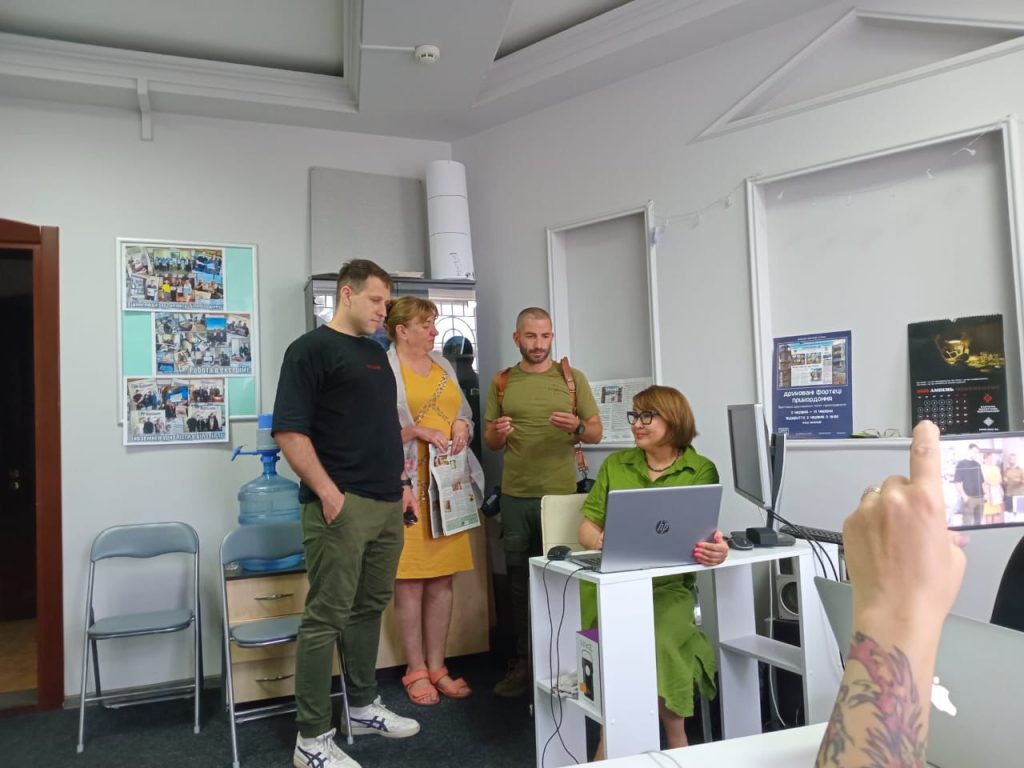
In the summer, the Russian troops struck central Sumy city several times. Some missiles went off near the Mediabaza.
“We in Bilopillya are already used to shelling, to various problems. We know how to take cover. The explosions nearby scared us a little, but they did not interfere with our work. The space is more or less protected. Which is why we continue to work here. Not only on the issue of Bilopilshchyna the newspaper, which is our traditional media product, but we also filling up our website Bilopillya.City. Our colleagues from Krasnopillya also come here (evacuation efforts have been announced in this village as well. – Ed.). Together we are making a special issue called Spilnopillya. And we have started working on a major project with the Ministry of Culture and Digital Transformation, the newspaper Visnyk Hromad Sumyshchyny (Sumy Communities’ Herald)”, chief editor said.
The newspaper’s Bilopillya office has been damaged in the course of Russia’s full-scale invasion: a guided bomb fell next to it in 2022. There were strikes that hit closeby this year as well. Some staff members remain in the community despite the shelling, said Natalia Kalinichenko. She essentially splits herself between two cities as well. The team delivers the newspaper to subscribers in their own car, with a drone detector on the control panel.
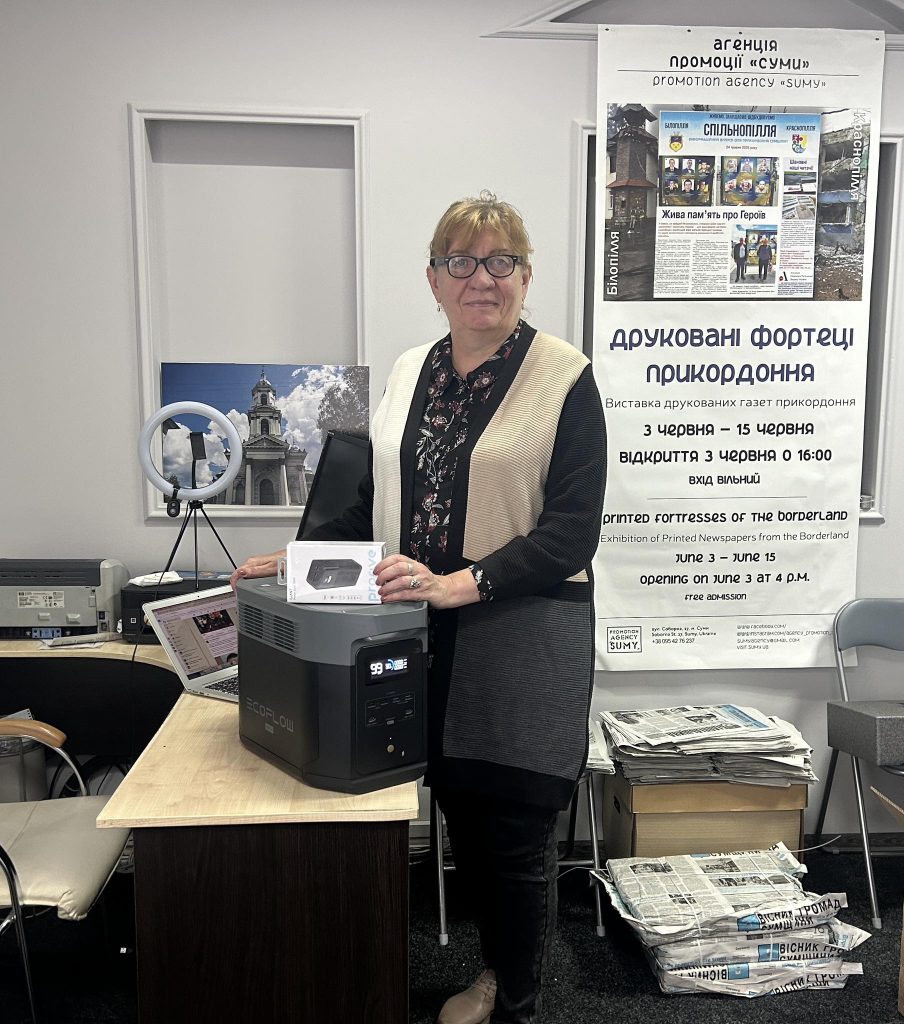
Mediabaza Sumy supports the local journalist community. We are ready to provide a work space to those who need it: when your editorial office is damaged or when there is another shelling-induced blackout. Contact the hub on Facebook and we will help you.
TikTok popularity for media
TikTok is an opportunity for a media outlet to expand their outreach, as some videos on the platform can yield thousands if not millions of views. Radio Free Europe / Radio Liberty social media producer Angelina Lomakina shared her tips on how to improve your chances of going “viral” at a Mediabaza Cherkasy class.
1. Define your target audience
Angelina said that before joining TikTok media outlets should get an understanding of not just how the platform works, but also who their audience is. The more narrowly you can define “your people,” the better. For instance, purely socio-political or music-themed media outlets have been more successful in taking off on social media because it is easier for social media platforms to understand whom to advertise this content to. With standard news outlets it can be trickier, because they often have to produce content that varies in subject matter, which “confuses” the platform as to how the algorithms should target it.
2. Choose the right content
Another thing worth considering is what media outlets can offer their audience and what content to post on TikTok. After all, one of the biggest mistakes is to upload same videos as to other platforms without adapting them in meaning and form. Angelina Lomakina advises media professionals to leave TikTok for selected stories only and not to forget about the added value of each one. For instance, you can adapt:
- scoops;
- analytics and news;
- investigations;
- emotional news;
- people’s stories;
- discoveries and inventions.
3. Write a good script
“Emotion and information are key to success. Especially if the video elicits a reaction, too. It doesn’t have to be a negative one,” said Angelina. It is not enough to just cut out a clip from a YouTube video (unless it is an emotionally charged clip) or read out a paragraph from an article on camera. On TikTok, you should present information briefly and in simple sentences, adding an emotional component and, if possible, humor. And to try and maintain an intrigue until the very end while leading with the most exciting thing.
It is better to start the video with a “hook” – a phrase that will touch the viewer emotionally. And it is the hook that you should consider most carefully. It can be either an emotional line or an interesting fact, or a question like “did you know?”, “have you heard?” or phrases like “what really happened”, “a fact that will change your ideas about…”, “5 seconds and you will be expert in…”, etc.
“The more specific the information you provide, the better it sticks. Overdone hooks such as “5 interesting facts about…” may work worse. It’s great when the video has a hook followed by emotional sync,” noted Angelina Lomakina. “You should close with some conclusions, answers to questions, or predictions.”
OSINT basics from IMI’s regional representative Maya Holub
In September, Maya Holub, an investigative journalist and IMI representative in Volyn oblast, visited Mediabaza Zhytomyr. Maya has extensive experience working with OSINT tools, investigating fake news and manipulative reports. She worked with the project InfoCrime Lutsk for a long time, analysing Russian propaganda narratives, exposing misinformation and explaining how disinformation works.
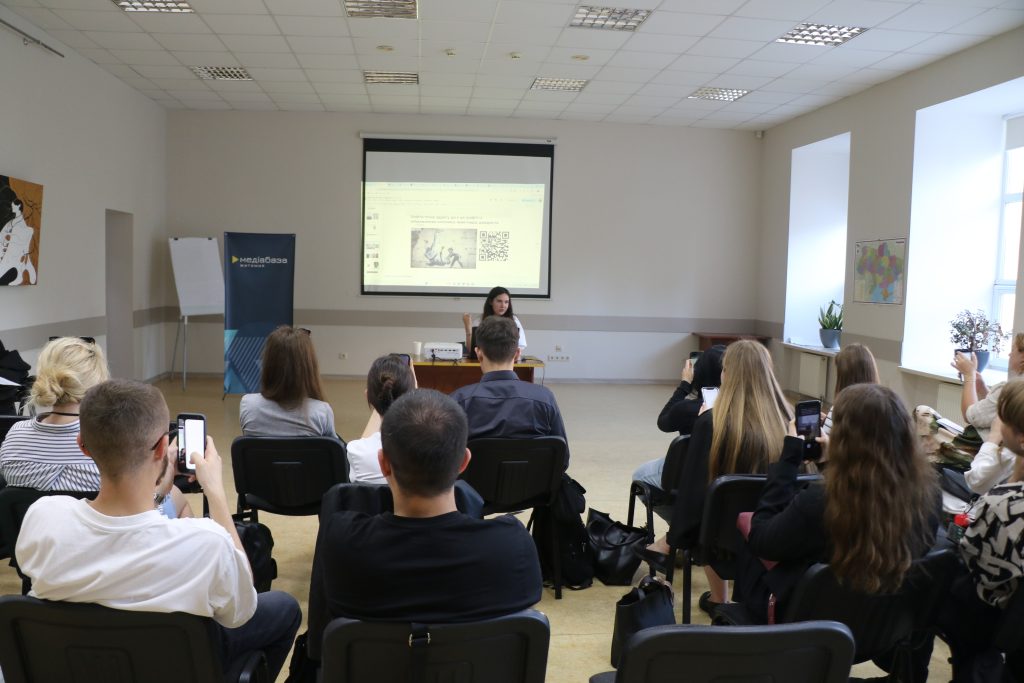
Maya recommends you start by asking yourself some simple questions:
- Does the information have a source? Who said that?
- Has there been confirmation by other news outlets or official bodies?
- Is the headline clickbait?
- Does the story draw a line between facts and opinions?
- Does it urge you to share it or react immediately?
Maya advises to be especially wary of news reports that evoke strong emotions such as fear, anger, despair or delight. Emotions are what makes most people “buy” fake news.
And to make the class as helpful as possible, the attendees not only listened to theory, but also applied their skills in practice by checking photos, videos, and accounts. If you want to expand your OSINT toolkit, here is a selection of services recommended by Maya Holub.
Searching for images and people:
- PimEyes – search for people by photo;
- Search4Faces – search for social media profiles by photo;
- Mxface and ToolPie Face Comparison – face comparison services that help you tell if two photos depict the same person.
Searching for companies and persons:
- YouControl – search for data on companies, managers, and court rulings;
- CorruptInfo – register of persons and entities involved in corruption;
- Checko.ru and EGRUL – search for data on Russian companies.
Other helpful services:
- Wayback Machine – search for deleted webpages and their earlier versions;
- Archive.li – archiving webpages to preserve information;
- Baza GAI – search for data by car license numbers;
- Have I Been Pwned – check if your email address has been listed in leaked databases.
Secrets of quality reporting by Serhiy Nikitenko and Eva Vasylevska
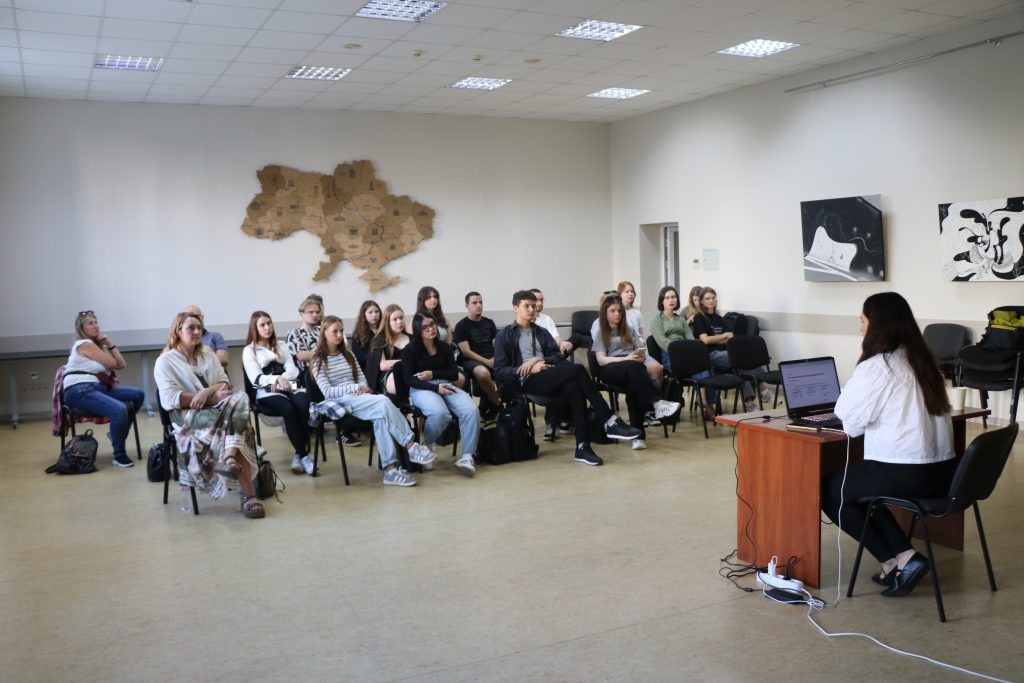
Mediabaza Odesa / Kherson does not fall behind in terms of its speakers’ expertise. It hosted lectures by MOST chief editor Serhiy Nikitenko and deputy chief editor Eva Vasylevska, who shared their experiences, challenges, and their own views on reporting as a genre.

- Work on your personal growth. “In journalism, you need to have a knack for feeling: the text, the person, the event. Shaping a cultural background is important for this, and there are no instructions here, everything works intuitively,” deputy chief editor Eva Vasylevska explained. It is important to learn to see not just the facts, but also the emotions and meanings behind them. “The only advice I can give is: work on your personal growth. Develop a sense of observation, learn the theory, watch good movies, read high-quality texts. And when you learn to pinpoint the main things, then you will succeed,” she said.
- Find a media outlet that is willing to invest in reportage. “This genre is expensive and time-consuming, but it is what gives journalism depth,” explained Serhiy Nikitenko.
- Stories are being born right in front of you — you just have to watch closely. “What matters is that they be true. We live our life together with our heroes, and this helps a lot in creating stories,” Serhiy said. High-quality reporting always centers the person, their experience, pain or triumph. Another question that interested the students was how to get to the “most interesting spots” where reportage stories are born. Serhiy replied that such opportunities most often arise unexpectedly: “You can come across a subject for your story by chance, but it all depends on whether you can build trust. The ability to communicate and negotiate with people is your main tool.”
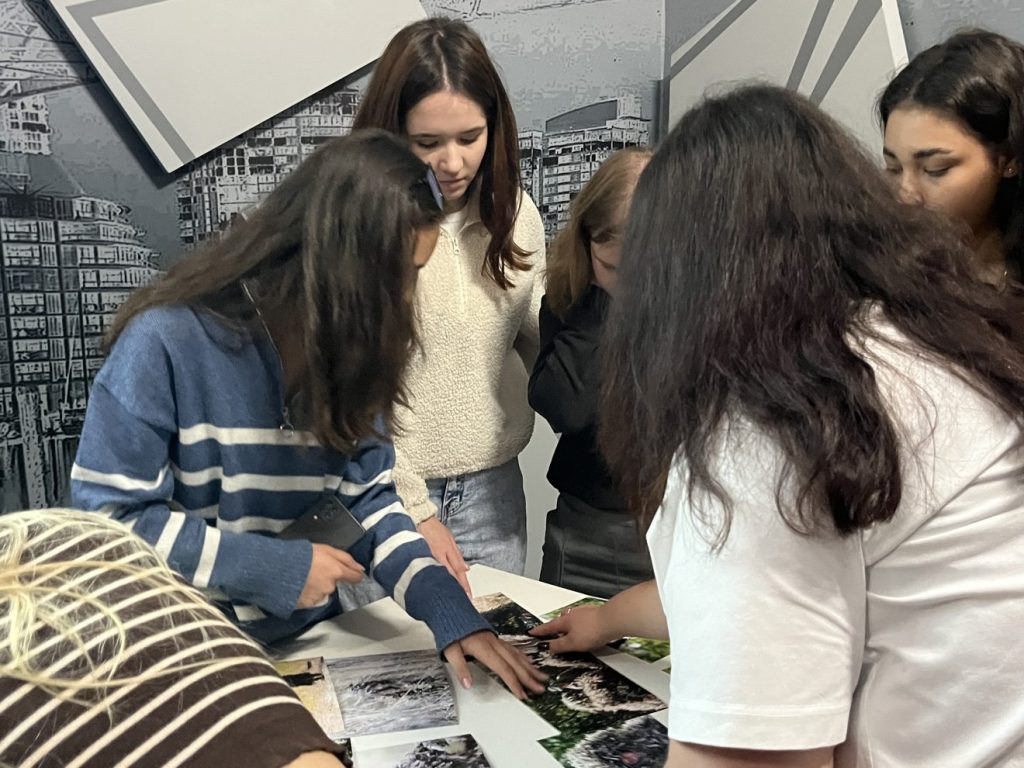
MykVisti‘s tips for aspiring journalists
MykVisti journalist Daryna Melnychuk shared her advice on starting a career in journalism at the Mediabaza Mykolaiv.
First, she explained the difference between the basic types of journalist material:
- a paragraph is as short and fact-based as possible, without value judgements or “frills”;
- a news story follows the “what, where, when, who, why” principle and has a clear structure: headline, lead, main text;
- a reportage has a “presence effect” when a journalist gives an “eyewitness account” of an event, adding details, emotion and direct quotes;
- an interview has emphasis on personality and dialogue where it is important not only to ask questions but to listen to the answers as well.
Daryna advises starting with paragraphs and short news stories: reportages and interviews have a more complex structure, which requires more experience.
When looking for a topic, pay attention to everything happening around you: from events in your own neighborhood or school to city initiatives. Even Facebook posts, Telegram chat messages, people complaining in the comments, or stories from friends can be your sources.
You can get your first writing experience in student news teams or during internships in regional media outlets. While you are at it, look for growth opportunities: from grants and journalism schools to classes and online courses.
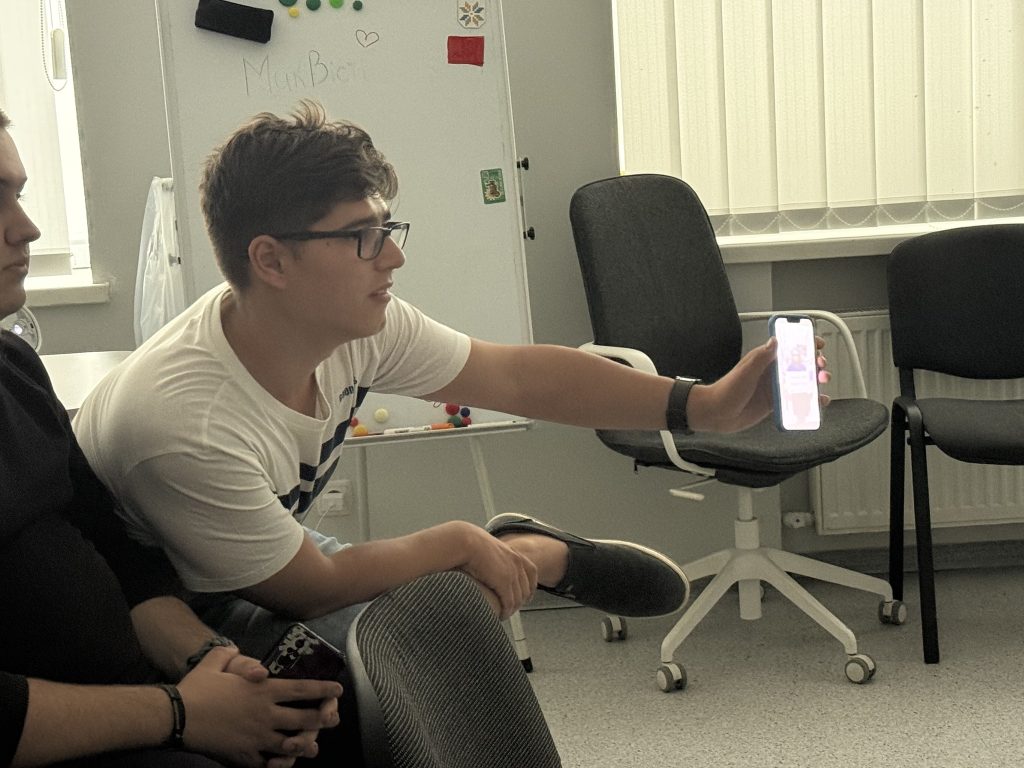
Latest AI developments that may be helpful to media workers
And finally, some technology news. Pavlo Belousov, digital security expert and Nadiyno.org tech lead, discussed the latest developments in artificial intelligence and explained which ones are safe to use for a media worker.
Perplexity browser
Perplexity has released its own fully functioning browser Comet with a pre-installed AI agent. In it, you can open any website while talking to the agent, which analyses the site and helps you find information. Perplexity has a free version and paid subscripton. However, if you register via PayPal, Perplexity gives you a year of of the paid subscription for free.
New Gemini and ChatGPT features
Pavlo Belousov says that Gemini and ChatGPT are best used for transcripts of physical documents and files. For example, Gemini allows you to convert up to five minutes of video and up to 30 minutes of audio into text for free. ChatGPT also has a record function. It allows you to make a transcript of a conversation while taking notes. However, this function is currently only available in the ChatGPT app, not in the web version.
Genspark.ai
This is a collection of AI agents that help with various tasks (working with spreadsheets, creating photos and videos, design) without you having to use many different platforms. Importantly, this tool immediately integrates all the latest AI features and doesn’t require an account.
Duck.ai
Everyone knows that AI services scrape information and train on data shared by users. However, if a request is sensitive (illnesses, personal life, or army-related topics), you can use the anonymous tool Duck.ai. It does not require an account and does not store chat information.
How to visit the IMI Mediabazas
To use a Mediabaza’s services, message the hub’s coordinator on Facebook:
- Mediabaza Khmelnytskyi – Olha Zahoruiko;
- Mediabaza Cherkasy– Yeliena Shchepak;
- Mediabaza Zhytomyr – Oksana Trokoz;
- Mediabaza Chernihiv – Pavlo Pushchenko;
- Mediabaza Kharkiv – Olha Kaplun;
- Mediabaza Poltava – Nadia Kucher;
- Mediabaza Dnipro – Kateryna Lysiuk;
- Mediabaza Zaporizhzhia – Natalia Vyhovska;
- Mediabaza Kropyvnytskyi – Pavlo Lisnychenko;
- Mediabaza Mykolaiv – Kateryna Sereda;
- Mediabaza Sumy – Alyona Yatsyna;
- Mediabaza Odesa / Kherson – Serhiy Nikitenko;
- Mediabaza Slovyansk – Valeriy Harmash;
- Mediabaza Chernivtsi – Taisia Harmash.
Please note that:
- in Kherson, the Mediabaza only issues equipment;
- in Slovyansk, you can use the Mediabaza equipment to film and broadcast video and audio materials;
- in Chernivtsi, you can record podcasts at the Mediabaza.
If necessary, you can contact the national Mediabaza coordinator Pavlo Lisnychenko by:
- calling 050 594 20 58
- or writing to [email protected].
If you need safety gear (bulletproof vest, helmet, first aid kit) or some other equipment, contact the coordinator in your region or fill in this Google form.