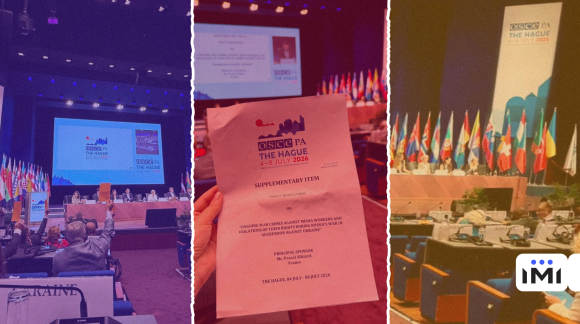

The OSCE Parliamentary Assembly included the draft resolution “On Ongoing War Crimes Against Media Workers and Violations of Their Rights During Russia’s War of Aggression against Ukraine” in the Hague Declaration concluding the Assembly’s 33rd session. The draft resolution cites data by the Institute of Mass Information’s Monitoring Study of Russia’s Crimes against Journalists and Media.
The document is based on the findings by the Verkhovna Rada’s Temporarily Investigative Commission (TIC) investigating Russia’s crimes against journalists and media professionals, reported Yevhenia Kravchuk, TIC Chair and member of Ukraine’s OSCE Delegation, in a comment to the Institute of Mass Information.
The resolution was initiated by the Ukrainian and French missions, signed first by the French Delegation Head, Pascal Allizard.
“This is important, because it does not begin and end with Ukraine’s statement about Russia’s crimes against Ukrainian media workers. The war has affected journalists from other countries: in particular, four French reporters have already been killed by the Russian troops,” Kravchuk said.
The MP added that the resolution emphasised that Russia’s crimes against journalists and the media have been systematic, that the persecution has taken various forms, the damage inflicted, and the importance of supporting the media in wartime and during Ukraine’s recovery process.
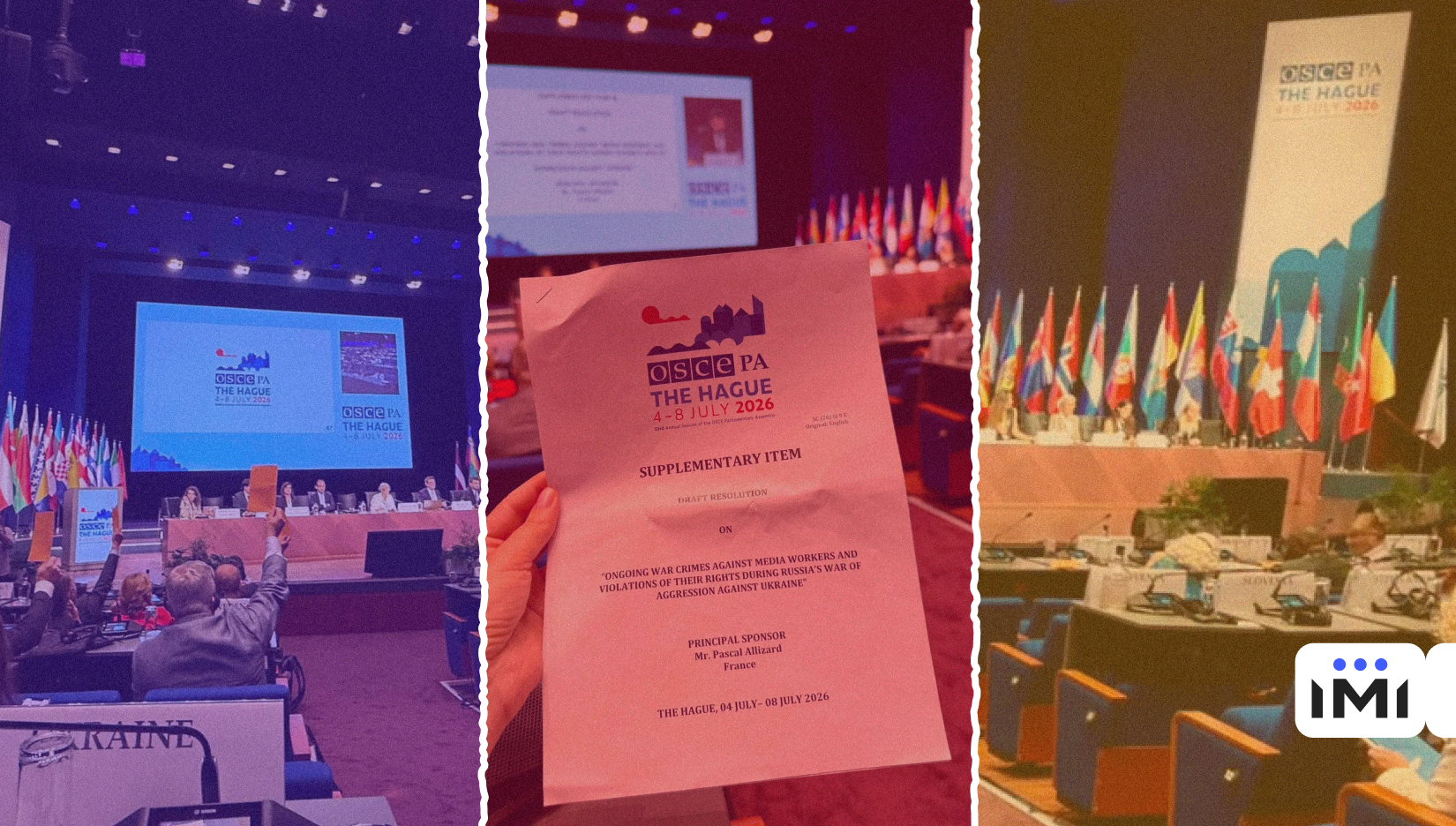
“Compared to other inernational documents, this resolution is the first to include a call not just for introducing sanctions, but for creating a dedicated sanctions track including the persons complicit in crimes against journalsits, the so-called Roshchyna List,” the MP said.
Yevhenia Kravchuk believes that the resolution’s primary value is as an important international political signal regarding crimes against the media: “Obviously, this is not a court ruling, but it raises the issue of crimes against the media to a very high political level. There are even more countries in the OSCE than in the Council of Europe.”
The Institute of Mass Information stresses the Russia’s consistent efforts to destroy Ukraine’s media infrastructure. IMI has tracked at least 85 deliberate attacks on media offices since the beginning of the full-scale invasion, and at least 337 news outlets have ceased operations due to the war and its impact.
“Russia has been purposefully creating an information blackout to erase the truth and make it so propaganda reigns everywhere,” said IMI director Oksana Romaniuk at the side event “Investigating Russia’s Crimes Against Media in Ukraine: Call for Justice”, which took place as part of the OSCE Parliamentary Assembly’s 33rd session on 6 July.
She added that international accountability mechanisms primarily focus on crimes against people while acts of destruction of media infrastructure have no separate legal status or compensation mechanism.
“In my opinion, it should be treated akin to the protection of cultural property or medical institutions. Media infrastructure, which ensures public access to information, deserves to have a protected status of its own. I think this could be an idea for the next resolution,” Oksana Romaniuk said.
Data on Russia’s crimes against media in Ukraine
The draft resolution cites data by the Insitute of Mass Information, which suggest that Russia has committed 937 crimes against journalists and media in Ukraine since the start of the full-scale invasion. These crimes resulted in the deaths of 131 media workers, 15 of whom died while reporting. At least 26 Ukrainian journalists remain imprisoned by Russian forces.
The draft resolution’s contents
The document says that Russia’s crimes against journalists, media professionals, and media infrastructure have been systematic in nature, encompassing:
- killings and injuries;
- arbitrary detention, torture, enforced disappearances;
- intimidation, politically motivated prosecutions;
- cyberattacks;
- destruction and seizure of media infrastructure;
- suppression of independent broadcasting, forced displacement of media outlets, and broader efforts aimed at dismantling the independent Ukrainian information space,
The resolution emphasises that visible identification as “PRESS” has increasingly failed to provide protection to journalists and media workers and has, in many documented cases, effectively turned them into deliberate targets of attacks by the Russian Federation.
The document condemns Russia’s actions in the temporarily occupied territories of Ukraine aimed at dismantling the independent Ukrainian information space, including through the dissemination of state-controlled propaganda.
The OSCE Parliamentary Assembly also expressed concern over the imprisonment of Ukrainian journalists by Russia, the continued lack of access to the facilities where they are detained faced by international organisations, and the death in Russian prison of Ukrainian journalist Viktoria Roshchyna.
Calls on Russia and OSCE participating states
The resolution calls on Russia to:
- immediately cease the persecution, arbitrary detention, imprisonment, torture, ill-treatment, enforced disappearance and other forms of intimidation or harassment of journalists and media workers;
- grant international organisations access to the Ukrainian journalists arbitrarily detained by Russian forces;
- provide full and verifiable information regarding the circumstances of the death in captivity of Ukrainian journalist Viktoria Roshchyna and to ensure accountability for all those responsible;
- immediately and unconditionally release all Ukrainian journalists and media workers.
The document calls on OSCE participating states to step up support for independent Ukrainian media, including through funding, safety assistance, trauma support, and legal aid, and to support the mechanisms bringing the perpetrators to justice.
The resolution emphasises the need for more international sanctions targeting the persons complicit in crimes against journalists, including through the creation of the “Roshchyna List”.
As previously reported, on June 3 the Verkhovna Rada released the six-month report by the Temporarily Commission investigating crimes against journalists and media workers committed by Russian army units.