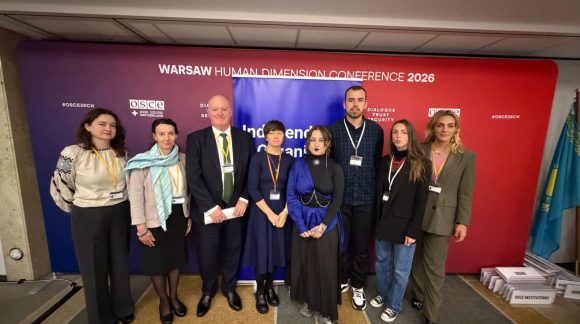
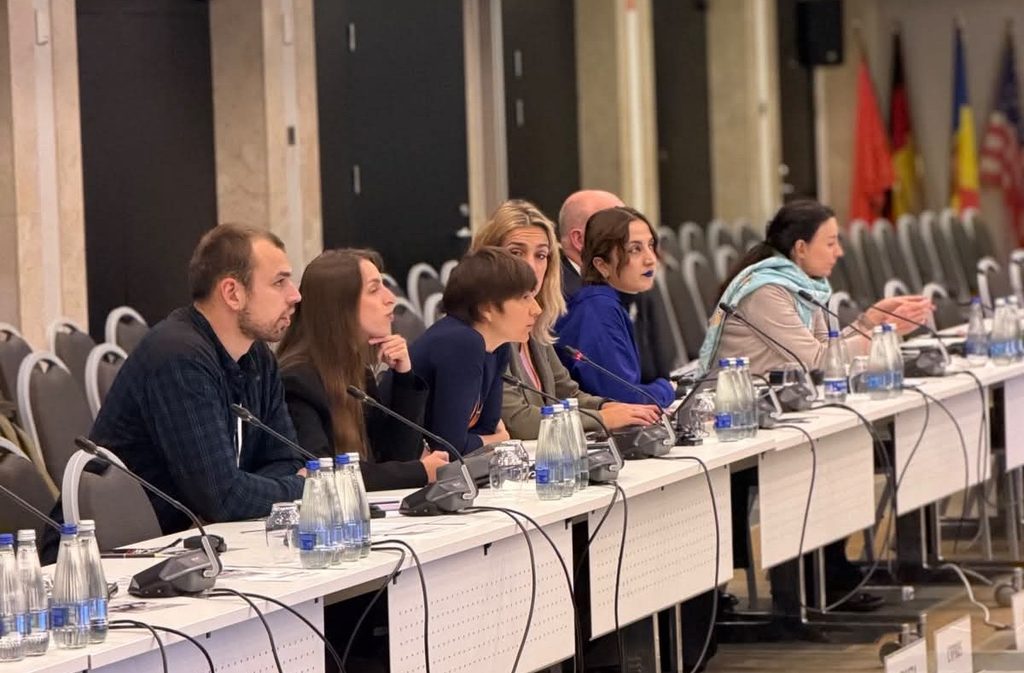
International Humanitarian Law (IHL) is out of step with modern warfare and should not just document crimes against journalists but to prevent them, Kateryna Dyachuk, chief of press freedom monitoring at the Institute of Mass Informaion (IMI), said during the side event Reporting Under Fire: Safety of Frontline Journalists in Ukraine and Accountability for Russian Crimes at the OSCE Human Dimension Conference in Warsaw on 13 October.
“The task of IHL is not just to record that a journalist has died but to do everything to keep them alive,” Kateryna Dyachuk stressed.
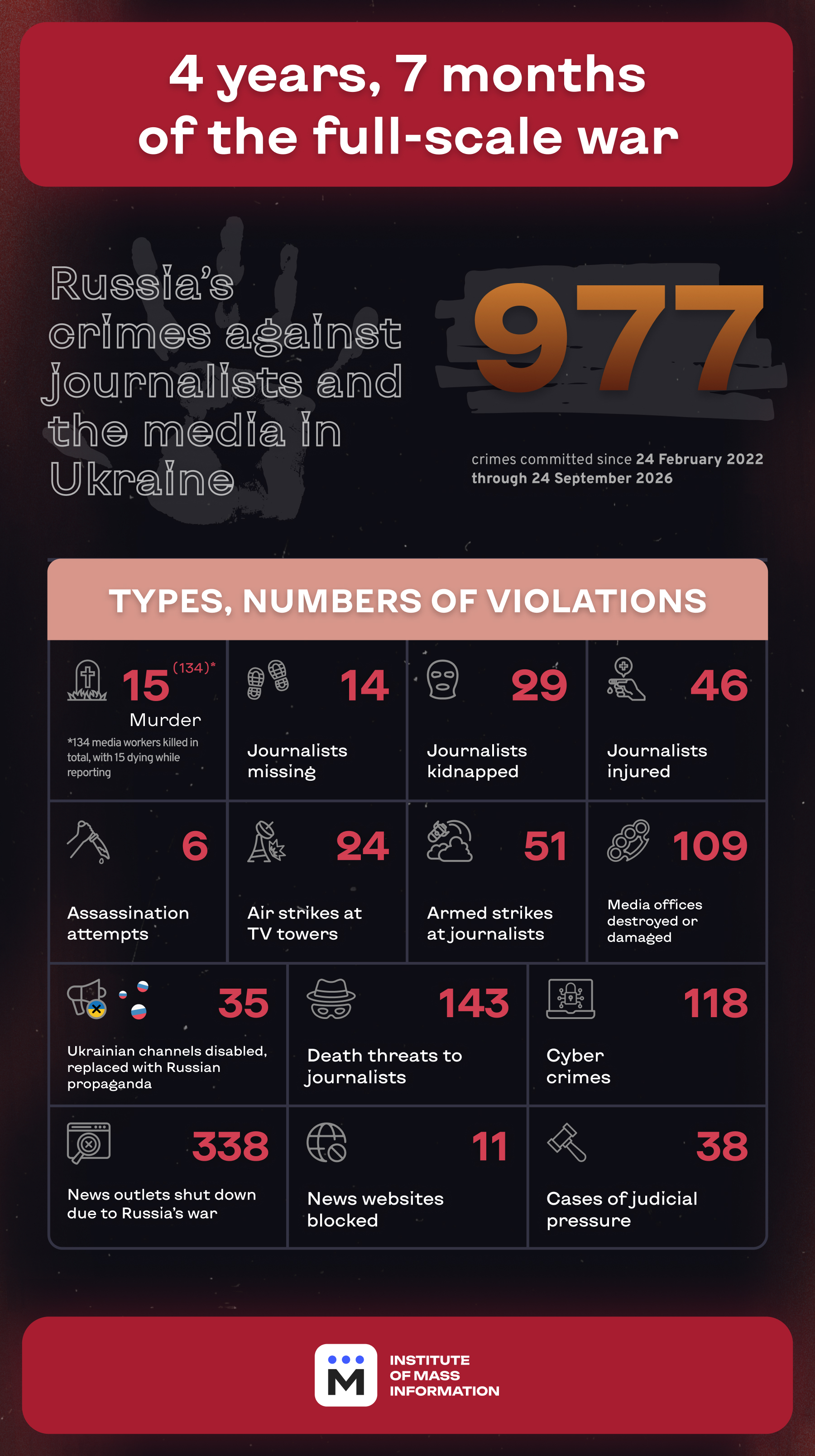
977 crimes, 139 media professionals killed
Kateryna Dyachuk said that Russia’s full-scale war had remained the primary threat to the survival of Ukrainian media as well as to the safety of journalists in Ukraine since 2022. In the upwards of four years of the big war, IMI recorded 977 Russian crimes against journalists and the media. 139 media workers have been killed, with 15 dying while reporting.
Drones became a major weapon used in attacks on journalists in 2025 – 2026.
“PRESS insignia no longer guarantee protection,” IMI expert said. Three media professionals were killed in targeted Russian drone strikes in 2025: French photojournalist Antoni Lallican and a Freedom TV filming crew, Alyona Hubanova and Yevhen Karmazin.
IMI has also recorded no fewer than 85 deliberate air strikes on newsrooms, and at least three 337 media outlets have halted operations.
Imprisonment, crackdowns, and pressure in Crimea
As of October 2026, at least 27 Ukrainian civilians working in the media remain unlawfully detained by Russia. Three Ukrainian civilian journalists were released from Russian custody in 2025: Dmytro Khyliuk, Mark Kaliush, and Vladyslav Yesypenko. They have spoken about the torture and human rights abuses they had faced and witnessed while unlawfully imprisoned by Russia.
Russian courts have sentenced journalists to fourteen to sixteen years in prison for their pro-Ukrainian views and reporting. These journalists included Heorhiy Levhcenko, Vladyslav Hershon, and Yana Suvorova, who ran the Ukrainian Telegram channels “RIA Melitopol” and “Melitopol Is Ukraine”, as well as Vilen Temeryanov, a citizen journalist from Crimea. In twenty twenty-six, Melitopol-based journalist Iryna Levchenko was sentenced to fifteen years in prison by a Russian court.
Russian forces in occupied Crimea have been exerting systemic pressure on Crimean Tatar journalists over their reporting, such as arrests in absentia (Oleksina Dorohan with Krym.Realii), fines to alleged “foreign agents” and repeated warnings from the police (Lutfiye Zudiyeva), searches and interrogations (Lenora Dyulber), Kateryna Dyachuk said.
Cyber-attacks as part of the war on media
IMI has also recorded Russian cyber-attacks on Ukrainian news organisations (national as well as regional). Russian special services are behind the attacks, which have been systematic and included DDoS attacks, hacked websites, phishing, and impersonation (such as posing as the news outlet “Ukrainska Pravda” to mail out Russian spam messages).
What needs to change
Kateryna Dyachuk stressed the need to rethink the approach to protective equipment reporters are allowed to use. She said that drone detectors, means of electronic warfare, and anti-drone systems should be viewed as tools for self-defense, not combat: a drone detector merely alerts to danger, and an electronic warfare system jams signals and inflicts no harm on people.
“A journalist using non-lethal means to repel an attack should not automatically lose their civilian status,” IMI expert said. She called on international donors and institutions to stop blocking journalists’ access to them out of fear of “dual use”.
IMI proposes:
- to adapt the interpretation of IHL to meet the reality of drone warfare;
- to acknowledge journalists’ right to tactical anonymity;
- to clearly define the status of non-lethal anti-drone devices;
- to move from documenting a journalist’s death postfactum towards real efforts to prevent attacks.
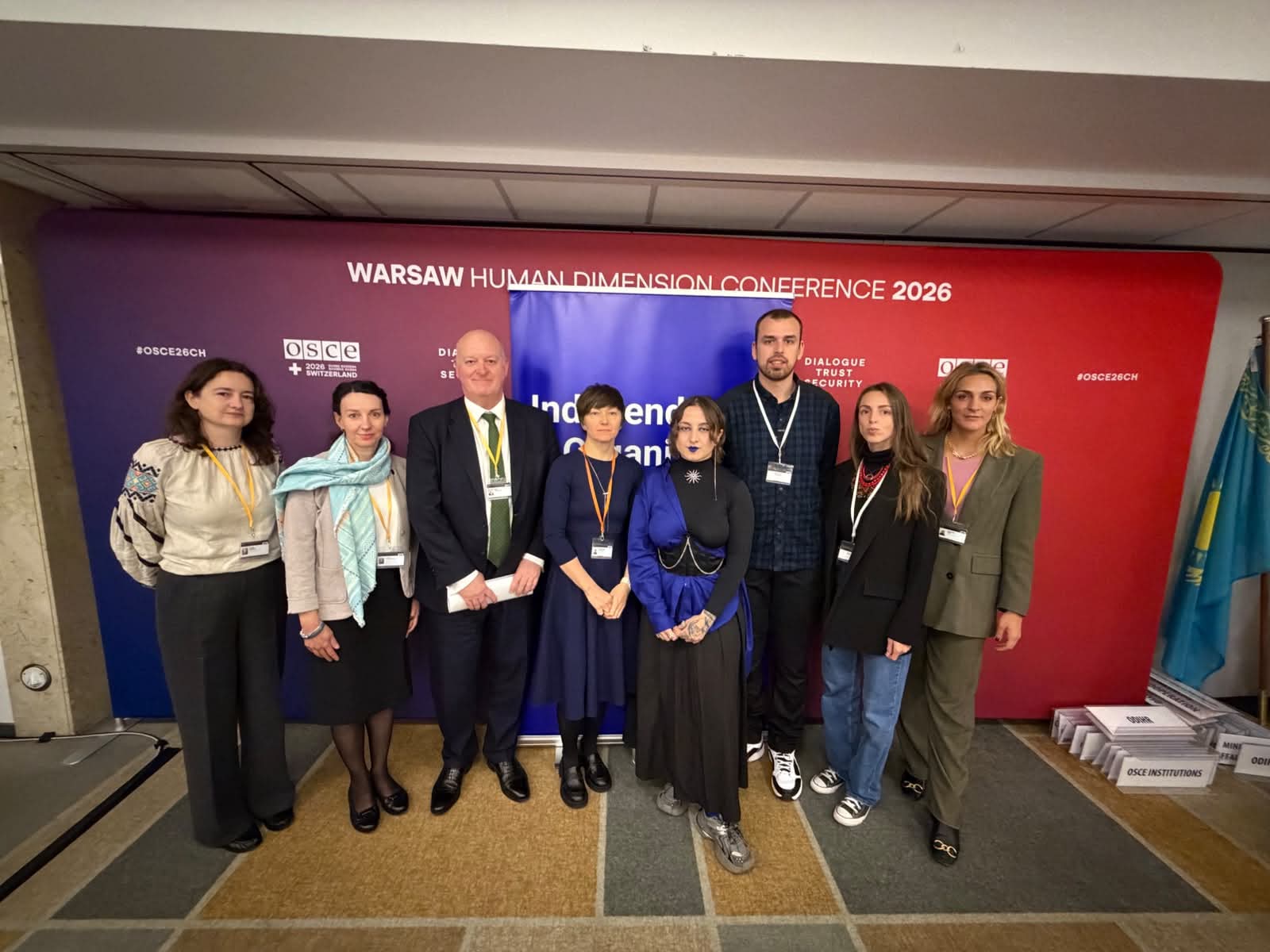
The event was organised by the ZMINA Human Rights Centre, the Institute of Mass Information, and the Permanent Mission of Ukraine to International Organisations in Vienna, and co-organised by the EU Delegation to the OSCE, the Permanent Delegation of the United Kingdom to the OSCE, and the Netherlands Helsinki Committee.
Despite the war, independent newsrooms have retained the ability to work, carry out investigations, and fight disinformation, Kateryna Dyachuk added. It is telling that Ukraine went up seven places in the RSF’s World Press Freedom Index in 2026, now ranking 55th out of 180 countries, which is a rare instance of a country improving its ranking amid ongoing aggression.
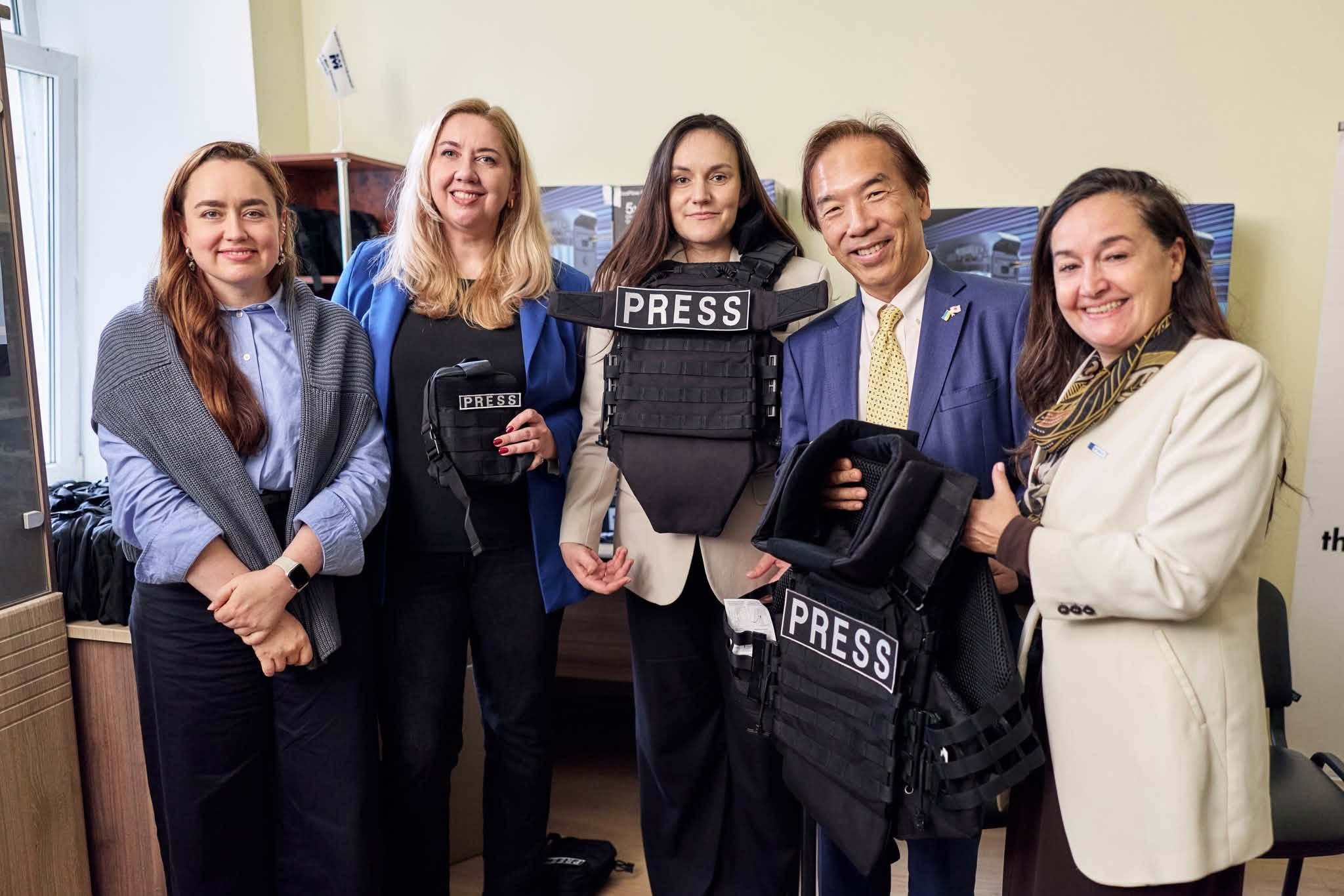
The Institute of Mass Information (IMI) is a civil society organization specializing in the media, operating since 1996. IMI defends the rights of journalists, studies the media landscape and reports on media-related events, fights propaganda and disinformation, and provides media workers with safety equipment for trips to combat areas (since the start of the Russo–Ukrainian war in 2014).
IMI carries out the only monitoring study of freedom of speech in Ukraine, keeps a list of transparent and responsible online media outlets, and tracks Russia’s media crimes in the war on Ukraine. IMI has representatives in 20 oblasts of Ukraine and runs a network of Media Hubs that provide journalists with unfailing support. IMI’s partners include Reporters Without Borders (RSF); the organization is also a member of the International Freedom of Expression Exchange (IFEX).