
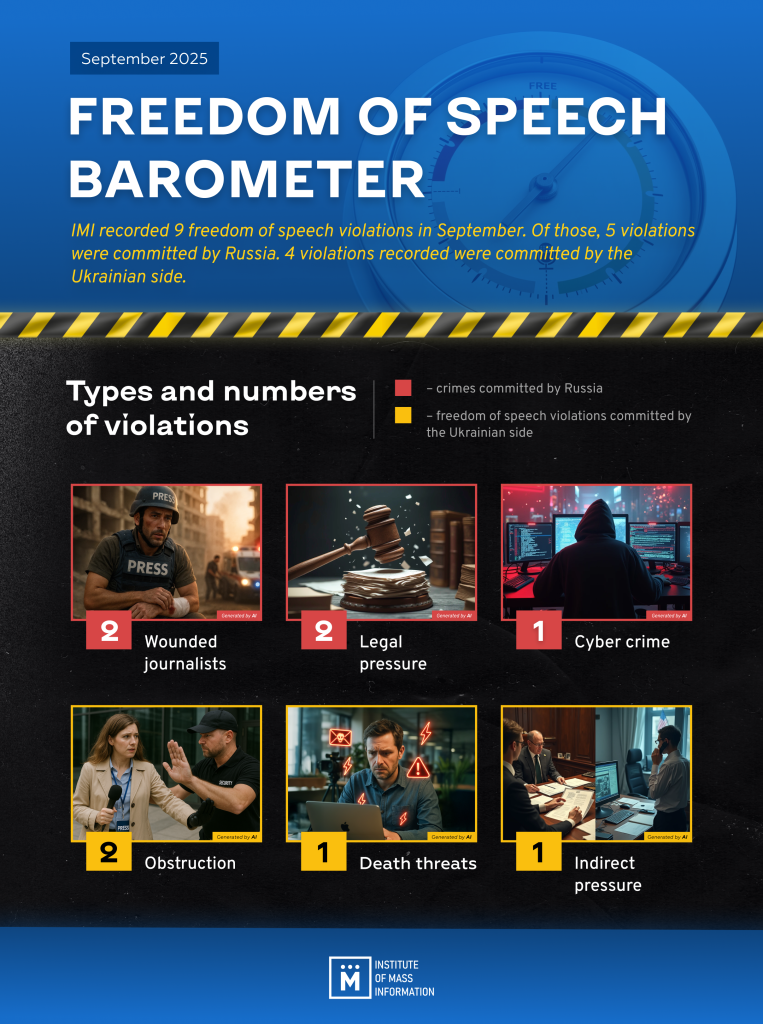
The Institute of Mass Information experts recorded 9 freedom of speech violations in Ukraine in September 2025, according to the IMI’s monthly monitoring study Freedom of Speech Barometer.
IMI recorded five crimes against media and journalists committed by Russia in September. These included murder and wounding of journalists, as well as legal pressure.
Four media workers defending Ukraine in the ranks of the UAF were reported dead in September. One of them had been considered missing in action since October 2024.
- Oleksandr Holyachenko, former Kyiv FM and Nash Kyiv journalist turned servicemember. Killed in action in Zaporizhzhia oblast on 3 September 2025.
- Denys Ponomarenko, Starlight Media director of photography turned serviceman. Died on 7 September 2025 while performing a combat mission in Kharkiv oblast. Denys was a cameraman and director of photography for many projects including Psychic Challenge, X Factor, Ukraine Got Talent, Everybody Dance, Phenomenon, CUBE, Lie Detector, Hearts of Three, Mole, Psychics On The Case until 2021.
- Yaroslav Levytskyi, former cameraman with Channel 5 and the media agency ACC turned serviceman. Had been considered missing since October 2024. Reported dead on 9 September 2025. Assigned to a military unit fighting near Pokrovsk (Donetsk oblast) in late October 2024. Yaroslav went missing a few days after joining the unit.
- Bohdan Buday, journalist with the Vinnytsia-based news outlet Vezha turned officer in the Ukrainian Armed Forces. Died on 26 September 2025 in the area where he was performing his duties.
112 media personnel have been killed since the start of Russia’s full-scale invasion of Ukraine, with 13 dying while reporting.
Freedom of speech in Ukraine in September 2025
Media workers injured:
- Vadym Khomenko, chief engineer at Suspilne Kherson, was injured in a Russian “petal mine” explosion in downtown Kherson on 22 September. He suffered severe injuries to his leg but was quickly hospitalised and had surgery thanks to his colleagues’ prompt action; his condition is now stable. It was later reported that the explosion happened on Suspilne Kherson premises, which employees (who mostly work remotely) visit every now and then as the equipment remains in the office. The Russian troops plant mines on the Suspilne Kherson premises by dropping anti-personnel mines such as “petals” from drones. This was reported following a SES inspection, which revealed several more mines on the broadcaster’s premises. Even though the office was cleared of mines after the de-occupation, new mines suggest a deliberate attack on media infrastructure. The office was temporarily shut down in response for safety reasons and Suspilne stepped up the protection of their staff in the regions near the front line.
- A crew including Channel 5 correspondent Olha Kalynovska hit a magnetic mine, which detonated under their car, during a trip near Pokrovsk (Donetsk oblast) on 19 September. All four crew members suffered concussions and one was injured in the leg (in addition to a large bruise, his upper leg bones were broken). The car was severely damaged.
Russia’s cyber crimes:
- Russia’s special services hacked the blog of Ukrainska Pravda contributor Yana Matviychuk and made a fake post impersonating her. The post aimed to discredit the Ukrainian Armed Forces, claiming that they had targeted civilian objects in Foros in southern Crimea. Matviychuk said that the blogpost had been fabricated from beginning to end and had aimed to undermine trust in the Ukrainian army and to smear her personally. The fake post was promptly taken down, but by then it had already been picked up by key Russian propaganda outlets. Matviychuk believes the attack was a response to an alleged UAF strike at several facilities in Foros, including the Foros sanatorium, known as the “FSB villa.” Ukrainska Pravda technicians and competent authorities are investigating the hacker attack.
Ukrainian media workers sentenced by Russian courts:
- In September, Russian-installed courts in the occupied part of Zaporizhzhia oblast sentenced two Ukrainian media workers, Heorhiy Levchenko and Vladyslav Hershon, to 16 and 15 years in prison respectively. Both were admins for the Ukrainian Telegram channels RIA Melitopol and Melitopol Is Ukraine, which continued to work following the occupation of the city. The two men were detained back in 2023, kept in undisclosed locations, and then charged with “high treason,” “espionage,” and “terrorism.” The trials were held in camera and the rulings were based on charges that Russia only applies to Russian citizens. According to Mass Information, 26 Ukrainian media workers remain Russia’s political prisoners today. The imprisoned journalists face pressure, inhumane detention conditions, and have little to no access to legal defense.
IMI also recorded four freedom of speech violations unrelated to Russia’s war on Ukraine. These included cases of obstruction of reporting, threats, and persecution of journalists.
Obstruction of reporting:
- Kryvyi Rih City Council official Viktoria Samoylenko (Tretyak) obstructed the work of Pershyi Kryvorizkyi journalist Yelyzaveta Makarcheva at a Zhadan i Sobaky concert. She physically disrupted the filming, shoved the journalist, grabbed her by the arms and the bag, claiming that the reporter was getting in the way of her enjoying the show. Samoylenko denies being in the wrong, but in the video the journalist is visibly wearing a reporter badge.
- Chetverta Vlada journalist Serhiy Turovych faced obstruction and violent threats while filming in the Rivne Razom reception office, where pensioners were being handed out groceries in exchange for their personal data. Upon showing his press ID, he was accused of “provocation” by the office employees, who tried to make him leave, and the crowd tried to shove him out. A man threatened him and demanded he “go to the front line.” The journalist decided against calling the police so as not to harm the people who were waiting for the aid.
Threats:
- The Kyiv Independent reported pressure by the management of Fire Point following their investigation into the possible irregularities in state drone procurement agreements. The company demanded a retraction and threatened to report the news outlet to the SBU for “high treason” and “abetting the aggressor state.” Editor Olha Rudenko said this was an attempt to intimidate the journalists and to influence their independent editorial policy.
Indirect pressure (Stalking):
- The Kyiv Independent CEO Daryna Shevchenko was stalked near the building where she lives in Kyiv. An unknown man interviewed her neighbours, showing them her photo and taking pictures of the entrance to her home. According to the news outlet’s editor Olha Rudenko, he was escorted to the building by employees of the local housing office, who said that he had shown them a badge, but did not say what kind of badge. Shevchenko has filed a statement with the police on stalking. The team believes the incident has to do with her activities and the media outlet’s investigative work.
See the full list of freedom of speech violations in Ukraine in September 2025.
The Institute of Mass Information (IMI) is a civil society organization specializing in the media, operating since 1996. IMI defends the rights of journalists, studies the media landscape and reports on media-related events, fights propaganda and disinformation, and provides media workers with safety equipment for trips to combat areas (since the start of the Russo–Ukrainian war in 2014).
IMI carries out the only monitoring study of freedom of speech in Ukraine, keeps a list of transparent and responsible online media outlets, and tracks Russia’s media crimes in the war on Ukraine. IMI has representatives in 20 oblasts of Ukraine and runs a network of Media Hubs that provide journalists with unfailing support. IMI’s partners include Reporters Without Borders (RSF); the organization is also a member of the International Freedom of Expression Exchange (IFEX).